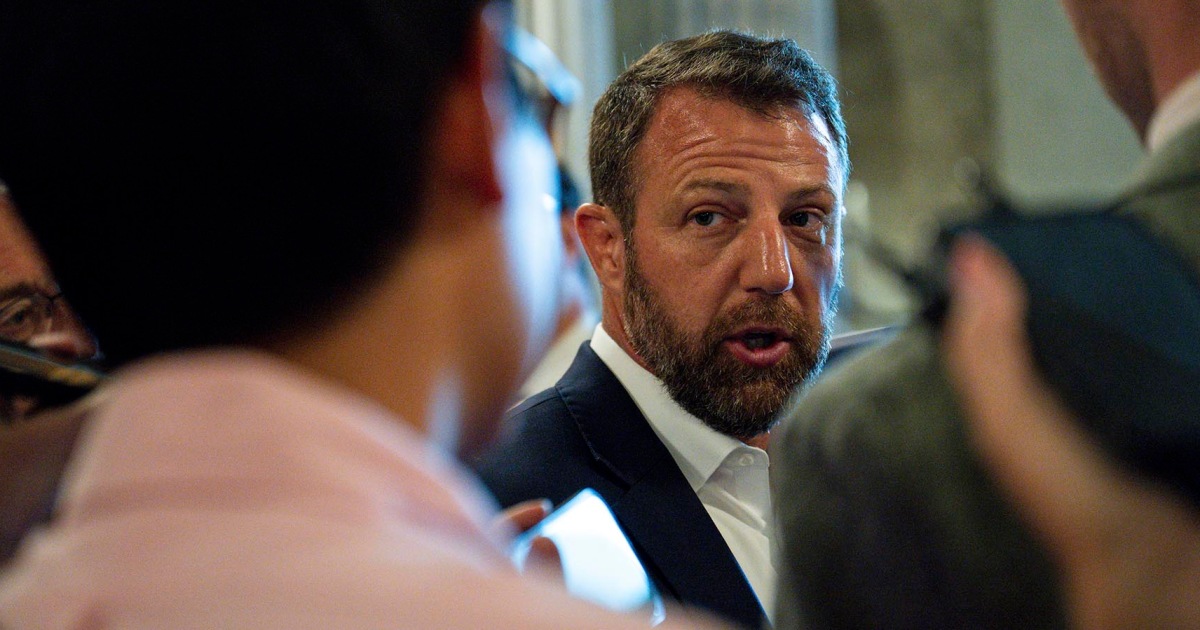
Daily Beast: Schumer Explodes at Trump Sending His Trial Lawyer to Interview Ghislaine Maxwell: ‘Stinks of High Corruption’

Top Democrat torches Todd Blanche’s prison sit-down with Jeffrey Epstein’s accomplice and gloats about an “Epstein Recess.”

Chuck Schumer blasted Donald Trump for sending his “personal lawyer” to interview Ghislaine Maxwell in prison in what he described as a clear “conflict of interest.”

“Sending Donald Trump’s personal lawyer, Todd Blanche, to interview Ghislaine Maxwell while she’s in prison, a woman who’s been convicted of abusing people, to offer some kind of corrupt deal so that she can exonerate Donald Trump just stinks of high corruption,” the Senate minority leader said in a video posted on X.

Blanche was appointed deputy attorney general in March, serving under Attorney General Pam Bondi, but he is most famous for having served as Trump’s lead counsel in his criminal case a year earlier.

The 50-year-old lawyer traveled to the Federal Correctional Institution Tallahassee on Thursday and spoke with Maxwell for several hours, in a meeting that was widely criticized on social media.

In his own post on X Thursday, Blanche confirmed the meeting and announced a follow-up session: “Today, I met with Ghislaine Maxwell, and I will continue my interview of her tomorrow. The Department of Justice will share additional information about what we learned at the appropriate time.”

Maxwell, 63, is serving a 20-year sentence for trafficking under-age girls for Jeffrey Epstein. The social links between her and Epstein with Trump continue to dog the president.

Blanche did not disclose what was discussed during the six-hour meeting.

However, Maxwell was said to have “answered every single question” during Thursday’s interview with Blanche, according to her lawyer David Markus. “She answered all questions and did not take the Fifth,” he added.

Amazingly, it appears to be the first time Maxwell—who declined to testify at her trial in 2021—has ever been formaly interviewed about the Epstein case.

Jonathan Turley, a leading legal commentator and professor at the George Washington University Law School, wrote on X that he had recently spoken with Maxwell’s counsel, Leah Saffian, and she “surprisingly maintained that neither state nor federal investigators ever interviewed Maxwell.

He added: “That struck me as curious in a scandal involving a myriad of state and federal investigations. If so, she may have new information.”

Within minutes of Schumer’s first tweet, the 74-year-old fired off a second, aimed at House Republicans, who had just departed Washington for their August break.

“It’s the first day of House Republicans fleeing town for their Epstein Recess. They high-tailed it out of here hoping to hide the story. But the story is growing louder by the hour with Trump and the administration’s lies.”

The House’s early getaway heightened Democratic accusations of a Republican Trump-Epstein cover-up.

The Daily Beast has contacted the Justice Department for comment.

Yes, it’s “fishy”, but remember that Ghislaine Maxwell is 63 and already serving a 20 year sentence.

https://www.thedailybeast.com/schumer-explodes-at-trump-sending-his-trial-lawyer-to-interview-ghislaine-maxwell-stinks-of-high-corruption

Raw Story: ‘Irate’ Pam [Bimbo #3] Bondi appointee screams at prosecutors after jury fails to indict LA protester

Trump administration appointee has been going hard after demonstrators in Los Angeles who in recent weeks have been protesting against Immigration and Customs Enforcement operations—but it seems like he’s having a hard time getting grand juries to go along.

The Los Angeles Times reports that Bill Essayli, who was appointed by U.S. Attorney General Pam [Bimbo #3] Bondi earlier this year to serve as the U.S. attorney for the Central District of California, recently became “irate” and could be heard “screaming” at prosecutors in the federal courthouse in downtown Los Angeles when a grand jury declined to indict an anti-ICE protester who had been targeted for potential felony charges.

And according to the LA Times’ reporting, this failure to secure an indictment against demonstrators was far from a one-off.

“Although his office filed felony cases against at least 38 people for alleged misconduct that either took place during last month’s protests or near the sites of immigration raids, many have been dismissed or reduced to misdemeanor charges,” the paper writes. “In total, he has secured only seven indictments, which usually need to be obtained no later than 21 days after the filing of a criminal complaint. Three other cases have been resolved via plea deal.”

It is incredibly rare for prosecutors to fail to secure indictments from grand juries, which only require a determination that there is “probable cause” to believe a suspect committed a crime and which do not hear arguments from opposing counsels during proceedings.

Meghan Blanco, a former federal prosecutor and current defense attorney representing one of the anti-ICE protesters currently facing charges, told the LA Times that there’s a simple reason that grand juries aren’t pulling the trigger on indictments: Namely, prosecutors’ cases are full of holes.

In one case, Blanco said she obtained video evidence that directly contradicted a sworn statement from a Border Patrol officer who alleged that her client had obstructed efforts to chase down a suspect who assaulted him. When she presented this video at her client’s first court hearing, charges against him were promptly dropped.

“The agent lied and said he was in hot pursuit of a person who punched him,” Blanco explained. “The entirety of the affidavit is false.”

So why aren’t these scumbags prosecuted for perjury?

One anonymous prosecutor who spoke with the LA Times similarly said that ICE agents have been losing credibility when their actions and statements are put under a legal microscope.

“There are a lot of hotheaded [Customs and Border Protection] officers who are kind of arresting first and asking questions later,” they said. “We’re finding there’s not probable cause to support it.”

Aaron Reichlin-Melnick, senior fellow at the American Immigration Council, was floored by the failures to secure indictments against the anti-ICE demonstrators.

“Incredible,” he wrote on social media website X. “Federal prosecutors are seeing many cases of people accused of assaulting Border Patrol agents being turned down by grand juries! Los Angeles federal prosecutors are privately saying it’s because CBP agents are just ‘arresting first and asking questions later.'”

Rep. Ted Lieu (D-Calif.) similarly bashed prosecutors for using easily discredited statements from ICE officers to secure indictments.

“I’m a former prosecutor and can confirm that any prosecutor can get a grand jury to indict a ham sandwich,” he wrote. “Except the top prosecutor in L.A. Why? Because this article points out ICE AGENTS ARE MAKING S–T UP. You want your agents respected? Tell them to stop lying.”

Don’t get your hopes up. ICE & CBP are the dregs from the bottom of the barrel. They’re not capable of doing any better.

https://www.rawstory.com/irate-bondi-appointee-screams-at-prosecutors-after-jury-fails-to-indict-la-protester

Raw Story: ‘Blindsided and annoyed’: Pam [Bimbo #3] Bondi insiders tell of fury at Tulsi Gabbard

Attorney General Pam [Bimbo #3] Bondi found herself scrambling to contain the political fallout after Director of National Intelligence Tulsi Gabbard hijacked her handling of the Jeffrey Epstein crisis and launched an uncoordinated attack on Barack Obama, according to several sources close to the AG.

Gabbard, reportedly desperate to repair her standing with Trump after being “excoriated” and excluded from recent meetings, suddenly demanded [Bimbo #3] Bondi investigate what she called a “treasonous conspiracy” by Obama officials regarding the 2016 Russia investigation.

The move caught [Bimbo #3] Bondi completely off-guard, the sources told The New York Times. Fresh off a nasty fight with top FBI officials over the mess regarding her announcement that an Epstein client list didn’t exist, the attorney general was given “little warning” that Gabbard was about to dump the Obama investigation in her lap, sources said.

Sources inside her camp told the Times she “felt blindsided and annoyed.”

Gabbard made the announcement earlier this week, then went into detail during a surprise appearance at a White House press conference on Wednesday.

“She’s, like, hotter than everybody. She’s the hottest one in the room right now,” Trump declared at a White House event Tuesday, signaling Gabbard was back in his good graces after her diversionary attack relieved pressure from the “never-ending Epstein file crisis.”

But the stunt put [Bimbo #3] Bondi in an “nearly untenable position.” Her staff scrambled for a solution that would satisfy Trump without committing to a politically explosive Obama investigation with “unpredictable legal and political consequences.”

Hours after Gabbard’s provocative White House briefing, [Bimbo #3] Bondi’s deputies posted an ambiguous statement announcing a “strike force” to examine the accusations—though details about the group’s operations and timeline remained absent.

A spokesman for Obama dismissed the attacks as “ridiculous and a weak attempt at distraction.”

Current and former officials warned that building a coherent conspiracy case against Obama-era intelligence officials would be “challenging,” while prosecuting Obama himself would be “practically impossible” given Supreme Court immunity protections.

Gabbard stepped far outside traditional intelligence boundaries by directly accusing Obama of criminal wrongdoing, the Times reported.

“The evidence that we have found and that we have released directly point to President Obama leading the manufacturing of this intelligence assessment,” she claimed, though she “produced no evidence of wrongdoing.”

Republican senators offered [Bimbo #3] Bondi an escape route by suggesting a special counsel—forcing her into a “tactical U-turn” since she’s opposed such appointments in political cases.

https://www.rawstory.com/gabbard-bondi-obama

Maddow Blog | On Epstein, Senate Republican admits the party is trying to give Trump ‘cover’

When it comes to transparency and disclosures in the Jeffrey Epstein scandal, arguably no Senate Democrat has been as aggressive as Sen. Ruben Gallego. In fact, last week, the Arizonan became the first senator to push a resolution to formally demand the release of documents from the Justice Department.

But because Gallego is in the Democratic minority, he had limited options to force a vote. He took the only credible step available to him: Last Thursday, Gallego went to the Senate floor and sought unanimous consent on his proposal. He knew, of course, that the effort would fail if only one Republican objected, and one did: Oklahoma’s Markwayne Mullin, an ardent Trump ally, balked.

Seven days later, as NBC News reported, the two faced off again:

In other words, Gallego rejected a narrow and toothless Republican alternative after Mullin rejected a more meaningful Democratic effort. (The Arizonan offered to back both resolutions, but the Oklahoman wouldn’t take the deal.)

As part of the back and forth, however, Mullin made an off-hand comment that stood out.

“I’m sure this would be handled just like any other thing [the Democrats] have tried to go after like the baseless impeachments. Or the baseless special counsels. Or the unbelievable amount of charges they tried to file against the president,” Mullin said. “I’m sure this would be handled the exact same way. What we’re simply wanting to do here is give [Trump] cover.”

For now, let’s not dwell on the fact that Trump’s impeachments weren’t “baseless.” Let’s also skip past the fact that the incumbent Republican president faced investigations from two special counsels — Robert Mueller and Jack Smith — and neither was “baseless.”

Rather, I’m interested in the GOP senator’s acknowledgement that “we” are trying to give the president “cover” in the Epstein scandal.

As The New Republic asked, “What exactly do Trump and his administration need cover for?”

For now, the party has not tried to answer the question, though Democratic Sen. Chris Murphy of Connecticut noted via Bluesky around the same time as the Gallego/Mullin exchange, “The number one priority of Republicans is protecting Donald Trump. It’s not protecting you. It’s protecting him.”

Three words: Midterms are coming!

And they’re going to be mayhem for Republicans.

https://www.msnbc.com/rachel-maddow-show/maddowblog/epstein-senate-republican-admits-party-trying-give-trump-cover-rcna221110

Disability Rights California: “They Treat Us Like Dogs in Cages”

Inside the Adelanto ICE Processing Center

“¡Nos tratan como perros!
¡Nos tratan como perros en jaulas!”

People being held at the Adelanto ICE Processing Center (“Adelanto”) shouted in Spanish about being treated like dogs in cages as Disability Rights California (“DRC”) conducted a monitoring visit on June 25, 2025. DRC monitored Adelanto after receiving alarming reports that the U.S. Department of Homeland Security’s (“DHS”) Immigration and Customs Enforcement (“ICE”) was holding people with disabilities in unsafe and unsanitary conditions at Adelanto. ICE confines non-citizens at Adelanto, which is an immigration detention center in San Bernardino County, California. The facility is owned and operated by the GEO Group, Inc., a private company that ICE contracts with to provide custody services.

Disability Rights California is the designated protection and advocacy system for people with disabilities in the state. DRC is charged under federal and state laws with protecting and advocating for the rights of people with disabilities, including through the monitoring of facilities that provide care and treatment to such individuals.1

During the monitoring visit, DRC investigated the reports it received and sought to determine whether ICE and GEO Group are subjecting people with disabilities to abuse and neglect.2 DRC toured various areas of the Adelanto facility, including those used for intake, housing, segregation, medical and mental health care, recreation, and visitation. DRC also spoke with GEO Group representatives, ICE officials, and Adelanto staff, and interviewed 18 individuals detained at Adelanto.

Based on the conditions DRC observed, its interviews with detention center leadership and individuals held at Adelanto, and reviews of related information, DRC finds that ICE and GEO Group are subjecting people with disabilities to abuse and neglect. As detailed below, the conditions that DRC observed and the reports it received are alarming. DRC urges DHS, ICE, and the GEO Group to immediately address these issues and prevent further abuse and neglect of people with disabilities by ensuring:

  • Access to appropriate medical and mental health care;
  • Access to processes that properly address disability-related needs;
  • Access to basic needs, including adequate food, water, and clothing; and
  • Access to family and natural supports to prevent decompensation.

Disability Rights California protects and advocates for the rights of all people with disabilities in the State of California, regardless of their ethnicity, cultural background, language, or immigration status.

Many people migrating to the United States are forced to leave their countries due to political instability, dangerous conditions, or persecution. Many are seeking asylum. They exhibit high instances of trauma and present numerous mental health needs. Immigration detention facilities are generally ill-equipped, and are not the least restrictive setting to meet the medical, mental health, and other needs of adults and children with disabilities.

Disability Rights California has long fought for the de-institutionalization of people with disabilities and for their right to live and receive services in the community. Immigrants with disabilities deserve this same treatment.

Background

The reports DRC recently received about the conditions at Adelanto are similar to conditions DRC observed during its prior investigation of Adelanto in 2019.3 In 2019, DRC published a report that detailed serious issues with the conditions in which people with disabilities were held and the poor treatment to which they were subjected—ultimately finding that conditions at Adelanto resulted in the abuse and neglect of people with disabilities. As part of the June 25, 2025 visit, DRC also sought to determine whether conditions have changed since 2019. 

During DRC’s recent monitoring visit, ICE and GEO Group held nearly 1,400 people at Adelanto—a dramatic increase from the approximately 300 individuals it held there just weeks before.4 Due to the surging numbers of people at Adelanto, conditions appear to have quickly deteriorated. 

Overall, DRC found serious issues including: (1) inadequate access to medical treatment, such as life-saving medication and wound care, and exposure to widespread respiratory illnesses; (2) inadequate access to food and water, including extreme delays in meal distribution, provision of food that results in significant health issues, and a shortage of drinking water; (3) inadequate access to clean clothes, with many remaining in soiled clothing for long periods of time; and (4) minimal opportunities to contact family. Further intensifying these issues, many of the people DRC interviewed had never experienced incarceration and felt overwhelmed and terrified by their confinement in a locked, jail-like facility.5 

Findings

1. Inadequate Access to Medical and Mental Health Care and Disability Accommodations

During the monitoring visit, DRC observed and noted serious issues concerning inadequate access to medical and mental health care and failure to properly address disability-related accommodations.6 These issues appear to be ongoing, in part due to Adelanto staff difficulties in identifying and addressing the health care needs of detained individuals, particularly those with disabilities.7 These issues are compounded by the fact that many individuals detained at Adelanto have never been confined and do not know how to navigate the jail-like systems at Adelanto.

DRC met with many individuals during the monitoring visit who were not receiving proper medication to manage their medical conditions.8 One person reported that he needed to take diabetes medication twice per day but had only received it twice over the 10 days he had been detained—placing him at life-threatening risk of diabetic shock. Other individuals reported insufficient access to medication to manage severe asthma and urinary conditions or not having medications transferred from previous facilities to ensure continued treatment.9

One person reported that he needed to take diabetes medication twice per day but had only received it twice over the 10 days he had been detained—placing him at life-threatening risk of diabetic shock.

DRC also spoke with several individuals who reported inadequate medical treatment.10 DRC interviewed one person who had a large, swollen, untreated lump near her wrist, reportedly sustained when she was taken into ICE custody 17 days prior. DRC interviewed another individual using a prosthetic eye who was unable to clean the prosthesis to prevent infection. Although both individuals requested medical attention, neither received a response as of DRC’s visit.11 In addition, several individuals informed DRC that they did not understand how to make requests for medical care or declined to do so because Adelanto staff failed to respond. 

Individuals also reported contagious respiratory viruses quickly spreading due to the increased crowding at Adelanto. People consistently expressed concern that they received limited treatment, if any, to ease their symptoms. DRC also observed staff not wearing masks to prevent the spread of respiratory illnesses. These reports and observations are especially concerning given Adelanto’s prior record of inadequate COVID-19 policies and practices, which led to a 2020 court order limiting the number of individuals who could be held at Adelanto.12 

DRC also interviewed several individuals who reported experiencing mental health symptoms but not receiving mental health care.13 One individual, for example, described struggling with anxiety and panic attacks due to past traumatic events, including sexual assault and torture, that took place in his country of origin. He feared that he would be imprisoned and tortured again if he returned. Although he sought help from Adelanto staff for his mental health symptoms, he reported that he had not been evaluated yet despite being held in detention for over three weeks. Other people DRC interviewed also reported difficulty obtaining access to mental health services. Indeed, staff reported that there were only three psychologists to serve the population of nearly 1,400 as of June 25, 2025.

Several individuals with disabilities reported that they were not being afforded reasonable accommodations to manage their health.14 For example, two individuals reported acute spinal conditions that substantially impacted their ability to lie down to rest. The first individual said that the facility-issued mattress was damaged and was causing significant pain to his spine. He submitted multiple requests for a new or additional mattress but reportedly never received a response. Another person approached DRC and showed his broken hearing aid that needed repair.  

The troubling issues that DRC encountered are likely related to the recent sharp increase in the number of people held at Adelanto. Adelanto staff stated that the facility was not adequately staffed to respond to the sudden surge, so staff from other facilities were assisting with operations.

2. Inadequate Access to Food, Water, and Clothes

Based on DRC’s interviews and observations, DRC finds that ICE and GEO Group are failing to provide for individuals’ basic needs, including sufficient access to healthy food, water, and clean clothing.

Limited access to food was a recurring issue throughout DRC’s monitoring tour.15 While walking through the housing units, DRC observed several individuals pointing towards their mouths and shaking their heads “no” to indicate that they were not receiving food.

People also consistently reported extreme delays in meal distribution. During the visit, DRC asked Adelanto staff when they would serve lunch and staff said that “feeding” would be provided starting at 11 a.m. However, most of the people DRC interviewed between 1 p.m. and 4 p.m. reported that they had not received food since around 5 a.m. to 8 a.m. Many also said that they feared they would not eat again until potentially 10 p.m.

The inconsistency of, and significant delays in, meal distribution have left many individuals in Adelanto in prolonged states of hunger and physical pain. One individual reported experiencing significant weight loss in the 20 days since their arrival at Adelanto. For people with chronic medical conditions, the harmful impact of inconsistent meals may be even more serious. One individual reported that he had diabetes and was unable to properly manage his blood sugar because he did not know when to expect meals. DRC met multiple people with diabetes facing similar challenges. 

Most people DRC interviewed also reported that the quality of the food was poor or portions were too small to keep them satisfied. Many individuals shared that they are experiencing gastric issues due to poor food quality, including severe stomach cramping and pain.

DRC received similar reports of limited access to water.16 Adelanto brings large water coolers into the housing units, but the individuals DRC spoke to expressed concern that there is not enough water for everyone and people are dehydrated. They also raised safety concerns about the water from sinks and drinking fountains, which they said appears cloudy and has an unusual taste.

Many people also complained about the lack of access to clean clothes.17 Several individuals pulled on their shirts and shook their heads “no” to indicate that they did not have adequate clean clothing. One individual wearing visibly soiled clothing told DRC that Adelanto had not provided him with clean clothes for 20 days. He reported that after showering, he puts on the same soiled clothing out of necessity. Others reported having to wash their clothes by hand in the sink because Adelanto fails to provide sufficient clean clothes.

One individual wearing visibly soiled clothing told DRC that Adelanto had not provided him with clean clothes for 20 days.

3. Limited Connections with Family and Natural Supports 

During the monitoring visit, DRC received multiple reports of minimal opportunities to remain in contact with family and loved ones while in detention. Individuals reported limited access to phones/devices to make calls to loved ones, and calls were regularly disconnected. Two individuals also reported that they had been separated from and not been permitted to speak with their spouses, even though their spouses are also being held in Adelanto. Limiting access to family can exacerbate feelings of isolation, depression, and anxiety, particularly for people with disabilities.18 In fact, many people reported feelings of overwhelm, hopelessness, and fear. Given the unique stressors present in detention settings, facilitating connection with family and natural supports is critical to prevent people with mental health conditions from experiencing further psychological harm and decompensation.19  

Conclusion

The conditions that DRC observed at Adelanto on June 25, 2025, and the reports it received, are alarming. Based on the monitoring visit and related interviews, DRC finds that conditions at Adelanto continue to result in the abuse and neglect of people with disabilities. DHS, ICE, and GEO Group must safeguard the rights, safety, and dignity of the people detained at Adelanto. DRC urges DHS, ICE, and GEO Group to immediately address the issues detailed in this report and ensure the following:

  • Access to appropriate medical and mental health care;
  • Access to processes that properly address disability-related needs;
  • Access to basic needs, including adequate food, water, and clothing; and
  • Access to family and natural supports to prevent decompensation.

DRC has grave concerns that the recent surge of individuals being held in Adelanto will only place individuals with disabilities at even greater risk of abuse, neglect, and serious harm. The conditions at Adelanto make it clear that the current system of immigration detention is dangerous and inadequate for all people, especially for those with disabilities. 

  • 1.See 42 U.S.C. §§ 15001 et seq. (“Developmental Disabilities Assistance and Bill of Rights Act”); 29 U.S.C. §§ 794e et seq. (“Protection and Advocacy of Individual Rights Act”); 42 U.S.C. §§ 10801 et seq. (“Protection and Advocacy for Individuals with Mental Illness Act”); Cal. Welf. & Inst. Code §§ 4900 et seq. (“Protection and Advocacy Agency”).
  • 2.“Abuse” and “neglect” are defined in federal and state law and their implementing regulations. See 42 C.F.R. § 51.2; 45 C.F.R. § 1326.19; Cal. Welf. & Inst. Code § 4900.
  • 3.Disability Rights California, There Is No Safety Here: The Dangers for People with Mental Illness and Other Disabilities in Immigration Detention at GEO Group’s Adelanto ICE processing Center (2019), https://www.disabilityrightsca.org/system/files/file-attachments/DRC_REPORT_ADELANTO-IMMIG_DETENTION_MARCH2019.pdf [hereinafter DRC’s 2019 Adelanto Report].
  • 4.Charles Homans & Philip Montgomery, Trump Got the Fight He Wanted. Did it Turn Out the Way He Expected?, N.Y. Times (June 21, 2025), https://www.nytimes.com/2025/06/21/magazine/trump-los-angeles-immigration.html
  • 5.People who are detained by ICE are civil, not criminal, detainees. See, e.g., Zadvydas v. Davis, 533 U.S. 678, 690 (2001); Bell v. Wolfish, 441 U.S. 530, 536 (1979).
  • 6.The Performance-Based National Detention Standards define reasonable accommodations as: [A]ny change or adjustment in detention facility operations, any modification to detention facility policy, practice, or procedure, or any provision of an aid or service that permits a detainee with a disability to participate in the facility’s programs, services, activities, or requirements, or to enjoy the benefits and privileges of detention programs equal to those enjoyed by detainees without disabilities. U.S. Immigration & Customs Enf’t, Performance-based National Detention Standards (2011, rev. 2016), https://www.ice.gov/doclib/detention-standards/2011/pbnds2011r2016.pdf [hereinafter PBNDS].
  • 7.See DRC’s 2019 Adelanto Report, supra note 2, at 40-44.
  • 8.See PBNDS, supra note 5, § 4.3(V)(G), (H), (U) (discussing standards for medication management).
  • 9.See id. § 4.3(V)(Z) (discussing standards for continuity of care).
  • 10.See id. §§ 2.13 (discussing standards for communication between staff and detainees), 4.8 (discussing standards for assessing and identifying disabilities and accommodations).
  • 11.After the June 25 visit, DRC submitted individual inquiries to ICE, some of which ICE stated were addressed.
  • 12.ACLU of S. Cal., Roman v. Wolf, https://www.aclusocal.org/en/cases/roman-v-wolf (last visited July 15, 2025).
  • 13.Studies show that immigration detention is associated with negative and harmful impact on mental health. See Altaf Saadi, Caitlin Patler & Paola Langer, Duration in Immigration Detention and Health Harms, 8 JAMA Network Open no. 1 (2025), https://jamanetwork.com/journals/jamanetworkopen/fullarticle/2829506#zoi241575r33.
  • 14.See PBNDS, supra note 5, § 4.8 (discussing standards for assessing and identifying disabilities and accommodations).
  • 15.See id. 6 § 4.1, (discussing food service standards).
  • 16.See id. § 4.1(D)(1), (requiring clean and potable drinking water to be available).
  • 17.See id. § 4.5(V)(A) (requiring the regular issuance and exchange of clothing, bedding, linens, towels and personal hygiene items).
  • 18.Saadi, Patler & Langer, supra note 13.
  • 19.Practices that are likely to cause immediate psychological harm or result in long-term harm if the practices continue may constitute abuse. See, e.g., Cal. Welf. & Inst. Code § 4900(b).

https://www.disabilityrightsca.org/drc-advocacy/investigations/inside-the-adelanto-ice-processing-center


LAist: Disabled immigrants are being abused and neglected inside Adelanto Detention Center, report says

A disability-rights group says immigrant detainees inside a federal detention center near Victorville are being abused and neglected, in part because the population inside the facility has grown rapidly in recent weeks, according to a new report.

Investigators with the non-profit watchdog Disability Rights California toured the Adelanto Detention Center late last month. They said they interviewed 18 people during the monitoring visit.

They also noted in the report, released last week, that the population inside the facility had risen dramatically from approximately 300 people in the weeks before the visit to nearly 1,400. The increase coincided with immigration agents ramping up raids across the L.A. region.

“Due to the surging numbers of people at Adelanto, conditions appear to have quickly deteriorated,” according to the report.

Spokespeople for Immigration and Customs Enforcement, which rents the facility, and The GEO Group, which operates it, did not immediately respond to requests for comment.

Rep. Jay Obernolte, a Republican who represents the Adelanto area, recently toured the facility and praised its operations.

“Those in custody are provided with access to medical care, legal counsel, meals, and the full rights guaranteed under federal law,” he said in a statement.

We reached out to two Democratic members of Congress who toured the facility, but they were unavailable for comment in time or did not respond.

The findings

The report provides a rare look inside the conditions at the Adelanto facility.

Overall, Disability Rights California said it found serious issues including:

  • Inadequate access to medical treatment, such as life-saving medication and wound care, and exposure to widespread respiratory illnesses; 
  • Inadequate access to food and water, including extreme delays in meal distribution, provision of food that results in significant health issues, and a shortage of drinking water; 
  • Inadequate access to clean clothes, with many remaining in soiled clothing for long periods of time; and 
  • Minimal opportunities to contact family. 

“Further intensifying these issues, many of the people DRC interviewed had never experienced incarceration and felt overwhelmed and terrified by their confinement in a locked, jail-like facility,” the report states.

Among the 18 people interviewed during the June 25 visit, many said they were not receiving proper medication to manage their medical conditions, according to Disability Rights California.

One person reported he needed to take diabetes medication twice per day but had only received it twice over the 10 days he had been detained — placing him at life-threatening risk of diabetic shock, according to the report. Other people reported insufficient access to medication to manage severe asthma and urinary conditions, or not having medications transferred from previous facilities to ensure continued treatment.

Access to clean clothes is another problem, investigator Paula Sandoval told LAist. She said she met one man who said he didn’t have access to clean clothes for nearly three weeks.

Another investigator, Robert Reyes Villagomez, described a Venezuelan man who said he had panic attacks stemming from his fear of returning to the country. The investigator said the man came to the U.S. seeking asylum because he was tortured and sexually assaulted by government officials.

“He hadn’t seen or talked to anybody on the medical team despite putting in written medical accommodation requests multiple times,” Villagomez said.

Staff at Adelanto told investigators there were three psychologists to serve the entire population inside the detention center.

According to the report, two people told investigators they had acute spinal conditions that substantially impacted their ability to lie down to rest. The first person said his mattress was damaged and causing significant pain to his spine. He asked for a new mattress, the report states, but never received a response.

‘Grave concerns’

The report focused on people with disabilities, but it noted many of the detainees who were interviewed or otherwise interacted with said they faced the same conditions.

“While walking through the housing units, investigators observed several individuals pointing towards their mouths and shaking their heads ‘no’ to indicate that they were not receiving food,” the report stated.

Most people who were interviewed also reported that the quality of the food was poor or portions were too small to keep them satisfied. Many shared that they are experiencing gastric issues due to poor food quality, including severe stomach cramping and pain.

During the monitoring visit, detainees told investigators they had minimal opportunities to remain in contact with family and loved ones while in detention. They reported limited access to phones to make calls, and those calls were regularly disconnected.

The watchdog group said it has “grave concerns” that a continued surge of detainees held in Adelanto will put those with disabilities at even greater risk of abuse, neglect and harm, according to the report.

“The conditions at Adelanto make it clear that the current system of immigration detention is dangerous and inadequate for all people, especially for those with disabilities.”

The report is available online here.

https://laist.com/news/disabled-immigrants-are-being-abused-and-neglected-inside-adelanto-detention-center-report-says

Latin Times: ICE Arrests Migrant Deemed Mentally Impaired by Judge as He Exits Immigration Court: ‘He’s Clearly Not Understanding the Questions’

Judge O’Brien had granted the man more time for the man to find legal representation but he was detained by ICE agents a few minutes afterwards

A migrant man whose mental competence was questioned in open court was arrested by Immigration and Customs Enforcement officers moments after his immigration hearing in San Francisco on Thursday. Law enforcement proceeded despite a judge’s explicit concerns about his ability to participate in legal proceedings.

The man, who was only fluent in Mam, a Mayan language primarily spoken in Guatemala, muttered to himself throughout the hearing and was unable to answer basic questions from Immigration Judge Patrick O’Brien, including his home address.

“It’s obvious to me that there are competency issues,” said O’Brien, as Mother Jones reports. O’Brien added that the man appeared confused even after a Mam interpreter was eventually located to assist. “He’s clearly not understanding the questions.”

O’Brien denied a Department of Homeland Security attorney’s initial request to dismiss the man’s case, a move that could have led to expedited removal, and instead granted a continuance, allowing more time for the man to find legal representation. Still, within minutes of leaving the courtroom at 630 Sansome Street, he was arrested by ICE agents, one of at least three arrests that morning witnessed by reporters.

Over the past several weeks, more than 30 immigrants have been arrested by ICE at or just outside San Francisco’s immigration courts, even when judges have not approved dismissals or deportation orders, as Mother Jones also reported earlier this week.

On Thursday, two women also had their cases dismissed or delayed by DHS motions and were arrested as they exited their hearings. O’Brien warned one of them, “I am pretty sure you won’t be coming back to my court,” and advised both to seek legal help quickly. Both women began crying during their hearings. One said through an interpreter, “How am I supposed to respond to this motion if I don’t understand it?”

The arrests occurred in the absence of court-appointed attorneys, leaving legal advocacy groups scrambling to respond after the fact. Attorneys with the “Attorney of the Day” program, who typically monitor proceedings and alert legal networks, were not present that morning.

The piece comes days after a new report from Disability Rights California, which documents deteriorating conditions for disabled immigrants inside California’s Adelanto Detention Center, including insufficient access to medication, food, clean clothing, and communication with family. “Many had never experienced incarceration before,” the report notes. “They felt overwhelmed and terrified.”

ICE is now preying on vulnerable people without attorneys whose cases are continued. This is beyond disgusting.

https://www.latintimes.com/ice-arrests-migrant-deemed-mentally-impaired-judge-he-exits-immigration-court-hes-clearly-not-587576

Bradenton Herald: City Council Considers Revoking Permit in Blow to ICE

The Portland City Council is reportedly considering revoking Immigration and Customs Enforcement (ICE)’s permit for the South Waterfront facility due to concerns regarding unlawful detentions exceeding 12 hours. Community unrest has risen amid reports of intimidation and policy violations linked to ICE operations. The council has responded by reviewing legal options in light of resident pressure for more humane immigration enforcement.

At the latest hearing, residents reported intimidation and attacks linked to ICE agents, claiming they have violated Portland’s sanctuary policy. Critics argued that ICE has disrupted housing and schools.

Protests outside the facility escalated, with federal agents using tear gas and rubber bullets. Rising vandalism has further strained tensions between residents and authorities.

City Council Member Angelita Morillo claimed that tolerating ICE’s actions could set a dangerous precedent. Morillo said, “If we allow ICE to continue to operate when they have violated their permits, that means that anything becomes permissible moving forward.”

https://www.msn.com/en-us/news/us/city-council-considers-revoking-permit-in-blow-to-ice/ss-AA1JirF2

Alternet: ‘Not just racist but stupid’: VP slammed for ‘sleight of hand’ while promoting far-right theory

JD Dunce, “Not Just Racist But Stupid”

Author Katherine Stewart says Vice President JD Vance is “polishing ideas from the far-right gutters with an Ivy League sheen,” particularly when it comes to smearing a pretty face over the racist Great Replacement Theory.

Stewart says President Donald Trump is expelling asylum seekers, abusing foreign visitors and deporting and incarcerating people who have never been accused of any crime. Meanwhile, Vance is in the wings, pushing a “thoughtful” version of the “Great Replacement Theory” that’s sure to appease nativists who embrace the idea that immigration is part of a deliberate plot to destroy the U.S. by replacing “real” or “true” Americans with aliens.

Stewart notes how Vance recently argued that America’s founders understood “that our shared qualities, our heritage, our values, our manners and customs confer a special and indispensable advantage. … Social bonds form among people who have something in common. They share the same neighborhood. They share the same church.”

“Vance is using a sleight of hand here,” said Stewart, agreeing that social bonds do form when people share things in common, but she adds that a nation’s people who “define themselves according to the church their grandparents attended … [is] not the America that Lincoln and Jefferson … established.”

“We the people have agreed to promote the general welfare not by conducting a survey of the views of some subset of ancestors who happened to be present at the Civil War, but by making laws through representative government based on the idea that all people are free and equal before the law.”

Versions of the Vance ideology haunt American history, Steward argues, and always with the same malicious intent: to divide “real” Americans from the ones who “don’t belong.”

“The intent becomes clear the moment you ask the speaker who the ‘real’ Americans are,” Stewart said. “Are they the descendants of the Mayflower? That’s just silly. … Are the real Americans white? That’s not just racist but stupid; most Black Americans today have ancestors that lived in America significantly longer, on average, than white Americans.”

But the argument serves the purpose of putting a lot of money in the hands of a few, said Stewart, whether it’s letting slaveholders get rich while their white neighbors get outcompeted by slave labor or funneling money to “the establishment of a grifty concentration camp on American soil.” (Research shows contractors affiliated with the controversial “Alligator Alcatraz” have “lost” tens of millions of dollars, while others have forced states to pay for detention centers it never built.)

“We can’t know what’s in JD Vance’s heart,” Stewart argued, but “he seems to believe that, to keep himself and his associates in power, the U.S. government needs to ship asylum seekers off to random islands and engage in an ever-expanding menu of sadistic acts. Meanwhile, none of our actual immigration issues are resolved and the rest of us are simply forced to pay the price.”

Read the full New Republic report at this link.

https://www.alternet.org/jd-vance-baseless-claim


More in The New Republic:

JD Vance’s “Intellectual” Spin on the Racist Great Replacement Theory

As the Trump administration advances its draconian immigration schemes, the vice president is doing his part—by polishing ideas from the far-right gutters with an Ivy League sheen.

USA Today: Immigrants forced to eat ‘like a dog’ in detention centers

Forced to eat the day’s only meal “like a dog,” with their hands shackled behind their back. Detained for days with nothing but shoes for a pillow and no other bedding ‒ just cold, concrete floors and constant fluorescent lighting. Medical care that denied a man with diabetes insulin for a week and may have contributed to at least one death.  

A Human Rights Watch report says three Miami immigrant detention facilities have subjected people to conditions so inhumane they have become, at times, life-threatening. Many ICE detention facilities are becoming overcrowded and conditions are deteriorating, according to the July 21 report.

The report, which drew from the testimonials of 17 detainees, examined conditions since President Donald Trump took office in January. Investigators say conditions at the Krome North Processing Center, Federal Detention Center and Broward Transitional Center flout international law on holding people in immigrant detention and federal government standards.

The conditions for people held in the detention facilities “are not the way that any legitimate, functioning government should treat people within its custody,” report author and editor Alison Leal Parker, deputy director of the Human Rights Watch’s US Program, said.

While the facilities have had issues predating this administration, Parker said Trump administration officials have been unwilling to uphold standards to properly treat immigrant detainees. The conditions indicate the system is “overwhelmed, overcrowded and chaotic,” she said.

Tricia McLaughlin, assistant secretary for public affairs at the Department of Homeland Security, said claims of subprime conditions at Immigration and Customs Enforcement detention centers are “FALSE.”

“All detainees are provided with proper meals, medical treatment, and have opportunities to communicate with their family members and lawyers,” McLaughlin said in an emailed statement. “Ensuring the safety, security, and well-being of individuals in our custody is a top priority at ICE. ICE has higher detention standards than most U.S. prisons that hold actual U.S. citizens.”

Southern, Republican-led states have emerged as key partners in the Trump administration’s immigration crackdown. Florida stood up a tent city called “Alligator Alcatraz.” Georgia is expanding its largest ICE detention center. And Louisiana is hosting the most dedicated ICE facilities outside Texas.

Time at all three facilities

Entrepreneur Harpinder Singh Chauhan, 56, spent time at all three facilities during nearly four months as a detainee, beginning in February. 

The British national, who first entered the country on an E-2 investor visa in 2016, opened small businesses in Florida. One of them failed ‒ a franchise of Dickey’s Barbecue Pit, which also bankrupted many other franchisees. He and his wife were seeking permanent residency through a valid EB-5 visa petition when their business collapsed.

While Chauhan was never convicted of crimes, he was ordered to pay restitution to Florida for tax issues, court records show. In February, he was turned over to ICE after a routine probation check-in.

At the Krome facility, he spent days in cold, crowded processing cells without beds or showers. He said he was denied medical care, including insulin for his diabetes and an inhaler for his asthma. He used his shoes as a pillow. 

During a tuberculosis outbreak, he said the facility had no soap. Instead, staff made detainees use shampoo to wash their hands. Detainees jokingly said everyone had “Krome’s disease,” a play on Chrohn’s disease, a chronic gastrointestinal illness, Chauhan recalled.

Detainees were beaten for protesting their treatment, and one man was hogtied, the report said. Officials also used solitary confinement as punishment, according to women who spoke to Human Rights Watch. In June, detainees at Krome signaled “SOS” to news cameras from the yard over conditions.

The report said women were placed at Krome, a privately operated men’s facility, where they were crowded in small holding cells without gender-appropriate care or privacy. USA TODAY reported on similar conditions inside Krome, where one man died ‒ an incident Human Rights Watch suspects may have been linked to medical neglect.

Akima, a private Alaska Native Corporation that operates Krome, didn’t respond to USA TODAY’s request for comment. But in response to a Human Rights Watch letter summarizing findings and questions, the company said it couldn’t comment publicly on the specifics of its “engagement” with the government, according to the report.

‘Like a dog’

Midway through his detention, on April 15, Chauhan was placed inside a crowded Federal Detention Center holding cell awaiting transfer without a meal for the day. Styrofoam food containers sat full for hours on other side of the federal prison’s bars.

In the evening, he and others finally received food. But with their hands shackled at their waist, they were forced to eat by putting their faces to bite into potatoes rolling around, rice and dry chicken, he said.

“You’ve got to kind of prop it up with your knees and then eat out of it like a dog,” Chauhan said. Another 21-year-old detainee interviewed by Human Rights Watch also described being forced to eat like an animal.

The 25 to 30 men forced to eat this way were transferred from the facility several hours later, Chauhan said.

Less than a week later, at Broward, Chauhan collapsed in the heat awaiting dinner and was taken to a hospital, with no information given to his family. He had not had his insulin for nearly a week. A 44-year-old Haitian woman, Marie Ange Blaise, died at the facility in April, following a medical emergency that was not treated urgently, according to Human Rights Watch and advocates.

“We strongly believe her death could have been prevented,” Guerline Jozef, director of the nonprofit Haitian Bridge Alliance told USA TODAY at the time. “We will continue to demand accountability and protection for people in ICE custody.”

GEO Group, which operates Broward, denied the report’s allegations, including questions about Chauhan’s account.

The facility has around-the-clock access to medical care, as well as access to visitations, libraries, translation services and amenities, Christopher Ferreira, a spokesperson for the company, said in a statement. Support services are monitored by ICE, including on-site personnel, and other organizations within DHS.

A ‘dark time’ in US

Chauhan was ordered deported and boarded a flight back to the United Kingdom on June 5. His family, including two adult children, stayed in Florida to close what remains of their businesses.

Now living outside London, Chauhan said he plans to keep paying his Florida debt. Even though his family is ready to leave, he hopes to one day return to America.

“Every nation goes through a dark time,” he said. “I feel this is just a test.”

https://www.usatoday.com/story/news/nation/2025/07/24/trump-immigration-detention-conditions-dog/85338970007