Washington Post: In confrontation, Md. lawmakers urge ICE field director to ‘be humane’

The emotional back-and-forth mirrored the alarm many throughout the Washington region have been saying about President Donald Trump’s immigration crackdown.

Maryland politicians and advocates publicly confronted the interim director of Immigration and Custom Enforcement’s Baltimore field office last week at the state’s premier gathering for policymakers, questioning her agents’ tactics for targeting and detaining immigrants and imploring her to resist what they called the harsher edicts of the Trump administration’s enforcement crackdown.

“Your officers have to do your job, but do you have to do it in a manner where the windows are broken?” Del. Joseline A. Peña-Melnyk (D-Prince George’s) asked ICE director Nikita Baker during a heated question-and-answer session at the Maryland Association of Counties Conference in Ocean City.

Peña-Melnyk, one of several in the audience to question Baker on Thursday afternoon, questioned why ICE agents would use force to detain otherwise cooperative people, especially in front of children, and pleaded with the acting director to honor “due process.”

“We need to be respectful because we are lacking empathy right now in this country, and we are abusing people and we have laws for a reason,” Peña-Melnyk said. “Can you please go back to your office and tell them to be kinder?”

Baker said she would go back to her agents and convey that message. She defended them as professionals who have a job to do: “I can understand your feelings about it, but, however, I can’t stop doing my job. And my job is to enforce the law.”

The emotional back-and-forth mirrored the alarm many throughout the Washington region have been saying about President Donald Trump’s immigration crackdown since he took office earlier this year. The president declared a crime emergency last week in the District — mobilizing federal police agents and deploying the National Guard — and daily arrest sweeps have focused on immigration enforcement.

In Maryland, where many immigrant families reside, lawmakers are mobilizing to raise the issue during the 2026 state legislative session.

“What do we have to lose?” Peña-Melnyk said in an interview after the panel. “What in the world do we need to lose when we’re losing it all?”

While the General Assembly was in session from January to April this year, advocates warned lawmakers about the Trump administration’s immigration enforcement tactics, including detaining people with no history of criminal violations. In one incident, ICE agents in Maryland broke car windows in front of children during arrests, according to the Baltimore Banner.

But the comprehensive policy agenda that was introduced at the start of the session was narrowed in the end, with lawmakers barely beating the clock to pass the Maryland Values Act. That law requires law enforcement to notify officials when they are conducting activity at “sensitive locations,” including schools, libraries and courthouses.

But the law doesn’t include language championed by the Democratic majority in the House of Delegates that would have banned 287(g) partnerships, which are signed agreements between local law enforcement and U.S. Immigration Customs and Enforcement that enable collaboration among agencies to deport people.

The Senate killed the effort to curtail the 287(g) program, with Senate President Bill Ferguson (D-Baltimore County) saying he feared the move could provoke the White House amid Trump’s immigration crackdown and threaten critical federal funding amid a budget crisis in Maryland.

Those who championed the proposed law to limit 287(g), many of whom were in Ocean City for Thursday’s panel, said those fears have come true despite the state’s attempts to assuage the president.

“From the start, I believed that they were going to be who they are,” said Del. Ashanti Martinez (D-Prince George’s), chair of the Latino Caucus. “It’s our responsibility to be who we are as a state.”

Passing a ban on 287(g) agreements, Martinez said, would “highlight how we as Maryland are a welcoming state.”

Del Nicole Williams (D-Prince George’s), who championed the effort to ban 287(g) agreements, spoke on the Ocean City panel and announced that she will likely refile legislation that would curtail ICE’s power to deputize local police to enforce federal immigration laws.

“The Trump administration will probably continue to ramp up the enforcement activities that we have been seeing here in Maryland and across the country,” she said, noting that she has received a lot of requests urging her to reintroduce the 287(g) ban.

The panel focused on the relationship between Maryland and ICE, which varies substantially from county to county. Panelist Daniel Galbraith, the warden at the Harford County Detention Center, told the crowd about his county’s participation in the 287G program, a federal partnership between the Harford County Sheriff and ICE.

Baker outlined her agency’s responsibilities and championed its work to prioritize the deportation of violent criminals. She said the Baltimore field office had removed more sex offenders than any other in the nation, and had removed the second-largest number of alleged gang members. She also defended the choice of some of her officers to wear masks while arresting people because of incidents of immigration agents being doxed, threatened or followed home.

During her presentation, Williams called attention to the detention of Kilmar Abrego García, the Maryland man who entered the United States illegally when he was a teenager and applied for asylum in 2019. He was mistakenly deported to El Salvador by ICE and accused, without evidence, of being a gang member. The Supreme Court said in an unsigned ruling in April that his removal to El Salvador was illegal.

Baltimore City council member Odette Ramos, the first and only Latina on the council, recounted reports of masked ICE agents arresting city residents and taking them away in unmarked cars, and criticized the conditions of temporary holding cells in Baltimore that have drawn the attention of the state’s congressional delegation. Ramos urged Baker to use her position to make her agents act differently.

“It’s just really abhorrent that this is happening,” Ramos said. “I’m asking you to resist. I’m asking you to stop doing this.”

Other local officials and immigration reform advocates repeatedly questioned Baker over reported incidents of ICE allegedly violating due process rights and holding detainees in inhumane conditions. Baker’s responses drew mumbled rebuttals from the crowd.

Martinez, who moderated the panel, said he was glad the conference invited a group of people with differing perspectives on immigration enforcement to come together.

“We are having a lot of these conversations but in silos, right?” Martinez said. “Folks that are in support or folks that are opposed of the current enforcement measures of this administration are talking amongst themselves. I think this panel provided us an opportunity to get all the stakeholders in the room to have an honest and truthful conversation in a way that’s respectful of one another’s point of views.”

After the panel, a woman from the audience approached Williams and showed her a picture of her young granddaughter, whose father was deported a few years ago. The woman told Williams that she doesn’t know whether they’ll see him again, and that his absence has had a negative impact on her granddaughter.

“That’s the human side of this story that we’re dealing with,” Williams said. “And this is why I do what I do and why I fight so hard. Because these are actual human beings, these are my friends, these are family members, this is my community.”

https://www.washingtonpost.com/dc-md-va/2025/08/19/maryland-ice-detention-legislature-baltimore

Newsweek: Green card holder detained by ICE says food not fit for his dog

Agreen card holder detained by Immigration and Customs Enforcement (ICE) has told Newsweek that conditions at the Houston Detention Center are harsh, saying the food served is so poor that he wouldn’t even give it to his dog.

Deon Lewis, who has lived in the United States since 1993, was taken into ICE custody on June 17. He has criminal convictions for cocaine possession, firearm offenses, multiple drug-related charges and driving without a license, according to the Department of Homeland Security (DHS).

He has faced serious medical challenges, including sickle cell disease and two lung surgeries due to pneumothorax. Lewis requested to be deported after struggling to live inside the ICE-run facility.

“The conditions in the Houston Detention Center are terrible. From the health care to the food they feed us. This food my dog wouldn’t even eat,” he told Newsweek from inside ICE custody.

The Department of Homeland Security has denied the allegations.

“There is black mold growing in the showers and bathroom floors. The air quality is horrible,” Lewis said.

“Some guards treat us like animals. Not all of them, but I think they try their best to keep us as uncomfortable as they possibly can,” he said.

“These facilities they are holding these people in are not set up correctly for humans to be held in. The conditions are not humane,” he added.

His wife, Roxanne Lewis, told Newsweek, “I have had many nights not being able to sleep from the worry about his health.”

She said that during transfers between detention centers—from Baltimore to New Jersey, Boston, Louisiana and finally Houston—he was denied proper medical attention. She recounted one incident in Louisiana when a nurse allegedly laughed while he vomited on the floor.

President Donald Trump has directed his administration to remove millions of migrants without legal status as he seeks to fulfill his campaign pledge of widespread mass deportations. In addition to people living in the country without legal status, immigrants with valid documentation, including green cards and visas, have been detained.

Lewis has a criminal record dating back to 2002, when he was arrested for cocaine possession, pleaded guilty and was sentenced to probation, according to the Houston Chronicle. In 2020, he faced additional charges, including possession of marijuana and cocaine and carrying a firearm, the outlet reported.

DHS has defended Lewis’ detention, emphasizing his criminal history and ICE’s commitment to providing medical care and maintaining humane conditions for detainees.

“The fake news refuses to report on Americans raped, murdered, and molested by criminal illegal aliens but maintain their 24-7 news cycle peddling false sob stories for dangerous lawbreakers—like Deon Kevon Lewis,” said Tricia McLaughlin, a spokesperson for DHS.

She continued: “Lewis is a 43-year-old convicted DRUG TRAFFICKER from Trinidad and Tobago, with multiple convictions including for cocaine trafficking, being a felon in possession of a firearm, and driving without a license and carrying a loaded firearm in a vehicle.

“ICE provides all detainees access to comprehensive medical, dental and mental health care to include conducting an intake screening within 12 hours of their arrival at each detention facility. DHS takes its commitment to promote safe, secure, humane environments for those in our custody very seriously.”

Despite DHS’s assurances, Lewis said his experience in detention had been painful and disheartening.

“I am still here being detained, praying to be deported back to my birth country. I am paying for a crime I committed 23 years ago. I paid my dues to society, for the wrong I had done & don’t deserve this,” he said.

His wife described the toll the detention has had on the family, saying: “We are all feeling as a family very depressed. Being without Deon has been extremely difficult. He is a loving Father, Husband, Son, & Friend to many. He isn’t the ‘public safety threat’ as they are trying to portray him as. He is always willing to help someone in need.”

https://www.newsweek.com/green-card-holder-detained-ice-food-2114892

Associated Press: Trump’s rhetoric about DC echoes a history of racist narratives about urban crime

President Donald Trump has taken control of D.C.’s law enforcement and ordered National Guard troops to deploy onto the streets of the nation’s capital, arguing the extraordinary moves are necessary to curb an urgent public safety crisis.

Even as district officials questioned the claims underlying his emergency declaration, the Republican president promised a “historic action to rescue our nation’s capital from crime, bloodshed, bedlam and squalor and worse.” His rhetoric echoed that used by conservatives going back decades who have denounced cities, especially those with majority non-white populations or led by progressives, as lawless or crime-ridden and in need of outside intervention.

“This is liberation day in D.C., and we’re going to take our capital back,” Trump promised Monday.

As D.C. the National Guard arrived at their headquarters Tuesday, for many residents, the prospect of federal troops surging into neighborhoods represented an alarming violation of local agency. To some, it echoes uncomfortable historical chapters when politicians used language to paint historically or predominantly Black cities and neighborhoods with racist narratives to shape public opinion and justify aggressive police action.

April Goggans, a longtime D.C. resident and grassroots organizer, said she was not surprised by Trump’s actions. Communities had been preparing for a potential federal crackdown in D.C. since the summer of 2020, when Trump deployed troops during racial justice protests after the murder of George Floyd.

“We have to be vigilant,” said Goggans, who has coordinated local protests for nearly a decade. She worries about what a surge in law enforcement could mean for residents’ freedoms.

“Regardless of where you fall on the political scale, understand that this could be you, your children, your grandmother, your co-worker who are brutalized or have certain rights violated,” she said.

Other residents reacted with mixed feelings to Trump’s executive order. Crime and homelessness has been a top concern for residents in recent years, but opinions on how to solve the issue vary. And very few residents take Trump’s catastrophic view of life in D.C.

“I think Trump’s trying to help people, some people,” said Melvin Brown, a D.C. resident. “But as far as (him) trying to get (the) homeless out of this city, that ain’t going to work.”

“It’s like a band-aid to a gunshot wound,” said Melissa Velasquez, a commuter into D.C. “I feel like there’s been an increase of racial profiling and stuff, and so it’s concerning for individuals who are worried about how they might be perceived as they go about their day-to-day lives.”

Uncertainty raises alarms

According to White House officials, troops will be deployed to protect federal assets and facilitate a safe environment for law enforcement to make arrests. The Trump administration believes the highly visible presence of law enforcement will deter violent crime. It is unclear how the administration defines providing a safe environment for law enforcement to conduct arrests, raising alarm bells for some advocates.

“The president foreshadowed that if these heavy-handed tactics take root here, they will be rolled out to other majority-Black and Brown cities, like Chicago, Oakland and Baltimore, across the country,” said Monica Hopkins, executive director of the American Civil Liberties Union’s D.C. chapter.

“We’ve seen before how federal control of the D.C. National Guard and police can lead to abuse, intimidation and civil rights violations — from military helicopters swooping over peaceful racial justice protesters in 2020 to the unchecked conduct of federal officers who remain shielded from full accountability,” Hopkins said.

A history of denigrating language

Conservatives have for generations used denigrating language to describe the condition of major cities and called for greater law enforcement, often in response to changing demographics in those cities driven by nonwhite populations relocating in search of work or safety from racial discrimination and state violence. Republicans have called for greater police crackdowns in cities since at least the 1965 Watts Riots in Los Angeles.

President Richard Nixon won the White House in 1968 after campaigning on a “law and order” agenda to appeal to white voters in northern cities alongside overtures to white Southerners as part of his “Southern Strategy.” Ronald Reagan similarly won both his presidential elections after campaigning heavily on law and order politics. Politicians, including former New York Mayor Rudy Giuliani and former President Bill Clinton have cited the need to tamp down crime as a reason to seize power from liberal cities for decades.

D.C. Mayor Muriel Bowser called Trump’s takeover of local police “unsettling” but not without precedent. Bowser kept a mostly measured tone during a Monday news conference but decried Trump’s reasoning as a “so-called emergency,” saying residents “know that access to our democracy is tenuous.”

Trump threatened to “take over” and “beautify” D.C. on the campaign trail and claimed it was “a nightmare of murder and crime.” He also argued the city was “horribly run” and said his team intended “to take it away from the mayor.” Trump on Monday repeated old comments about some of the nation’s largest cities, including Baltimore, Chicago, Los Angeles, Oakland and his hometown of New York City. All are currently run by Black mayors.

“You look at Chicago, how bad it is. You look at Los Angeles, how bad it is. We have other cities in a very bad, New York is a problem. And then you have, of course, Baltimore and Oakland. We don’t even mention that anymore. They’re so far gone. We’re not going to let it happen,” he said.

Civil rights advocates see the rhetoric as part of a broader political strategy.

“It’s a playbook he’s used in the past,” said Maya Wiley, CEO of the Leadership Conference on Civil and Human Rights.

Trump’s rhetoric “paints a picture that crime is out of control, even when it is not true, then blames the policies of Democratic lawmakers that are reform- and public safety-minded, and then claims that you have to step in and violate people’s rights or demand that reforms be reversed,” Wiley said.

She added that the playbook has special potency in D.C. because local law enforcement can be directly placed under federal control, a power Trump invoked in his announcement.

Leaders call the order an unjustified distraction

Trump’s actions in Washington and comments about other major cities sent shock waves across the country, as other leaders prepare to respond to potential federal action.

Democratic Maryland Gov. Wes Moore said in a statement that Trump’s plan “lacks seriousness and is deeply dangerous” and pointed to a 30-year-low crime rate in Baltimore as a reason the administration should consult local leaders rather than antagonize them. In Oakland, Mayor Barbara Lee called Trump’s characterization of the city “fearmongering.”

The administration already faced a major flashpoint between local control and federal power earlier in the summer, when Trump deployed National Guard troops to quell protests and support immigration enforcement operations in LA despite opposition from California Gov. Gavin Newsom and LA Mayor Karen Bass.

Civil rights leaders have denounced Trump’s action in D.C. as an unjustified distraction.

“This president campaigned on ‘law and order,’ but he is the president of chaos and corruption,” said NAACP President Derrick Johnson. “There’s no emergency in D.C., so why would he deploy the National Guard? To distract us from his alleged inclusion in the Epstein files? To rid the city of unhoused people? D.C. has the right to govern itself. It doesn’t need this federal coup.”

https://apnews.com/article/trump-washington-dc-takeover-race-39388597bad7e70085079888fe7fb57b

NBC News: Anti-ICE protests held coast to coast after L.A. unrest as national movement grows

Activists plan more events Tuesday in New York, Chicago, Dallas and Atlanta.

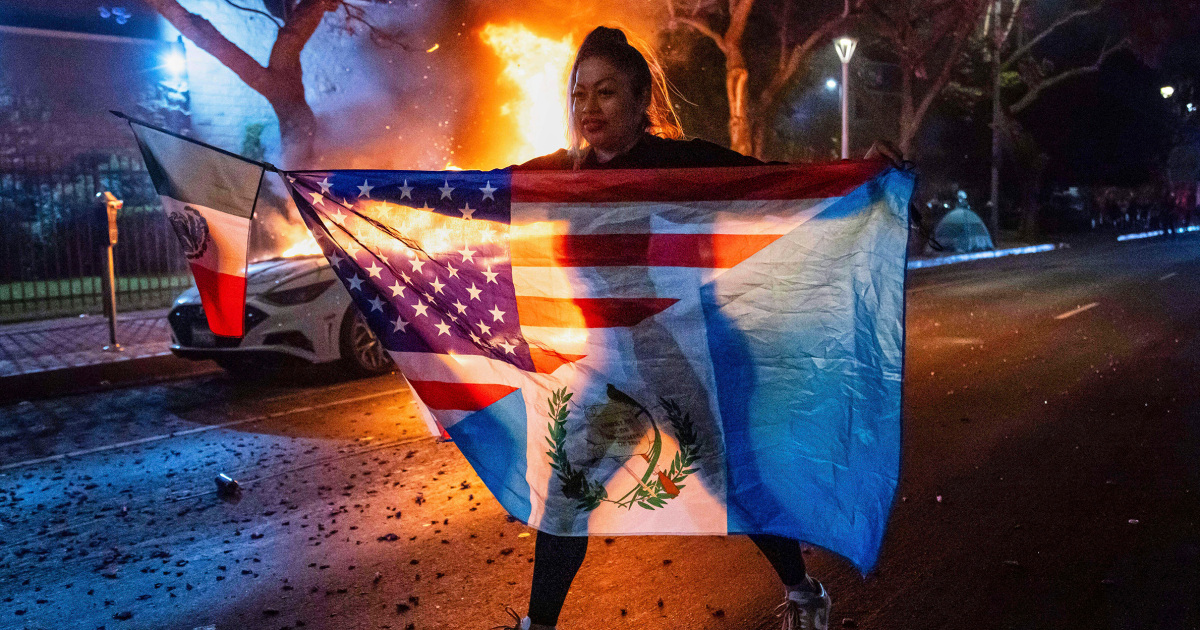
The protests that roiled Los Angeles over the weekend were set to spread Tuesday across the country, as activists planned demonstrations in New York, Chicago, Dallas, Atlanta and elsewhere.

Rallies protesting ICE raids and the government’s immigration policies have spread across California and beyond this week. A series of so-called No Kings demonstrations are planned nationwide for Saturday.

NBC News counted at least 25 rallies and demonstrations coast to coast. Some of them involved only a few dozen participants, while others attracted thousands to make a stand against the detention and removal of suspected undocumented migrants.

Many protesters across the country were trade unionists calling for the release of SEIU California President David Huerta, who was arrested on Friday.

Bimbo #2 is still too dense to get the message:

Homeland Security Secretary Kristi [Bimbo #2] Noem signaled on Tuesday that she would continue the agency’s program of raids and deportations despite the widespread protests.

“ICE will continue to enforce the law,” [Bimbo #2] Noem said.

It’s only just begun! 🙂

https://www.nbcnews.com/news/us-news/anti-ice-protests-held-coast-coast-l-unrest-national-movement-grows-rcna211980

Washington Post: This Los Angeles port is among the first casualties of Trump’s trade war

Empty berths and idle cranes show the effects of sky-high tariffs on Chinese goods.

The number of shipping containers that arrived at the nation’s top container port last week was roughly one-third lower than during the same period last year — a sharper decline than during the depths of the Great Recession. More than one-fifth of the giant ships that were scheduled to call in Los Angeles this month have already canceled, and that number is expected to rise.

Trump’s 145 percent tariffs on Chinese goods — and Beijing’s triple-digit retaliation — are bringing a swift halt to the trans-Pacific flow of electronics, clothing, furniture, industrial parts and everything else that the world’s two largest economies exchange.

https://www.washingtonpost.com/business/2025/05/11/los-angeles-port-tariffs-trade-tensions

Bloomberg: Trump Has Been Stopped By Courts More Than 200 Times

President Donald Trump’s expansive use of executive power faced at least 328 lawsuits as of May 1 — with judges halting his policies far more often than they allowed them.

Courts entered more than 200 orders stopping the administration’s actions in 128 cases, with judges sometimes ruling at multiple stages of the legal fights. Judges had allowed contested policies to go ahead in 43 cases, and hadn’t ruled yet in more than 140 others. Most cases are in the early stages, and new ones are being filed daily.

https://archive.is/zZ9zU#selection-1251.0-1258.0