Guardian: Pentagon has blocked Ukraine from striking deep inside Russia – report

Wall Street Journal says move is part of Trump administration’s effort to get Putin into peace talks

US defense officials have blocked Ukraine from using US-supplied long-range missiles to strike targets inside Russia since late spring as part of a Trump administration effort to get Vladimir Putin to engage in peace talks , according to a report on Saturday.

Worked really well, didn’t it, King Donald, you f*ck*ng Surrender Monkey. Your chum Putin continued doing what he was doing and just blitzed the sh*t out of Ukraine, including destroying an American factory.

The Wall Street Journal reports that the Pentagon has blocked Ukraine from using US-made Army Tactical Missile Systems, or Atacms.

Two US officials told the outlet that on at least one occasion, Ukraine had sought to use Atacms against a target but was denied under a “review mechanism” developed by Elbridge Colby, the Pentagon’s undersecretary for policy, that governs how US long-range weapons or those provided by European allies that rely on American intelligence and components can be used.

The review process also applies to Britain’s Storm Shadow cruise missile because it depends on US targeting data, according to two US officials and a British official, the Journal said.

The review system reportedly gives US defense secretary Pete Hegseth approval over the use of the Atacms, which have a range of nearly 190 miles (305km). Ukraine was previously given authority by the Biden administration to use the missile system against targets inside Russia in November after North Korean troops entered the war.

Before the inauguration in January, Trump told Time magazine that the decision to allow Ukraine to use US weapons systems to attack targets inside Russia had been a mistake.

“I disagree very vehemently with sending missiles hundreds of miles into Russia. Why are we doing that? We’re just escalating this war and making it worse. That should not have been allowed to be done,” he said.

It is unclear whether the US defense department’s review process amounts to a formal policy change. But it comes alongside increasing control of munitions to Ukraine as US stocks are themselves depleted.

In a statement to the Journal, White House press secretary Karoline Leavitt said Trump “has been very clear that the war in Ukraine needs to end. There has been no change in military posture in Russia-Ukraine at this time.”

But last week, amid efforts to broker talks between the Russian president and Voldomyr Zelenskyy, Trump said that Ukraine couldn’t defeat Russia unless it could “play offense” in the war.

“It is very hard, if not impossible, to win a war without attacking an invader’s country,” Trump wrote on Thursday. “It’s like a great team in sports that has a fantastic defense, but is not allowed to play offense. There is no chance of winning.”

Last month, the US agreed to supply Ukraine with new weapons systems but only if European nations paid for them. While Trump has said that the US is “not looking” to provide longer-range weapons that could reach Moscow, US officials told the Journal that the administration has approved the sale of 3,350 Extended Range Attack Munition air-launched missiles, or Erams, which have a range of 280 miles (400km).

Not surprising that Ukraine is developing its own long range drone (code name “Flamingo”) with a range of 3,000 km. to reduce their reliance on the buffoon Trump.

https://www.theguardian.com/us-news/2025/aug/23/pentagon-ukraine-russia-missiles

NBC News: Judge rules ‘Alligator Alcatraz’ can stay open but halts construction and bars new detainees

Within 60 days, the facility must also remove “all generators, gas, sewage, and other waste and waste receptacles,” which calls into question how it would operate.

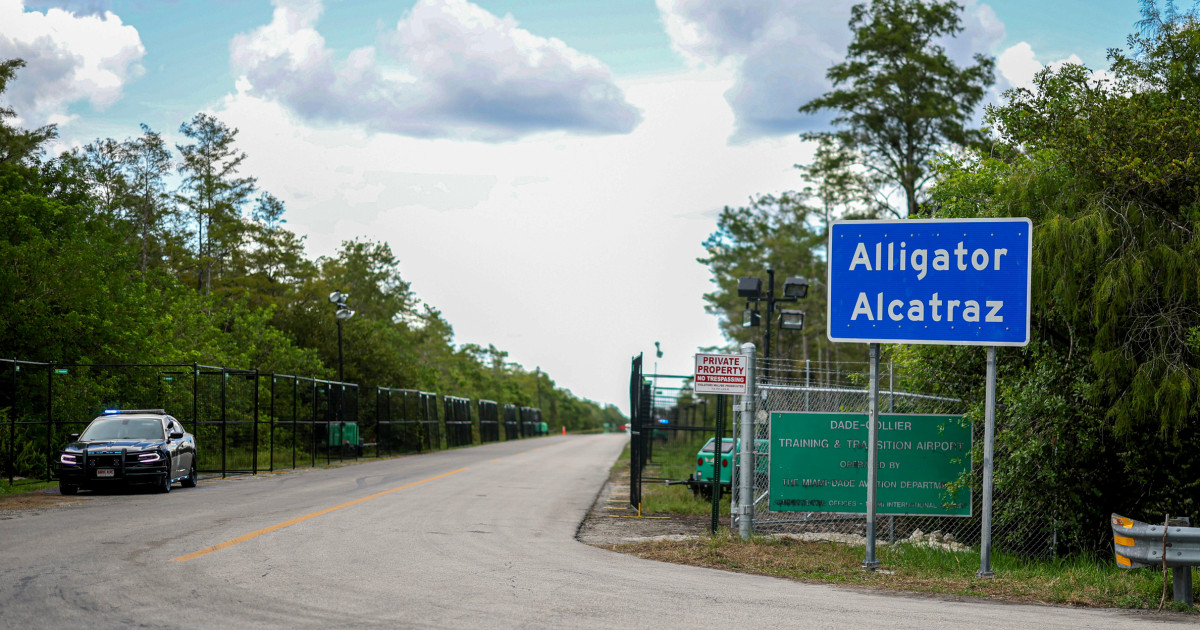
A federal judge in Miami ruled Thursday that “Alligator Alcatraz,” the contested migrant detention facility in the Florida Everglades, can remain operational for now but that it cannot be expanded and no additional detainees can be brought in.

U.S. District Judge Kathleen M. Williams entered a preliminary injunction to prevent the installation of any additional industrial-style lighting and any site expansion. Her ruling further prevents “bringing any additional persons … who were not already being detained at the site at the time of this order.”

The ruling was filed late Thursday, allowing the injunction that was requested over National Environmental Policy Act violations.

Within 60 days, “and once the population attrition allows for safe implementation of this Order,” the facility must also remove “all generators, gas, sewage, and other waste and waste receptacles that were installed to support this project,” the 82-page ruling said.

It must also remove additional lighting that was installed for the detention facility. Light pollution was a hot topic during the hearings this month.

It’s unclear how the facility will remain operational if those resources are removed.

The government must also remove temporary fencing installed to allow Native American tribe members access to the site consistent with the access they had before the facility was erected.

The defense has appealed the ruling, court records show.

Neither the Justice Department nor the Department of Homeland Security immediately responded to requests for comment. The offices of Florida Gov. Ron DeSantis and the Florida Division of Emergency Management also didn’t immediately respond to requests for comment.

Williams’ decision came down the same day a temporary construction freeze she previously issued expired and after a four-day hearing over environmental concerns about the facility’s location in the sensitive wetlands.

Williams had issued a temporary restraining order this month to temporarily halt operations over a lawsuit alleging the detention facility’s construction skirted environmental laws. That ruling meant no filling, paving or installation of additional infrastructure was allowed, but it didn’t affect the center’s immigration enforcement activity.

A ‘major victory’

The environmental groups that sued demanding an injunction celebrated the ruling in a joint statement late Thursday as “a major victory for Florida’s imperiled wildlife and fragile ecosystems which are threatened by the detention center.”

“Today’s decision means the facility must wind down operations in an orderly fashion within 60 days,” the statement said, saying the center posed a threat to the Everglades ecosystem, endangered species, clean water and dark night skies.

“The state and federal government paved over 20 acres of open land, built a parking lot for 1,200 cars and 3,000 detainees, placed miles of fencing and high-intensity lighting on site and moved thousands of detainees and contractors onto land in the heart of the Big Cypress National Preserve, all in flagrant violation of environmental law,” said Paul Schwiep, counsel for Friends of the Everglades and the Center for Biological Diversity. “We proved our case and are pleased that the court has issued a preliminary injunction against this travesty”

Thursday’s “preliminary injunction will remain in place while the lawsuit challenging the detention center is heard,” the statement said.

The Miccosukee Tribe of Indians of Florida also praised the ruling Thursday.

“This is not our first fight for our land and rights. The Miccosukee Tribe remains steadfast in our commitment to protect our ancestral lands in Big Cypress from development as a permanent detention facility,” Chairman Talbert Cypress said in a statement. “We will continue to fight to ensure that the government does not dodge its legal requirements for environmental review on seized public lands, sacred to our people.”

“When it comes to our homeland, there is no compromise,” he added.

Environmental outcry

Environmental groups and Native Americans had protested the construction of the site, which is part of the Trump administration’s crackdown on immigration, because of the Everglades’ delicate and unique ecosystem, which is home to endangered and threatened species.

Environmental groups sued in June to stop the facility, which opened in July on an airstrip in Ochopee’s Big Cypress National Preserve.

The suit said that the center was built without ecological reviews required under the National Environmental Policy Act and without public notice or comment and that the government failed to comply with other state and federal statutes, including the Endangered Species Act.

The Trump administration downplayed the environmental concerns and argued that the facility was necessary because voters want the federal government to curb illegal immigration.

Schwiep, the attorney, said in court Aug. 13 that the “suggestion there is no environmental impact is absurd.”

“So why here? There are runways elsewhere. … Why the jetport in this area?” Schweip asked. “Alligator Alcatraz. A name just meant to sound ominous. I would submit, judge, this is just a public relations stunt.”

Significance to Miccosukee Tribe

On Aug. 12, the court heard from Amy Castaneda, director of water resources for the Miccosukee Tribe of Indians of Florida. Castaneda said that she has worked with the tribe for 19 years and that the entrance to the jetport where the facility is built is a quarter-mile from the tribe’s land.

Asked what the Everglades land means to the Miccosukee tribe, she replied, “It’s written into the constitution to protect the Everglades because the Everglades protected them when they were hunted by the government.”

Castaneda said that for nearly two decades, there has been “minimal” activity at the jetport but that that changed after June with the construction of the detention facility.

“There’s much more activity there, vehicles going in and out, cars usually isolated on the southside of Tamiami Trail taking photos with the sign. Tankers, protesters, media, people setting up tents to sell merch for Alligator Alcatraz. Just different levels,” she said.

Castaneda said no one from the federal government, the state or any other governmental entity contacted the tribe about the construction.

She said water resources officials for the tribe have collected samples downstream from the facility to test and determine whether there has been a nutrient shift or potential health concerns.

Marcel Bozas, the director of fish and wildlife for the Miccosukee Tribe of Indians of Florida, also testified Aug. 12, noting the airstrip is a couple of miles from the tribe’s sites.

While tribal members can’t access the airstrip, some trails are no longer accessible. Asked about the impact of hunting on the land, Bozas said, “Tribal members are concerned the wildlife they could be formerly hunting for are no longer in that area.” There’s also concern that medicinal plants are affected.

https://www.nbcnews.com/news/us-news/judge-rules-alligator-alcatraz-florida-no-new-detainees-rcna224550

Slingshot News: ‘A Lack Of Cooperation’: Secretary Kristi Noem Blames Local American Police For Her Department’s Own Failures In House Hearing

https://www.msn.com/en-us/news/opinion/a-lack-of-cooperation-secretary-kristi-noem-blames-local-american-police-for-her-department-s-own-failures-in-house-hearing/vi-AA1KRC27

San Francisco Chronicle: ICE arrests of people with no criminal convictions have surged in Northern California

As it has nationwide, ICE is arresting far more suspected immigration violators this summer than before

ICE arrests in Northern California have surged this summer, a Chronicle analysis of deportation data shows. That’s in keeping with national trends.

The Department of Homeland Security, in coordination with Immigration and Customs Enforcement (ICE), claimed on Friday that they are “cleaning up the streets,” targeting what they continued to call the “WORST OF THE WORST” — including “illegal alien pedophiles, sex offenders, and violent thugs.”

But the numbers tell a more complicated story.

Since the beginning of 2025, Immigration and Customs Enforcement has arrested roughly 2,640 people in its San Francisco “area of responsibility” — a 123% increase compared to the final seven months of the Biden administration. The pace picked up dramatically in June and July.

That area spans a large portion of California, from Kern County northward, and also includes Hawaii, Guam, and Saipan. The Chronicle’s analysis focused only on arrests made within California.

Notably, under the Trump administration, arrests of people without criminal convictions have risen sharply. Many of those taken into custody have only pending criminal charges — or none at all. In June, about 58% of arrests involved individuals with no prior convictions. That figure dipped slightly to 56% in July, but just a few months earlier, the numbers were far lower: In December, before President Donald Trump took office, only 10% of arrests involved people without a criminal conviction.

Among those without a conviction, ICE has arrested a large number of individuals whose only suspected violation is entering the country illegally or overstaying their visa. Although administration officials often call these undocumented immigrants “criminals,” being in the U.S. without legal status is a civil violation, not a crime. 

Arrests of convicted criminals are also up, though not as sharply. Those convictions varied widely — from serious and violent crimes like child sexual assault, homicide, and drug trafficking, to lesser charges such as traffic violations and low-level misdemeanors.

ICE officers raided a home in East Oakland on Tuesday and detained at least six people, including a minor and a person with a severe disability, according to an immigration attorney. In June, Oakland police confirmed to the Chronicle that ICE alerted them of its activity, but ICE did not provide additional details. 

Also, for the first time in the Bay Area, ICE detained two U.S. citizens during a protest on Aug. 8, outside the agency’s San Francisco field office at 630 Sansome St. Aliya Karmali, an Oakland immigration attorney, told Mission Local that she hasn’t seen “ICE arresting [U.S. citizen] protestors in the Bay since entering the legal field nearly 20 years ago.”

The picture is similar nationwide. National data from the Transaction Records Access Clearinghouse at Syracuse University indicates that the number of people detained by ICE — excluding those arrested by Customs and Border Protection — saw a 178% increase between Jan. 26 and July 13. 

Since the beginning of 2025, ICE arrests of people with no criminal convictions has skyrocketed, with a 370% increase from the end of January to mid-July. In June, ICE held more people for immigration violations than for pending charges for the first time — a trend that continued into July.  

Reports indicate that ICE has been targeting workers in mostly Latino neighborhoods and on jobsites — sometimes based on vague tips from people claiming they saw undocumented immigrants, but often with no clear reason at all. It has also arrested thousands of people in public places. 

Though the administration views the increased immigration enforcement as necessary for public safety or border security, many believe the arrests are fueling fear, separating families, disrupting labor markets and local economies, and doing little to actually solve the country’s broader immigration problems.

“It seems like they’re just arresting people they think might be in the country without status and amenable to deportation,” said Julia Gelatt, associate director of the U.S. immigration policy program at the nonpartisan Migration Policy Institute, in a June Reuters story.

https://www.sfchronicle.com/bayarea/article/ice-arrests-deport-data-20818148.php

Washington Post: Eligible for asylum in Canada, stuck in ICE detention

Three members of an Afghan family, including a man who worked for the U.S. military, could be eligible for asylum in Canada. ICE won’t release them.

They trekked through a dozen countries, from Asia to South America, on horseback across the perilous Darien Gap and up through Central America to Mexico.

Members of Afghanistan’s persecuted Shiite Hazara minority, the family — a man who worked for the U.S. military in Afghanistan, his wife and three of their children — spent months in Mexico trying to schedule an appointment with U.S. immigration authorities through the Biden administration’s CBP One app, to no avail.

https://www.washingtonpost.com/world/2025/08/18/canada-afghan-migrants-ice-detention

Defense One: How Trump’s DC takeover could supercharge surveillance

The emergency declaration, combined with new tech, will give government broad new abilities to watch and monitor citizens.

President Trump’s declaration of a “crime emergency” in Washington, D.C., will further entwine the U.S. military—and its equipment and technology—in law-enforcement matters, and perhaps expose D.C. residents and visitors to unprecedented digital surveillance. 

Brushing aside statistics that show violent crime in D.C. at a 30-year low, Trump on Monday described a new level of coordination between D.C. National Guard units and federal law enforcement agencies, including the FBI, ICE, and and the newly federalized D.C. police force

“We will have full, seamless, integrated cooperation at all levels of law enforcement, and will deploy officers across the district with an overwhelming presence. You’ll have more police, and you’ll be so happy because you’re being safe,” he said at a White House press conference. 

Defense Secretary Pete Hegseth, standing beside Trump, promised close collaboration between the Pentagon and domestic authorities. “We will work alongside all DC police and federal law enforcement to ensure this city is safe.” 

What comes next? The June 2020 deployment of National Guard units to work alongside D.C. police offers a glimpse: citywide use of sophisticated intelligence-gathering technologies normally reserved for foreign war zones.

Some surveillance platforms will be relatively easy to spot, such as spy aircraft over D.C.’s closely guarded airspace. In 2020, authorities deployed an RC-26B, a military-intelligence aircraft, and MQ-9 Predator drones. The FBI contributed a Cessna 560 equipped with “dirtboxes”: devices that mimic cell towers to collect mobile data, long used by the U.S. military to track terrorist networks in the Middle East.

Other gear will be less obvious.The 2020 protests saw expanded use of Stingrays, another type of cellular interception device. Developed to enable the military to track militants in Iraq and Afghanistan, Stingrays were used by the U.S. Secret Service in 2020 and 2021 in ways that the DHS inspector general found broke the law and policies concerning privacy and warrants. Agency officials said “exigent” circumstances justified the illicit spying.

Now, with federal agencies and entities working with military personnel under declared-emergency circumstances, new gear could enter domestic use. And local officials or the civilian review boards that normally oversee police use of such technologies may lack the power to prevent or even monitor it. In 2021, the D.C. government ended a facial-recognition pilot program after police used it to identify a protester at Lafayette Square. But local prohibitions don’t apply to federalized or military forces. 

Next up: AI-powered surveillance 

How might new AI tools, and new White House measures to ease sharing across federal entities, enable surveillance targeting?

DHS and its sub-agencies already use AI. Some tools—such as monitoring trucks or cargo at the border for contraband, mapping human trafficking and drug networks, and watching the border—serve an obvious public-safety mission. Last year, DHS used AI and other tools to identify 311 victims of sexual exploitation and to arrest suspected perpetrators. They also helps DHS counter the flow of fentanyl; last October, the agency cited AI while reporting a 50 percent increase in seizures and an 8 percent increase in arrests.

TSA uses facial recognition across the country to match the faces and documents of airline passengers entering the United States in at least 26 airports, according to 2022 agency data. The accuracy has improved greatly in the past decade, and research suggests even better performance is possible: the National Institute of Standards and Technology has shown that some algorithms can achieve 99%-plus accuracy under ideal conditions. 

But conditions are not always ideal, and mistakes can be costly. “There have been public reports of seven instances of mistaken arrests associated with the use of facial recognition technology, almost all involving Black individuals. The collection and use of biometric data also poses privacy risks, especially when it involves personal information that people have shared in unrelated contexts,” noted a Justice Department report in December. 

On Monday, Trump promised that the increased federal activity would target “known gangs, drug dealers and criminal networks.” But network mapping—using digital information to identify who knows who and how—has other uses, and raises the risk of innocent people being misidentified. 

Last week, the ACLU filed a Freedom of Information Act request concerning the use of two software tools by D.C.’s Homeland Security and Emergency Management Agency. Called Cobwebs and Tangles, the tools can reveal sensitive information about any person with just a name or email address, according to internal documents cited in the filing.

Cobwebs shows how AI can wring new insights from existing data sources, especially when there are no rules to prohibit the gathering of large stores of data. Long before the capability existed to do it effectively, this idea was at the center of what, a decade ago, was called predictive policing

The concept has lost favor since the 2010s, but many law-enforcement agencies still pursue versions of it. Historically, the main obstacle has been too much data, fragmented across systems and structures. DHS has legal access to public video footage, social media posts, and border and airport entry records—but until recently, these datasets were difficult to analyze in real time, particularly within legal constraints.

That’s changing. The 2017 Modernizing Government Technology Act encouraged new software and cloud computing resources to help agencies use and share data more effectively, and in March, an executive order removed several barriers to interagency data sharing. The government has since awarded billions of dollars to private companies to improve access to internal data.

One of those companies is Palantir, whose work was characterized by the New York Times as an effort to compile a “master list” of data on U.S. citizens. The firm disputed that in a June 9 blog post: “Palantir is a software company and, in the context of our customer engagements, operates as a ‘data processor’—our software is used by customers to manage and make use of their data.”

In a 2019 article for the FBI training division, California sheriff Robert Davidson envisioned a scenario—now technologically feasible—in which AI analyzes body-camera imagery in real time: “Monitoring, facial recognition, gait analysis, weapons detection, and voice-stress analysis all would actively evaluate potential danger to the officer. After identification of a threat, the system could enact an automated response based on severity.”

The data DHS collects extends well beyond matching live images to photos in a database or detecting passengers’ emotional states. ICE’s Homeland Security Investigations unit, for instance, handles large volumes of multilingual email. DHS describes its email analytics program as using machine learning “for spam classification, translation, and entity extraction (such as names, organizations, or locations).”

Another DHS tool analyzes social-media posts to gather “open-source information on travelers who may be subject to further screening for potential violation of laws.” The tool can identify additional accounts and selectors, such as phone numbers or email addresses, according to DHS documentation.

Meanwhile, ICE’s operational scope has expanded. The White House has increased the agency’s authority to operate in hospitals and schools, collect employment data—including on non-imigrants, such as “sponsors” of unaccompanied minors—and impose higher penalties on individuals seen as “interfering” with ICE activities. Labor leaders say they’ve been targeted for their political activism. Protesters have been charged with assaulting ICE officers or employees. ICE has installed facial-recognition apps on officers’ phones, enabling on-the-spot identification of people protesting the agency’s tactics. DHS bulletins sent to local law enforcement encourage officers to consider a wide range of normal activity, such as filming police interactions, as potential precursors to violence.

Broad accessibility of even legally collected data raises concerns, especially in an era where AI tools can derive specific insights about people. But even before these developments, government watchdogs urged greater transparency around domestic AI use. A December report by the Government Accountability Office includes several open recommendations, mostly related to privacy protections and reporting transparency. The following month, DHS’s inspector general warned that the agency doesn’t have complete or well-resourced oversight frameworks. 

In June, Sen. Ed Markey, D-Mass., and several co-signers wrote to the Trump White House, “In addition to these concerning uses of sentiment analysis for law enforcement purposes, federal agencies have also shown interest in affective computing and deception detection technologies that purportedly infer individuals’ mental states from measures of their facial expressions, body language, or physiological activity.” 

The letter asks the GAO to investigate what DHS or Justice Department policies govern AI use and whether those are being followed. Markey’s office did not respond to a request for comment.

Writing for the American Immigration Council in May, Steven Hubbard, the group’s senior data scientist, noted that of DHS’ 105 AI applications, 27 are “rights-impacting.”

“These are cases that the OMB, under the Biden administration, identified as impacting an individual’s rights, liberty, privacy, access to equal opportunity, or ability to apply for government benefits and services,” Hubbard said.

The White House recently replaced Biden-era guidance on AI with new rules meant to accelerate AI deployment across the federal government. While the updated guidelines retain many safety guardrails, they do include some changes, including merging “privacy-impacting” and “safety-impacting” uses of AI into a single category: “high impact.”

The new rules also eliminate a requirement for agencies to notify people when AI tools might affect them—and to offer an opt-out.

Precedents for this kind of techno-surveillance expansion can be found in countries rarely deemed models for U.S. policy. China and Russia have greatly expanded surveillance and policing under the auspices of security. China operates an extensive camera network in public spaces and centralizes its data to enable rapid AI analysis. Russia has followed a similar path through its “Safe Cities” program, integrating data feeds from a vast surveillance network to spot and stop crime, protests, and dissent.

So far, the U.S. has spent less than these near-peers, as a percent of GDP, on surveillance tools, which are operated under a framework, however strained, of rule-of-law and rights protections that can mitigate the most draconian uses.

But the distinction between the United States and China and Russia is shrinking, Nathan Wessler, deputy director with the ACLU’s Speech, Privacy, and Technology Project, said in July. “There’s the real nightmare scenario, which is pervasive tracking of live or recorded video, something that, by and large, we have kept at bay in the United States. It’s the kind of thing that authoritarian regimes have invested in heavily.” 

Wessler noted that in May, the Washington Post reported that New Orleans authorities were applying facial recognition to live video feeds. “At that scale, that [threatens to] just erase our ability to go about our lives without being pervasively identified and tracked by the government.”

https://www.defenseone.com/threats/2025/08/how-trumps-dc-takeover-could-supercharge-surveillance/407376

Washington Post: Top Hegseth aide tried to oust senior White House liaison from Pentagon

The unusual dispute received White House intervention and appears rooted in deeper frustrations over failed attempts to fill jobs on the defense secretary’s staff.

Defense Secretary Pete Hegseth’s acting chief of staff tried and failed to oust a senior White House liaison assigned to the Pentagon, people familiar with the matter said Monday, detailing an unusual dispute that marks the latest instance of infighting among a staff plagued by disagreement and distrust.

The clash last week between Ricky Buria, Hegseth’s acting chief of staff, and Matthew A. McNitt, who coordinates personnel policy as White House liaison at the Pentagon, appears rooted in Buria’s frustration with pushback from the White House as he has attempted to fill positions in the defense secretary’s office. It coincides, too, with the White House’s refusal to let Buria take over the powerful chief of staff job on a permanent basis.

Those familiar with the situation, which has not been previously reported, spoke on the condition of anonymity to avoid reprisal by the Trump administration.

The dispute between Buria and McNitt appears to have shaken a fragile agreement between Hegseth and the White House, which allowed Buria to serve as chief of staff only unofficially after several other people were considered for the position but declined to take it, the people familiar with the matter said. Officials at the White House, they said, intervened when Buria tried to get rid of McNitt, effectively blocking the move.

Anna Kelly, a White House spokeswoman, said in a statement that Trump is “fully supportive of Secretary Hegseth and his efforts to restore a focus on warfighters at the Pentagon,” rather than diversity efforts and “woke initiatives.”

Ninety percent of political appointments in the Defense Department have been filled, Kelly said, “and all personnel, including Matt McNitt, reflect the administration’s shared mission to ensure our military is the most lethal fighting force in the world.”

The statement did not reference Buria.

It is not clear whether Hegseth supported or approved Buria’s attempt to remove McNitt from the Pentagon, or whether the secretary was even made aware of the power play in advance.

Sean Parnell, a Pentagon spokesman and senior adviser to Hegseth, declined to address questions about the situation, issuing a brief statement instead downplaying the intra-staff upheaval.

“When the Fake News Media has nothing to report to the American people, they resort [to] blog posting about water cooler gossip to meet their quota for clicks,” the statement said. “This kind of nonsense won’t distract our team from our mission.”

McNitt, who served in a handful of roles during the first Trump administration, could not be reached for comment. Buria did not respond to a request for comment.

Their dispute is the latest in a series of fights that has consumed the Pentagon over the first six months of President Donald Trump’s return to office. Hegseth’s tenure has been marked by abrupt firings, personality clashes, threats and other forms of dysfunction that have drawn scrutiny from Capitol Hill and continue to be closely monitored by the White House.

Buria has been at the center of much of the turmoil, seeking to isolate Hegseth from other senior advisers on his staff and assert control over the Pentagon’s inner workings, people familiar with the issues have said. A recently retired Marine Corps colonel, he has served as the de facto chief of staff since April, after Hegseth’s initial choice for the job, Joe Kasper, voluntarily departed to return to the corporate world.

Buria’s rapid transition from nonpartisan military officer to political warrior has stunned people who know him and raised questions among some Trump administration officials who remain skeptical of his warm relations with Biden administration appointees in the Pentagon while he served as a junior military aide for then-Defense Secretary Lloyd Austin.

Hegseth and Buria have clashed repeatedly with top generals and admirals serving in some of the Pentagon’s senior-most positions.

Most recently, the secretary rescinded the planned promotion of Army Lt. Gen. Douglas Sims, whose last day as director of the Joint Staff was last week. The decision, first reported last month by the New York Times, was made despite a direct appeal to Hegseth from Gen. Dan Caine, chairman of the Joint Chiefs of Staff.

The director’s job, widely considered one of the military’s most important, is being filled on a temporary basis by Marine Corps Maj. Gen. Stephen Liszewski, people familiar with the matter said. Trump in June nominated Navy Vice Adm. Fred Kacher to replace Sims, and he awaits Senate confirmation.

Hegseth, fixated on trying to stop a succession of embarrassing leaks to the news media, earlier this year threatened to have a polygraph test conducted on Sims, a detail reported earlier by the Wall Street Journal. The secretary’s team did briefly conduct polygraph tests against some Pentagon officials in April and early May, but the effort was stopped at the direction of the White House after Patrick Weaver, a political appointee on Hegseth’s team, complained that Buria wanted him to submit to testing despite Weaver’s history of supporting Trump’s agenda.

Buria also has faced scrutiny alongside Hegseth over the secretary’s use of the unclassified chat app Signal. The Defense Department’s independent inspector general has received evidence that Hegseth’s Signal account in March shared operational details about a forthcoming bombing campaign in Yemen, information taken from a classified email labeled “SECRET/NOFORN.”

That designation means defense officials believed disclosure of the information to the wrong parties could damage national security. Among those who received the information were other top Trump administration officials, but also Hegseth’s wife, Jennifer, and personal attorney, Tim Parlatore.

The inspector general’s review is, in part, attempting to establish who posted in those group chats the highly sensitive information shared under Hegseth’s name, people familiar with the matter said. In addition to the defense secretary, Buria had access to Hegseth’s personal phone and sometimes posted information on his behalf, officials have said.

Last week, Hegseth’s team at the Pentagon lashed out at the inspector general’s office in what appeared to be an attempt to undermine the inquiry’s legitimacy even before its findings are made public.

https://www.washingtonpost.com/national-security/2025/08/04/hegseth-buria-white-house-liaison-mcnitt

Alternet: Donald Trump just debunked his own lie — and it should get him sued | Opinion

Walmart, Apple , and Amazon, the most successful companies in the U.S., base their corporate strategies on data: consumer behavior data, market research, financial, product, and competitive analysis data.

Any CEO who deliberately relied on falsified data, or who demanded cooked books, would be fired immediately — and likely sued by the Board of Directors.

Any CEO of any company who tried to manipulate the appearance of short-term success for his own personal gain, at the expense of long-term viability for the company, would also be fired and likely sued for malfeasance, and worse.

A successful CEO knows that falsifying economic or financial data can lead to charges of securities fraudwire fraud, and other financial crimes, because false data can ruin investors, corporations, and markets overnight.

Enter Donald Trump, whose self-proclaimed governing philosophy is “running the country like it’s a business.” Debunking the lie of his own manufactured image as a “successful businessman,” last Friday Trump angrily fired the Bureau of Labor Statistics (BLS) Commissioner because he didn’t like her data — even as he wears 34 felony convictions for falsifying records.

Dr. Erika McEntarfer, a widely respected statistician, enjoyed bipartisan support, including confirmation votes from Marco Rubio and JD Vance. Appointed commissioner under the Biden administration, she holds a Ph.D. in economics from Virginia Tech, and served at the Census Bureau for two decades under both parties prior to her BLS appointment.

By federal law, McEntarfer’s appointment ends in 2028. Trump fired her anyway because he was embarrassed by jobs data that didn’t match his own hype.

In May, the White House said that April’s jobs report “proved” that Trump was “revitalizing” the economy. In June, Trump posted, “GREAT JOBS NUMBERS.” After the Labor Department released revised jobs figures for those months — a common practice because jobs reports are sample projections that get adjusted when actual employer data come in — Trump fired the messenger.

Trump’s penchant for hiding and falsifying data has put American corporations and the economy in more danger. Just as he scrubbed government websites of climate data to bolster his fossil fuel donors, just as he ordered the Smithsonian to remove an exhibit accurately reflecting his own impeachments, Trump thinks reality is whatever he says it is.

As he fantasizes about returning America to the Gilded Age, where robber barons extracted the earth’s resources for unimaginable profit while laborers worked for starvation wages, he’s forgetting that his oligarch donors need accurate economic data too. At least oligarchs creating real products and delivering real services—as opposed to merely speculating in Trump’s image—need real, reliable, and uncooked data.

McEntarfer should sue

When Trump fired McEntarfer in a social media post, he declared that her numbers were “phony.” He wrote on Friday, “In my opinion, today’s Jobs Numbers were RIGGED in order to make the Republicans, and ME, look bad,” adding: “But, the good news is, our Country is doing GREAT!”

He said the numbers had been manipulated for political purposes, and announced he fired McEntarfer as a result.

Trump also baselessly accused McEntarfer of manipulating jobs numbers before the November election to advantage Kamala Harris. Trump said to reporters, “I believe the numbers were phony, just like they were before the election, and there were other times. So you know what I did? I fired her, and you know what? I did the right thing.”

When asked what his source was, he said, “my opinion,” confirming that there was no evidence to back up his reckless claims, claims that permanently tanked the reputation of a celebrated career professional.

Presidents not immune from civil prosecution

No doubt Trump slurred McEntarfer based on his own “opinion” to avoid defamation liability, but an opinion that implies a false fact is still defamatory, it is still actionable, and presidents are not immune from civil lawsuits for defamation.

The four legal elements of defamation are easily found here: false statement; publication; negligence in repeating the falsehood; and reputational harm.

More, a president has immunity from civil lawsuits only for actions taken in furtherance of his core constitutional powers. One of the main “core constitutional powers” of a president is ensuring the faithful execution of laws, such that acting to impede the execution of federal law would fall outside core official responsibilities. (As an aside, even under the disastrous Trump v. US criminal immunity ruling, Trump’s J6 conduct would likely have fallen outside his core function, had it proceeded to trial.)

Trump knowingly and intentionally lied about the BLS commissioner in a manner that directly conflicts with the Department of Labor’s statutory mission; as such, it was not a “core Constitutional function.” Announcing that previous labor reports were “falsified” causes immediate reputational harm to the Commissioner, the Department of Labor, and the US economy overall. It directly impedes the accurate compilation of labor data, a charge mandated by the Wagner-Peyser Act of 1933 as well as the Fair Labor Standards Act.

By implicitly directing that all future US data should be falsified to suit his own political narrative, Trump’s statements not only harm America’s economy, but they hinder rather than aid the faithful execution of laws.

As McEntarfer’s predecessor puts it, McEntarfer’s “totally groundless firing” sets a dangerous precedent and “undermines the statistical mission of the bureau.”

“We need accurate Jobs Numbers,” Trump told reporters, suggesting McEntarfer’s jobs numbers weren’t.

“She will be replaced with someone much more competent and qualified,” he added, suggesting McEntarfer was neither.

Missing the risible irony as he seeks manipulated jobs data for his own political purposes, Trump added, “Important numbers like this must be fair and accurate, they can’t be manipulated for political purposes.”

https://www.alternet.org/alternet-exclusives/trump-lie-debunked

CBS News: Border agents directed to stop deportations under Trump’s asylum ban, sources say

U.S. border agents have been directed to stop deporting migrants under President Trump’s ban on asylum claims, following a federal court order that said the measure could not be used to completely suspend humanitarian protections for asylum-seekers, two Department of Homeland Security officials told CBS News.

The move effectively lifts a sweeping policy that had closed the American asylum system to those entering the U.S. illegally or without proper documents. It’s a measure the second Trump administration has credited for a steep drop in illegal immigration at the U.S.-Mexico border, where officials last month reported the lowest monthly level of migrant apprehensions on record.

Mr. Trump’s asylum crackdown was unprecedented in scope. The proclamation underpinning it, issued just hours after he returned to the White House in January, gave U.S. border officials the power to summarily deport migrants without allowing them to request asylum, a right enshrined in American law for decades. 

Mr. Trump said the extraordinary action was necessary due to what he called an “invasion” of migrants under the Biden administration, which faced record levels of illegal crossings at the southern border until it too restricted asylum last year. 

On Friday, a federal appeals court lifted its pause on a lower judge’s ruling that found Mr. Trump’s decree violated U.S. asylum laws. While the appellate court narrowed the lower court’s order, saying Mr. Trump’s proclamation could be used to pause access to the asylum system, it also ruled the U.S. government could not disregard other laws that bar officials from deporting migrants to places where they could be tortured or persecuted.

Those laws require the U.S. to grant legal protections — known as “withholding of removal” and protection under the United Nations Convention Against Torture — to migrants who prove they would likely face persecution or torture if deported to their home countries. Unlike asylum, those protections do not allow recipients to get permanent U.S. residency or protect them from being deported to a third party country.

Officials at Customs and Border Protection were instructed this weekend to halt deportations under Mr. Trump’s proclamation and to process migrants under U.S. immigration law, which affords foreigners on American soil the right to request humanitarian refuge, the two DHS officials said, requesting anonymity to discuss an internal directive.

CBP officials received instructions to process migrants through different mechanisms, including through a fast-track deportation procedure known as expedited removal, according to the DHS officials. While expedited removal allows for relatively quick deportations, migrants processed under the policy are also allowed to apply for asylum if they convince officials that their fears of being harmed if deported are credible.

For months, U.S. border agents had been using Mr. Trump’s asylum ban to swiftly deport those crossing into the country illegally to Mexico, their home countries and, in some cases, third party nations that had agreed to accept them. Internally, officials have dubbed those deportations “212(f) repatriations,” in reference to the legal authority Mr. Trump invoked in his proclamation.

While the lifting of Mr. Trump’s order may reopen the U.S. asylum system, those caught crossing the southern border illegally will likely remain detained while officials vet their claims. The Trump administration has largely stopped the practice of releasing migrants into the U.S. while they await their court dates, limiting releases to cases involving extraordinary circumstances. 

The Justice Department could also try to get Friday’s court order suspended by the Supreme Court, in a bid to revive Mr. Trump’s asylum ban.

In a statement to CBS News late Monday, CBP said Friday’s court order affirmed “the President’s authority to deny asylum to aliens participating in an invasion into the United States.”

CBP said the Trump administration is “committed to ensuring that aliens illegally entering the United States face consequences for their criminal actions.”

“This includes prosecution to the fullest extent of the law and rapid removal from the United States,” the agency added. “CBP will continue to process illegal/inadmissible aliens consistent with law, including mandatory detention and expedited removal.”  

After soaring to record levels in late 2023, illegal border crossings dropped sharply in former President Biden’s last year office, following increased efforts by Mexico to interdict U.S.-bound migrants and an order issued by Biden in June 2024 to restrict access to the American asylum system. But they have plunged even further since Mr. Trump took office for a second time.

In July, Border Patrol encountered just 4,600 migrants along the southern border, the lowest monthly tally ever publicly reported by the agency. It’s also a figure the Biden administration recorded in 24 hours on many days.

https://www.cbsnews.com/news/border-agents-directed-to-stop-deportations-under-trumps-asylum-ban-after-court-order

Newsweek: Green card applicants’ kids may lose legal status after Trump admin move

Children of H-1B visa holders may now age out of their protected legal status while their parents apply for green cards, under a Trump administration policy change announced Friday.

The Department of Homeland Security (DHS) announced that it was reversing a Biden administration policy that prevented young adults from losing their legal status if a parent’s application was still pending when their children reached age 21.

Why It Matters

Around 200,000 children and young adults could be affected by the change, which comes amid a flurry of alterations at the U.S. Citizenship and Immigration Service (USCIS) to bring policies in line with President Donald Trump’s directives to tighten immigration controls.

What To Know

The USCIS policy change affects those who fall under the Child Status Protection Act (CSPA), which the administration of former President Joe Biden had allowed in February 2023 to apply to some children as soon as their parents became eligible to apply for a green card.

That meant that even if they “aged out” during the wait for a green card, they would not lose legal status.

On Friday, the Trump administration rolled those extensions back, saying that CSPA protections would once again only apply when a visa becomes available via the Department of State. USCIS said this would create a more consistent approach for those applying for adjustment of status and immigrant visas.

With long wait times for adjustment of status applications, particularly for H-1B and other temporary visa holders, this could now mean that when a dependent child turns 21, they lose their legal status and may have to leave the U.S., even if they have lived in the country for most or all of their lives.

Doug Rand, a DHS official during the Biden administration, said that many of those children would be American to their core, but would now be forced to the back of the line for a green card.

What People Are Saying

USCIS, in a news release: “The Feb. 14, 2023, policy resulted in inconsistent treatment of aliens who applied for adjustment of status in the United States versus aliens outside the United States who applied for an immigrant visa with the Department of State.”

Doug Rand, former DHS official, in a statement shared with Newsweek: “Back in 2023, the team I was part of at USCIS made a sensible policy change to make this situation a little less awful for a few more young people. Basically, the government has a choice about whether certain people who “age out” of their immigration status can still hang on to their parents’ place in line for a green card some day.

“We chose yes. Today, the Trump administration is choosing no.”

What’s Next

The new guidance will apply to requests filed after August 15, with those already in process not affected.

https://www.newsweek.com/h1b-green-card-applicants-children-protections-change-trump-administration-2111075