LA Times: California took center stage in ICE raids, but other states saw more immigration arrests

Ever since federal immigration raids ramped up across California, triggering fierce protests that prompted President Trump to deploy troops to Los Angeles, the state has emerged as the symbolic battleground of the administration’s deportation campaign.

But even as arrests soared, California was not the epicenter of Trump’s anti-immigrant project.

In the first five months of Trump’s second term, California lagged behind the staunchly red states of Texas and Florida in the total arrests. According to a Los Angeles Times analysis of federal Immigration and Customs Enforcement data from the Deportation Data Project, Texas reported 26,341 arrests — nearly a quarter of all ICE arrests nationally — followed by 12,982 in Florida and 8,460 in California.

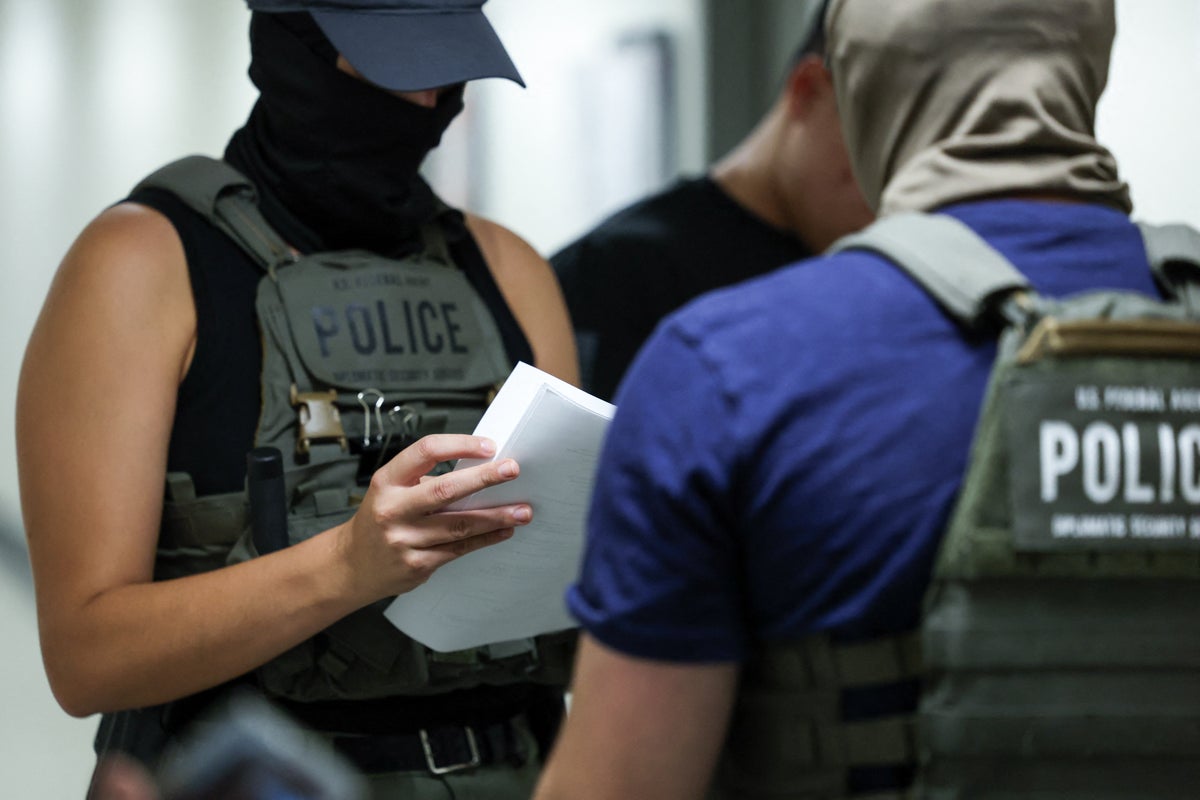
Even in June, when masked federal immigration agents swept through L.A., jumping out of vehicles to snatch people from bus stops, car washes and parking lots, California saw 3,391 undocumented immigrants arrested — more than Florida, but still only about half as many as Texas.

When factoring in population, California drops to 27th in the nation, with 217 arrests per million residents — about a quarter of Texas’ 864 arrests per million and less than half of a whole slew of states including Florida, Arkansas, Utah, Arizona, Louisiana, Oklahoma, Tennessee, Georgia, Virginia and Nevada.

The data, released after a Freedom of Information Act lawsuit against the government, excludes arrests made after June 26 and lacks identifying state details in 5% of cases. Nevertheless, it provides the most detailed look yet of national ICE operations.

Immigration experts say it is not surprising that California — home to the largest number of undocumented immigrants in the nation and the birthplace of the Chicano movement — lags behind Republican states in the total number of arrests or arrests as a percentage of the population.

“The numbers are secondary to the performative politics of the moment,” said Austin Kocher, a geographer and research assistant professor at Syracuse University who specializes in immigration enforcement.

Part of the reason Republican-dominated states have higher arrest numbers — particularly when measured against population — is they have a longer history of working directly with ICE, and a stronger interest in collaboration. In red states from Texas to Mississippi, local law enforcement officers routinely cooperate with federal agents, either by taking on ICE duties through so-called 287(g) agreements or by identifying undocumented immigrants who are incarcerated and letting ICE into their jails and prisons.

Indeed, data show that just 7% of ICE arrests made this year in California were made through the Criminal Alien Program, an initiative that requests that local law enforcement identify undocumented immigrants in federal, state and local prisons and jails.

That’s significantly lower than the 55% of arrests in Texas and 46% in Florida made through prisons or jails. And other conservative states with smaller populations relied on the program even more heavily: 75% of ICE arrests in Alabama and 71% in Indiana took place via prisons and jails.

“State cooperation has been an important buffer in ICE arrests and ICE operations in general for years,” said Ariel Ruiz Soto, a Sacramento-based senior policy analyst at the Migration Policy Institute. “We’ve seen that states are not only willing to cooperate with ICE, but are proactively now establishing 287(g) agreements with their local law enforcement, are naturally going to cast a wider net of enforcement in the boundaries of that state.”

While California considers only some criminal offenses, such as serious felonies, significant enough to share information with ICE; Texas and Florida are more likely to report offenses that may not be as severe, such as minor traffic infractions.

Still, even if fewer people were arrested in California than other states, it also witnessed one of the most dramatic increases in arrests in the country.

California ranked 30th in ICE arrests per million in February. By June, the state had climbed to 10th place.

ICE arrested around 8,460 immigrants across California between Jan. 20 and June 26, a 212% increase compared with the five months before Trump took office. That contrasts with a 159% increase nationally for the same period.

Much of ICE’s activity in California was hyper-focused on Greater Los Angeles: About 60% of ICE arrests in the state took place in the seven counties in and around L.A. during Trump’s first five months in office. The number of arrests in the Los Angeles area soared from 463 in January to 2,185 in June — a 372% spike, second only to New York’s 432% increase.

Even if California is not seeing the largest numbers of arrests, experts say, the dramatic increase in captures stands out from other places because of the lack of official cooperation and public hostility toward immigration agents.

“A smaller increase in a place that has very little cooperation is, in a way, more significant than seeing an increase in areas that have lots and lots of cooperation,” Kocher said.

ICE agents, Kocher said, have to work much harder to arrest immigrants in places like L.A. or California that define themselves as “sanctuary” jurisdictions and limit their cooperation with federal immigration agents.

“They really had to go out of their way,” he said.

Trump administration officials have long argued that sanctuary jurisdictions give them no choice but to round up people on the streets.

Not long after Trump won the 2024 election and the L.A. City Council voted unanimously to block any city resources from being used for immigration enforcement, incoming border enforcement advisor Tom Homan threatened an onslaught.

“If I’ve got to send twice as many officers to L.A. because we’re not getting any assistance, then that’s what we’re going to do,” Homan told Newsmax.

With limited cooperation from California jails, ICE agents went out into communities, rounding up people they suspected of being undocumented on street corners and at factories and farms.

That shift in tactics meant that immigrants with criminal convictions no longer made up the bulk of California ICE arrests. While about 66% of immigrants arrested in the first four months of the year had criminal convictions, that percentage fell to 30% in June.

The sweeping nature of the arrests drew immediate criticism as racial profiling and spawned robust community condemnation.

Some immigration experts and community activists cite the organized resistance in L.A. as another reason the numbers of ICE arrests were lower in California than in Texas and even lower than dozens of states by percentage of population.

“The reason is the resistance, organized resistance: the people who literally went to war with them in Paramount, in Compton, in Bell and Huntington Park,” said Ron Gochez, a member of Unión del Barrio Los Angeles, an independent political group that patrols neighborhoods to alert residents of immigration sweeps.

“They’ve been chased out in the different neighborhoods where we organize,” he said. “We’ve been able to mobilize the community to surround the agents when they come to kidnap people.”

In L.A., activists patrolled the streets from 5 a.m. until 11 p.m., seven days a week, Gochez said. They faced off with ICE agents in Home Depot parking lots and at warehouses and farms.

“We were doing everything that we could to try to keep up with the intensity of the military assault,” Gochez said. “The resistance was strong. … We’ve been able, on numerous occasions, to successfully defend the communities and drive them out of our community.”

The protests prompted Trump to deploy the National Guard and Marines in June, with the stated purpose of protecting federal buildings and personnel. But the administration’s ability to ratchet up arrests hit a roadblock on July 11. That’s when a federal judge issued a temporary restraining order blocking immigration agents in Southern and Central California from targeting people based on race, language, vocation or location without reasonable suspicion that they are in the U.S. illegally.

That decision was upheld last week by the 9th U.S. Circuit Court of Appeals. But on Thursday, the Trump administration petitioned the Supreme Court to lift the temporary ban on its patrols, arguing that it “threatens to upend immigration officials’ ability to enforce the immigration laws in the Central District of California by hanging the prospect of contempt over every investigative stop.”

The order led to a significant drop in arrests across Los Angeles last month. But this week, federal agents carried out a series of raids at Home Depots from Westlake to Van Nuys.

Trump administration officials have indicated that the July ruling and arrest slowdown do not signal a permanent change in tactics.

“Sanctuary cities are going to get exactly what they don’t want: more agents in the communities and more work site enforcement,” Homan told reporters two weeks after the court blocked roving patrols. “Why is that? Because they won’t let one agent arrest one bad guy in the jail.”

U.S. Border Patrol Sector Chief Gregory Bovino, who has been leading operations in California, posted a fast-moving video on X that spliced L.A. Mayor Karen Bass telling reporters that “this experiment that was practiced on the city of Los Angeles failed” with video showing him grinning. Then, as a frenetic drum and bass mix kicked in, federal agents jump out of a van and chase people.

“When you’re faced with opposition to law and order, what do you do?” Bovino wrote. “Improvise, adapt, and overcome!”

Clearly, the Trump administration is willing to expend significant resources to make California a political battleground and test case, Ruiz Soto said. The question is, at what economic and political cost?

“If they really wanted to scale up and ramp up their deportations,” Ruiz Soto said, “they could go to other places, do it more more safely, more quickly and more efficiently.”

https://www.latimes.com/california/story/2025-08-10/california-was-center-stage-in-ice-raids-but-texas-and-florida-each-saw-more-immigration-arrests

Washington Post: Patient seeking care at NIH hospital detained by ICE

NIH officials called immigration authorities after scrutinizing the patient’s identification presented to security at the National Institutes of Health Clinical Center.

Federal immigration authorities detained a woman seeking medical care at the National Institutes of Health’s flagship research hospital, according to an internal document and an NIH official briefed on the situation.

The woman, an existing patient, drew scrutiny at a security station to enter the campus of the NIH Clinical Center in Bethesda, Maryland, when she handed over a state driver’s license that failed to meet new federal security ID standards.

That prompted NIH officials to check for warrants and discover she had an order for removal. They then called U.S. Immigration and Customs Enforcement.

The woman was to receive care through the National Institute of Arthritis and Musculoskeletal and Skin Diseases, according to the official and the document. The official spoke on the condition of anonymity because they were not authorized to speak to the media.

A spokesman for the Department of Health and Human Services, which oversees NIH, confirmed the detainment.

“We are grateful to NIH security for apprehending an illegal alien attempting to enter the NIH campus Thursday,” Andrew Nixon, the spokesman, said in a statement. “Like any taxpayer-funded service, NIH clinical trials are for people here legally, whether they be citizens or those with proper visas that allow them to participate in clinical trials and/or treatment at the NIH. We are grateful to our law enforcement partners for acting swiftly to protect patients and staff at NIH Clinical Center.”

The Department of Homeland Security did not immediately return requests for comment.

The document and official did not have the woman’s name or the date of her detention. Details of the woman’s immigration history were not immediately available; immigration judges typically issue orders of removal after authorities present evidence that a noncitizen should be deported.

Maryland allows undocumented immigrants to receive driver’s licenses, although it’s unclear if the woman presented a Maryland license. Congress mandated that states implement Real ID, a set of security standards for driver’s licenses designed to limit forgeries. Real IDs, or other acceptable forms of identification such as passports, are needed to enter most federal buildings, according to DHS.

Hospitals have historically been considered sensitive locations off limits to immigration enforcement. When enforcement actions happen in these settings, they may deter people from seeking care, especially for people who are undocumented, immigrant advocates and health experts have said.

President Donald Trump has directed ICE to ramp up the detention and deportations of immigrants. In the early days of Trump’s second term, officials revoked a directive that had essentially prevented ICE from detaining immigrants around sensitive areas such as schools, hospitals and churches.

Matthew Lopas, director of state advocacy at the National Immigration Law Center, said incidents like the reported detention at NIH raise serious concerns about immigrant access to health care.

“Hospitals and clinics should be places of healing, not fear. This kind of enforcement does not just impact undocumented patients. It undermines public health for everyone,” said Lopas, whose organization published a guide for doctors and hospital administrators on how to protect patient rights when immigration authorities visit medical facilities.

Still, reports of ICE showing up at hospitals have been rare.

Last month, a nurses union and immigrant advocates raised concern about the presence of ICE agents who spent days at a Glendale, California, hospital seeking to detain a woman who had been hospitalized while in their custody. The woman had previously been ordered deported, DHS said.

Democratic members of Congress have introduced legislation that would largely limit immigration enforcement actions within 1,000 feet of places such as hospitals, schools and churches. But the measure is not likely to pass given Republican control of Congress.

“We need to ensure that everyone can access essential services without the threat of ICE enforcement looming over them,” the bill’s sponsor, Rep. Jesús “Chuy” García (D-Illinois), said in a statement Friday responding to the detainment at NIH.

https://www.washingtonpost.com/health/2025/08/08/nih-clinical-center-ice-arrest

San Francisco Chronicle: ICE is holding people in its S.F. office for days. Advocates say there are no beds, private toilets

U.S. Immigration and Customs Enforcement officials handcuffed Jorge Willy Valera Chuquillanqui as he walked out of his court hearing in San Francisco recently and placed him in an eighth-floor cell at a downtown field office with no bed. He spent the next four days there with six other detainees before being sent to Fresno and eventually to a larger facility in Arizona.

“It was hell,” the 47-year-old Peruvian man said. His meals were granola bars and bean-and-cheese burritos, and at one point had to be transferred to a hospital after he started feeling pain related to a stroke he suffered a year ago.

“I’ve never experienced something like this, not even in my own country,” Valera said.

As President Donald Trump’s mass deportation efforts ramp up and immigration authorities strive to meet an arrest quota of 3,000 people per day, detention centers continue to fill up, leading to overcrowding in some cases. As of July 27, just under 57,000 people were being held at detention centers compared to just under 40,000 people in January, according to TRAC Immigration, a data gathering nonprofit organization. 

Immigration attorneys say that as a result, they’ve seen an increase in ICE holding people at its 25 field offices across the country for extended periods of time – raising concerns that the facilities are ill-equipped for people to sleep in, and lack medical care for those who need it and privacy to use the bathroom. 

The situation has prompted legal action from immigration advocates across the country. In the Bay Area, lawyers have raised concerns about the conditions of the offices as holding centers and are looking into taking legal action. 

Until recently, ICE limited detentions in field offices such as that at 630 Sansome St. to 12 hours “absent exceptional circumstances,” but increased that to 72 hours earlier this year after Trump ordered mass deportations.  

ICE said in a statement to the Chronicle that there are occasions where detainees might need to stay at the San Francisco field office “longer than anticipated,” but that these instances are rare. 

“All detainees in ICE custody are provided ample food, regular access to phones, legal representation, as well as medical care,” the agency said. “The ICE field office in San Francisco is intended to hold aliens while they are going through the intake process. Afterwards, they are moved to a longer-term detention facility.” 

ICE did not respond to questions about what kind of medical staff the agency has at its San Francisco facility, its only field office in the Bay Area. The second nearest field office is in Sacramento. Other field offices in the state are located in Los Angeles, San Diego and other parts of Southern California.

In a memorandum filed in court in June, ICE said that the agency increased its detention limit at field offices to 72 hours to meet the demands of increased enforcement. ICE stated that increased enforcement efforts have strained the agency’s efforts to find and coordinate transfers to available beds, and that it is no longer permitted to release people. 

“To accommodate appropriately housing the increased number of detainees while ensuring their safety and security and avoid violation of holding facility standards and requirements, this waiver allows for aliens to be housed in a holding facility for up to, but not exceeding, 72 hours, absent exceptional circumstances,” the memorandum states. 

After the passage of Trump’s policy legislation, ICE’s annual budget increased from $8 billion to about $28 billion – allowing the agency to hire more enforcement officers and double its detention space. While there are no detention centers in the Bay Area, ICE is poised to convert a 2,560-bed facility in California City (Kern County) into a holding facility. Immigrant advocates are worried that FCI Dublin, a former women’s prison that closed after a sexual abuse scandal, could be used as a detention center, but a spokesperson for the Bureau of Prisons told the Chronicle there are no plans to reopen the prison. 

Meanwhile, some immigrant advocacy groups are starting to take action against ICE for using its field offices as holding facilities. 

In Baltimore, an immigrant advocacy group filed a federal class action lawsuit in May on behalf of two women who were held at ICE’s field offices in “cage-like” holding cells for multiple days. A judge denied the group’s request for a temporary restraining order, but attorneys said they intend to try again. 

“They have no beds, a lot of them have no showers, they are not equipped to provide medical care or really provide food because it’s not designed to be a long-term facility,” said Amelia Dagen, a senior attorney at Amica Center for Immigrant Rights, a Washington D.C.-based nonprofit that filed the​​ lawsuit. 

“We have heard this is not exclusive to Baltimore and is happening quite a bit in other field offices. This is an ongoing issue unfortunately because with arrest quotas being what they are… everyone is a priority,” Dagen added. 

Jordan Wells, a senior staff attorney at Lawyer’s Committee For Civil Rights in San Francisco, said he and other attorneys are examining the Maryland case. Wells has filed habeas petitions on behalf of two people who were initially held at Sansome Street. A judge ordered the temporary release of one of his clients and a court hearing is scheduled for later this month for the second person, who has since been transported to a detention center in Bakersfield.

A separate class action lawsuit seeking a temporary restraining order against the Department of Homeland Security to stop raids in Los Angeles said that ICE is holding people in a short-term processing center in the city and a basement for days – describing the conditions of the “dungeon-like facilities” as “deplorable and unconstitutional.” A judge granted the temporary restraining order last week. 

Immigrant advocates have criticized ICE for detaining more people than they have room for, saying that their strategy is devastating communities. 

“If there is bed space ICE will fill it, and that means more terror for local communities,” said Jessica Yamane Moraga, an immigration attorney at Pangea Legal Services, which provides services to immigrants. 

It remains unclear exactly how many people have been held at ICE’s San Francisco field office. 

Moraga said she saw six people held at the San Francisco ICE field office for at least three days. She represented a 27-year-old Colombian woman from San Jose who was detained at the office for nearly four days. 

When ICE arrests people in the Bay Area, they typically are taken to the San Francisco field office for processing and then transferred to a detention center, usually in Southern California. However, as beds fill up, many people are starting to be transferred to centers out of state. 

Earlier this year, ICE started detaining people leaving their court hearings. Moraga said that when people are detained on Thursday or Friday by ICE at 630 Sansome St., which has three courtrooms and a processing center, authorities are sometimes unable to find a long-term detention facility to transport people to until after the weekend. 

“ICE is deciding to use the blunt instrument of detention to turn away people who have lawful claims,” Moraga said.

Lawyers, legal advocates and migrants reported substandard conditions at ICE’s field offices.

Three days after  Valera, the Peruvian migrant, was detained, Ujwala Murthy, a law student and summer intern at nonprofit Pangea Legal Services, visited him at the ICE field office.  

As she was preparing to leave, she heard a loud pounding. She said she saw multiple women, apparently in detention, banging on the glass window of a door behind the front desk. A security guard came. One of the women reported that somebody was overheating. That day, it was hotter inside the field office than outdoors, she said.

Security personnel unlocked the door and Murthy said she saw a woman in a white track suit step out flushed and sweating, looking distressed. The woman was given a bottle of water and led out of Murthy’s sight.

“It made me upset,” she said. “It was very dehumanizing.”

At Valera’s asylum hearing before he was unexpectedly detained on July 25, an ICE attorney had tried to dismiss his case, part of a new Trump tactic to speed up deportations. The judge declined and continued the case to October to give Valera time to respond. But minutes after exiting the courtroom, ICE officers seized him. 

In his cell at the ICE field office, he started feeling pain in the left half of his body that was paralyzed from a stroke a year ago, according to a habeas petition his attorney filed. He said he urged ICE to get him medical care and was eventually transported to San Francisco General Hospital, but returned to custody at the field office a day later. 

 Valera, who crossed the border in December 2022 after fleeing his home in Peru where he received death threats from an organized criminal group, was eventually transported to Fresno and then Arizona to be held in detention. He was released last month after a judge granted him a temporary restraining order.

“I’m going to ask my lawyer to help me go to therapy,” he said, “because I am traumatized.” 

https://www.msn.com/en-us/news/us/ice-is-holding-people-in-its-s-f-office-for-days-advocates-say-there-are-no-beds-private-toilets/ar-AA1K9wQ1

Tampa Free Press: California vs. Washington Lawsuit On Federal Power And Protests Heads To Bench Trial

Governor Newsom’s Lawsuit Against President Trump Over National Guard Deployment Heads to Bench Trial

A constitutional battle is set to begin Monday, as a bench trial opens in a federal court case pitting California Governor Gavin Newsom against President Donald Trump. At issue is a question about the balance of power between the states and the federal government: When can a president deploy military forces to a state without the governor’s consent?

The lawsuit stems from a contentious summer in which President Trump ordered the deployment of federalized National Guard troops to Los Angeles to quell protests sparked by Immigration and Customs Enforcement raids. The demonstrations, which the President characterized as a “breakdown of order,” were deemed by Governor Newsom to be under the control of state forces.

The trial, presided over by Judge Charles R. Breyer, will examine the legality of President Trump’s actions. The administration justified the deployment under Title 10 of the U.S. Code, which allows the President to federalize the National Guard in cases of “rebellion” or “invasion.” However, California’s lawsuit argues that no such conditions existed and that the President’s actions constituted an illegal overreach of authority.

This is the first time since the Civil Rights Movement that a president has deployed federal troops without a governor’s request, a point that is central to California’s legal challenge. The state’s case, which previously saw Judge Breyer order the return of the troops to state control, hinges on the argument that President Trump violated both federal code and the Tenth Amendment, which reserves powers not delegated to the federal government to the states.

The outcome of this trial is expected to have far-reaching implications, setting a precedent for the extent of presidential authority to intervene in state-level unrest. As the nation watches, the court will weigh the Insurrection Act, which the Trump administration cites as justification, against the Posse Comitatus Act and the principle of state sovereignty.

https://www.tampafp.com/california-vs-washington-lawsuit-on-federal-power-and-protests-heads-to-bench-trial

San Francisco Chronicle: San Jose Spotlight: Ice Fears Keep San Jose Students Away From School

It’s been a rocky year for San Jose students due to the Trump administration’s aggressive immigration enforcement policy.

Students have dropped out of summer and afterschool enrichment programs, opting to stay home in fear of U.S. Immigration and Customs Enforcement agents detaining their family and friends, according to people working in San Jose school districts.

In January, schools across Santa Clara County experienced an average drop in attendance of 5,000 students, and the number doubled to 10,000 in February, according to Santa Clara County Office of Education Trustee Jorge Pacheco Jr. It’s unclear if attendance remained down or if it picked back up in the following months, as he said he doesn’t have data after February.

“This fear has been causing significant trauma that has been preventing children from learning and reaching their socio-emotional and academic milestones,” Pacheco Jr. told San Jose Spotlight.

Pacheco Jr. represents Area 4, which includes a majority portion of San Jose Unified School District, a portion of Oak Grove School District and a portion of East Side Union High School District.

The county has one of the highest concentrations of immigrant families in California, where about 60% of students have at least one immigrant parent, or more than 165,000 people. The impact of ICE activity on students has been far-reaching, Pacheco said.

“We all know that when students miss 10% or more of school, they are less likely to be at grade level, graduate from high school or even attend college,” he said.

One youth mentorship program, ConXion to Community, has seen a 30% drop in student participation this summer. The nonprofit serves marginalized communities by providing tutoring, leadership development and enrichment opportunities.

Mabel Aburto, director of youth programs for the nonprofit, said she fears students who are already struggling with school will fall further behind. They operate in three schools: Overfelt and Yerba Buena high schools and Bridges Academy.

“Since January, we noticed the decline in grades, the decline in focusing,” Aburto told San Jose Spotlight. “They are not focusing on how to achieve their potential. They are focusing on surviving.”

During President Donald Trump’s previous term in office, attendance in the programs dipped slightly at first, but students came back. This time, Aburto said the number of students choosing to skip school enrichment programs is unprecedented. A group of six students pulled out of one of the group’s summer programs after ICE detained their friend’s parents.

Program mentors have pivoted to educating the youth on what they can do when they hear about or encounter ICE and helping them create a safety plan in case someone in their family is detained. Even though mentors have assured students they’re in a safe place and no strangers are allowed to enter the building, Aburto said their hands are tied — there’s only so much they can do to comfort students outside the classroom.

“At this point, there is no way that we can guarantee the youths’ safety,” she said. “There is not much that I think any organization right now can do.”

Not all school districts have experienced a drop in attendance, though fear and stress of families being deported has been palpable throughout.

East Side Union High School District Trustee J. Manuel Herrera said regular school attendance has not been affected significantly by ICE agents. During the 2024-25 school year, an average of more than 92% of the district’s 20,000 students enrolled were present each day, a slight increase from last year.

“The impact goes beyond school attendance,” Herrera told San Jose Spotlight. “The impact has manifested itself in students and families feeling stressed, fearful and worried.”

In response to the deportations, the county has set up training for school workers on how to respond to immigration enforcement agents and organized legal clinics at Alum Rock Union School District, Mount Pleasant Elementary School District and Santa Clara Unified School District. Pacheco Jr. said anyone who wants more information about the legal clinics can contact John Sweeney, senior legislative and policy analyst with the Santa Clara County Office of Education, at jsweeney@sccoe.org.

https://www.sfgate.com/news/bayarea/article/san-jose-spotlight-ice-fears-keep-san-jose-20807558.php

LA Times: Lopez: ‘Silence is violence’: Teachers, retirees, first-time activists stand up to immigration raids

“Thank you so much for showing up this morning,” Sharon Nicholls said into a megaphone at 8 a.m. Wednesday outside a Home Depot in Pasadena.

As of Friday afternoon, no federal agents had raided the store on East Walnut Street. But the citizen brigade that stands watch outside and patrols the parking lot in search of ICE agents has not let down its guard—especially not after raids at three other Home Depots in recent days despite federal court rulings limiting sweeps. On Friday, a Home Depot in Van Nuys was raided twice before noon.

About two dozen people gathered Wednesday near the tent that serves as headquarters of the East Pasadena Community Defense Center. Another dozen or so would be arriving over the next half hour, some carrying signs.

“Silence is Violence”

“Migrants Don’t Party With Epstein”

Cynthia Lunine, 70, carried a large sign that read “Break His Dark Spell” and included a sinister image of President Trump. She said she was new to political activism, but added: “You can’t not be an activist. If you’re an American, it’s the only option. The immigration issue is absolutely inhumane, it’s un-Christian, and it’s intolerable.”

There are local supporters, for sure, of Trump’s immigration crackdown. Activists told me there aren’t many days in which they don’t field shouted profanities or pro-Trump cheers from Home Depot shoppers.

But the administration’s blather about a focus on violent offenders led to huge demonstrations in greater Los Angeles beginning in June, and the cause continues to draw people into the streets. Not all day laborers are undocumented, one Pasadena protester told me, and the taxpayer-funded use of federal forces to arrest people looking for work is offensive.

Dayena Campbell, 35, is a volunteer at Community Defense Corner operations in other parts of Pasadena, a movement that followed high-profile raids and was covered in the Colorado Boulevard newspaper and, later, in the New York Times. A fulltime student who works in sales, Campbell was also cruising the parking lot at the Home Depot on the east side of Pasadena in search of federal agents.

She thought this Home Depot needed its own Community Defense Corner, so she started one about a month ago. She and her cohort have more than once spotted agents in the area and alerted day laborers. About half have scattered, she said, and half have held firm despite the risk.

When I asked what motivated Campbell, she said:

“Inhumane, illegal kidnappings. Lack of due process. Actions taken without anyone being held accountable. Seeing people’s lives ripped apart. Seeing families being destroyed in the blink of an eye.”

Anywhere from a handful to a dozen volunteers show up daily to to hand out literature, patrol the parking lot and check in on day laborers, sometimes bringing them food. Once a week, Nicholls helps organize a rally that includes a march through the parking lot and into the store, where the protesters present a letter asking Home Depot management to “say no to ICE in their parking lot and in their store.”

Nicholls is an LAUSD teacher-librarian, and when she asks for support each week, working and retired teachers answer the call.

“I’m yelling my lungs out,” said retired teacher Mary Rose O’Leary, who joined in the chants of “ICE out of Home Depot” and “No hate, no fear, immigrants are welcome here.”

“Immigrants are what make this city what it is … and the path to legal immigration is closed to everybody who doesn’t have what, $5 million or something?” O’Leary said, adding that she was motivated by “the Christian ideal of welcoming the stranger.”

Retired teacher Dan Murphy speaks Spanish and regularly checks in with day laborers.

“One guy said to me, ‘We’re just here to work.’ Some of the guys were like, ‘We’re not criminals … we’re just here … to make money and get by,’” Murphy said. He called the raids a flexing of “the violent arm of what autocracy can bring,” and he resents Trump’s focus on Southern California.

“I take it personally. I’m white, but these are my people. California is my people. And it bothers me what might happen in this country if people don’t stand firm … I just said, ‘I gotta do something.’ I’m doing this now so I don’t hate myself later.”

Nicholls told me she was an activist many years ago, and then turned her focus to work and raising a family. But the combination of wildfires, the cleanup and rebuilding, and the raids, brought her out of activism retirement.

“The first people to come out after the firefighters—the second-responders—were day laborers cleaning the streets,” Nicholls said. “You’d see them in orange shirts all over the city, cleaning up.”

The East Pasadena Home Depot is “an important store,” because it’s a supply center for the rebuilding of Altadena, “and we’re going out there to show our love and solidarity for our neighbors,” Nicholls said. To strike the fear of deportation in the hearts of workers, she said, is “inhumane, and to me, it’s morally wrong.”

Nicholls had a quick response when I asked what she thinks of those who say illegal is illegal, so what’s left to discuss?

“That blocks the complexity of the conversation,” she said, and doesn’t take into account the hunger and violence that drive migration. Her husband, she said, left El Salvador 35 years ago during a war funded in part by the U.S.

They have family members with legal status and some who are undocumented and afraid to leave their homes, Nicholls said. I mentioned that I had written about Pasadena Mayor Victor Gordo, who was undocumented as a child, and has kept his passport handy since the raids began. In that column, I quoted Gordo’s friend, immigrant-rights leader Pablo Alvarado, director of the National Day Laborer Organizing Network.

“Full disclosure,” Nicholls said, “[Alvarado] is my husband.”

It was news to me.

When the raids began, Nicholls said, she told her husband, “I have the summer off, sweetie, but I want to help, and I’m going to call my friends.”

On Wednesday, after Nicholls welcomed demonstrators, Alvarado showed up for a pep talk.

“I have lived in this country since 1990 … and I love it as much as I love the small village where I came from in El Salvador,” Alvarado said. “Some people may say that we are going into fascism, into authoritarianism, and I would say that we are already there.”

He offered details of a raid that morning at a Home Depot in Westlake and said the question is not whether the Pasadena store will be raided, but when. This country readily accepts the labor of immigrants but it does not respect their humanity, Alvarado said.

“When humble people are attacked,” he said, “we are here to bear witness.”

Nicholls led demonstrators through the parking lot and into the store, where she read aloud the letter asking Home Depot to take a stand against raids.

Outside, where it was hot and steamy by mid-morning, several sun-blasted day laborers said they appreciated the support. But they were still fearful, and desperate for work.

Jorge, just shy of 70, practically begged me to take his phone number.

Whatever work I might have, he said, please call.

https://www.latimes.com/california/story/2025-08-09/teachers-retirees-first-time-activists-standing-up-to-immigrationraids-because-silence-is-violence

Newsweek: Trump administration suffers double legal blow within hours

The Trump administration suffered two legal defeats within hours on Friday.

A judge in California ordered the release of a Syrian national it has been seeking to deport while a federal Rhode Island judge blocked the imposition of new conditions on domestic violence programs as part of the president’s campaign against “gender ideology.”

Details of both cases were shared on X by Kyle Cheney, senior legal affairs reporter for Politico.

Newsweek contacted the Department of Homeland Security and the Department of Justice for comment on Saturday outside of regular office hours via email and press inquiry form respectively.

Why It Matters

With Republicans controlling both chambers of Congress as well as the White House the courts have emerged as one of the main impediments to Trump administration policy.

The administration has suffered a number of prominent legal defeats including courts striking down punitive measures introduced by Trump against law firms involved in proceedings against him, blocking a bid to strip thousands of Haitian migrants of legal protection and removing sanctions aimed at International Criminal Court employees.

Release of Salam Maklad

U.S. District Court Judge Jennifer Thurston, of the Eastern District of California, on Friday instructed the release of Salam Maklad, a Syrian from the Druze religious minority who arrived in the United States in 2002 without valid entry documents and claimed asylum, according to court documents seen by Newsweek.

Maklad went on to marry a man who was granted asylum, which her legal team argued made her eligible for legal immigration status.

On July 9, Maklad was detained by Immigration and Customs Enforcement (ICE) officers after arriving for what she believed was a routine “check-in” meeting and subsequently placed in “expedited removal proceedings” seeking to deport her from the U.S.

Thurston noted that Maklad had no criminal history and wasn’t considered a flight risk, and concluded that “the balance of the equities and public interest weigh in favor of Ms. Maklad.” Consequently she ordered her release from custody and said authorities are blocked from rearresting her “absent compliance with constitutional protections, which
include at a minimum, pre-deprivation notice—describing the change of circumstances necessitating her arrest—and detention, and a timely bond hearing.”

Domestic Violence Funding

Friday also saw Senior District Judge William Smith of Rhode Island rule the Trump administration couldn’t impose fresh conditions on funds granted by the Violence Against Women Act due to the president’s Executive Order 14168 titled “Defending Women from Gender Ideology Extremism and Restoring Biological Truth to the Federal Government.”

This funding is distributed by the Department of Justice’s Office on Violence Against Women.

Trump’s order stated that sex is a person’s “immutable biological classification as male or female,” and that the federal government should “prioritize investigations and litigation to enforce the rights and freedoms” associated with this position.

The Office on Violence Against Women updated its policy on what constitutes “out of scope activities,” and therefore should not be funded by its grants, after this order was issued in “approximately May 2025,” according to the court filing.

This added spending on “inculcating or promoting gender ideology as defined
in Executive Order 14168″ to the prohibited list.

The case was brought by a coalition of 17 nonprofit groups which argued adhering to President Trump’s position on gender was impeding their ability to assist victims of domestic violence.

Judge Smith backed the coalition’s position concluding that the fresh requirements imposed by the Trump administration “could result in the disruption” of services for victims of domestic and sexual violence.

What People Are Saying

In the California case Judge Thurston ruled: “Respondents are PERMANENTLY ENJOINED AND RESTRAINED from re[1]arresting or re-detaining Ms. Maklad absent compliance with constitutional protections, which include at a minimum, pre-deprivation notice—describing the change of circumstances necessitating her arrest—and detention, and a timely bond hearing.

“At any such hearing, the Government SHALL bear the burden of establishing, by clear and convincing evidence, that Ms. Maklad poses a danger to the community or a risk of flight, and Ms. Maklad SHALL be allowed to have her counsel present.”

In his ruling Judge Smith wrote: “On the one hand, if the Court does not grant preliminary relief, then the Coalitions will face real and immediate irreparable harm from the challenged conditions, conditions which the Court has already concluded likely violate the APA.

“This could result in the disruption of important and, in some cases, life[1]saving services to victims of sexual assault and domestic violence. On the other hand, if the Court grants preliminary relief, then the Office will simply have to consider grant applications and award funding as it normally does.”

What’s Next

It remains to be seen whether the Trump’s administration will seek to appeal either of Friday’s rulings.

https://www.newsweek.com/trump-administration-suffers-double-legal-blow-within-hours-2111192

Guardian: Trump Burger owner in Texas faces deportation after Ice arrest

Roland Beainy from Lebanon, who opened chain of restaurants in support of president, says charges ‘not true’

The owner of a Donald Trump-themed hamburger restaurant chain in Texas is facing deportation after immigration authorities under the command of the president detained him.

Roland Mehrez Beainy, 28, entered the US as “a non-immigrant visitor” from Lebanon in 2019 and was supposed to have left the country by 12 February 2024, an Immigration and Customs Enforcement (Ice) spokesperson told the Guardian.

Citing the Department of Homeland Security (DHS), Texas’s Fayette County Record newspaper reported that Beainy applied for legal status after purportedly wedding a woman – but the agency maintained there is no proof he ever lived with her during the alleged marriage.

Ice said its officers arrested Beainy on 16 May – five years after he launched the first of multiple Trump Burger locations – and placed him into immigration proceedings, an agency statement said.

“Under the current administration, Ice is committed to restore integrity to our nation’s immigration system by holding all individuals accountable who illegally enter the country or overstay the terms of their admission,” the agency’s statement also said.

“This is true regardless of what restaurant you own or political beliefs you might have.”

In remarks to the Houston Chronicle, Beainy denied Ice’s charges against him, saying: “Ninety percent of the shit they’re saying is not true.” He is tentatively scheduled for a hearing in immigration court on 18 November.

Trump Burger gained national attention after Beainy opened the original location in Bellville, Texas, in 2020, the same year Trump lost his bid for a second presidential term to Joe Biden. Replete with memorabilia paying reverence to Trump as well as politically satirical menu items targeting his enemies, Beainy’s chain expanded to other locations, including Houston.

Trump won a second presidency in January, and his administration summarily began delivering on promises to pursue mass deportations of immigrants. Political supporters of Trump in the US without papers, at least in many cases, have not been spared.

One case which generated considerable news headlines was that of a Canadian national who supported Trump’s plans for mass deportation of immigrants – only for federal authorities to detain her in California while she interviewed for permanent US residency and publicly describe her in a statement as “an illegal alien from Canada”.

In another instance, Ice reportedly detained a Christian Armenian Iranian woman who lost her legal permanent US residency, or green card, after a 2008 burglary conviction and incarcerated her at a federal detention facility in California despite her vocal support of Trump. Her husband, with whom she is raising four US citizen children, subsequently blamed the couple’s plight on Biden’s “doing for open borders”, as Newsweek noted.

Beainy’s detention by Ice is not his only legal plight, according to the Houston Chronicle. He sued the landlord of a Trump Burger location in Kemah, Texas, whom Beainy claimed forcibly removed staff and took over the restaurant.

The landlord responded with his own lawsuit accusing Beainy of unpaid debts and renamed the Kemah restaurant Maga Burger.

In 2022, Beainy told the Houston Chronicle he endured threats to have Trump Burger burned down when the first one opened its doors. But the brand had since gained a loyal following and a portion of its profits were set aside to aid Trump’s fundraising, Beainy said to the outlet.

“I would love to have [Trump’s] blessing and have him come by,” Beainy said at the time. “We’re hoping that he … sees the place.”

https://www.theguardian.com/us-news/2025/aug/09/trump-burger-ice-arrest

Independent: Trump administration tried to reopen deportation proceedings for man who was long dead: ‘They’re very negligent’

Government rushes to reopen years-old removal proceedings to boost Trump’s mass deportation agenda

Thousands of immigrants who have legally lived and worked in the United States for years have assumed they would be protected against their removal from the country after their cases were frozen.

But the Trump administration is stripping immigrants of their legal status and reopening removal proceedings as the Department of Homeland Security expands its mass deportation machine.

Homeland Security isn’t even checking to see whether these immigrants targeted for deportation are even alive, let alone legally protected from removal, according to California immigration attorneys speaking to The Los Angeles Times.

An immigration judge had closed removal proceedings against construction worker Helario Romero Arciniega, who was severely beaten with a metal sprinkler head and qualified for a special visa for victims of crime.

Earlier this year, the government reopened removal proceedings against him. He died in January, according to the LA County Coroner’s Office.

“They don’t do their homework,” immigration attorney Patricia Corrales told the newspaper. “They’re very negligent in the manner in which they’re handling these motions to re-calendar.”

Corrales, a former Immigration and Naturalization Service and Homeland Security attorney, told The Independent that the government’s recent motions to recalendar removal proceedings that were administratively closed — and not active — are “boilerplate motions” and “DHS doesn’t do their homework” and are “lazy or negligent in the information they provide to the court.”

“My client was in removal proceedings before he passed away. He was alive when his removal proceedings were administratively closed,” she added.

DHS filed a motion to recalendar on July 10 and “failed to mention an important detail,” she told The Independent.

“So, DHS was negligent in failing to even do some basic research to determine whether my client was alive or moved or anything,” she said.

In another case, Adan Rico, a new father studying to be an HVAC technician, said he had no idea the government restarted deportation proceedings against him.

His original lawyer had died, and “if it wasn’t for his daughter calling, I would have never found out my case was reopened,” Rico told The LA Times. “The Department of Homeland Security never sent me anything.”

A statement from Homeland Security assistant secretary Tricia McLaughlin said Donald Trump’s administration is “once again implementing the rule of law” and accused former President Joe Biden of indefinitely delaying cases that left “criminals” stay in the country illegally.

“Now, President Trump and Secretary Noem are following the law and resuming these illegal aliens’ removal proceedings and ensuring their cases are heard by a judge,” she said in a statement shared with The Independent.

Rico, however, is among immigrants with removal protections under Deferred Action for Childhood Arrivals, which doesn’t come up for renewal until 2027, according to Corrales.

The Trump administration has effectively “de-legalized” more than 1 million immigrants since January.

Thousands of people who are following immigration law — including those showing up for their court-ordered Immigration and Customs Enforcement check-ins, immigration court hearings and U.S. Customs and Immigration Services appointments — have become easy targets for arrests.

Unlike federal district courts, immigration court judges operate under the direction of the attorney general’s office.

When immigrants have appeared for their hearings, Homeland Security attorneys have moved for the cases to be dismissed, while the Executive Office for Immigration Review at the Department of Justice has issued guidance to judges to grant those motions on the spot.

Those quick dismissals mean immigrants can then be subject to removal, leading to scenes of masked ICE agents dragging people out of courtrooms across the country.

Those arrests have been condemned by immigrants’ rights groups and attorneys as a “corruption” of the courts, “transforming them from forums of justice into cogs in a mass deportation apparatus,” American Immigration Lawyers Association president Kelli Stump said earlier this year.

“The expansion of expedited removal strips more people of their right to a hearing before a judge — as our laws promise,” she added.

In April, Sirce E. Owen, acting director of the Executive Office for Immigration Review, issued a memo calling the suspension of removal proceedings “de facto amnesty program with benefits” because immigrants can still have authorization and deportation protections.

Owen stated that, as of April, roughly 379,000 cases were still administratively closed in immigration courts, adding to the system’s backlog of 4 million cases.

A spokesperson for the Executive Office for Immigration Review confirmed to The Independent that immigration courts must first receive the underlying initial motion before accepting a response to that motion.

Immigration attorney Edgardo Quintanilla told The LA Times that he has received 40 cases, some dating back to the 2010s. “There is always the fear that they may be arrested when they go to the court,” he said. “With everything going on, it is a reasonable fear.”

Mariela Caravetta told the newspaper that roughly 30 clients have been targeted with new motions from the government reopening their cases in the last month, some of which have been frozen for a decade.

By law, she has only 10 days to reply, forcing her to try to track down clients who have since moved.

“People aren’t getting due process,” Caravetta said. “It’s very unfair to the client because these cases have been sleeping for 10 years.”

The Independent is the world’s most free-thinking news brand, providing global news, commentary and analysis for the independently-minded. We have grown a huge, global readership of independently minded individuals, who value our trusted voice and commitment to positive change. Our mission, making change happen, has never been as important as it is today.

https://www.the-independent.com/news/world/americas/us-politics/trump-immigration-cases-dead-ice-b2803051.html

LA Times: Westlake Home Depot raided again, reigniting fears of more sweeps despite judge’s order to stop

After weeks of relative quiet, Border Patrol agents raided a Home Depot in Westlake on Wednesday as a top federal agent warned, “We’re not leaving,” and posted images of half a dozen border agents running from a Penske truck through the parking lot.

As many as 16 immigrants were reported rounded up and arrested in what U.S. Border Patrol Sector Chief Greg Bovino called “Operation Trojan Horse.” The early morning raids revived fears of more widespread sweeps that organizers had hoped would ease with a federal judge’s order, affirmed by a 9th Circuit Court of Appeals panel, that immigration officials cannot racially profile people or use roving patrols to target immigrants.

“For those who thought Immigration enforcement had stopped in Southern California, think again,” acting U.S. attorney Bill Essayli posted on X, shortly after the raid. “The enforcement of federal law is not negotiable and there are no sanctuaries from the reach of the federal government.”

A day laborer, who identified himself as Ceasar, said around 6:45 a.m. a yellow Penske truck pulled up to the laborers who had gathered in the parking lot. The driver told them in Spanish he was looking for workers.

Several of the men gathered around the truck and then someone, it was unclear who to him, rolled up the back of the truck. Masked agents, one wearing a cowboy hat, jumped out and started chasing people. People scattered.

“This is the worst feeling ever,” said Ceasar, who has been going to the home improvement store to pick up work for several years.

Video on social media captured the moment the back of the rental truck opened. When Penske Truck Rental was asked about it, they said they were aware of the incident.

“The company was not made aware that its trucks would be used in today’s operation and did not authorize this,” said Penske spokesman Randolph P. Ryerson. “Penske will reach out to DHS and reinforce its policy to avoid improper use of its vehicles in the future.

He added: “Penske strictly prohibits the transportation of people in the cargo area of its vehicles under any circumstances,” the statement said.

One worker who escaped was still shaken by the experience an hour later. He identified himself as Raul, and said he saw at least eight people get arrested.

“That’s one of their cars,” he said pointing to a silver Toyota sedan.

The Home Depot had been one of the scene of the first raids in June that kicked off a more than month of operations in Southern California in which civil rights lawyers say federal agents indiscriminately arrested immigrants. The raids gutted businesses, spread fear and tore apart families.

On July 11, a federal judge temporarily blocked federal agents from using racial profiling to carry out indiscriminate arrests after the ACLU, Public Counsel, other groups and private attorneys sued over the practices saying that the region had been “under seige.”

Department of Justice attorneys argued the order hinders them from carrying federal immigration enforcement, but the 9th U.S. Circuit Court of Appeal upheld the order.

For the past weeks since the restraining order kicked in in early July, Bovino has shared photos of arrests of undocumented immigrants, stating that some had active arrest warrants. With others, he referenced a lengthy criminal history, marking the arrests as more targeted than they had been prior.

But organizers say a similar operation to the raid unfolded on Monday at a Home Depot in Hollywood that was the site of a massive raid in June. That operation also sparked concerns about violations of the TRO.

Maegan Ortiz, the executive director of the nonprofit group Instituto de Educación Popular del Sur de California, known as IDEPSCA, said they began receiving word about an immigration operation at the Home Depot in Hollywood around 6:50 a.m. on Monday.

https://www.msn.com/en-us/news/us/ar-AA1K1YKo