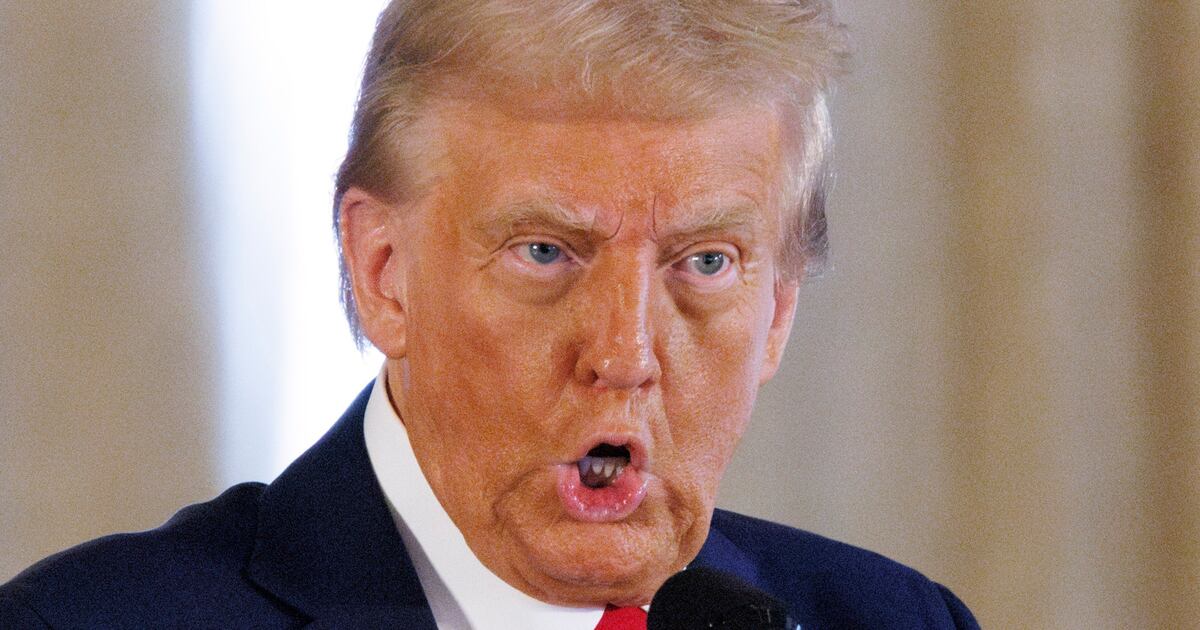
Daily Beast: Trump Threatens Countries Failing to Show Him ‘Respect’ in Deranged Late-Night Meltdown

The president makes vague threats while lashing out at overseas digital services taxes.

Tariff-loving Donald Trump has issued an unhinged threat against countries he claims don’t show the U.S. and major tech companies “respect.”

In a typical deranged late-night post on Truth Social, the MAGA president warned he would impose “substantial” new tariffs and block U.S. chip exports to countries that enforce digital taxes.

Trump argued that digital service taxes are designed to “harm, or discriminate” against American technology, and issued a sinister warning for if they are not dropped.

Trump has long railed against digital services taxes, including those imposed in Europe, which primarily hit U.S. tech giants, including Apple, Google, and Meta.

“They also, outrageously, give a complete pass to China’s largest Tech Companies. This must end, and end NOW,” Trump wrote.

“With this TRUTH, I put all Countries with Digital Taxes, Legislation, Rules, or Regulations, on notice that unless these discriminatory actions are removed,” he added. “America, and American Technology Companies, are neither the ‘piggy bank’ nor the ‘doormat’ of the World any longer. Show respect to America and our amazing Tech Companies or, consider the consequences! Thank you for your attention to this matter.”

While not mentioning any nation by name, his comments appear to be a swipe at the European Union, whose Digital Markets Act (DMA) designates tech behemoths as “gatekeepers” and seeks to ensure they do not have a monopoly on their respective markets or abuse their powers.

The president’s warning came shortly after the U.S. and EU issued a joint statement pledging to negotiate over “unjustified trade barriers” targeting U.S. tech companies and agreeing not to impose customs duties on electronic transmissions, Bloomberg reported.

In June, Canada also pulled plans to tax American tech companies’ operations in the country to appease Trump amid threats to impose higher tariffs on imports from its northern neighbor.

Trump blasted Canada’s proposed digital tax—which would have slapped a 3 percent levy on Canadian revenue above $20 million—as a “blatant attack.”

At the time, White House Press Secretary Karoline Leavitt said Canadian Prime Minister Mark Carney “caved” to Trump by dropping the tax, originally announced in 2020.

https://www.thedailybeast.com/donald-trump-threatens-countries-failing-to-show-him-respect-in-deranged-late-night-meltdown

Black Enterprise: Black Beauty Salons Hit Hard By Trump Tariffs: ‘We’re Impacted At Every Level’

Trump’s tariffs are taking a heavy toll on Black-owned beauty salons that rely on Chinese-made hair products.

Diann Valentine, 55, founder of Slayyy Hair, first felt the impact of tariffs when a 145% levy on Chinese imports hit, resulting in a $300,000 bill to clear 26,000 units of braiding hair at the Los Angeles port in May. Since then, she has raised the prices of her braiding hair and drawstring ponytail extensions by 20%. Valentine was also forced to lay off four employees and now works 16-hour days to keep her two Glow+Flow beauty supply stores in Inglewood and Hawthorne, California, running smoothly.

“To lose that kind of money at this stage has been devastating,” Valentine said.

“We’re being impacted at every level,” said Dajiah Blackshear-Calloway, 34, a salon owner based in Smyrna, Georgia. “I’m either having to eat that cost or pass that expense along to my clients, which affects their budgets and their pockets as well.”

Blackshear-Calloway’s salon, staffed by two stylists, offers a range of services from $50 natural hairstyles to $745 tape-in weave extensions. Her most popular services include $254 sew-in weaves and $125 quick weaves, where extensions are glued onto a stocking cap.

However, tariffs have driven up the cost of a package of hair imported from Vietnam from $190 in May to $290, while a bottle of hair glue from China jumped from $8 to $14.99 at her local supply store. To avoid passing these costs on to clients, Blackshear-Calloway now asks them to bring their own hair, making a quick weave $140 without hair, compared to $400 with hair provided.

Diann Valentine, 55, founder of Slayyy Hair, first felt the impact of tariffs when a 145% levy on Chinese imports hit, resulting in a $300,000 bill to clear 26,000 units of braiding hair at the Los Angeles port in May. Since then, she has raised the prices of her braiding hair and drawstring ponytail extensions by 20%. Valentine was also forced to lay off four employees and now works 16-hour days to keep her two Glow+Flow beauty supply stores in Inglewood and Hawthorne, California, running smoothly.

“To lose that kind of money at this stage has been devastating,” Valentine said.

Tariffs are hitting Black business owners particularly hard, including many salon owners. Andre Perry, a senior fellow at the Brookings Institution, notes that the wealth gap leaves Black entrepreneurs, especially those in low-margin industries like consumer goods or haircare services, in financially vulnerable positions, with tariffs further eroding their profits.

“Many Black entrepreneurs started off with less wealth,” Perry said.

Black businesses have endured for generations through innovation and resilience, and it will take that same spirit to navigate the challenges Americans now face due to Trump’s tariffs. Industry experts have been offering tips for small business owners affected by the tariffs, including communicating openly with customers, reassessing supply chains, streamlining operations to address inefficiencies, consulting a financial advisor, and exploring business credit lines.

Raw Story: Ex-general warns Trump using National Guard as ‘catnip’: ‘He needs to put on a show’

A retired American general tore into President Donald Trump and said his latest threats to send the National Guard into Democratic-run cities are merely a tactic to distract his base and the media, likening it to “catnip.”

Major General William Enyart joined MSNBC on Monday afternoon to discuss Illinois Gov. J.B. Pritzker’s (D) blistering speech, hitting back at Trump’s plans to send troops to Chicago.

“A barnburner of a speech from Illinois Gov. J.B. Pritzker, who told the people of Illinois in no uncertain terms that what Donald J. Trump plans to do in his city is, ‘unprecedented, illegal, unconstitutional, and un-American,’ urging him publicly with the city’s business, faith and elected officials, ‘Do not come to Chicago,'” noted host Nicolle Wallace.

She added that Pritzker made a “salient, indisputable fact” that 13 of the top 20 cities when it comes to homicide rates are led by Republicans. Additionally, eight Republican-led states have the top homicide rates.

Enyart said Pritzker made a “spot-on speech.”

“Trump desperately needs to cling on to power. And I think the reason that he is taking these actions is distraction, distraction, distraction,” he said.

Enyart then hit back at Trump’s claims with statistics of his own.

“The price of hamburger a year ago today: $5.35 a pound. Hamburger today: $6.98 a pound. That’s a 33% increase. Coffee $6.32 a year ago. Today, it’s $8.41 a pound, another 30-plus percent. Food prices have gone up every single month, but one, since Trump took office,” he noted.

Enyart called out Trump for vowing to drive food prices down.

“Yet another lie. He can’t afford to face truth. And that’s why he has to have distraction,” he railed.

Enyart called Trump’s use of the National Guard in Washington, D.C., and proposal to do the same in Chicago simply that.

“He is doing it in order to provide a distraction to his base and to, frankly, to most of the news media so they’ll chase that catnip,” he said, calling Trump’s tariffs a “failure,” along with his negotiations with Russian President Vladimir Putin.

“Corn prices have cratered. Corn prices are 40% down from what they were under the Biden administration,” he added.

Soybean prices for farmers, he added, are down more than 50% since Biden’s administration.

” China used to buy 60% of their soybeans from the United States farmers. Today? 20%. Brazil took those. Why? Trump’s tariffs. His policies are incredibly unpopular, and so he needs to put on a show. He is a mastermind at showmanship, and that’s what he is doing.”

See the video below or at the link here.

https://www.rawstory.com/trump-grocery-prices-2673917522

Slingshot News: ‘I Will Find Out’: Pam Bondi Exposes Her Incompetence, Admits She Has Not Secured Sensitive FBI Data In House Hearing

https://www.msn.com/en-us/lifestyle/relationships/i-will-find-out-pam-bondi-exposes-her-incompetence-admits-she-has-not-secured-sensitive-fbi-data-in-house-hearing/vi-AA1KRKzO

America Uncovered: What Trump’s Proposal Could Mean for the 14th Amendment

https://www.msn.com/en-us/news/politics/what-trump-s-proposal-could-mean-for-the-14th-amendment/vi-AA1HPtzp

Defense One: How Trump’s DC takeover could supercharge surveillance

The emergency declaration, combined with new tech, will give government broad new abilities to watch and monitor citizens.

President Trump’s declaration of a “crime emergency” in Washington, D.C., will further entwine the U.S. military—and its equipment and technology—in law-enforcement matters, and perhaps expose D.C. residents and visitors to unprecedented digital surveillance. 

Brushing aside statistics that show violent crime in D.C. at a 30-year low, Trump on Monday described a new level of coordination between D.C. National Guard units and federal law enforcement agencies, including the FBI, ICE, and and the newly federalized D.C. police force

“We will have full, seamless, integrated cooperation at all levels of law enforcement, and will deploy officers across the district with an overwhelming presence. You’ll have more police, and you’ll be so happy because you’re being safe,” he said at a White House press conference. 

Defense Secretary Pete Hegseth, standing beside Trump, promised close collaboration between the Pentagon and domestic authorities. “We will work alongside all DC police and federal law enforcement to ensure this city is safe.” 

What comes next? The June 2020 deployment of National Guard units to work alongside D.C. police offers a glimpse: citywide use of sophisticated intelligence-gathering technologies normally reserved for foreign war zones.

Some surveillance platforms will be relatively easy to spot, such as spy aircraft over D.C.’s closely guarded airspace. In 2020, authorities deployed an RC-26B, a military-intelligence aircraft, and MQ-9 Predator drones. The FBI contributed a Cessna 560 equipped with “dirtboxes”: devices that mimic cell towers to collect mobile data, long used by the U.S. military to track terrorist networks in the Middle East.

Other gear will be less obvious.The 2020 protests saw expanded use of Stingrays, another type of cellular interception device. Developed to enable the military to track militants in Iraq and Afghanistan, Stingrays were used by the U.S. Secret Service in 2020 and 2021 in ways that the DHS inspector general found broke the law and policies concerning privacy and warrants. Agency officials said “exigent” circumstances justified the illicit spying.

Now, with federal agencies and entities working with military personnel under declared-emergency circumstances, new gear could enter domestic use. And local officials or the civilian review boards that normally oversee police use of such technologies may lack the power to prevent or even monitor it. In 2021, the D.C. government ended a facial-recognition pilot program after police used it to identify a protester at Lafayette Square. But local prohibitions don’t apply to federalized or military forces. 

Next up: AI-powered surveillance 

How might new AI tools, and new White House measures to ease sharing across federal entities, enable surveillance targeting?

DHS and its sub-agencies already use AI. Some tools—such as monitoring trucks or cargo at the border for contraband, mapping human trafficking and drug networks, and watching the border—serve an obvious public-safety mission. Last year, DHS used AI and other tools to identify 311 victims of sexual exploitation and to arrest suspected perpetrators. They also helps DHS counter the flow of fentanyl; last October, the agency cited AI while reporting a 50 percent increase in seizures and an 8 percent increase in arrests.

TSA uses facial recognition across the country to match the faces and documents of airline passengers entering the United States in at least 26 airports, according to 2022 agency data. The accuracy has improved greatly in the past decade, and research suggests even better performance is possible: the National Institute of Standards and Technology has shown that some algorithms can achieve 99%-plus accuracy under ideal conditions. 

But conditions are not always ideal, and mistakes can be costly. “There have been public reports of seven instances of mistaken arrests associated with the use of facial recognition technology, almost all involving Black individuals. The collection and use of biometric data also poses privacy risks, especially when it involves personal information that people have shared in unrelated contexts,” noted a Justice Department report in December. 

On Monday, Trump promised that the increased federal activity would target “known gangs, drug dealers and criminal networks.” But network mapping—using digital information to identify who knows who and how—has other uses, and raises the risk of innocent people being misidentified. 

Last week, the ACLU filed a Freedom of Information Act request concerning the use of two software tools by D.C.’s Homeland Security and Emergency Management Agency. Called Cobwebs and Tangles, the tools can reveal sensitive information about any person with just a name or email address, according to internal documents cited in the filing.

Cobwebs shows how AI can wring new insights from existing data sources, especially when there are no rules to prohibit the gathering of large stores of data. Long before the capability existed to do it effectively, this idea was at the center of what, a decade ago, was called predictive policing

The concept has lost favor since the 2010s, but many law-enforcement agencies still pursue versions of it. Historically, the main obstacle has been too much data, fragmented across systems and structures. DHS has legal access to public video footage, social media posts, and border and airport entry records—but until recently, these datasets were difficult to analyze in real time, particularly within legal constraints.

That’s changing. The 2017 Modernizing Government Technology Act encouraged new software and cloud computing resources to help agencies use and share data more effectively, and in March, an executive order removed several barriers to interagency data sharing. The government has since awarded billions of dollars to private companies to improve access to internal data.

One of those companies is Palantir, whose work was characterized by the New York Times as an effort to compile a “master list” of data on U.S. citizens. The firm disputed that in a June 9 blog post: “Palantir is a software company and, in the context of our customer engagements, operates as a ‘data processor’—our software is used by customers to manage and make use of their data.”

In a 2019 article for the FBI training division, California sheriff Robert Davidson envisioned a scenario—now technologically feasible—in which AI analyzes body-camera imagery in real time: “Monitoring, facial recognition, gait analysis, weapons detection, and voice-stress analysis all would actively evaluate potential danger to the officer. After identification of a threat, the system could enact an automated response based on severity.”

The data DHS collects extends well beyond matching live images to photos in a database or detecting passengers’ emotional states. ICE’s Homeland Security Investigations unit, for instance, handles large volumes of multilingual email. DHS describes its email analytics program as using machine learning “for spam classification, translation, and entity extraction (such as names, organizations, or locations).”

Another DHS tool analyzes social-media posts to gather “open-source information on travelers who may be subject to further screening for potential violation of laws.” The tool can identify additional accounts and selectors, such as phone numbers or email addresses, according to DHS documentation.

Meanwhile, ICE’s operational scope has expanded. The White House has increased the agency’s authority to operate in hospitals and schools, collect employment data—including on non-imigrants, such as “sponsors” of unaccompanied minors—and impose higher penalties on individuals seen as “interfering” with ICE activities. Labor leaders say they’ve been targeted for their political activism. Protesters have been charged with assaulting ICE officers or employees. ICE has installed facial-recognition apps on officers’ phones, enabling on-the-spot identification of people protesting the agency’s tactics. DHS bulletins sent to local law enforcement encourage officers to consider a wide range of normal activity, such as filming police interactions, as potential precursors to violence.

Broad accessibility of even legally collected data raises concerns, especially in an era where AI tools can derive specific insights about people. But even before these developments, government watchdogs urged greater transparency around domestic AI use. A December report by the Government Accountability Office includes several open recommendations, mostly related to privacy protections and reporting transparency. The following month, DHS’s inspector general warned that the agency doesn’t have complete or well-resourced oversight frameworks. 

In June, Sen. Ed Markey, D-Mass., and several co-signers wrote to the Trump White House, “In addition to these concerning uses of sentiment analysis for law enforcement purposes, federal agencies have also shown interest in affective computing and deception detection technologies that purportedly infer individuals’ mental states from measures of their facial expressions, body language, or physiological activity.” 

The letter asks the GAO to investigate what DHS or Justice Department policies govern AI use and whether those are being followed. Markey’s office did not respond to a request for comment.

Writing for the American Immigration Council in May, Steven Hubbard, the group’s senior data scientist, noted that of DHS’ 105 AI applications, 27 are “rights-impacting.”

“These are cases that the OMB, under the Biden administration, identified as impacting an individual’s rights, liberty, privacy, access to equal opportunity, or ability to apply for government benefits and services,” Hubbard said.

The White House recently replaced Biden-era guidance on AI with new rules meant to accelerate AI deployment across the federal government. While the updated guidelines retain many safety guardrails, they do include some changes, including merging “privacy-impacting” and “safety-impacting” uses of AI into a single category: “high impact.”

The new rules also eliminate a requirement for agencies to notify people when AI tools might affect them—and to offer an opt-out.

Precedents for this kind of techno-surveillance expansion can be found in countries rarely deemed models for U.S. policy. China and Russia have greatly expanded surveillance and policing under the auspices of security. China operates an extensive camera network in public spaces and centralizes its data to enable rapid AI analysis. Russia has followed a similar path through its “Safe Cities” program, integrating data feeds from a vast surveillance network to spot and stop crime, protests, and dissent.

So far, the U.S. has spent less than these near-peers, as a percent of GDP, on surveillance tools, which are operated under a framework, however strained, of rule-of-law and rights protections that can mitigate the most draconian uses.

But the distinction between the United States and China and Russia is shrinking, Nathan Wessler, deputy director with the ACLU’s Speech, Privacy, and Technology Project, said in July. “There’s the real nightmare scenario, which is pervasive tracking of live or recorded video, something that, by and large, we have kept at bay in the United States. It’s the kind of thing that authoritarian regimes have invested in heavily.” 

Wessler noted that in May, the Washington Post reported that New Orleans authorities were applying facial recognition to live video feeds. “At that scale, that [threatens to] just erase our ability to go about our lives without being pervasively identified and tracked by the government.”
https://www.defenseone.com/threats/2025/08/how-trumps-dc-takeover-could-supercharge-surveillance/407376

Some Ojibwe signs, books could be removed as feds evaluate national parks

National Park Service employees had to report any signs or books that could be interpreted as anti-American.

Federal officials are reviewing whether to remove books and signs with historic references to the harsh treatment of Native Americans from Minnesota’s national park sites.

An executive order issued by President Donald Trump in March required employees at all national park sites to audit and report to the Department of the Interior any material that negatively portrayed Americans, past or present, by July 18.

In Minnesota, staff reported informational signs and books that referenced forced relocations, starvation and treaty violations of Native American tribes living in Minnesota and Wisconsin, including Ojibwe, Yankton Sioux and Dakota, according to groups that work with the parks and staffers who did not want to talk for attribution for fear of losing their jobs.

“That’s very worrisome,” said Chris Goepfert, the associate director of the National Parks Conservation Association.

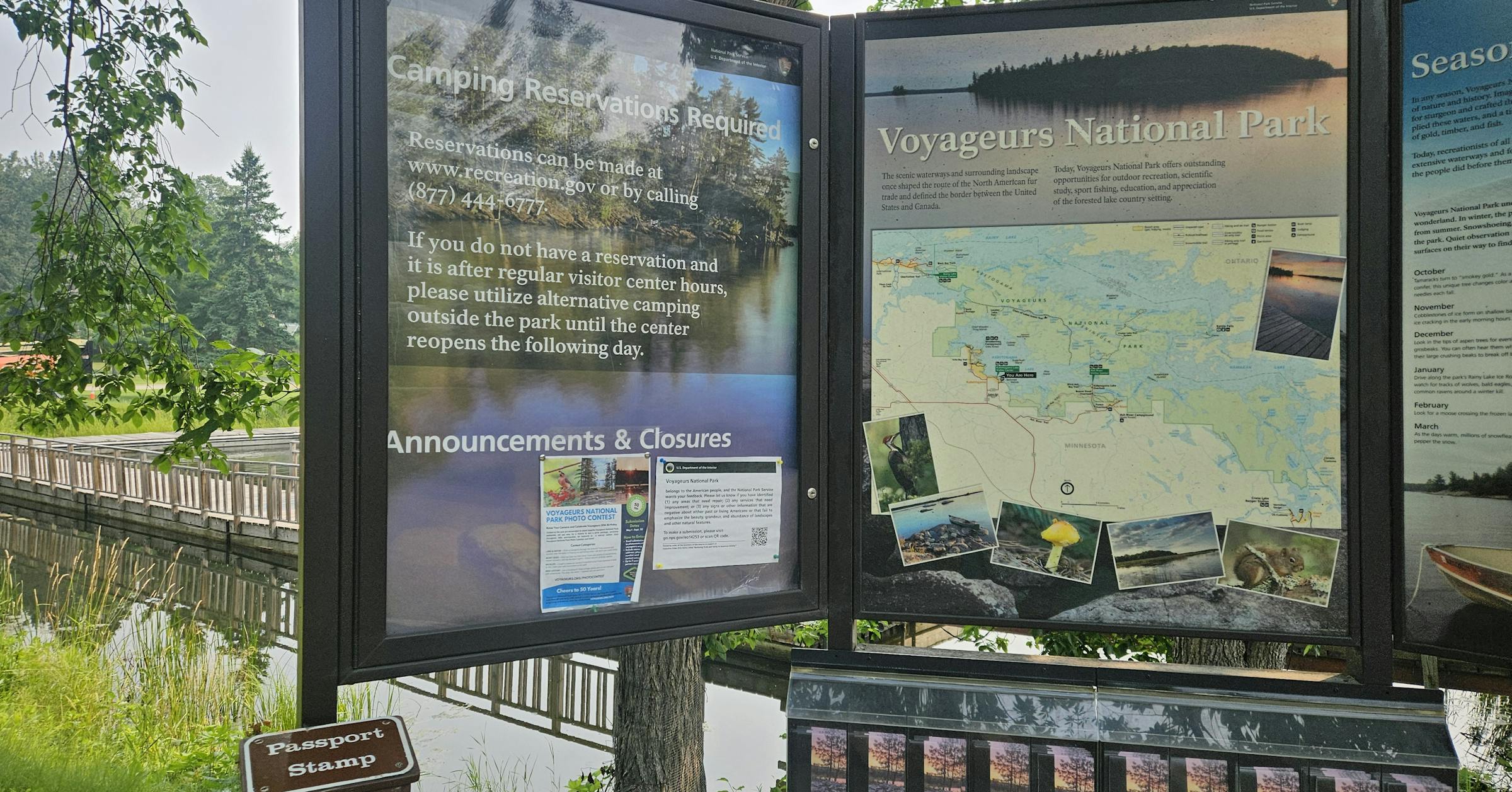
Goepfert was shocked last month when she stumbled across a sign at the visitors center at Voyageurs National Park in International Falls asking the public’s help in identifying anti-American material.

Similar signs were posted at other national park sites, including the Mississippi River and Recreation Area and Pipestone National Monument.

They asked visitors to alert the government “of any signs or other information that are negative about either past or living Americans” in support of Trump’s executive order called Restoring Truth and Sanity to American History.

Interior officials recently told park superintendents in a meeting that any reported materials deemed to be “inappropriate” must be covered up or removed by Sept. 18.

“Our national parks are about our history, and so for them to specifically target [and consider] removing some of our American stories, is[troubling]‚” Goepfert said.

The reported material is now under review, according to a statement on Monday from the National Park Service.

“As we carry out this directive, we are also manually reviewing and evaluating public feedback we’ve received,” the statement said. “This effort reinforces our commitment to telling the full and accurate story of our nation’s past and is not about rewriting our past.”

Tony Drews fears the possible removal of Ojibwe material.

“It’s horrible. … I don’t have enough vocabulary to properly express how this makes me feel. These are just huge steps backwards,” said the Ojibwe language teacher and founder of Nashke Native Games, a company that makes board games to teach children, plus park and museum staff the Ojibwe language.

The games are used at Voyageurs National Park and discussions are underway for their adoption at the Grand Portage National Monument.

Drews said he was inspired to teach children about their Ojibwe culture and language because of what happened to his grandmother.

“As a child, she was sent to [an Indian boarding school] and forced not to learn her language” and to give up her culture, he said.

“It feels like the momentum had been going well for our people, but this? It’s tragic,” he said, adding that he plans to reach out to U.S. Sen. Amy Klobuchar for help.

Librarians, historians and University of Minnesota data experts started a “Save our signs” campaign to document monuments, signs, books and websites to preserve any historic information that is removed. To date, the public has submitted to the campaign more than 3,000 photos nationwide, including 92 from Minnesota.

Nationwide, the lists submitted from parks to the Department of Interior for possible removal included scores of plaques and books referencing George Washington owning slaves and Franklin Roosevelt’s polio, according to the Washington Post. One book reported was “Wives, Slaves, and Servant Girls: Advertisements for Female Runaways in American Newspapers 1770-1783.”

Park employees in Minnesota and Wisconsin said they did not know what the Interior Department intended to do with the submitted lists or who would be evaluating their appropriateness.

At Voyageurs National Park in International Falls, employees who submitted three signs and 11 books to top officials only know that eventually “there’s going to be some sort of critique,” said Park Ranger Kate Severson.

“It’s bizarre, because all of our history books talk about people, and people are a mixed bag,“ she said. ”Most of our history is centered around the voyagers and the Ojibwe. And the Ojibwe have not been treated extremely well by American politicians.”

Because of this past treatment, several of the Voyageurs’ books include critiques of Minnesota politicians, which meant the staff had to report them, Severson said. They are now waiting to hear back whether they must remove them from shelves.

Ted Gostomski — a biologist at the research center in Ashland, Wis., who performs fish and wildlife studies for all of the national parks and Mississippi River and Recreation areas in Minnesota, Wisconsin and Michigan — said top park officials not only asked for employees’ and visitors’ reporting help, but were also scanning websites to look for potentially offensive language.

Gostomski, who had nothing to report at his research lab, said the exercise is confusing.

“You can’t rewrite history that way and you can’t be afraid to acknowledge and work to change things that happened in the past to make sure they don’t happen again,” he said.

Yet the Park Service said in its statement any material that disproportionately emphasizes negative aspects of U.S. history “without acknowledging broader context or national progress” can also misrepresent history.

The administration’s goal, the statement said, is to “foster honest, respectful storytelling that educates visitors while honoring the complexity of our nation’s shared journey.”

https://www.startribune.com/ojibwe-national-parks-voyageur-mississippi-pipestone-executive-order-evaluating-signs-books/601448172

Kansas City Star: Court Upholds Restraining Order in Blow to ICE

Los Angeles Mayor Karen Bass has criticized President Trump’s aggressive ICE raids, arguing they harm the city’s economy by spreading fear among immigrants. She notes significant business losses in Latino neighborhoods like Boyle Heights. Bass condemned the use of National Guard and Marines to quell protests, calling it excessive.

Earlier this month, a federal court upheld a restraining order against indiscriminate ICE arrests in Southern California. Bass joined a lawsuit to stop the raids, highlighting their impact on families, while adopting a bolder leadership approach amid recovery from January 2025 wildfires and her 2026 reelection campaign.

Bass said, “Let me just say that, because we are a city of immigrants, we have entire sectors of our economy that are dependent on immigrant labor. We have to get the fire areas rebuilt. We’re not going to get our city rebuilt without immigrant labor.”

Bass added, “And it’s not just the deportations, it’s the fear that sets in when raids occur, when people are snatched off the street. And I know you are aware that even people who are here legally, even people who are U.S. citizens, have been detained.”

Bass stated that “what I think we need is comprehensive immigration reform. I served in Congress for 12 years.” She stressed the importance of immigrant labor in post-crisis recovery and noted that ICE raid fears impact both undocumented residents and U.S. citizens.

,,,,

https://www.msn.com/en-us/news/us/court-upholds-restraining-order-in-blow-to-ice/ss-AA1Khr9r

Associated Press: Whitmer told Trump in private that Michigan auto jobs depend on a tariff change of course

Michigan Gov. Gretchen Whitmer met privately in the Oval Office with President Donald Trump to make a case he did not want to hear: the automotive industry he said he wants to save were being hurt by his tariffs.

The Democrat came with a slide deck to make her points in a visual presentation. Just getting the meeting Tuesday with the Republican president was an achievement for someone viewed as a contender for her party’s White House nomination in 2028.

Whitmer’s strategy for dealing with Trump highlights the conundrum for her and other Democratic leaders as they try to protect the interests of their states while voicing their opposition to his agenda. It’s a dynamic that Whitmer has navigated much differently from many other Democratic governors.

The fact that Whitmer had “an opening to make direct appeals” in private to Trump was unique in this political moment, said Matt Grossman, a Michigan State University politics professor.

It was her third meeting with Trump at the White House since he took office in January. This one, however, was far less public than the time in April when Whitmer was unwittingly part of an impromptu news conference that embarrassed her so much she covered her face with a folder.

On Tuesday, she told the president that the economic damage from the tariffs could be severe in Michigan, a state that helped deliver him the White House in 2024. Whitmer also brought up federal support for recovery efforts after an ice storm and sought to delay changes to Medicaid.

Trump offered no specific commitments, according to people familiar with the private conversation who were not authorized to discuss it publicly and spoke only on condition of anonymity to describe it.

Whitmer is hardly the only one sounding the warning of the potentially damaging consequences, including factory job losses, lower profits and coming price increases, of the import taxes that Trump has said will be the economic salvation for American manufacturing.

And the odds that King Donald will actually give due consideration to intelligent advice from a Democrat — not to mention a female Democrat — are … zero?

https://apnews.com/article/trump-whitmer-michigan-tariffs-auto-industry-c14e8791aa880643bddcdf9ea5372dca

Fresno Bee: Some Californians carry passports in fear of ICE. ‘We’re being racially profiled’

With the Trump administration’s directive that federal immigration agents arrest 3,000 people per day as part of a massive deportation campaign, some U.S. citizens are taking the extraordinary step of carrying their passports to avoid being profiled and detained.

For some Fresno residents, it’s an obvious choice. They say it’s the simplest way to prove citizenship in case of encounters with U.S. Customs and Immigration Enforcement agents.

For others, the decision is rooted in fear and distrust of the federal government and law enforcement due to being erroneously profiled for being Latino in the past.

“This is the first time I renewed my passport not for travel but for proof of citizenship,” said Fresno resident Paul Liu.

There’s growing concern about how ICE is ensnaring citizens in its deportation operations. A 2021 report from the U.S. Government Accountability Office found that, between 2015 to 2020, ICE arrested 674 U.S. citizens, detained 121 and deported an estimated 70 citizens.

Liu’s passport expired in January 2024. He renewed in February one month after Trump took office.

Liu, 52, said his decision is inspired by his family’s experience in China. His great-uncle sympathized with the Nationalist Party that opposed the Communist Party of China. As far as Liu’s family knows, his uncle was disappeared by the government and wasn’t seen until 30 years later by a sister who recognized him working on a chain gang in the city.

“I see what an oppressive regime has done to our family,” he said. “I’m just convinced that now, the onus is on anyone who’s not white, male and MAGA to prove they belong in this country.”

The REAL ID or a valid passport is required for domestic travel as of May, but American citizens are not otherwise required to carry a national form of identification.

To avoid potential detention and arrest, immigration lawyer Olga Grosh of Pasifika Immigration Law Group, LLP said people can consider having evidence of valid immigration status handy, or a copy of these documents in your wallet if concerned about about loss or theft.

“But does a citizen have to live in fear of being kidnapped by their own government?” Grosh said. “There has been a shift from it being the government burden to show to a judge that a person should be detained under the law, to citizens proving that they shouldn’t be detained by unidentified agents.”

Click the links below to read the rest of the article:

https://www.msn.com/en-us/news/us/some-californians-carry-passports-in-fear-of-ice-we-re-being-racially-profiled/ar-AA1JPvLq