Newsweek: Trump administration suffers double legal blow within hours

The Trump administration suffered two legal defeats within hours on Friday.

A judge in California ordered the release of a Syrian national it has been seeking to deport while a federal Rhode Island judge blocked the imposition of new conditions on domestic violence programs as part of the president’s campaign against “gender ideology.”

Details of both cases were shared on X by Kyle Cheney, senior legal affairs reporter for Politico.

Newsweek contacted the Department of Homeland Security and the Department of Justice for comment on Saturday outside of regular office hours via email and press inquiry form respectively.

Why It Matters

With Republicans controlling both chambers of Congress as well as the White House the courts have emerged as one of the main impediments to Trump administration policy.

The administration has suffered a number of prominent legal defeats including courts striking down punitive measures introduced by Trump against law firms involved in proceedings against him, blocking a bid to strip thousands of Haitian migrants of legal protection and removing sanctions aimed at International Criminal Court employees.

Release of Salam Maklad

U.S. District Court Judge Jennifer Thurston, of the Eastern District of California, on Friday instructed the release of Salam Maklad, a Syrian from the Druze religious minority who arrived in the United States in 2002 without valid entry documents and claimed asylum, according to court documents seen by Newsweek.

Maklad went on to marry a man who was granted asylum, which her legal team argued made her eligible for legal immigration status.

On July 9, Maklad was detained by Immigration and Customs Enforcement (ICE) officers after arriving for what she believed was a routine “check-in” meeting and subsequently placed in “expedited removal proceedings” seeking to deport her from the U.S.

Thurston noted that Maklad had no criminal history and wasn’t considered a flight risk, and concluded that “the balance of the equities and public interest weigh in favor of Ms. Maklad.” Consequently she ordered her release from custody and said authorities are blocked from rearresting her “absent compliance with constitutional protections, which
include at a minimum, pre-deprivation notice—describing the change of circumstances necessitating her arrest—and detention, and a timely bond hearing.”

Domestic Violence Funding

Friday also saw Senior District Judge William Smith of Rhode Island rule the Trump administration couldn’t impose fresh conditions on funds granted by the Violence Against Women Act due to the president’s Executive Order 14168 titled “Defending Women from Gender Ideology Extremism and Restoring Biological Truth to the Federal Government.”

This funding is distributed by the Department of Justice’s Office on Violence Against Women.

Trump’s order stated that sex is a person’s “immutable biological classification as male or female,” and that the federal government should “prioritize investigations and litigation to enforce the rights and freedoms” associated with this position.

The Office on Violence Against Women updated its policy on what constitutes “out of scope activities,” and therefore should not be funded by its grants, after this order was issued in “approximately May 2025,” according to the court filing.

This added spending on “inculcating or promoting gender ideology as defined
in Executive Order 14168″ to the prohibited list.

The case was brought by a coalition of 17 nonprofit groups which argued adhering to President Trump’s position on gender was impeding their ability to assist victims of domestic violence.

Judge Smith backed the coalition’s position concluding that the fresh requirements imposed by the Trump administration “could result in the disruption” of services for victims of domestic and sexual violence.

What People Are Saying

In the California case Judge Thurston ruled: “Respondents are PERMANENTLY ENJOINED AND RESTRAINED from re[1]arresting or re-detaining Ms. Maklad absent compliance with constitutional protections, which include at a minimum, pre-deprivation notice—describing the change of circumstances necessitating her arrest—and detention, and a timely bond hearing.

“At any such hearing, the Government SHALL bear the burden of establishing, by clear and convincing evidence, that Ms. Maklad poses a danger to the community or a risk of flight, and Ms. Maklad SHALL be allowed to have her counsel present.”

In his ruling Judge Smith wrote: “On the one hand, if the Court does not grant preliminary relief, then the Coalitions will face real and immediate irreparable harm from the challenged conditions, conditions which the Court has already concluded likely violate the APA.

“This could result in the disruption of important and, in some cases, life[1]saving services to victims of sexual assault and domestic violence. On the other hand, if the Court grants preliminary relief, then the Office will simply have to consider grant applications and award funding as it normally does.”

What’s Next

It remains to be seen whether the Trump’s administration will seek to appeal either of Friday’s rulings.

https://www.newsweek.com/trump-administration-suffers-double-legal-blow-within-hours-2111192
Independent: Trump administration tried to reopen deportation proceedings for man who was long dead: ‘They’re very negligent’

Government rushes to reopen years-old removal proceedings to boost Trump’s mass deportation agenda

Thousands of immigrants who have legally lived and worked in the United States for years have assumed they would be protected against their removal from the country after their cases were frozen.

But the Trump administration is stripping immigrants of their legal status and reopening removal proceedings as the Department of Homeland Security expands its mass deportation machine.

Homeland Security isn’t even checking to see whether these immigrants targeted for deportation are even alive, let alone legally protected from removal, according to California immigration attorneys speaking to The Los Angeles Times.

An immigration judge had closed removal proceedings against construction worker Helario Romero Arciniega, who was severely beaten with a metal sprinkler head and qualified for a special visa for victims of crime.

Earlier this year, the government reopened removal proceedings against him. He died in January, according to the LA County Coroner’s Office.

“They don’t do their homework,” immigration attorney Patricia Corrales told the newspaper. “They’re very negligent in the manner in which they’re handling these motions to re-calendar.”

Corrales, a former Immigration and Naturalization Service and Homeland Security attorney, told The Independent that the government’s recent motions to recalendar removal proceedings that were administratively closed — and not active — are “boilerplate motions” and “DHS doesn’t do their homework” and are “lazy or negligent in the information they provide to the court.”

“My client was in removal proceedings before he passed away. He was alive when his removal proceedings were administratively closed,” she added.

DHS filed a motion to recalendar on July 10 and “failed to mention an important detail,” she told The Independent.

“So, DHS was negligent in failing to even do some basic research to determine whether my client was alive or moved or anything,” she said.

In another case, Adan Rico, a new father studying to be an HVAC technician, said he had no idea the government restarted deportation proceedings against him.

His original lawyer had died, and “if it wasn’t for his daughter calling, I would have never found out my case was reopened,” Rico told The LA Times. “The Department of Homeland Security never sent me anything.”

A statement from Homeland Security assistant secretary Tricia McLaughlin said Donald Trump’s administration is “once again implementing the rule of law” and accused former President Joe Biden of indefinitely delaying cases that left “criminals” stay in the country illegally.

“Now, President Trump and Secretary Noem are following the law and resuming these illegal aliens’ removal proceedings and ensuring their cases are heard by a judge,” she said in a statement shared with The Independent.

Rico, however, is among immigrants with removal protections under Deferred Action for Childhood Arrivals, which doesn’t come up for renewal until 2027, according to Corrales.

The Trump administration has effectively “de-legalized” more than 1 million immigrants since January.

Thousands of people who are following immigration law — including those showing up for their court-ordered Immigration and Customs Enforcement check-ins, immigration court hearings and U.S. Customs and Immigration Services appointments — have become easy targets for arrests.

Unlike federal district courts, immigration court judges operate under the direction of the attorney general’s office.

When immigrants have appeared for their hearings, Homeland Security attorneys have moved for the cases to be dismissed, while the Executive Office for Immigration Review at the Department of Justice has issued guidance to judges to grant those motions on the spot.

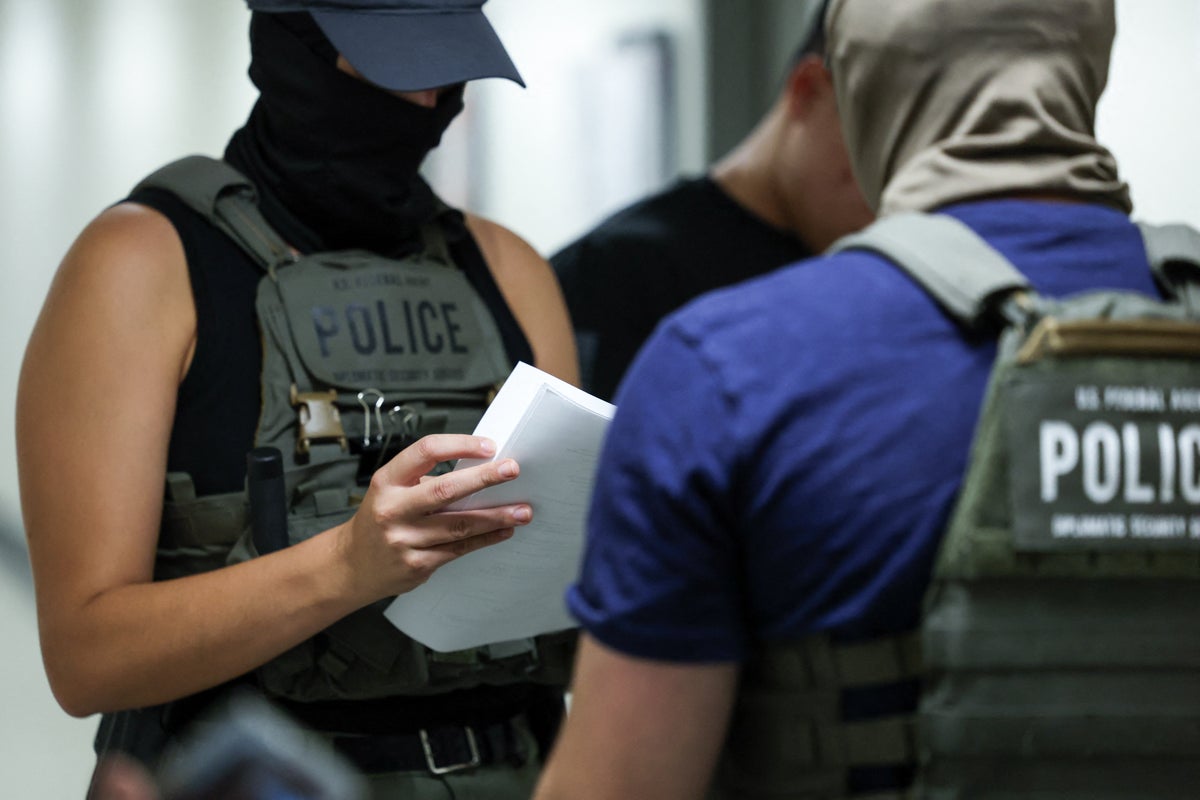
Those quick dismissals mean immigrants can then be subject to removal, leading to scenes of masked ICE agents dragging people out of courtrooms across the country.

Those arrests have been condemned by immigrants’ rights groups and attorneys as a “corruption” of the courts, “transforming them from forums of justice into cogs in a mass deportation apparatus,” American Immigration Lawyers Association president Kelli Stump said earlier this year.

“The expansion of expedited removal strips more people of their right to a hearing before a judge — as our laws promise,” she added.

In April, Sirce E. Owen, acting director of the Executive Office for Immigration Review, issued a memo calling the suspension of removal proceedings “de facto amnesty program with benefits” because immigrants can still have authorization and deportation protections.

Owen stated that, as of April, roughly 379,000 cases were still administratively closed in immigration courts, adding to the system’s backlog of 4 million cases.

A spokesperson for the Executive Office for Immigration Review confirmed to The Independent that immigration courts must first receive the underlying initial motion before accepting a response to that motion.

Immigration attorney Edgardo Quintanilla told The LA Times that he has received 40 cases, some dating back to the 2010s. “There is always the fear that they may be arrested when they go to the court,” he said. “With everything going on, it is a reasonable fear.”

Mariela Caravetta told the newspaper that roughly 30 clients have been targeted with new motions from the government reopening their cases in the last month, some of which have been frozen for a decade.

By law, she has only 10 days to reply, forcing her to try to track down clients who have since moved.

“People aren’t getting due process,” Caravetta said. “It’s very unfair to the client because these cases have been sleeping for 10 years.”

The Independent is the world’s most free-thinking news brand, providing global news, commentary and analysis for the independently-minded. We have grown a huge, global readership of independently minded individuals, who value our trusted voice and commitment to positive change. Our mission, making change happen, has never been as important as it is today.

https://www.the-independent.com/news/world/americas/us-politics/trump-immigration-cases-dead-ice-b2803051.html

LA Times: Westlake Home Depot raided again, reigniting fears of more sweeps despite judge’s order to stop

After weeks of relative quiet, Border Patrol agents raided a Home Depot in Westlake on Wednesday as a top federal agent warned, “We’re not leaving,” and posted images of half a dozen border agents running from a Penske truck through the parking lot.

As many as 16 immigrants were reported rounded up and arrested in what U.S. Border Patrol Sector Chief Greg Bovino called “Operation Trojan Horse.” The early morning raids revived fears of more widespread sweeps that organizers had hoped would ease with a federal judge’s order, affirmed by a 9th Circuit Court of Appeals panel, that immigration officials cannot racially profile people or use roving patrols to target immigrants.

“For those who thought Immigration enforcement had stopped in Southern California, think again,” acting U.S. attorney Bill Essayli posted on X, shortly after the raid. “The enforcement of federal law is not negotiable and there are no sanctuaries from the reach of the federal government.”

A day laborer, who identified himself as Ceasar, said around 6:45 a.m. a yellow Penske truck pulled up to the laborers who had gathered in the parking lot. The driver told them in Spanish he was looking for workers.

Several of the men gathered around the truck and then someone, it was unclear who to him, rolled up the back of the truck. Masked agents, one wearing a cowboy hat, jumped out and started chasing people. People scattered.

“This is the worst feeling ever,” said Ceasar, who has been going to the home improvement store to pick up work for several years.

Video on social media captured the moment the back of the rental truck opened. When Penske Truck Rental was asked about it, they said they were aware of the incident.

“The company was not made aware that its trucks would be used in today’s operation and did not authorize this,” said Penske spokesman Randolph P. Ryerson. “Penske will reach out to DHS and reinforce its policy to avoid improper use of its vehicles in the future.

He added: “Penske strictly prohibits the transportation of people in the cargo area of its vehicles under any circumstances,” the statement said.

One worker who escaped was still shaken by the experience an hour later. He identified himself as Raul, and said he saw at least eight people get arrested.

“That’s one of their cars,” he said pointing to a silver Toyota sedan.

The Home Depot had been one of the scene of the first raids in June that kicked off a more than month of operations in Southern California in which civil rights lawyers say federal agents indiscriminately arrested immigrants. The raids gutted businesses, spread fear and tore apart families.

On July 11, a federal judge temporarily blocked federal agents from using racial profiling to carry out indiscriminate arrests after the ACLU, Public Counsel, other groups and private attorneys sued over the practices saying that the region had been “under seige.”

Department of Justice attorneys argued the order hinders them from carrying federal immigration enforcement, but the 9th U.S. Circuit Court of Appeal upheld the order.

For the past weeks since the restraining order kicked in in early July, Bovino has shared photos of arrests of undocumented immigrants, stating that some had active arrest warrants. With others, he referenced a lengthy criminal history, marking the arrests as more targeted than they had been prior.

But organizers say a similar operation to the raid unfolded on Monday at a Home Depot in Hollywood that was the site of a massive raid in June. That operation also sparked concerns about violations of the TRO.

Maegan Ortiz, the executive director of the nonprofit group Instituto de Educación Popular del Sur de California, known as IDEPSCA, said they began receiving word about an immigration operation at the Home Depot in Hollywood around 6:50 a.m. on Monday.

https://www.msn.com/en-us/news/us/ar-AA1K1YKo

LA Times: Contributor: Under Trump, U.S. returns to treating violence against women as a ‘private matter’

The U.S. has been waffling for decades over whether women have a right to refugee protection when fleeing gender-based violence. Under different administrations, the Department of Justice has established and reversed precedents, issued and repealed rulings. But the latest flip-flop by the Trump administration is not just another toggle between rules.

In July, the Trump administration’s high court of immigration, the Board of Immigration Appeals, issued a deeply troubling decision. The ruling held that a “particular social group” — one of the five grounds for refugee protection — cannot be defined by gender, or by gender combined with nationality. The ruling, in a case known as Matter of K-E-S-G-, is binding on all adjudicators across the country.

The legal reasoning is both unpersuasive and alarming. It seeks to return refugee law to an era when violence against women was dismissed as a private matter, not of concern to governments or human rights institutions. It is part of a broader, ongoing assault by the Trump administration on women’s rights and immigrant rights — in this case, attempting to turn back history to 1992.

It was in 1993, at the Vienna Conference on Human Rights, when the catchphrase “women’s rights are human rights” gained global prominence. This was a response to the long-standing focus on the violation of civil and political rights by governments, while much of the violence against women was committed by nonstate actors. Women and girls fleeing gender-based violence were considered outside the bounds of protection. But the Vienna Conference marked a turning point, leading to transformative change in how governments and international bodies addressed gender-based violence — because much of the violence in this world is targeted at women. Laws and policies were adopted worldwide to advance women’s rights, including for those seeking refugee protection.

Under international and U.S. law, a refugee is someone with a well-founded fear of persecution linked to that person’s “race, religion, nationality, membership in a particular social group, or political opinion,” which are commonly referred to as the protected grounds. Gender is not explicitly listed, and as a result, women fleeing gender-based forms of persecution, such as honor killings, female genital cutting, sexual slavery or domestic violence, were often denied protection, with their risk wrongly categorized as “personal” or “private,” and not connected to one of the protected grounds.

To address the misconception that women are outside the ambit of refugee protection, beginning in 1985 the United Nations High Commissioner for Refugees issued a series of guidance documents explaining that although “gender” is not listed as a protected ground, women could often be considered a “particular social group” within a country. The commissioner called on countries that were parties to the international refugee treaty — the 1951 Refugee Convention and its 1967 Protocol — to issue guidance for their adjudicators to recognize the ways in which gender-based claims could meet the refugee definition.

The United States was among the first to respond to the call. In 1995, the Department of Justice issued a document instructing asylum officers to consider the evolving understanding of women’s rights as human rights. The following year, the Board of Immigration Appeals issued a watershed decision, granting asylum to a young woman fleeing genital cutting. The court recognized that claims of gender-based violence could qualify under the “particular social group” category.

Yet the path forward was anything but smooth. In 1999, the same court denied asylum to a Guatemalan woman who endured a decade of brutal beatings and death threats from her husband, while the state refused to intervene. Atty. Gen. Janet Reno found the decision to be so out of step with U.S. policy that she used her authority to vacate it. And so women remained eligible to be considered a “particular social group” when seeking refuge in the U.S. The view was affirmed by a 2014 case recognizing that women fleeing domestic violence could indeed qualify for asylum.

But that progress was short-lived. In 2018, Atty. Gen. Jeff Sessions took jurisdiction over the case of Anabel, a Salvadoran survivor of domestic violence to whom the top U.S. immigration court had granted asylum.

Sessions ruled that domestic violence is an act of personal or private violence, rather than persecution on account of a protected ground. This characterization of the violence as personal or private was in direct repudiation of the principle that women’s rights are human rights, deserving of human rights remedies, such as asylum.

The Biden administration sought to undo the damage. In 2021, Atty. Gen. Merrick Garland vacated that ruling and reinstated the 2014 precedent, restoring a measure of protection for gender claims.

Now comes the recent ruling from the immigration court under the Trump administration. Going beyond Sessions’ determination that gender violence is personal, the court is striking at the heart of the legal framework itself by barring gender or gender-plus-nationality as a valid way to define a social group. This erects an even higher barrier for women and girls fleeing persecution. It is a transparent attempt to roll back decades of legal progress and return us to a time when women’s suffering was invisible in refugee law.

The implications are profound. This ruling will make it far more difficult for women and girls to win asylum, even though their claims often involve some of the most egregious human rights violations. But it does not foreclose all claims — each must still be decided on its own facts — and there is no doubt the precedent will be challenged in federal courts across the country.

Another reversal is now sorely needed, to get the struggle for gender equality moving in the right direction again. Our refugee laws should protect women, because women should not be subject to gender-based violence. That is, in fact, one of our human rights.

https://www.latimes.com/opinion/story/2025-08-03/womens-rights-refugee-gender-human-rights

Raw Story: DOJ scrambling away from Stephen Miller’s comments on mass immigrant arrests: report

Department of Justice attorneys are attempting to put some distance between themselves and demands from Donald Trump’s White House Deputy Chief of Staff Stephen Miller for ICE agents to come up with 3,000 immigrant arrests per day.

In May, Miller told Fox News personality Sean Hannity, “Under President Trump’s leadership, we are looking to set a goal of a minimum of 3,000 arrests for ICE every day and President Trump is going to keep pushing to get that number up higher each and every day,”

According to a report from Politico’s Kyle Cheney and Josh Gerstein, DOJ attorney Yaakov Roth was put on the spot over that number and told a judge the number came from “anonymous reports in the newspapers.”

The report notes that there is a growing “gulf” between what the White House wants and what DOJ can defend before skeptical judges who have serious questions about the sweeps that have all the appearances of racial profiling.

Politico is reporting, “The existence of the target has created particular complications in the case challenging the immigration sweeps in Los Angeles. The administration is fighting an order that a federal judge issued last month prohibiting ICE from conducting ‘roving’ immigration arrests based on broad criteria such as presence at a home improvement store or car wash.”

The report notes that, on Monday, Roth battled with judges but did concede, “… that such a quota, if it existed, could support claims that some arrests did not meet the legal standard.”

“In this instance, the chasm may be undermining the DOJ’s already strained credibility with judges,” Politico is reporting.

https://www.rawstory.com/stephen-miller-2673853490

Explicame: Trump policies forced to pass thanks to Supreme Court

A recent series of Supreme Court decisions has significantly reshaped the balance of power in the U.S. government, drawing attention from legal scholars.

The U.S. Supreme Court has increasingly played a pivotal role in enabling the Trump administration’s policy objectives, marking a pronounced shift in the dynamics between the executive and judicial branches. Through a series of recent rulings, the Court has upheld key Trump-era administrative actions, reinforcing executive authority and raising concerns about the long-term implications for constitutional checks and balances.

Over just six months in office, the Trump administration’s Department of Justice filed more than 20 emergency requests with the Supreme Court, surpassing the 19 total emergency filings submitted during the entirety of Joe Biden’s presidency. This aggressive use of the emergency docket has yielded significant policy victories and underlined a broader transformation in how executive power is being exercised, and supported, by the judiciary.

Among the cases that the Court has ruled in favor of the Trump administration are Trump v. CASA, Trump v. AFGE, McMahon v. New York, and high-profile dismissals involving the Consumer Product Safety Commission and the Federal Trade Commission. These rulings have allowed the administration to fast-track deportations, eliminate certain migrant protections, freeze federal education grants, and access Social Security data, among other sweeping policy shifts.

In addition to these substantive decisions, the Supreme Court has moved to limit the ability of lower-court judges to issue nationwide injunctions that could block presidential actions. Critics argue this undermines a core function of judicial oversight. Justice Ketanji Brown Jackson, dissenting in one of the related cases, warned that curtailing universal injunctions could “threaten the rule of law.”

Chief Justice John Roberts has publicly emphasized the importance of judicial independence, rejecting the notion that disagreement with judicial decisions justifies impeachment. However, his leadership has also reflected a broader willingness to defer to executive authority in cases with broad constitutional implications.

Legal observers point to a trend: vague rulings, expedited decisions on the shadow docket, and a lack of clear legal reasoning have made it harder to track the boundaries of presidential power. Critics warn that this ambiguity may create the perception that the president can unilaterally restructure federal agencies, an alarming precedent for those who view judicial review as a safeguard against executive overreach.

As the Supreme Court continues to weigh in on high-stakes policy issues, the alignment between the bench and the executive branch under Trump’s leadership has redefined the limits of presidential authority. The consequences of this realignment are likely to shape American governance well beyond the current administration.

https://www.msn.com/en-us/news/politics/trump-policies-forced-to-pass-thanks-to-supreme-court/ar-AA1JNnKh

MSNBC: Pam [Bimbo #3] Bondi’s cynical, misleading attack on Judge Boasberg

Another crack in the foundation of American democracy.

Earlier this week, the Justice Department escalated its fight with the judiciary by filing an ethics complaint against Judge James Boasberg, the chief U.S. district judge in Washington, D.C. Boasberg is overseeing the case challenging the Trump administration’s deportation of alleged Venezuelan gang members to a Salvadoran prison without due process. The new complaint, signed by Attorney General Pam [Bimbo #3] Bondi’s chief of staff, accuses Boasberg of making improper comments about President Donald Trump.

Only those wearing MAGA-tinted glasses could fail to see this complaint for what it is: another brazen attack on the rule of law and the constitutional separation of powers, and another crack in the foundation of American democracy.

The controversy began March 15, when five Venezuelans sued Trump and other administration officials to block their imminent deportation under a 2025 presidential proclamation invoking the Alien Enemies Act. That 1798 law allows the removal of foreign citizens when there is a “declared war … or any invasion or predatory incursion” by a foreign nation against the United States. The plaintiffs were among hundreds being deported to a country other than their homeland. They were not given an opportunity to challenge the legality of their deportation, or even to contest the government’s allegations that they were gang members. Comparing the situation to a Kafka-esque nightmare, Boasberg ordered the administration to stop the deportations.

In April, the case went to the Supreme Court, which ruled for the administration on a legal technicality regarding the proper mechanism and jurisdiction for the suit. At the same time, the court unanimously affirmed that those facing deportation must be allowed to bring a legal challenge before removal. The case was sent back to Boasberg and remains ongoing.

Shortly after the Supreme Court’s ruling, Boasberg also found that the government had likely committed criminal contempt of court by willfully disobeying his order to stop deportations. He offered the government a chance to correct its contempt before referring the case for prosecution, but in April a three-judge panel from the D.C. appellate court paused the contempt proceedings without addressing the merits. Curiously, the pause has lasted for months, leaving the contempt action in limbo.

Then came Monday. The Justice Department formally accused Boasberg of committing misconduct during a national judicial conference held March 11 — before the deportation case began. The complaint alleges Boasberg “attempted to improperly influence Chief Justice [John] Roberts and roughly two dozen other federal judges” by expressing “his belief that the Trump Administration would ‘disregard rulings of federal courts’ and trigger ‘a constitutional crisis.’” In the AEA case, then, Boasberg “began acting on his preconceived belief that the Trump Administration would not follow court orders.” The DOJ argues that Boasberg’s “words and deeds” harmed “public confidence in the integrity and impartiality of the judiciary.”

To begin with, the DOJ’s complaint is misleading: The memo it cites, summarizing the conference, says Boasberg “raised his colleagues’ concerns,” not his own. But no matter who raised the concerns, they would be right on the mark. Trump’s record of contempt for the judiciary is well established. Throughout his first term, he repeatedly criticized judges who ruled against the administration. While out of office, Trump repeatedly leveled personal attacks against not only the judges presiding over his criminal and civil cases, but even court staff and their family members. And Trump specifically called for Boasberg’s impeachment in March after the judge ordered a temporary pause in deportations.

Although Trump has publicly said that he would follow court orders, his administration’s track record on respecting judicial authority suggests otherwise. For example, in early July, the Justice Department filed an unprecedented lawsuit against the entire bench of federal judges in Maryland, challenging an administrative order issued by their chief judge regarding deportation cases. Disturbingly, there is also evidence that Emil Bove, whom the Senate confirmed Tuesday to an appellate judgeship, told DOJ prosecutors that, if necessary, they should ignore court orders that stop deportations.

Given this track record, for the Trump administration to accuse Boasberg of undermining public confidence in the judiciary is the pinnacle of hypocrisy. In truth, the complaint against Boasberg is an obvious stunt. The administration is following the old legal adage: When the facts and the law are against you, “pound the table and yell like hell.”

No matter where this complaint goes from here, it is likely to have a chilling effect on judicial independence. Judges routinely discuss their constitutional approach or emerging legal trends in public, including during Senate confirmation hearings. This complaint puts a target on the backs of judges who speak out against executive overreach or comment on other broad legal issues that could be perceived as contrary to administration policy.

It will threaten judicial independence, undermine judicial legitimacy, and ultimately show that, for this administration, legal authority depends on political loyalty rather than adherence to the rule of law.

The justices of the Supreme Court appear to at least understand this in principle. Speaking at a judicial ceremony in May, Chief Justice John Roberts emphasized judicial independence is “crucial” to “check the excesses of the Congress or the executive.” Against the backdrop of Trump’s attacks on the federal judiciary, Roberts reiterated the familiar simile that judges are like umpires, responsible for calling balls and strikes fairly and impartially.

It’s less clear whether Roberts and his colleagues are prepared to fight for that ideal. After all, when a manager’s antics — like kicking dirt at the umpire’s feet or screaming in his face — begin to undermine the integrity of the game itself, eventually even the most restrained umpire must be prepared to eject him. Without that implicit threat, the game will collapse under the bullying of any manager who is unwilling to follow the rules everyone else plays by.

No one should tolerate that: not in a sporting event and certainly not in an arena when our nation and democracy are at stake.

https://www.msnbc.com/opinion/msnbc-opinion/justice-department-pam-bondi-judge-boasberg-rcna222067

Bradenton Herald: Trump Suffers Legal Blow — Judge Sides with Blue State

District Judge Lindsay Jenkins has dismissed a lawsuit from the Trump administration regarding sanctuary policies in Illinois and Chicago, affirming that local governments have retained the right to refuse cooperation with federal immigration enforcement under the Tenth Amendment. The ruling marks a major setback for the administration’s efforts to challenge state and city-level protections for undocumented immigrants. It upholds laws such as Chicago’s Welcoming City Ordinance, reinforcing local authority in guiding immigration-related policies.

The Trump administration had sued sanctuary cities in California and New York. The Department of Justice (DOJ) targeted laws such as Illinois’ Way Forward Act and Chicago’s Welcoming City Ordinance.

The court rejected DOJ claims that state laws violated federal authority and dismissed Illinois Gov. JB Pritzker from the case. Meanwhile, some local governments like Louisville have expressed a willingness to work with federal agencies.

Chicago Mayor Brandon Johnson and Pritzker praised the ruling, claiming it upholds local laws that protect public safety and resist harmful immigration policies.

Pritzker wrote, “Illinois just beat the Trump Administration in federal court.”

Johnson stated, “This ruling affirms what we have long known: that Chicago’s Welcoming City Ordinance is lawful and supports public safety. The City cannot be compelled to cooperate with the Trump Administration’s reckless and inhumane immigration agenda.”

https://www.msn.com/en-us/news/politics/trump-suffers-legal-blow-judge-sides-with-blue-state/ss-AA1JFoTb

CNBC: Trump was told his name was in Jeffrey Epstein files before DOJ withheld documents: WSJ

  • President Donald Trump was told in May by Attorney General Pam Bondi that his name appeared multiple times in Department of Justice documents about sex offender Jeffrey Epstein, The Wall Street Journal reported.
  • Trump’s meeting with [Bimbo #3] Bondi at the White House as reported by the Journal occurred weeks before the DOJ said it would not release the Epstein files to the public, despite the attorney general’s earlier promises to do so.
  • Trump has directed [Bimbo #3] Bondi to seek the unsealing of transcripts for grand jury proceedings related to federal probes of Epstein and his convicted procurer, Ghislaine Maxwell.

Attorney General Pam [Bimbo #3] Bondi told President Donald Trump at a meeting in May that his name appeared multiple times in Department of Justice documents about sex offender Jeffrey Epstein, The Wall Street Journal reported Wednesday.

The May date reported by the Journal was weeks before the DOJ‘s July 7 announcement that it would not release the Epstein files despite earlier promises by the attorney general, who leads the DOJ, and others in the president’s orbit that the material would be disclosed to the public.

The DOJ said Wednesday in a statement that Bondi and Deputy Attorney General Todd Blanche discussed the Epstein files with Trump as part of their “routine briefing” but did not specify the timing of the briefing.

The Journal reported that the president was also told at the meeting that “many other high-profile figures were also named” in the Epstein files and that the “files contained what officials felt was unverified hearsay about many people, including Trump, who had socialized with Epstein in the past.” 

Being mentioned in the Epstein records is not a sign of wrongdoing, the Journal noted.

The DOJ’s decision not to release the Epstein files sparked backlash from Trump’s MAGA supporters, who have obsessed over conspiracies related to the Epstein case for years.

In the face of that criticism from his political base, Trump last week directed [Bimbo #3] Bondi to seek the unsealing of transcripts for grand jury proceedings related to federal probes of Epstein and his convicted procurer, Ghislaine Maxwell.

Trump had been friends with Epstein for years, but the two men fell out long before Epstein killed himself in jail in August 2019, weeks after being arrested on federal child sex trafficking charges. Epstein also had many other wealthy, high-profile friends, including Britain’s Prince Andrew.

Reached for comment on the Journal’s new reporting, White House Communications Director Steven Cheung told CNBC, “The fact is that The President kicked [Epstein] out of his [Mar-a-Lago] club for being a creep.”

“This is nothing more than a continuation of the fake news stories concocted by the Democrats and the liberal media, just like the Obama Russiagate scandal, which President Trump was right about,” Cheung said.

In a joint statement Wednesday on the Journal’s reporting, Bondi and Blanche said, “The DOJ and FBI reviewed the Epstein Files and reached the conclusion set out in the July 6 memo. Nothing in the files warranted further investigation or prosecution, and we have filed a motion in court to unseal the underlying grand jury transcripts.”

“As part of our routine briefing, we made the President aware of the findings,” Blanche and [Bimbo #3] Bondi said.

Trump was asked last week by an ABC News journalist if [Bimbo #3] Bondi had told him “your name appeared in the files.”

“No, no,” Trump replied. “She’s given us just a very quick briefing, and in terms of the credibility of the different things that they’ve seen.”

Trump went on to say he believed that “these files were made up by” former FBI director James Comey and by the administrations of former Democratic Presidents Barack Obama and Joe Biden.

The DOJ last week fired Manhattan federal prosecutor Maurene Comey, the daughter of James Comey, whose past cases had included the federal prosecutions of Epstein and Maxwell.

The Journal last week published an article reporting that Trump in 2003 sent Epstein a “bawdy” letter to mark his 50th birthday, at Maxwell’s request.

The letter “contains several lines of typewritten text framed by the outline of a naked woman, which appears to be hand-drawn with a heavy marker,” the Journal reported.

“A pair of small arcs denotes the woman’s breasts, and the future president’s signature is a squiggly ‘Donald’ below her waist, mimicking pubic hair,” according to the newspaper.

“The letter concludes: ‘Happy Birthday — and may every day be another wonderful secret,'” the Journal wrote.

Trump has angrily denied writing the letter.

“This is not me. This is a fake thing. It’s a fake Wall Street Journal story,” he said Thursday. “I never wrote a picture in my life. I don’t draw pictures of women,” he said. “It’s not my language. It’s not my words.”

On Friday, the president filed a defamation lawsuit related to the story against media mogul Rupert Murdoch; News Corp, which Murdoch’s family controls; News Corp’s CEO, Robert Thomson; the Journal’s publisher, Dow Jones & Co.; and the two reporters who wrote the article, which was published Thursday evening. News Corp owns the Journal.

Trump’s lawsuit seeks at least $10 billion in damages.

A Dow Jones spokesperson told CNBC: “We have full confidence in the rigor and accuracy of our reporting, and will vigorously defend against any lawsuit.”

https://www.cnbc.com/2025/07/23/trump-jeffrey-epstein-files-wsj.html

Newsweek: Alina [Bimbo #4] Habba defies judges’ ouster: ‘Broken’

Alina [Bimbo #4] Habba, former personal defense lawyer to President Donald Trump, is pushing back forcefully against efforts to remove her from her post as U.S. Attorney for New Jersey—vowing to fight what she describes as a politically motivated campaign to oust her.

“To put it in really simple terms, it’s a complicated mechanism—what’s happening—and it’s, frankly, I think, a broken one,” she said during an interview with political commentator Benny Johnson.

Why It Matters

It comes after a panel of federal judges in New Jersey declined to extend [Bimbo #4] Habba’s term as the state’s interim top prosecutor.

Trump tapped [Bimbo #4] Habba to serve as interim U.S. attorney in late March and nominated her on July 1 to be the U.S. attorney in a permanent capacity, which would have removed her interim status by the end of this week.

But a DOJ spokesperson told The New York Times on Thursday that the president has withdrawn her nomination, which will allow her to continue serving in a temporary capacity.

What To Know

During the interview, [Bimbo #4] Habba said the Senate’s blue slip courtesy—a nonbinding tradition—is being used to block presidential appointments of U.S. attorneys, which she says effectively amounts to stalling or undermining the president’s authority.

The blue slip tradition is a Senate custom that gives home-state senators significant influence over federal judicial and U.S. attorney nominations in their state. It allows a senator to approve or block a nominee by returning or withholding a blue-colored form, known as the “blue slip,” to the Senate Judiciary Committee.

In [Bimbo #4] Habba’s case, both of New Jersey’s Democratic senators, Cory Booker and Andy Kim, withheld their blue slips, signaling formal opposition and preventing her nomination from moving forward through the Senate Judiciary Committee.

Booker and Kim allege that she has pursued politically motivated prosecutions against Democratic lawmakers to serve Trump’s agenda.

During [Bimbo #4] Habba’s tenure as interim U.S. Attorney for the District of New Jersey, Mayor Ras Baraka of Newark was charged with trespassing following a congressional visit to an immigration detention facility. The case was dropped days later, and a federal judge condemned the arrest as a “worrisome misstep,” warning it should not be used as a political tool.

Meanwhile, Representative LaMonica McIver was charged with assaulting federal agents during the same protest. McIver and critics called the prosecution politically motivated, especially given her congressional oversight role. Legal experts observed the case appeared “spectacularly inappropriate,” claiming [Bimbo #4] Habba bypassed required DOJ supervisory approval for charges against elected officials.

[Bimbo #4] Habba also launched investigations into Democratic Governor Phil Murphy and Attorney General Matt Platkin, focused on New Jersey’s decision to limit cooperation with federal immigration enforcement—a move viewed by critics as aligned with Trump’s political priorities.

But [Bimbo #4] Habba said the decision to remove her from her post was an attempt to thwart President Trump’s powers.

“What we’re seeing is a systemic problem, where they are using the blue slip courtesy—it’s not a law—as a mechanism to block the appointment of U.S. attorneys by the president, per the Department of Justice,” Habba said.

“That puts those U.S. attorneys in a position where they’re kind of stuck. You’re in this freeze, and you can’t get out. Then they’ll run the clock on you, and basically, what ends up happening is they’re attempting to thwart the president’s powers.

“What we saw in my situation, the Senate minority leader sent direct instructions on Twitter telling the judges to vote and block me. Once it’s out of Senate ownership, the judges can vote to keep you. I stepped down as interim and am now the acting attorney.. You have 120 days in the interim, I stepped down the day before.”

Trump has the power to remove U.S. attorneys who have been appointed by judges.

A panel of federal judges in New Jersey ruled on Tuesday to replace [Bimbo #4] Habba with her handpicked top deputy in the U.S. attorney’s office, Desiree Leigh Grace, after her 120 day term was up.

Soon after the court’s decision, the Justice Department, led by Attorney General Pam Bondi, fired Grace and accused the judges of political bias meant to curb the president’s authority.

In response, Trump’s team withdrew [Bimbo #4] Habba’s nomination for the permanent role—allowing her to resign as interim U.S. Attorney, then be appointed First Assistant U.S. Attorney, and automatically ascend to the role of acting U.S. Attorney under relevant vacancy laws, extending her tenure for another 210 days.

What People Are Saying

Harrison Fields, a White House spokesperson, previously told Newsweek in a statement: “President Trump has full confidence in Alina [Bimbo #4] Habba, whose work as acting U.S. Attorney for the District of New Jersey has made the Garden State and the nation safer. The Trump Administration looks forward to her final confirmation in the U.S. Senate and will work tirelessly to ensure the people of New Jersey are well represented.”

What Happens Next

[Bimbo #4] Habba will remain in her role as interim U.S. attorney in New Jersey for at least the next 210 days.

Alina Habba is Trump’s suck-up pit bull, an incompetent corrupt political hack who has no business serving as U.S. Attorney.

https://www.newsweek.com/alina-habba-new-jersey-us-attorney-2104538