Money Talks News: “There’s No Way This Is Going to Happen to Us” : Army Sergeant, Before ICE Deports His Wife

Salon: Florida desensitized my family to cruel and unusual punishment

It’s not just at Alligator Alcatraz. Horrific conditions exist throughout the Sunshine State’s prisons

In the weeks since Alligator Alcatraz opened deep within the Everglades in southern Florida, there have been mounting reports of the horrific conditions inside: Maggots in the food, sewage overflowing near beds, people having to remove fecal matter from the toilets with their bare hands due to a lack of water. To protest the conditions, detainees have launched a hunger strike, which likely continues, despite the Department of Homeland Security’s attempts to deny and suppress information about it.

Construction at Alligator Alcatraz could be halted indefinitely in the wake of a lawsuit filed by environmental groups and an Indigenous tribe arguing the detention center’s development on protected wetlands violates environmental laws. Another suit brought by the ACLU claims detainees’ constitutional rights are being violated. Florida seems undeterred. The state is planning to build a second detention center at a correctional institution that was shuttered in 2021 after numerous reports of excessive violence and abuse of inmates by guards. Florida Gov. Ron DeSantis is calling the facility “the deportation depot.”

This scary reality is snowballing in its brutality as President Donald Trump and his administration, Republican politicians and large swaths of the American population continue to broaden the cultural profile of who we deem dangerous enough to lock up. Several states are developing similar concentration camps, including one at Fort Bliss in El Paso, Texas, and an Indiana facility dubbed “The Speedway Slammer.” I’m not surprised. 

I’m also not surprised that Florida is leading the way in building these facilities. The U.S. has the largest incarcerated population in the world, and Florida locks up a higher percentage of its people than any independent democratic country on earth. To date, no other state has spent as much effort collaborating with Immigration and Customs Enforcement (ICE) during the second Trump administration. Following DeSantis’ special session on immigration in January, the Sunshine State passed laws requiring local jurisdictions to enter into agreements with ICE and offering a $1,000 bonus to local officers participating in ICE raids and operations. Immigration detention in Florida quadrupled in less than six months. As the state runs out of space, Florida jails are being used to house detainees, exacerbating overcrowded conditions and forcing people to sleep on the floor. When ICE staff opposed the plans to use Florida jails as ICE detention facilities because it would violate current federal regulations and standards, a local sheriff dismissed the claims, calling them “woke.” 

Prisoners in the Florida Department of Corrections system are often held under many of the same inhumane conditions present at Alligator Alcatraz. My uncle is one of them. 

I’ve visited him in facilities up and down the state: In detention centers; maximum security units; psych wards; private correctional institutions; facilities with barbed wire fences, search dogs and rooftops decorated with armed guards; places in towns so small the only store for miles is a Piggly Wiggly.

I don’t pretend that many of Florida’s prisoners are not guilty of the crimes they’ve been charged with, and I won’t downplay the severity of the crimes committed — my uncle’s included. Unlike the detainees held in Alligator Alcatraz, they have ostensibly been given due process, though we could argue about the justice system’s version of the right that is often applied to Black, brown and poor people. Regardless of the circumstances, however, I believe every person deserves to be treated with dignity and humanity. I don’t believe that violence and cruelty has ever nudged anyone toward a better version of themselves.

One Wednesday in May, I woke up to frantic voicemails from my mom. My uncle had been stabbed multiple times, and she wasn’t sure if he was alive or dead. It had happened two days earlier, but she’d just found out that morning from a fellow prisoner’s girlfriend. Details were spotty. My uncle was an inmate at Dade Correctional Institution, a facility in south Miami deemed the “deadliest in Florida” by the Miami Herald following an investigation into a record number of inmate deaths in 2017. An earlier investigation into the facility revealed that officers had made “sport” of tormenting mentally ill inmates, including forcing inmates into a specially rigged, scalding hot shower as punishment for unruly behavior. 

My uncle had been transferred to the facility from another prison a few years ago because Dade Correctional Institution has an Americans With Disabilities Act unit and he, a lifer, has gone deaf from decades of loud, echoing conditions. 

Since he’s deaf, he didn’t hear the man — or men — coming up on him with the knife. Despite our many requests, the Florida Department of Corrections has not gotten him a hearing aid that doesn’t beep loudly in his ears, so he prefers to stay in his own, soundless world. 

I imagined him walking into the same yard where we’ve sat for visits, thinking about how he’ll get to pet his favorite rescue dog later, the one corrections officers  bring in for training. He prefers the dogs to humans, saying they’re the only redeeming thing about the place. In my mind, he was thinking about the dog when he was surrounded by the other men. He was thinking about the dog as the knife pierced his skin, plunging into the back of his neck and then into his ear. I imagined and reimagined the scene, watching him get caught by surprise, his eyes widening at the pain. 

Did he fall to the ground? Call out for help? The woman who called my mom said four other inmates were also stabbed, and that corrections officers were involved, but it’s impossible to verify. 

There are so many questions. Did the officers provide the knife? Join in on the stabbing? Simply look the other way?

My mom and siblings and I called and emailed each of the prison’s classification officers, coordinators and wardens. This was not the first time in my uncle’s 30-year incarceration that we’ve had to hound the Florida Department of Corrections for answers about his well-being. It was not the first time we’ve received calls from another inmate’s girlfriend or relative about my uncle. There was the time, a few years ago at another facility, when he was taken to the medical unit for lesions in his stomach. He was kept on a gurney in a hallway for days without treatment. He was in so much pain he thought he might die, so he had a friend get in touch with us to let us know. 

Then, like now, we called and tried to get information from the staff and were given the run around. The person with answers was always on break. The warden was never available. We were treated like nuisances for caring. They informed me I was not on “the list” to receive information, a bold-faced lie. I pleaded with anyone I could get on the line. They gave me one-word answers and told me to calm down in an almost bored tone. I cried, begging them to have some compassion, to imagine it was their loved one who was hurt. 

I canceled a few work calls. Without thinking much about it, I texted my co-worker and told her my uncle was stabbed. She expressed alarm and concern. I kept calling, relaying information to my mom and siblings. I reached out to the media, including the writer who investigated Dade Correctional Institution years ago. She recommended that I request copies of my uncle’s inmate file, which is public record, and any incident reports involving his name. I did this and got nothing. I tried again — still, nothing. Unfortunately, none of this was newsworthy, and my sources inside were not considered credible, so the reporters I spoke with didn’t have much to go on. I reached out to an advocacy group and received a reply three months later stating that, due to a lack of resources and too much demand, they could not help me.

A coordinator at the prison eventually told us my uncle was alive, that he had received medical treatment and was being held in solitary confinement for his safety. We were given nothing else. When I asked why we weren’t notified of the incident, I was told that it’s the inmate’s responsibility to notify loved ones — as if he could call us after being stabbed multiple times, and while he was in solitary confinement with a disability that makes it difficult to communicate by phone. 

Several weeks later, my uncle was transferred to another facility at the opposite end of the state. He had 28-day-old sutures he contemplated removing himself because they itched so badly. My fury was exhausting. My family and I stopped talking about the incident and went back to business as usual, putting money on his commissary, sending him books and figuring out how to get messages to him via the new facility’s byzantine communications systems. I dropped any hope of trying to get information about what happened, even from my uncle, who, speaking on a recorded line, just said, “Shit happens in here.” The upside, for him: At least the new facility has air conditioning.

The Eighth Amendment to the Constitution prohibits cruel and unusual punishment, including the denial of necessary medical care for inmates. But thanks to the Prison Litigation Reform Act of 1996, it’s incredibly challenging for inmates to bring suits against this treatment, and just about 1% of all cases actually win. One ongoing lawsuit against Dade Correctional Institution concerns the lack of air conditioning that led to four inmates dying last year in Miami, where heat indexes can rise up to 115 degrees Fahrenheit. The Florida Department of Corrections sought to dismiss the lawsuit, arguing that the deaths were not caused by heat, but a federal judge allowed the lawsuit to proceed. The majority of Florida’s prison housing units are not air-conditioned.

I imagine the detainees in Alligator Alcatraz without adequate shelter or air conditioning in the middle of hurricane season in a South Florida swamp. I think of the cavalier way Republican lawmakers have denied claims about the detention camp’s conditions. I think of Isidro Perez, the 75-year-old Cuban man who died in ICE custody at the Krome Detention Center in Miami in July. I think of the elderly prisoner in a wheelchair who begged for help in the heat at Dade Correctional Institution and died after being refused medical attention. I think of all the lives we have lost to the normalization of cruel punishment, and how many more there are to lose. 

Over the last 50 years, our bureaucratic desensitization to incarceration has grown largely unchecked. Prisons are built quietly, out of sight from the public. Visiting my uncle, regardless of where he is, requires a long drive, countless forms and hours waiting, adherence to seemingly arbitrary rules that differ from place to place and can change at any moment without notice. The point is isolation, to forget about these people. To systematically dehumanize them — first prisoners, then immigrants — and to watch as the public starts to believe they don’t deserve to be treated like humans.
https://www.salon.com/2025/08/17/florida-desensitized-my-family-to-cruel-and-unusual-punishment

Fort Worth Star Telegram: Two Legal Residents Arrested, Sparking Outrage


Law Professor Amelia Wilson stated, “The law contained within the Immigration and Nationality Act is clear.” She added, “The Department of Homeland Security cannot unilaterally ‘revoke’ a permanent resident’s status.”


Hernan Rafael Castro and Gonzalo Ladron de Guevara are two of the latest permanent residents arrested amid heightened immigration enforcement under President Donald Trump. Castro faces charges for allegedly providing false information on his naturalization application, while Guevara was detained after returning from Mexico. These cases have raised concerns among Democratic leaders over the treatment of legal residents and potential violations of due process.

Customs and Border Protection (CBP) stated, “Possessing a green card is a privilege, not a right.”

Law Professor Amelia Wilson stated, “The law contained within the Immigration and Nationality Act is clear.” She added, “The Department of Homeland Security cannot unilaterally ‘revoke’ a permanent resident’s status.”

Wilson said, “There is a process the agency must follow, including serving the individual with a ‘Notice of Intent to Rescind,’ at which time that individual is entitled to a hearing before an immigration judge.”

Wilson wrote, “During these proceedings, it is the government that bears the burden of proving by clear, unequivocal, and convincing evidence that the permanent resident should have their status taken away. At that point it is the immigration judge—and only the immigration judge—who can effectively strip an individual of their green card.”

The U.S. Attorney’s Office in Arizona charged Castro with falsely denying a past drug arrest on his naturalization form. He has pleaded not guilty and now faces possible deportation.

Guevara was detained after returning from Mexico, where he reportedly scattered his mother’s ashes. His family has reportedly been unable to visit Guevara for over a month.

https://www.msn.com/en-us/news/us/two-legal-residents-arrested-sparking-outrage/ar-AA1KGMBw

Daily Beast: ICE Accidentally Adds Wrong Person to Sensitive Group Chat

The reported blunder echoes the Trump administration’s infamous Signalgate fiasco.

ICE has joined the Trump cabinet in the group chat disaster club.

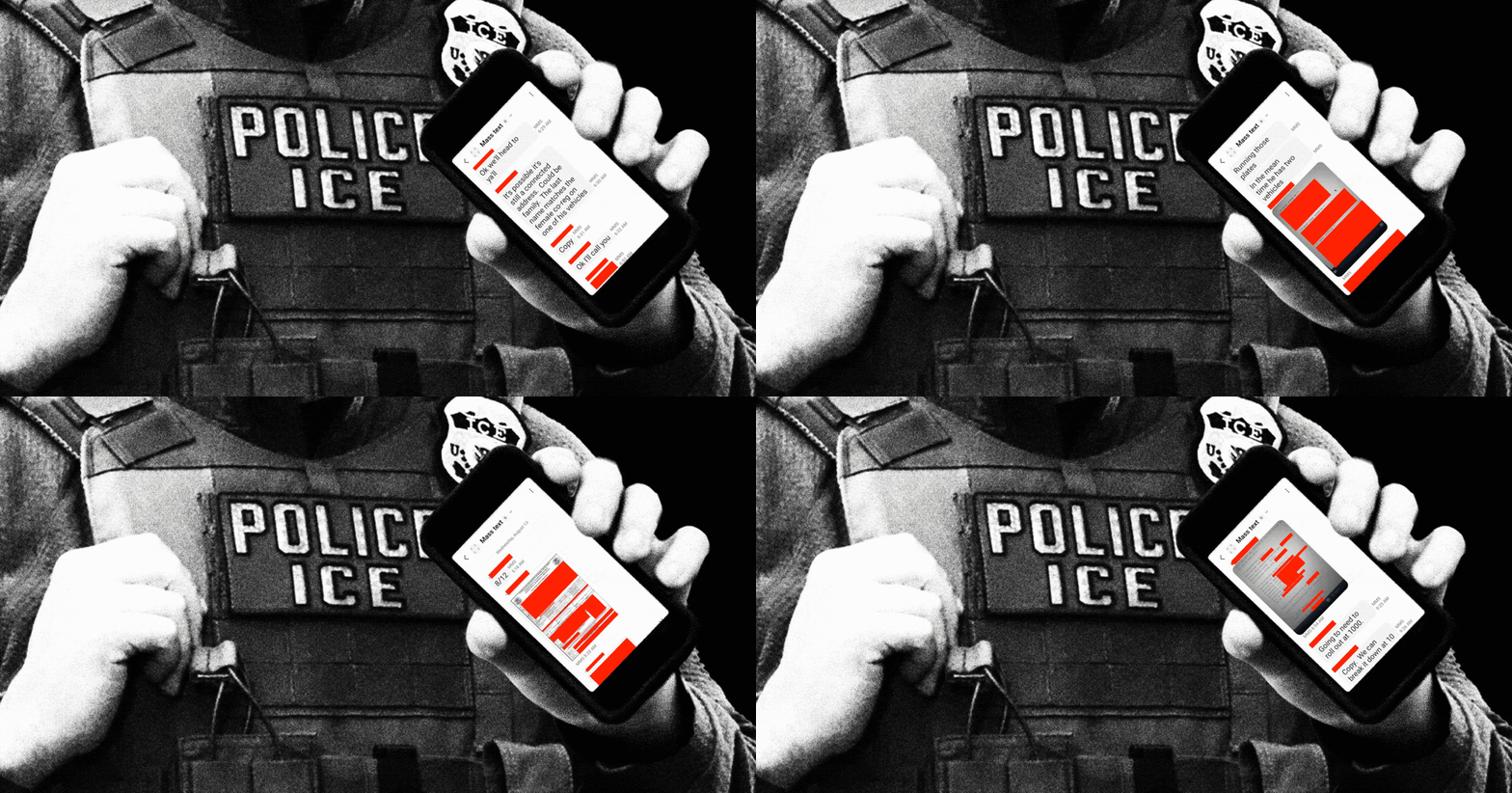
Law enforcement officials from Immigration and Customs Enforcement (ICE) and other agencies accidentally added a stranger to their group chat, exposing highly sensitive information about a manhunt, according to a 404 Media report published Thursday.

The blunder echoes the infamous Signal chat fiasco, in which a journalist was inadvertently included in a text chain where top members of the Trump administration discussed impending air strikes in Yemen.

The ICE messages, which discuss an active search for a convicted attempted murderer slated for deportation, were sent via MMS, or Multimedia Messaging Service, and were not end-to-end encrypted like messages on Signal or WhatsApp.

Officials reportedly texted an ICE “Field Operations Worksheet” on Wednesday that revealed detailed information about the person being sought—including their Social Security number—and DMV and license plate reader data, 404 Media reported.

The outlet labeled the incident a “significant data breach and operational security failure for ICE.”

404 Media reported that the group chat had six members, verifying one as an ICE official and identifying another as likely from the U.S. Marshals Service.

The Daily Beast has reached out to ICE and the U.S. Marshals Service for comment.

The person mistakenly added to the group chat is not a law enforcement official and had no connection to the manhunt, according to 404 Media. They told the outlet they were added weeks ago and assumed the messages were spam—until they received the ICE worksheet and license plate numbers.

404 Media, which said it obtained and verified screenshots from the group chat, has withheld the person’s identity to protect them from retaliation.

In Wednesday’s messages, the law enforcement officials discussed the search for their target and their next moves.

“Going to need to roll out at 1000,” one member texts the chat, called “Mass Text.”

“Copy. We can break it down at 10,” another replies.

The unintended recipient told 404 Media that the messages stopped coming shortly thereafter.

In what became known as “Signalgate,” Trump cabinet members, including Vice President JD Vance and Defense Secretary Pete Hegseth, discussed classified attack plans for airstrikes on Houthi rebels in Yemen on a Signal chat.

https://www.thedailybeast.com/ice-accidentally-adds-wrong-person-to-sensitive-group-chat-about-manhunt

Visa Lawyer Blog: New USCIS Policy Seeks to Intimidate Immigrants Applying for Green Cards by Threatening Deportation Proceedings


Until this month, if your family member was in the U.S. legally, you could file an I-130 on their behalf, and they could remain in the U.S. while it was being processed. In a devious underhanded move to increase their deportation numbers, the Trump regime intends to start deporting family members whose visas have expired while their I-130 filings are being processed.


On August 1st the U.S. Citizenship and Immigration Services (USCIS) announced new policies that could make immigrants applying for green cards through family-based petitions more vulnerable to deportation.

The changes appear in various updates to USCIS’ Policy Manual which states that immigration officials can begin removal proceedings for immigrants who lack legal status and apply to become permanent residents through family-based petitions.

According to the Policy Manual, “if USCIS determines the alien beneficiary is removeable and amenable to removal from the United States, USCIS may issue a Notice to Appear (NTA) [in immigration court] placing the beneficiary in removal proceedings. Petitioners and alien beneficiaries should be aware that a family-based petition accords no immigration status nor does it bar removal.”

The new policy went into effect immediately and applies to pending requests for a green card, and those filed on or after August 1st.

While the practical impact of this policy is yet to be seen, it provides immigration officials with more discretion to initiate removal proceedings even where a green card application is pending with USCIS, for those who entered the U.S. illegally, overstayed a U.S. visa, or otherwise failed to maintain their legal status.

These policy changes underscore the importance of maintaining underlying legal status throughout the green card process. Those who lack legal status or who lost their status during the green card process may be most at risk.

This shift is troubling because under previous administrations, green card applicants were not placed in removal proceedings while their green card applications were pending, except for cases involving serious criminal offenses.

USCIS has defended these policies stating that, “Fraudulent, frivolous, or otherwise non-meritorious family-based immigrant visa petitions erode confidence in family-based pathways to lawful permanent resident (LPR) status and undermine the immigration system in the United States. USCIS must ensure that qualifying marriages and family relationships are genuine, verifiable, and compliant with all applicable laws.”

Overtime, USCIS has become increasingly cooperative with agencies like DHS and ICE—moving from an administrative agency to an immigration enforcement agency placing a growing number of immigrants at risk of deportation.

These policies send a clear anti-immigrant message intended to intimidate and drive undocumented immigrants to self-deport. Green card applicants must not fall into this trap and instead seek legal counsel to fully understand their rights.

Slingshot News: ‘Not Guaranteed’: Secretary Kristi Noem Insults Puerto Ricans, Says She Can Cut Off Their Federal Aid In House Hearing

The bigoted racist bitch runs her mouth:

https://www.msn.com/en-us/news/politics/not-guaranteed-secretary-kristi-noem-insults-puerto-ricans-says-she-can-cut-off-their-federal-aid-in-house-hearing/vi-AA1KE3UZ

Guardian: ‘Petri dish for disease’: attorney raises alarm of possible Covid outbreak at ‘Alligator Alcatraz’

A respiratory disease is running rampant through Florida immigration jail, according to attorney of a detained person

An outbreak of a respiratory disease, possibly Covid-19, is running rampant through the remote Florida immigration jail known as “Alligator Alcatraz”, according to the attorney of an infected detainee removed from the camp last week.

Eric Lee said he was told by his client Luis Manuel Rivas Velásquez that conditions at the facility had deteriorated significantly since Thursday as more migrants held there by the Immigration and Customs Enforcement (Ice) agency experienced symptoms.

Lee said authorities removed Rivas Velásquez, a 38-year-old Venezuelan man, from the camp after he was diagnosed in a hospital visit last week, then secretly taken to a similar facility in Texas.

Protesters at the gates of the jail in the heart of the Florida Everglades have recorded a number of instances of ambulances arriving and leaving.

Lee said the hastily erected tented camp, which Democratic lawmakers have decried for holding thousands of undocumented detainees in cages as they await deportation, is a “petri dish for disease”.

He added: “Based on what multiple detainees have told me, in the last 72 to 100 hours, there is some respiratory disease which has made the majority, or I would even say vast majority of detainees, sick in some form.

“There are people who are losing breath. There are people who are walking around coughing on one another. Their requests for masks from the guards are denied, and they only are allowed to shower once or maybe twice a week.

“I said to Luis, ‘pass the phone. Let me hear it from somebody else. I just want to make sure that people’s stories are straight.’ And unfortunately they very much are.”

The development follows a claim by a woman, a state licensed corrections officer, who said she contracted Covid-19 after working at the camp in unsanitary conditions for about a week last month, and was subsequently fired.

“We had to use the porta-johns. We didn’t have hot water half the time. Our bathrooms were backed up,” the woman told NBC6 News after being granted anonymity to discuss conditions there.

“[The detainees] have no sunlight. There’s no clock in there. They don’t even know what time of the day it is. The bathrooms are backed up because so many people [are] using them.”

The Florida department of emergency management, which is responsible for operations at the jail, did not immediately respond to a request from the Guardian for comment.

In a statement to the Miami New Times, Stephanie Hartman, a department spokesperson, did not answer questions about a possible outbreak, but insisted: “Detainees have access to a 24/7, fully staffed medical facility with a pharmacy on site.”

Lee said Rivas Velásquez told him in a phone call that he pleaded for medical attention for 48 hours after contracting breathing difficulties, and eventually collapsed inside the metal cage in which he and dozens of other inmates were being held.

He said his client was taken to Miami’s Kendall regional medical center, where he was diagnosed with a respiratory infection, then returned only briefly to the Everglades camp before disappearing for three days. Lee said Rivas Velásquez called on Sunday from a new detention camp in El Paso, Texas.

“He said when he was returned to the Alcatraz facility he asked the guards to provide his medical records and they said they would not do that,” Lee said.

“The guards came to his bed, opened his pillow, took all the poetry and letters he’d been writing, and all the notes he’d been taking about his experiences, and told him he’s no longer allowed to write.”

Apart from the brief call from Texas, Lee said he had no further information about his client’s wellbeing.

“I haven’t heard from him for two days now. I have no idea how he’s doing or frankly whether he’s alive or not. It’s hard to wage a legal fight when you don’t even have access to your client,” he said.

If the outbreak is Covid, Lee added, it would have consequences beyond Alligator Alcatraz.

“The disease doesn’t recognize the prison walls and guards are going to get sick. They’ll give it to their kids, it’s going to get into the Miami school system, people are going to get sick and die as a result of the conditions that are in this facility,” he said.

https://www.theguardian.com/us-news/2025/aug/12/attorney-covid-outbreak-alligator-alcatraz

Newsweek: Nurse in US for 40 Years Self-Deports—’It’s Really Gotten Insane’

Matthew Morrison, a 69-year-old Irish immigrant and nurse in Missouri who became an immigration example in the late 1990s, left for Ireland on July 21 after living in the United States for 40 years due to fears of removal by the Trump administration.

Why It Matters

Morrison’s self-deportation has brought further attention to the complicated realities faced by long-term undocumented immigrants in the U.S., especially those with historic convictions or high-profile political backgrounds. His case, uniquely tied to historic U.S.–Ireland relations, was previously referenced during the Clinton administration as part of U.S.’s efforts to support the Northern Ireland peace process.

Morrison’s departure also underscores the anxiety and uncertainty experienced by noncitizens who fear changes in immigration enforcement policies, particularly those perceived to be at higher risk during political shifts.

What To Know

Morrison worked for roughly 20 years as a psychiatric nurse supervisor in Missouri, including stints at a children’s hospital and several state mental health facilities. He also presented at the St. Louis County Police Academy on topics including mental health and de-escalation tactics.

He told The Marshall Project that he voluntarily left the U.S. due to fear of detention by U.S. Immigration and Customs Enforcement (ICE) under President Donald Trump‘s administration.

“I would bite the dust in an ICE holding cell,” Morrison said prior to going home to Ireland. “There is nothing to stop them from deporting me to Ecuador, South Sudan or whatever. It’s really gotten insane here. It’s crazy what they are doing now, the Trump administration. You know what I mean?”

Morrison told The Marshall Project that although his work authorization expires in October, he didn’t want to spend the next few months in anxiety worrying about being deported.

On July 21, he and his wife reportedly boarded a one-way flight from Cleveland to Dublin and left behind a life in the St. Louis area that includes grown children, grandchildren and friends.

“I’ve come full circle,” Morrison said. “I came here as an immigrant and I am leaving as an immigrant, despite everything in between. The whole thing is a crazy, stressful situation.”

Morrison first arrived in the U.S. in the mid-1980s after serving time in prison in Northern Ireland due to his involvement with the Irish Republican Army (IRA) during “The Troubles.”

In 1985, he married his American pen pal, Francie Broderick, and had two children, Matt and Katie. Morrison later remarried to his current wife, Sandra Riley Swift.

He once served as a symbolic figure in American–Irish diplomacy. The former member of IRA previously spent 10 years in prison, convicted of attempted murder in a 1976 raid on a British barracks. Other ex-IRA men, all in the New York area, faced deportation for similar reasons.

In 1995, Morrison’s wife flew to Belfast while President Bill Clinton was in the region, attempting to garner his attention and protect him from deportation, according to the Associated Press. By 1997, the family received more than $70,000 in donations to help with legal fees.

The case for Morrison and others like him drew support from local and international lawmakers, notably due to IRA members being characterized by the U.S. government as terrorists.

The Missouri Legislature passed a resolution in 1996 urging the Immigration and Naturalization Service to drop deportation proceedings against him. Members of the Derry City Council in Northern Ireland followed suit across party lines, approving a resolution urging Clinton to suspend his deportation.

Morrison’s struggle won support from countless Americans, including neighbors in this suburban St. Louis community to state legislators to members of Congress.

The Irish Northern Aid, a nonprofit organization that helps families of Irish political prisoners, and the Ancient Order of Hibernians also have come to his defense.

In 2000, the Clinton administration ultimately terminated the deportation process against Morrison and five others. Then-Attorney General Janet Reno said in a statement that she had been advised by Secretary of State Madeleine Albright to drop deportation proceedings to “support and promote the process of reconciliation that has begun in Northern Ireland.”

Clinton at the time said the termination was “in no way approving or condoning their past criminal acts.” However, the ex-president echoed the sentiment of contributing to peace in Europe.

What People Are Saying

Matthew Morrison’s son, Matt, 37, to The Marshall Project about his father’s scheduled check-in with U.S. Citizenship and Immigration Services in June in St. Louis: “We were terrified that they were just going to take him right there…He has to live under that fear of somebody knocking on the door and dragging him out of the house, just like they did in Derry when he was young. I hate it. I am just worried about him. Until recently, I hadn’t heard him cry about it.”

Morrison’s daughter, Katie, to The Marshall Project: “Even though he’s still alive, I feel like I am grieving. It’s a huge loss for me and my children.”

What Happens Next?

Swift has a house in St. Charles, Missouri, as well as family in the U.S., The Marshall Project reported. After helping Morrison transition into an apartment in the town where he grew up, she wrote in a social media post that she’s going to travel between both countries for a while.

https://www.newsweek.com/immigration-deportation-ice-nurse-irish-army-2108527

Latin Times: DHS Reopens Long-Closed Immigration Cases In Efforts To Meet Deportation Quotas: ‘It’s Been 10 Years’

In efforts to reach ambitious deportation goals, the Department of Homeland Security is giving new life to long-time administratively closed immigration cases.

In efforts to continue stepping up immigration enforcement and reach ambitious deportation goals, the Department of Homeland Security is giving new life to long-time administratively closed immigration cases, even ones involving people who are dead.

Some lawyers have received dozens of motions to re-calendar— the first step to reopen old cases. If lawyers don’t succeed in opposing those motions, immigrants could wind up back in courthouses that in recent months have become a hub for arrests, a new report from Los Angeles Times details.

“It has been 10 years,” Adan Rico, a 29-year-old DACA recipient who has renewed his status at least four times, told the LA Times. “And all of a sudden our lives are on hold again, at the mercy of these people that think I have no right to be here.”

Attorneys handling these proceedings say the government is overwhelming the courts and immigration lawyers by dredging up cases, many of which are a decade old or more. In several of them, clients or their original lawyers have died. In other cases, immigrants have received legal status and were surprised to learn the government was attempting to revive deportation proceedings against them.

That was the case of Rico, a father who is studying to be an HVAC technician in the Inland Empire. The attorney who originally helped him with his immigration cases has since died, making the revival of his case even more confusing and surprising.

“If it wasn’t for his daughter calling, I would have never found out my case was reopened,” he said. “The Department of Homeland Security never sent me anything.”

A similar case occurred with construction worker Helario Romero Arciniega. Seven years ago, a judge administratively closed his deportation proceedings after he was severely beaten with a metal sprinkler head and had qualified for a visa for crime victims. This year, government officials filed a motion to bring back the deportation case even though he had died six months ago.

“They don’t do their homework,” Patricia Corrales, an attorney representing Romero Arciniega and Rico, said of the government lawyers. “They’re very negligent in the manner in which they’re handling these motions to re-calendar.”

Likewise, Mariela Caravetta, an immigration attorney in Van Nuys, said that since early June about 30 of her clients have been targeted with government motions to reopen their cases. By law, she has to reply in 10 days. That means she has to track down the client, who may have moved out of state.

“It’s bad faith doing it like that,” said Caravetta, who accused the federal government of flooding the immigration courts in an effort to meet its deportation quotas.

“People aren’t getting due process,” she said. “It’s very unfair to the client because these cases have been sleeping for 10 years.”

When asked about the government’s push to restart old proceedings, DHS spokesperson Tricia McLaughlin declined to address questions about the administration’s change in policy or respond to attorneys’ complaints about the process. She released a statement similar to others she has offered to the media on immigration inquiries.

“Biden chose to release millions of illegal aliens, including criminals, into the country and used prosecutorial discretion to indefinitely delay their cases and allow them to illegally remain in the United States,” she said. “Now, President Trump and Secretary Noem are following the law and resuming these illegal aliens’ removal proceedings and ensuring their cases are heard by a judge.”

https://www.latintimes.com/dhs-reopens-long-closed-immigration-cases-efforts-meet-deportation-quotas-its-been-10-years-588230

Idaho Statesman: Smashed windows. Missing court dates. How ICE is changing its tactics

Charles Hicks was at the gym when his husband called from the car to say he was being followed, Hicks recalled. His husband pulled over by their home, and Hicks watched on FaceTime as an Immigration and Customs Enforcement agent smashed his husband’s window.

He rushed to his Meridian apartment, but by then his husband was gone. Hicks, a U.S. citizen, already had started the process to get his husband legal status, he said. He and his husband had talked about the possibility of immigration enforcement, but Hicks said it still didn’t make him ready.

The Statesman is not naming the husband because Hicks said his husband fears repercussions for his case.

“I was not really prepared to watch that or to hear that,” Hicks said by phone. ICE agents screamed and yelled at his husband in the car, he said. “The No. 1 feeling that I had was just a pit in my stomach.”

Being in the United States without authorization is enough grounds to start the deportation process, and some immigrants who are here legally can also be removed. But under President Donald Trump, ICE agents in Idaho have been changing their tactics and using some strategies more often, according to local immigration lawyers. That includes smashing car windows, like with Hicks’ husband.

ICE did not respond to a request for comment sent via its official media email.

ICE agents also have conducted more arrests at ICE check-ins, which are routine meetings for agents to keep tabs on people going through the immigration process. Agents have also focused more on workplace enforcement, lawyers said. ICE isn’t necessarily going out to farms, but agents have been going to businesses to look for people employing undocumented immigrants, according to Neal Dougherty, a Nampa lawyer and partner at Ramirez-Smith Law.

The Owyhee County Sheriff’s Office and the Idaho State Police also have signed cooperation agreements with ICE, known as 287(g) agreements.

Overall, immigration arrests have increased over 900% in Idaho since Trump took office, according to The New York Times.

There aren’t increases in ICE’s resources or agents, said J.J. Despain, managing attorney for Wilner & O’Reilly’s Boise office, but ICE has lowered the bar on who it wants to deport and changed their strategies.

“Some of those are happening by surprise,” Despain told the Statesman.

The criminal justice system

In early April, a man failed to show up for his pretrial conference in Canyon County, perplexing his lawyer.

The lawyer, with the Idaho Public Defender’s Office, had been working with his client, who was charged in December 2024 with driving with a suspended or revoked driver’s license.

“I don’t know why he isn’t here today,” the lawyer told the judge in court audio obtained via a records request.

The next day, Immigration and Customs Enforcement posted a picture of the man being detained in Nampa by federal officers.

When ICE picks up people mid-case, they can face default judgments and parole or probation violations for failing to appear in court. When or if individuals ever return to the United States, there can already be a warrant out for an immigrant’s arrest, said Dougherty.

ICE picked up people while their Idaho criminal cases were ongoing before the new administration took office. But it’s happening more often now, Dougherty and Despain said, with potential consequences for the immigrants and any victims.

These aren’t all minor cases like driving with a suspended license. In one instance, a 27-year-old man from Mexico was arrested in Pocatello for child sexual abuse, child enticement and kidnapping. ICE posted a picture of him the day before his preliminary hearing, at which he failed to appear. He has since been deported, ICE spokesperson Alethea Smock said in an email. The case is listed as inactive and pending after the state asked to keep the case open.

Wood River Valley lawyer Justin McCarthy said immigrants in Idaho’s criminal justice system should finish their sentences in the Gem State.

“They should be held accountable here. … You don’t get to skate on the sentence,” McCarthy said. “What about victims? What about the victims’ families? … That person could come back, and they often do.”

An immigrant from El Salvador

Hicks had been with his husband for about five years by the time he was detained by ICE in late June. The couple married in 2023, according to a petition filed by his husband’s lawyers.

Hicks’s husband is originally from San Salvador, the capital of the Central American country of El Salvador. He came to the United States in 2018 to support his family and has worked in construction, Hicks said. His husband sends money to his mother, sisters and nephews back home, Hicks said. He hasn’t been able to see his family in years.

In 2021, his husband pleaded guilty to driving under the influence and received a withheld judgment. He was required to undergo alcohol education and was placed on unsupervised probation, according to court records. On June 5 of this year, he was found guilty of driving while using a cellphone, according to online court records.

After his arrest, the husband was sent to Elmore County first. Now he is detained in the Nevada Southern Detention Center west of Las Vegas, according to an online ICE detainee locator tool.

Hicks can’t go visit his husband in detention. The couple can conduct phone and video calls through the jail, Hicks said.

Lawyers for Hicks’ husband filed a petition in federal court to get him out of detention, arguing among other things that ICE agents didn’t show a warrant when they broke into his car and that an immigration judge was unfairly keeping him detained.

Hicks filed a petition earlier in 2025 for his husband to get residency, he said. But it will take four to six years, Hicks said.

“You should enter (the U.S.) with permission,” Hicks said. “But also, the whole process is just broken. It shouldn’t take someone five or six years to possibly get residency when they’re married to a U.S. citizen.”

https://www.idahostatesman.com/news/politics-government/state-politics/article311591857.html