USA Today: Immigrants forced to eat ‘like a dog’ in detention centers

Forced to eat the day’s only meal “like a dog,” with their hands shackled behind their back. Detained for days with nothing but shoes for a pillow and no other bedding ‒ just cold, concrete floors and constant fluorescent lighting. Medical care that denied a man with diabetes insulin for a week and may have contributed to at least one death.  

A Human Rights Watch report says three Miami immigrant detention facilities have subjected people to conditions so inhumane they have become, at times, life-threatening. Many ICE detention facilities are becoming overcrowded and conditions are deteriorating, according to the July 21 report.

The report, which drew from the testimonials of 17 detainees, examined conditions since President Donald Trump took office in January. Investigators say conditions at the Krome North Processing Center, Federal Detention Center and Broward Transitional Center flout international law on holding people in immigrant detention and federal government standards.

The conditions for people held in the detention facilities “are not the way that any legitimate, functioning government should treat people within its custody,” report author and editor Alison Leal Parker, deputy director of the Human Rights Watch’s US Program, said.

While the facilities have had issues predating this administration, Parker said Trump administration officials have been unwilling to uphold standards to properly treat immigrant detainees. The conditions indicate the system is “overwhelmed, overcrowded and chaotic,” she said.

Tricia McLaughlin, assistant secretary for public affairs at the Department of Homeland Security, said claims of subprime conditions at Immigration and Customs Enforcement detention centers are “FALSE.”

“All detainees are provided with proper meals, medical treatment, and have opportunities to communicate with their family members and lawyers,” McLaughlin said in an emailed statement. “Ensuring the safety, security, and well-being of individuals in our custody is a top priority at ICE. ICE has higher detention standards than most U.S. prisons that hold actual U.S. citizens.”

Southern, Republican-led states have emerged as key partners in the Trump administration’s immigration crackdown. Florida stood up a tent city called “Alligator Alcatraz.” Georgia is expanding its largest ICE detention center. And Louisiana is hosting the most dedicated ICE facilities outside Texas.

Time at all three facilities

Entrepreneur Harpinder Singh Chauhan, 56, spent time at all three facilities during nearly four months as a detainee, beginning in February. 

The British national, who first entered the country on an E-2 investor visa in 2016, opened small businesses in Florida. One of them failed ‒ a franchise of Dickey’s Barbecue Pit, which also bankrupted many other franchisees. He and his wife were seeking permanent residency through a valid EB-5 visa petition when their business collapsed.

While Chauhan was never convicted of crimes, he was ordered to pay restitution to Florida for tax issues, court records show. In February, he was turned over to ICE after a routine probation check-in.

At the Krome facility, he spent days in cold, crowded processing cells without beds or showers. He said he was denied medical care, including insulin for his diabetes and an inhaler for his asthma. He used his shoes as a pillow. 

During a tuberculosis outbreak, he said the facility had no soap. Instead, staff made detainees use shampoo to wash their hands. Detainees jokingly said everyone had “Krome’s disease,” a play on Chrohn’s disease, a chronic gastrointestinal illness, Chauhan recalled.

Detainees were beaten for protesting their treatment, and one man was hogtied, the report said. Officials also used solitary confinement as punishment, according to women who spoke to Human Rights Watch. In June, detainees at Krome signaled “SOS” to news cameras from the yard over conditions.

The report said women were placed at Krome, a privately operated men’s facility, where they were crowded in small holding cells without gender-appropriate care or privacy. USA TODAY reported on similar conditions inside Krome, where one man died ‒ an incident Human Rights Watch suspects may have been linked to medical neglect.

Akima, a private Alaska Native Corporation that operates Krome, didn’t respond to USA TODAY’s request for comment. But in response to a Human Rights Watch letter summarizing findings and questions, the company said it couldn’t comment publicly on the specifics of its “engagement” with the government, according to the report.

‘Like a dog’

Midway through his detention, on April 15, Chauhan was placed inside a crowded Federal Detention Center holding cell awaiting transfer without a meal for the day. Styrofoam food containers sat full for hours on other side of the federal prison’s bars.

In the evening, he and others finally received food. But with their hands shackled at their waist, they were forced to eat by putting their faces to bite into potatoes rolling around, rice and dry chicken, he said.

“You’ve got to kind of prop it up with your knees and then eat out of it like a dog,” Chauhan said. Another 21-year-old detainee interviewed by Human Rights Watch also described being forced to eat like an animal.

The 25 to 30 men forced to eat this way were transferred from the facility several hours later, Chauhan said.

Less than a week later, at Broward, Chauhan collapsed in the heat awaiting dinner and was taken to a hospital, with no information given to his family. He had not had his insulin for nearly a week. A 44-year-old Haitian woman, Marie Ange Blaise, died at the facility in April, following a medical emergency that was not treated urgently, according to Human Rights Watch and advocates.

“We strongly believe her death could have been prevented,” Guerline Jozef, director of the nonprofit Haitian Bridge Alliance told USA TODAY at the time. “We will continue to demand accountability and protection for people in ICE custody.”

GEO Group, which operates Broward, denied the report’s allegations, including questions about Chauhan’s account.

The facility has around-the-clock access to medical care, as well as access to visitations, libraries, translation services and amenities, Christopher Ferreira, a spokesperson for the company, said in a statement. Support services are monitored by ICE, including on-site personnel, and other organizations within DHS.

A ‘dark time’ in US

Chauhan was ordered deported and boarded a flight back to the United Kingdom on June 5. His family, including two adult children, stayed in Florida to close what remains of their businesses.

Now living outside London, Chauhan said he plans to keep paying his Florida debt. Even though his family is ready to leave, he hopes to one day return to America.

“Every nation goes through a dark time,” he said. “I feel this is just a test.”

https://www.usatoday.com/story/news/nation/2025/07/24/trump-immigration-detention-conditions-dog/85338970007

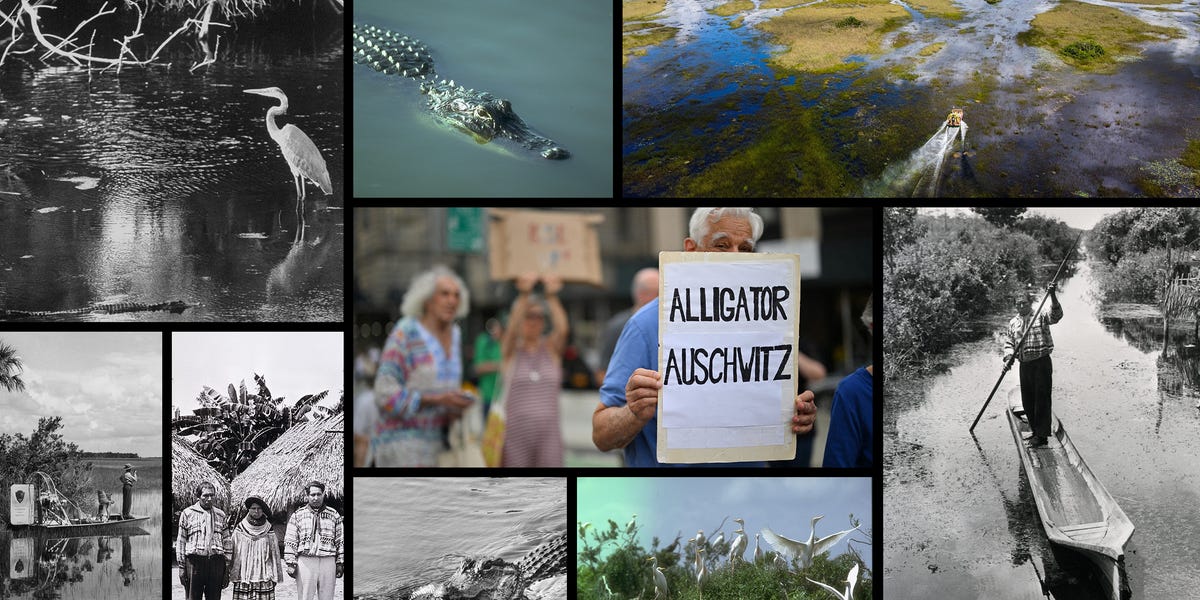
Harpar’s Bazaar: What Should Artists Do When Alligator Alcatraz Moves Next Door?

The Florida Everglades are home to a diverse community of artists. The Trump administration targeted this area to build a controversial ICE detention center, and residents are fighting back.

On June 14, Dakota Osceola was wrapping up the day, selling her bead art and necklaces at a festival in Miami, when she heard the news from a friend.

A new immigrant detention facility, to be named Alligator Alcatraz, would be built on a 10,500-foot-long old airport strip inside the Big Cypress National Preserve in the Florida Everglades.

“How is this happening right now?” she thought.

Home of the indigenous Miccosukee and Seminole people, the Everglades are the largest wetland ecosystem in the United States and the land where Osceola’s family grew up. This territory is considered a sacred place to tribe members and a national wildlife treasure to Floridians. But in less than 10 days, a portion of the Everglades was seized by the state and paved over to make room for a new prison built to hold up to 3,000 immigrants, a move supported by the Trump administration as a means to detain undocumented people.

On June 28, in the scorching heat, Osceola decided to go voice her opposition to this detention camp. Grassroots organizations such as Friends of the Everglades and Unidos Immokalee voiced environmental and human-rights concerns. Alongside independent activists, artists from the South Florida community joined with their protest art and signs to defend the home that has inspired them and that they love.

Outside the gates of the detention facility, and in the center of the Everglades, hundreds of Floridians gathered, chanting and holding up signs. Miccosukee tribal elder and environmental activist Betty Osceola, with Love the Everglades Movement, used her megaphone to address the crowd and keep people safe. Demonstrators lined up on the narrow road, north of the Tamiami Trail, as dozens of trucks with machinery entered the old Dade-Collier Airport, where the facility was being built. In the weeks since, different organizations have continued to arrange protests and gatherings weekly in front of these gates. There have been peaceful prayer vigils with no signs allowed, a protest asking to shut down the Everglades concentration camp, and family members of detainees gathered along with grassroots human-rights organizations, and a Catholic archbishop is waiting to see if he can hold a mass at the gates.

Outside the gates of the detention facility, and in the center of the Everglades, hundreds of Floridians gathered, chanting and holding up signs. Miccosukee tribal elder and environmental activist Betty Osceola, with Love the Everglades Movement, used her megaphone to address the crowd and keep people safe. Demonstrators lined up on the narrow road, north of the Tamiami Trail, as dozens of trucks with machinery entered the old Dade-Collier Airport, where the facility was being built. In the weeks since, different organizations have continued to arrange protests and gatherings weekly in front of these gates. There have been peaceful prayer vigils with no signs allowed, a protest asking to shut down the Everglades concentration camp, and family members of detainees gathered along with grassroots human-rights organizations, and a Catholic archbishop is waiting to see if he can hold a mass at the gates.

A member of the Seminole tribe, Osceola was aware of how hard the tribes fought in the 1970s to stop the construction of the old airport due to the environmental damage it would cause to the fragile ecosystem of the Glades. That battle was won when the construction came to a halt due to growing opposition from environmentalist groups. But now, into that abandoned air strip, the construction trucks started coming in, creating more and more traffic inside the Big Cypress National Preserve. Then, a sign with the words “Alligator Alcatraz” went up overnight, sparking sinister national jokes, memes, and merch about the alligators eating anyone who tries to escape this jail.

Protesters had different reasons to voice their opposition to the detention center: It would harm a fragile ecosystem and is not environmentally sound; it is an inappropriate use of FEMA funds; conditions there are inhumane. When Florida lawmakers visited the facility on a limited tour, they described 32 people per cage in the sweltering heat, exposed to bug infestations and fed meager meals, with prisoners crying for help and even one person pleading, “I’m a U.S. citizen!”

An important point ignored in national coverage is that the construction involves a seizure by the state of Miami-Dade-owned land under the guise of an emergency. The Miccosukee tribe joined other environmental groups, such as Love the Everglades, in suing federal and state agencies for failing to conduct an environmental review, as required by federal law, before initiating the project. Meanwhile, the ACLU is suing the Trump administration because of a lack of access to counsel at the detention center.

“I see my relatives, my family, in those cages. They came here undocumented, overstayed their visas, and eventually became citizens,” says Aubrey Brown, a Florida-based storyteller and artist who contributed to the protest sign art. Brown, who shares stories about Florida’s history with her 40,000 followers on social media, couldn’t stay silent and decided to speak up against the detention center, risking backlash. “I’ve always tried to stress that history and politics are inextricably intertwined,” she adds. Challenging the false narrative used by the president to make others believe there is nothing but fierce alligators and swamps in the Everglades, Brown argues, “People must understand that the Everglades is not a wasteland; this is people’s home. The Glades are wild, sacred, and free. It’s where the Seminoles went to hide from being captured, and it is where I go when I want to get away from everything.”

Acting as if no people exist in the Everglades, the federal government decided to seize land belonging to Miami-Dade County, completely ignoring the sovereignty of tribal nations at Big Cypress and that both their ceremonial and ancestral burial grounds stand near the facility.

“When it comes to my Seminole and Miccosukee friends, people treat them like they are not here anymore and are a relic of history,” Brown adds.

Once considered a swing state, Florida is now ground zero for the MAGA base supporting cruel anti-immigration policies. Built undercover, this facility was estimated to cost taxpayers $450 million a year. However, according to a review of purchases, the state has already spent $250 million on it in less than one month.

President Trump said that the facility would cage “some of the most vicious people on the planet” to be deported. Yet, a report released by the Miami Herald debunked this narrative, showing that hundreds of the detainees have no criminal charges.

Kidnapped without a warrant, stripped of their civil rights, and placed into a black hole where attorneys cannot reach their clients, only a third of detainees have a criminal conviction. But the public cannot see the nature of the sentence they received. ICE has so far offered the press only top-level statistics, which do not show whether a sentence is for a traffic violation or a murder attempt. Not only do the reports withhold details about the alleged offenses of each detainee, but ICE has not made public the records specifying how it targets the people it takes to detention centers, especially those without criminal charges. In response, The Guardian has decided to sue the Trump administration for withholding public documents from the press, which are a matter of clear public interest right now.

Maria Theresa Barbist, a Miami-based artist and psychologist who explores trauma, memory, and collective healing in her works, attended and made signs for the protest. “I am from Austria, and we have a dark history there. We have done this before. We have put people in concentration camps, and we know how this story ends. It’s our responsibility as descendants of Nazis never to let that happen again,” she says.

“The Nazis did not start with Auschwitz; they started with driving people out of their homes and putting them into camps. It was not just Jewish people, it was immigrants too,” she adds.

“This is not the first concentration camp being placed; they are just getting warmed up. Project 2025 is going to extend for at least the next four years,” says Eddie Aroyo, an artist who explores themes of power structures and attended the protest. “This is about absolute conquest,” he adds, referring to a conservative white nationalist agenda that opposes abortion and reproductive rights, LGBTQ rights, immigrants’ rights, and racial equity.

Democratic Florida representative Maxwell Frost visited the detention center on July 13 and shared on social media, “I didn’t see any Europeans who overstayed their visa. I saw nothing but Latino men and Haitian men. They are targeting specific types of people. And it’s the type of people that look like me.”

A few miles away from the detention camp, artist and native Floridian Sterling Rook, who attended the protest, is currently completing an artist residency in the Everglades National Park. Hosted by AIRIE (Artists in Residence in Everglades), this program allows artists to explore work related to the environment. The first day he entered the residency was also the day the first buses carrying migrants arrived in the Everglades. “It’s beautiful out here, but now I think about this every day, how 30 miles away from here there are people in tents in a terrible situation,” he says. “I’m not necessarily a political artist, but you become political just by the nature of your situation,” he adds. Rook used his residency time to work on a Glades skiff boat, which is known for navigating the marshy waters of the Everglades.

“As a performance, I would love to ride it out into ‘Alligator Alcatraz,’ maybe leave it there as a symbol of rescue and escape. But I also struggle with self-censorship,” he says.

This self-censorship comes from a place of very real fear about political persecution of artists who speak up. “There are genuine and considerable threats when speaking out against any of these violent governmental policies, especially in Florida,” says Johann C. Muñoz-Tapasco, an artist and organizer affiliated with the local collective Artists for Artists Miami (A4A: MIA). “Numerous artists have chosen to disengage from sought-after exhibition platforms and institutions altogether. Others have lost their jobs and clients. Many more have self-censored as a form of self-preservation.”

Federal and state funding cuts to the arts, combined with the elimination of National Endowment for the Arts grants and Florida’s political climate, have led many artists, organizations, and institutions that depend on this funding to limit freedom of expression, fearing retaliation or even more economic cuts. AIRIE did not respond to my request for a statement on its stance on this issue. The majority of Florida’s art institutions and organizations have remained silent.

A4A: MIA is currently discussing collaborative projects and planning actions against this detention facility, but it recognizes that American artists have been woefully unprepared to respond to the rise of fascism. “Since the postwar era, the ways artists validate their work and fund their practices have been tied to the tastes and whims of those in power,” misael soto, a Miami-based artist, educator, and organizer affiliated with this organization, stated. “Now those at the top whom we’ve been dependent on, on whichever side of the political spectrum, are mostly kneeling to fascism. Artists have to come to terms with how they sustain their practices and how this is intrinsically tied to their art.”

Mae’anna Osceola-Hart, a photographer and member of the Panther Clan and the Seminole tribe, participated in organizing the protest and lives within walking distance of the detention camp. Her grandfather was one of the tribe members who fought the development of the Dade-Collier Airport. These days, the traffic on the Big Cypress reserve is becoming increasingly dangerous, and she describes seeing the wildlife already being displaced. “The deer and bears now walk on the side of the road,” she says.

“My heart sinks, seeing how this concentration camp is affecting the land that protected us indigenous people since time immemorial, the environmental impacts it’s already causing, along with how it’s already harming human beings and their rights. Just yesterday, I saw three cars coming in with people wanting to take a photo in front of the [Alligator Alcatraz] sign, treating it like a roadside attraction,” she says.

“It feels like a fever dream.”

https://www.harpersbazaar.com/culture/features/a65488687/artists-fight-alligator-alcatraz

Latin Times: Florida AG Encourages People To Report Their Ex Partners To Immigration Authorities: ‘We’d Be Happy To Assist’

“If your ex is in this country illegally, please feel free to reach out to our office,” said James Uthmeier

Florida Attorney General James Uthmeier encouraged people to report their ex partners to immigration authorities so they can be deported.

In a social media post, Uthmeier said “we recently got a tip from someone whose abusive ex overstayed a tourism visa” and now he is “cued up for deportation.”

“If your ex is in the country illegally, please feel free to reach out to our office. We’d be happy to assist.”

Uthmeier has also made headlines recently for proposing the construction of the migrant detention facility known as “Alligator Alcatraz,” located at a remote airport site surrounded by Everglades wildlife. The facility has in fact been inaugurated and mired by allegations of mistreatment. Legal advocates are calling for the shutting down of the facility, decrying “unlivable” conditions that include mosquito-ridden units and lights being on all the time.

Uthmeier made the post as CBS News reported that Immigration and Customs Enforcement (ICE) conducted some 150,000 deportations in the first six months.

The figure is still far from its self-imposed goal of recording 1 million deportations in the first year of the administration, but the agency has vowed to ramp up efforts, especially after getting tens of billions in funds following the passage of President Donald Trump’s One Big Beautiful Bill Act.

Should deportations continue at this pace, they would reach about 300,000 by the end of the year, the highest figure since fiscal year 2014, when the Obama administration conducted 316,000 ICE removals. The highest amount ever recorded was in 2012, when the agency conducted some 410,000 deportations.

However, the administration is significantly ramping up efforts to that end, especially after getting an additional $45 billion from the One Big Beautiful Bill Act, as well as $30 billion to fund every stage of the deportation process. Acting ICE Director Todd Lyons said last week that the agency plans to use some of that money to hire 10,000 agents to locate and arrest migrants suspected of being in the country unlawfully.

Asshole!

James Uthmeier is such a pathetic excuse for human detritus!

https://www.latintimes.com/florida-ag-encourages-people-report-their-ex-partners-immigration-authorities-wed-happy-587482

Mirror: Donald Trump’s niece reveals latest symptom of cognitive decline and says he’s ‘far gone’

Mary Trump, a clinical psychologist and author, has launched a scathing attack on her uncle, President Donald Trump, claiming his ‘cognitive decline’

“He has an actually quite decent ability to mix cognitive decline with narcissism. I mean that’s a twofer,” she said, reports the Irish Star.

Donald Trump’s niece, Mary Trump, has made a biting remark about her uncle, stating that he “can’t tie his own shoes,” as concerns about Trump’s health continue to mount.

Mary Trump, a psychologist and the daughter of Donald’s older brother, Fred Trump Jr, lambasted the president’s “reign of idiocy” on her YouTube show, Trump Trolls Trump.

“We’re now 166 days into the Trump regime’s reign of terror, reign of confusion, reign of chaos, but also let’s call it what else it is, it’s a reign of idiocy,” she declared.

The 60-year-old author of the book ‘Too Much and Never Enough: How My Family Created the World’s Most Dangerous Man,’ continued to ruthlessly ridicule her uncle.

“Time flies when you’re having a horrible time and when democracy is slowly being strangled by a man who can’t tie his own shoes,” she said.

However, Mary did give credit where credit was due.

“Now, Donald is good at very, very few things but I’m going to give him credit for something,” she stated.

“He has an actually quite decent ability to mix cognitive decline with narcissism. I mean that’s a twofer,” she said, reports the Irish Star.

“Every time it is a 10 out of 10 for his performance in being a moron,” Mary pointed out.

She continued her blistering critique of the president, highlighting one of his latest embarrassing gaffes.

After his visit to a new Florida immigration detention center, nicknamed “Alligator Alcatraz” last week, the president was asked twice if he knew how long detainees would be kept there.

In a response to a question, Trump veered off-topic discussing his affection for Florida, Oval Office decor, and New York taxes before saying, “I’ll be here as much as I can, very nice question.”

“The question, you idiot, wasn’t do you like Florida?” Mary exclaimed in frustration.

She reasoned that Trump couldn’t provide an answer because he didn’t have one.

Mary blisteringly criticized Trump, saying she is “sick of this thuggish lunk sitting there any denying the American people access to any truths about anything whatsoever.

“Donald is, quite frankly, increasingly far gone these days. He has an attention span of a toddler, although that’s actually nothing new,” she asserted regarding her uncle.

Switching focus to Trump’s recent entrepreneurial endeavor, Mary scrutinized Trump’s launch of a new “victory” fragrance on Truth Social the previous week.

Describing the scent, which retails at $249 per 100ml and features a golden statuette of Trump, Mary said, “It is grotesque for the sitting president of the United States to grift off of his office, but here we are,”.

Finally, she lamented, “The idea of having to guess what that horror smells like is deeply unfair to those of us who are still sane.”

https://www.themirror.com/news/us-news/donald-trump-cant-dress-himself-1251052

L.A. Times: Environmentalists’ lawsuit to halt Alligator Alcatraz filed in wrong court, Florida official says

Florida’s top emergency official asked a federal judge on Monday to resist a request by environmentalists to halt an immigration detention center known as Alligator Alcatraz in the middle of the Florida Everglades because their lawsuit was filed in the wrong jurisdiction.

Even though the property is owned by Miami-Dade County, Florida’s southern district is the wrong venue for the lawsuit since the detention center is located in neighboring Collier County, which is in the state’s middle district. Decisions about the facility also were made in Tallahassee and Washington, Kevin Guthrie, executive director for the Florida Division of Emergency Management, said in a court filing.

“And all the detention facilities, all the buildings, and all the paving at issue are sited in Collier County, not Miami-Dade,” Guthrie said.

Environmental groups filed a lawsuit in Florida’s southern district last month, asking for the project being built on an airstrip in the heart of the Florida Everglades to be halted because the process didn’t follow state and federal environmental laws. A virtual hearing was being held Monday on the lawsuit.

Critics have condemned the facility as a cruel and inhumane threat to the ecologically sensitive wetlands, while Republican Gov. Ron DeSantis and other state officials have defended it as part of the state’s aggressive push to support President Trump’s crackdown on illegal immigration.

U.S. Homeland Security Secretary Kristi Noem has praised Florida for coming forward with the idea, as the department looks to significantly expand its immigration detention capacity.

Alligator Auschwitz is a disgrace and should be shut down.

https://www.latimes.com/world-nation/story/2025-07-21/environmentalists-lawsuit-to-halt-alligator-alcatraz-filed-in-wrong-court-florida-official-says

The Times: We’re caged like chickens, say Italians in ‘Alligator Alcatraz’

Gaetano Mirabella Costa and Fernando Artese plead for help after detention in Florida

The families of two Italians held in President Trump’s “Alligator Alcatraz” migrant detention centre have denounced the harsh conditions of their incarceration in Florida and appealed to the Italian authorities for help to get them out.

“We’re in cages like chickens, 32 people with three open toilets, everyone can see everything,” Gaetano Mirabella Costa, 45, told Italian state television in a telephone interview from the prison. “I don’t know what I’m accused of and I can’t speak with a lawyer or even a judge. Can the Italian authorities please help me to get out of this nightmare?”

The Italian, who was born in Taormina, Sicily, and had been living in the US for ten years, had recently served a short prison sentence for assault, drug possession and domestic violence and was transferred to the new detention centre on July 9.

His mother, Rosanna Vitale, said her son had been taken to court with his feet and hands shackled, “like a dog”. The only positive thing was that he was allowed to queue for a telephone to make collect calls from the prison, she said.

“The situation is very tough,” she added. “He said, ‘Mum, I haven’t seen the sun for ten days.’ We still haven’t been contacted by anyone to deal with this situation but we will do everything possible to get him back — we hope soon.”

Another Italian, Fernando Artese, 63, had been living in Florida and overstayed a 90-day visa by almost ten years. He was transferred to the prison at Dade-Collier, in the Everglades swamps, after being stopped by police on June 25.

In March Artese, who has joint Italian and Argentinian nationality, had been fined for driving without a licence. His family said he missed his traffic court date because he feared being detained.

Artese’s family had joined him in 2018 — his wife, Monica Riveira, 62, came on a student visa and his teenage daughter, Carla, legally accompanied her. They had been living in the Florida city of Hialeah, where Artese ran a company installing cameras, and were stopped while attempting to leave the country by driving their mobile home to Argentina.

“This is a concentration camp. They treat us like criminals — it’s a pursuit of humiliation,” Artese told the Tampa Bay Times in a phone interview. “We’re all workers and people fighting for our families.”

Carla Artese, 19, has raised more than $7,000 towards a target of $10,000 on an appeal for her father on the GoFundMe website.

“This year, we were trying to leave the USA, and ICE [Immigration and Customs Enforcement] got him and sent him to Alligator Alcatraz, where they treat them like criminals and [they] have no rights,” she said in the appeal. “They haven’t given him any information about his case or any right to an attorney. Not to mention, they haven’t added him to the system yet, so he doesn’t even appear like an inmate anywhere.”

She said her father wanted “to self-deport when they let him”, adding: “He is a hard worker who only wanted to leave the country with his family after paying taxes and working hard the whole time he’s been here!”

Carla told the Italian newspaper Corriere della Sera her father was lucky because he had previously been detained in another institution and that had given his family the chance to bring him his medicines. “Many don’t have medicine and there’s not much food,” she said. “They can’t sleep at night because the lights are on 24 hours a day. They can’t see the sun, they can’t go outside.”

The migrant detention centre, which has a capacity of 3,000, was built within weeks under the direction of Ron DeSantis, the governor of Florida, using emergency powers. Trump visited a few weeks ago and joked that escaping prisoners would have to run in zig-zag lines to avoid the local alligators.

Opposition politicians have criticised Giorgia Meloni, the Italian prime minister, for allegedly prioritising her friendship with Trump over the rights of her imprisoned compatriots. “Will the government of patriots continue to play majordomo to Trump or does it intend to defend the rights of an Italian citizen?” asked Matteo Renzi, a former prime minister.

Angelo Bonelli, an MP with the Green and Left Alliance, said the government was always ready to curry favour with Washington. “It remains silent even in the face of an obvious violation of human rights,” he said. “Patriots in words, vassals in reality.”

https://www.thetimes.com/us/news-today/article/what-is-alligator-alcatraz-italians-gz2gcqrbd

Human Rights Watch: “You Feel Like Your Life is Over”

Abusive Practices at Three Florida Immigration Detention Centers Since January 2025

Among the flurry of immigration-related executive orders marking the second presidential administration of Donald Trump is Executive Order 14159, establishing the policy of detaining individuals apprehended on suspicion of violating immigration laws for the duration of their removal proceedings “to the extent permitted by law.” President Trump’s call for mass deportations was matched by a surge in immigration detention nationally. In line with this policy, Trump issued dozens of other immigration-related executive orders and executive actions and signed into law the Laken Riley Act as part of a broader rollback of immigrants’ rights in the United States.

Within a month of the inauguration, the number of people detained by Immigration and Customs Enforcement (ICE) began increasing. Throughout 2024, an average of 37,500 people were detained in immigration detention in the US per day.[1] As of June 20, 2025, on any given day, over 56,000 people were in detention across the country, 40 percent more than in June 2024, and the highest detention population in the history of US immigration detention. As of June 15, immigration detention numbers were at an average of 56,400 per day, and nearly 72 percent of individuals detained had no criminal history.

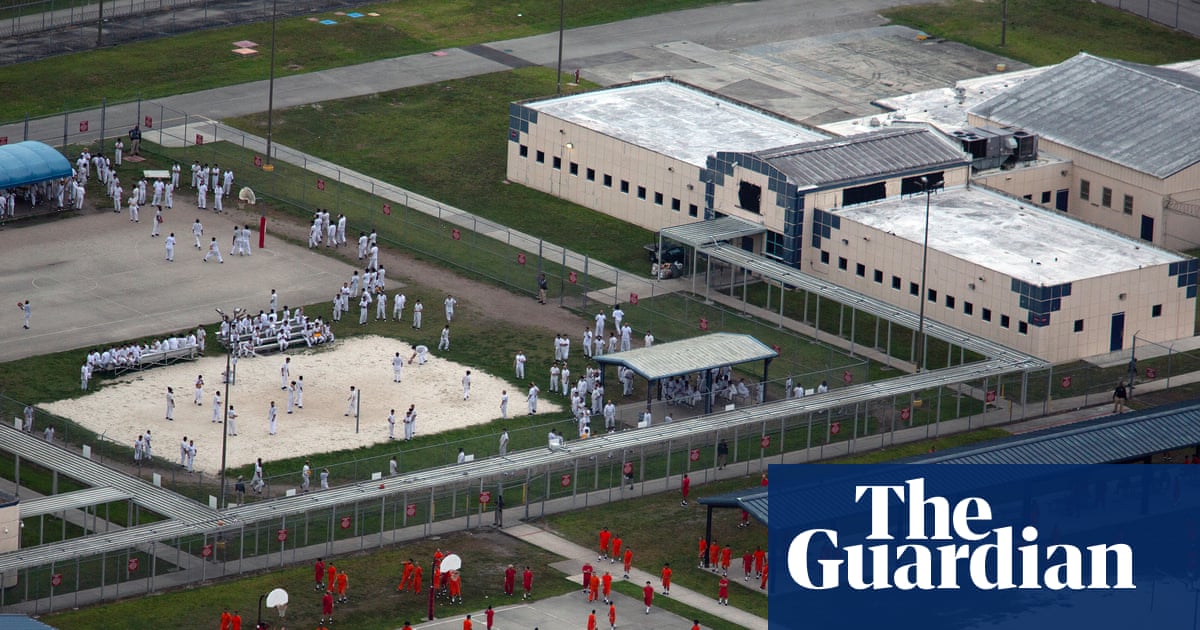
Between January and June 2025, thousands were held in immigration detention at the Krome North Service Processing Center (Krome), the Broward Transitional Center (BTC), and the Federal Detention Center (FDC), in Florida, under conditions that flagrantly violate international human rights standards and the United States government’s own immigration detention standards. By March, the number of people in immigration detention at Krome had increased 249 percent from the levels before the January inauguration. At times in March, the facility detained more than three times its operational capacity of inmates. As of June 20, 2025, the number of people in immigration detention at the three facilities was at 111 percent from the levels before the inauguration.

The change was qualitative as well as quantitative. Detainees in three Florida facilities told Human Rights Watch that ICE detention officers and private contractor guards treated them in a degrading and dehumanizing manner. Some were detained shackled for prolonged periods on buses without food, water, or functioning toilets; there was extreme overcrowding in freezing holding cells where detainees were forced to sleep on cold concrete floors under constant fluorescent lighting; and many were denied access to basic hygiene and medical care.

Five years ago, in April 2020, Human Rights Watch, together with the American Civil Liberties Union and the National Immigration Justice Center, reported on conditions in immigration detention under the first Trump administration. Human Rights Watch, along with other governmental and nongovernmental expert and oversight bodies, have carried out numerous investigations of immigration detention conditions in the United States. This report reveals that while the second Trump administration is using similar abusive practices, their impacts are exacerbated due to severe overcrowding caused by new state and local policies, including in Florida, where this report is focused. While these latest findings in Florida inform some of the policy recommendations in this report, the recommendations are also grounded in these years of investigations and findings.

This report finds that staff at the three detention facilities researchers examined subjected detained individuals to dangerously substandard medical care, overcrowding, abusive treatment, and restrictions on access to legal and psychosocial support. Officers denied detainees critical medication and detained some incommunicado in solitary confinement as an apparent punishment for seeking mental health care. Facility officers returned some detainees to detention directly from hospital stays with no follow-up treatment. They detained others in solitary confinement or transferred them without notice, disrupting legal representation. They forced them to sleep on cold concrete floors without bedding and gave them food which was sometimes substandard, and in many instances ignored their medical requirements. Some officers treated detainees in dehumanizing ways.

These findings match those of an April 2025 submission by Americans for Immigrant Justice (AIJ) to the United Nations Human Rights Council, which documented severe and systemic human rights violations at Krome. Combined with years of investigations by Human Rights Watch and other independent experts and groups in the US, they paint a picture of an immigration detention system that degrades, intimidates, and punishes immigrants.

The report is based on interviews with eleven currently and recently detained individuals, some of which took place at Krome and BTC; family members of seven detainees; and 14 immigration lawyers, as well as data analysis. Two of the facilities, Krome and BTC, are operated by private contractors under ICE oversight. On May 20, 2025 and again on June 11, 2025, Human Rights Watch sent letters to the heads of all three prison facilities, the acting director of ICE, the director of the Federal Bureau of Prisons, and the heads of the two companies managing Krome and BTC, with a summary of our findings and questions. At the time of publication, Human Rights Watch had only received one response from Akima Global Services, LLC (Akima), the company that runs Krome, stating “we cannot comment publicly on the specifics of our engagement.”

One woman described arriving at Krome–a facility that typically only holds men–late at night on January 28. Officers then confined her for days with dozens of other women without bedding or privacy, in a cell normally used only during incarceration intake procedures. “There was only one toilet, and it was covered in feces,” she said. “We begged the officers to let us clean it, but they just said sarcastically, ‘Housekeeping will come soon.’ No one ever came.”

A man recalled the frigid conditions in the intake cell where he was detained: “They turned up the air conditioning… You could not fall asleep because it was so cold. I thought I was going to experience hypothermia.”

This report documents serious violations of medical standards. Detention facility staff routinely denied individuals with diabetes, asthma, kidney conditions, and chronic pain their prescribed medications and access to doctors. In one case at Krome, a woman with gallstones began vomiting and lost consciousness after being denied care for several days. Officers returned her to the same cell after emergency surgery to remove her gallbladder—still without medication.

It is concerning that women were held for intake processing that could take days or even weeks at a facility primarily and historically used to detain men. Officers at Krome used the facility’s role as a men’s detention center to justify denying women held there access to medical care and appropriate sanitation conditions.

Authorities transferred a man with chronic illnesses from FDC to BTC without the prescription medication he needed daily, despite his having repeatedly reminded staff of his medical record. After he collapsed and was hospitalized, his family discovered he had been registered at the hospital under a false name. He was returned to detention in shackles.

This substandard medical care may have been linked to two deaths, one at Krome and one at BTC.

Staff were dismissive or abusive even when detainees were undergoing a visibly obvious medical crisis. For example, staff ignored a detained immigrant who began coughing blood in a crowded holding cell for hours. In that case, unrest ensued, and a Disturbance Control Team stormed the cell, forcing the men in it to lie face down on the wet, dirty floor while officers zip-tied their hands behind their backs. A detainee said he heard an officer order the cell’s CCTV camera feed to be turned off. Another detainee said a team member slapped him while shouting, “Shut the f*ck up.”

During another incident, officers made men eat while shackled with their hands behind their backs after forcing the group to wait hours for lunch: “We had to bend over and eat off the chairs with our mouths, like dogs,” one man said.

Women and men alike reported that seeking help—especially mental health support—could lead to punishment and retaliation. At BTC, authorities put detainees who complained of emotional distress in solitary confinement for weeks, creating a chilling effect. One woman said: “If you ask for help, they isolate you. If you cry, they might take you away for two weeks. So, people stay silent.”

With the exclusion of trips to a prison library at Krome, and painting sessions at BTC, authorities provided no educational or vocational activities whatsoever.

Lockdowns—during which staff denied detained people access to medical staff and basic recreation—were sometimes imposed only because the facility was short-staffed. Staff denied individuals access to medical staff and the ability to go outdoors at all, sometimes for days at a time. Detention center lockdowns, transfers without notice, and limited phone privileges have disrupted people’s ability to communicate with their families and their lawyers, hindering their ability to prepare their cases and exacerbating ongoing mental health concerns.

The treatment of detainees by staff at the three detention facilities appears to be in clear violation of ICE’s own standards, including the 2011 Performance-Based National Detention Standards (PBNDS) governing Krome and BTC, and the 2019 National Detention Standards (NDS) governing the detention of immigrants at FDC. Conditions in the centers also violated US obligations under the International Covenant on Civil and Political Rights (ICCPR), the Convention Against Torture (CAT), and key standards articulated under the UN Standard Minimum Rules for the Treatment of Prisoners (the Mandela Rules).

The Trump administration’s one-track immigration policy, singularly focused on mass deportations will continue to send more people into immigration detention facilities that do not have the capacity to hold them and will only worsen the conditions described in this report.

There is a growing number of agreements—223—between Florida’s local law enforcement and ICE related to detention and/or deportation of immigrants that come to the attention of, or are in custody of local law enforcement, but are non-citizens. These are known as 287(g) agreements, authorized by Section 287(g) of the Immigration and Nationality Act (INA). These agreements, combined with Florida’s state-level policies regarding immigration enforcement, and the broad application of federal mandatory detention policies, have led to a dramatic increase in arrests and detentions. Florida has, by large measure, the highest proportion of law enforcement agencies enrolled in the program of any state. Over 76 percent of Florida’s agencies have signed an agreement. In the next ranked state, Wyoming, only 11 percent of agencies have signed up.[2]

Under a January 2025 national law, the Laken Riley Act, an immigrant charged with any one of a broad range of criminal offenses, including theft and shoplifting, is subject to mandatory detention by ICE.

Other actions taken since January 2025 at the national level include designating some immigrants as “enemy aliens” and deporting them to incommunicado detention and abusive conditions in El Salvador; removing migrants and asylum seekers to countries like Panama and Costa Rica, of which they are not nationals, while denying them any opportunity to claim asylum; targeting birthright citizenship; expanding the use of rapid-fire “expedited removal” procedures (allowing the entry of removal orders without procedural guarantees such as the right to counsel, to appear before a judge, to present evidence, or to appeal); terminating parole and temporary protected status for people from various countries with widespread human rights violations, such as Venezuela, Haiti, and Afghanistan; and ending refugee admissions entirely except for South Africans of Afrikaner ethnicity or other racial minorities, under a policy “justified” by fear of future persecution.

Layered on top of all of this is the Trump administration’s decision to rescind the “sensitive locations” memo that previously protected immigrants from enforcement actions when at schools, medical clinics, churches and courts, putting even more people at risk of detention.

One person interviewed for this report was detained after attending a scheduled appointment with United States Citizenship and Immigration Services (USCIS) and another was detained while at an appointment with ICE. An activist who provides support to immigrants outside the ICE office in Miramar, Florida every Wednesday said people are increasingly skipping their appointments out of fear they will be arrested on the spot. “I’ve seen cars gathering dust in the parking lot,” she said, “because people went inside for an appointment and never came out.”

The result of all of these federal and state developments is an increasing climate of fear in which immigrants—many with no criminal conviction—avoid police, immigration appointments, and even hospitals, places of worship, and schools for fear of being detained and deported. Avoiding these institutions and services has a profound effect on daily life and potentially on the prospects of that individual and their family members for the future. Putting people in a position that they are too fearful to seek needed medical care and practice their religion is a violation of basic human rights.

A man from Colombia, detained while he was at someone else’s home and detained for 63 days but never accused of any crime, said:

We want to be in the United States. It seems like a great country to us. It seems like a country of many opportunities but from the bottom of my heart, I tell you that all of this has been poorly handled through a campaign of hate… You see it inside immigration detention—the guards treat you like garbage. Even if they speak Spanish, they pretend not to understand. It’s like psychological abuse… you feel like your life is over.

To address the abuses documented in this report, Human Rights Watch calls on the United States government to end the use of 287(g) agreements that entwine local law enforcement and immigration enforcement and in doing so erode community trust and public safety.

ICE, its contractors, and local governments should use immigration detention only as a last resort and increase rights-respecting case management programs, such as alternatives to detention. ICE and its contractors should also end the use of solitary confinement and ensure timely medical and mental health care. To ensure that conditions for detained immigrants comply with the United States’ own standards, staff in detention facilities should be trained in human rights and trauma-informed care. Facilities should adopt policies that guarantee access to legal counsel, and that prioritize safety, dignity, and due process for all individuals in custody. Detention facilities should also meet international and national standards, and independent oversight is urgently needed to investigate abuses and enforce accountability.
https://www.hrw.org/report/2025/07/21/you-feel-like-your-life-is-over/abusive-practices-at-three-florida-immigration

Guardian: Migrants at Ice jail in Miami made to kneel to eat ‘like dogs’, report alleges

Incident in which migrants were shackled with hands tied of one succession of alleged abuses at jails in Florida

Migrants at a Miami immigration jail were shackled with their hands tied behind their backs and made to kneel to eat food from styrofoam plates “like dogs”, according to a report published on Monday into conditions at three overcrowded south Florida facilities.

The incident at the downtown federal detention center is one of a succession of alleged abuses at Immigration and Customs Enforcement Agency (Ice) operated jails in the state since January, chronicled by advocacy groups Human Rights Watch, Americans for Immigrant Justice, and Sanctuary of the South from interviews with detainees.

Dozens of men had been packed into a holding cell for hours, the report said, and denied lunch until about 7pm. They remained shackled with the food on chairs in front of them.

“We had to eat like animals,” one detainee named Pedro said.

Degrading treatment by guards is commonplace in all three jails, the groups say. At the Krome North service processing center in west Miami, female detainees were made to use toilets in full view of men being held there, and were denied access to gender-appropriate care, showers, or adequate food.

The jail was so far beyond capacity, some transferring detainees reported, that they were held for more than 24 hours in a bus in the parking lot. Men and women were confined together, and unshackled only when they needed to use the single toilet, which quickly became clogged.

“The bus became disgusting. It was the type of toilet in which normally people only urinate but because we were on the bus for so long, and we were not permitted to leave it, others defecated in the toilet,” one man said.

“Because of this, the whole bus smelled strongly of feces.”

When the group was finally admitted into the facility, they said, many spent up to 12 days crammed into a frigid intake room they christened la hierela – the ice box – with no bedding or warm clothing, sleeping instead on the cold concrete floor.

There was so little space at Krome, and so many detainees, the report says, that every available room was used to hold new arrivals.

“By the time I left, almost all the visitation rooms were full. A few were so full men couldn’t even sit, all had to stand,” Andrea, a female detainee, said.

At the third facility, the Broward transitional center in Pompano Beach, where a 44-year-old Haitian woman, Marie Ange Blaise, died in April, detainees said they were routinely denied adequate medical or psychological care.

Some suffered delayed treatment for injuries and chronic conditions, and dismissive or hostile responses from staff, the report said.

In one alleged incident in April at the downtown Miami jail, staff turned off a surveillance camera and a “disturbance control team” brutalized detainees who were protesting a lack of medical attention to one of their number who was coughing up blood. One detainee suffered a broken finger.

All three facilities were severely overcrowded, the former detainees said, a contributory factor in Florida’s decision to quickly build the controversial “Alligator Alcatraz” jail in the Everglades intended to eventually hold up to 5,000 undocumented migrants awaiting deportation.

Immigration detention numbers nationally were at an average of 56,400 per day in mid-June, with almost 72% having no criminal history, according to the report.

The daily average during the whole of 2024 was 37,500, HRW said.

The groups say that the documented abuses reflect inhumane conditions inside federal immigration facilities that have worsened significantly since Trump’s January inauguration and subsequent push to ramp up detentions and deportations.

“The anti-immigrant escalation and enforcement tactics under the Trump administration are terrorizing communities and ripping families apart, which is especially cruel in the state of Florida, which thrives because of its immigrant communities,” said Katie Blankenship, immigration attorney and co-founder of Sanctuary of the South.

“The rapid, chaotic, and cruel approach to arresting and locking people up is literally deadly and causing a human rights crisis that will plague this state and the entire country for years to come.”

The Guardian has contacted Ice for comment.

https://www.theguardian.com/us-news/2025/jul/21/migrants-miami-ice-jail-abuses

Sun Herald: Tenth Death in ICE Custody Sparks Outrage

Immigration and Customs Enforcement (ICE) has launched an investigation into the death of Canadian citizen Johnny Noviello. He was reportedly found unresponsive at a Federal Detention Center in Miami. Noviello’s death has marked the tenth in ICE custody this year and the fourth in Florida.

ICE stated, “ICE remains committed to ensuring that all those in its custody reside in safe, secure, and humane environments. Comprehensive medical care is provided from the moment individuals arrive and throughout the entirety of their stay.”r

Bullshit! Way too many people have been saying otherwise.

ICE added, “All people in ICE custody receive medical, dental and mental health intake screening within 12 hours of arriving at each detention facility, a full health assessment within 14 days of entering ICE custody or arrival at a facility, access to medical appointments and 24-hour emergency care. At no time during detention is a detained illegal alien denied emergent care.”

More bullshit — see above.

ICE policies under President Donald Trump have drawn sharp criticism nationwide. ICE notified the Canadian consulate of Noviello’s death, though the consulate has not responded publicly. Noviello entered the U.S. in 1988 and became a lawful permanent resident in 1991.

https://www.msn.com/en-us/news/crime/tenth-death-in-ice-custody-sparks-outrage/ss-AA1IUBPZ

Latin Times: Florida Arrested Two Migrants Under a Law That a Federal Judge Had Already Blocked

According to reporting by The Marshall Project and the Tampa Bay Times, at least 27 people have been arrested under the law since the injunction.

At least two people were charged under Florida’s immigration law after a federal judge had issued an order halting its enforcement.

The law, signed by Governor Ron DeSantis in February, made it a first-degree misdemeanor for undocumented individuals to enter Florida after living in another U.S. state. In April, however, U.S. District Judge Kathleen Williams issued an injunction blocking enforcement of the law, citing likely constitutional violations.

Despite that ruling deputies in St. Johns County arrested two men in late May — one with an active federal immigration detainer — on charges of illegal entry. Prosecutors later dismissed or vacated the charges.

These arrests occurred more than a month after the judge’s order and were disclosed in Uthmeier’s biweekly report, a sanction imposed by Williams after she found him in civil contempt. Uthmeier said in his July report that he only became aware of the two cases at the end of June after requesting information from state and local law enforcement.

According to reporting by The Marshall Project and the Tampa Bay Times, at least 27 people have been arrested under the law since the injunction. In some cases, individuals were detained after minor traffic infractions. One U.S. citizen was reportedly arrested as a passenger in a speeding car.

After Judge Williams issued her original order, Uthmeier sent a memo to state and local law enforcement officers telling them to refrain from enforcing the law, even though he disagreed with the injunction. But five days later, he sent a memo saying the judge was legally wrong and that he couldn’t prevent police officers and deputies from enforcing the law, as the Associated Press points out.

Uthmeier also publicly the law in social media. In a June 17 post he wrote of the ruling:

“If being held in contempt is what it costs to defend the rule of law and stand firmly behind President Trump’s agenda on illegal immigration, so be it”

James Uthmeier = dumb fucking fool! It never ceases to amaze me that some of these idiots could pass a high school civics class, let alone graduate from law school.

https://www.latintimes.com/florida-arrested-two-migrants-under-law-that-federal-judge-had-already-blocked-586976