Reuters: These Trump voters back his immigration crackdown, but some worry about his methods

While Trump supporters are happy to see criminals deported, they are split over methods for detaining immigrants.

Juan Rivera voted for President Donald Trump, hoping that the president’s efforts to rid the United States of illegal immigration would improve safety in the Southern California city where the 25-year-old content creator lives.

Neighborhoods near Rivera’s home in San Marcos that used to be frequented by migrants with “violent tendencies” do feel much safer now, he said. But he also said he’ll “never forget” seeing U.S. Immigration and Customs Enforcement agents pull over a truck of Latino workers and haul the men into their cars without asking for identification, leaving the empty truck behind.

Some of Rivera’s family members work for U.S. Border Patrol. Other relatives who are in the process of establishing legal residency in the United States “are scared of going to work because they fear that they’re going to get pulled over by immigration,” he said.

Overall, however, Rivera gave the Trump administration very high marks on its handling of immigration because “there’s a lot more public safety.”

Seven months into his second term, Trump’s signature issue – immigration – is still helping buoy his overall sinking approval ratings, making up for a downturn in support for his economic policies. A group of 20 Trump voters Reuters has interviewed monthly since February, including Rivera, illuminated the complex views behind the numbers.

Reuters asked the voters to rate the Trump administration’s handling of immigration on a scale of 1 to 10. Sixteen gave it a rating of 7 or higher, and none rated it below 5.

They universally support Trump’s tightening of U.S. border security to prevent further illegal immigration and his efforts to expel immigration offenders with violent criminal records. But there was less consensus about how Trump is going about the crackdown.

“President Trump was elected based on his promise to close the border and deport criminal illegal aliens,” said White House spokesperson Abigail Jackson in an emailed statement. “The Trump Administration will continue carrying out the largest mass deportation operation in history.”

The 20 voters were selected from 429 respondents to a February 2025 Ipsos poll who said they voted for Trump in November and were willing to speak to a reporter. They are not a statistically representative portrait of all Trump voters, but their ages, educational backgrounds, races/ethnicities, locations and voting histories roughly correspond to those of Trump’s overall electorate.

Seven of the voters said they worried about the means Trump was using to achieve his goals, with some recoiling at the way authorities are rounding up immigrants for deportation.

“I agree that you have to have an immigration policy and enforce it. I don’t agree with kidnapping people off the street,” said Virginia Beach-based retiree Don Jernigan.

Jernigan, 75, said that footage of ICE raids he has seen on ABC and Fox News “reminds me of Nazi Germany. And you would rarely hear me say that name, Nazi, okay? But it does, the way they snatch people.”

Other voters, such as Will Brown, 20, a student at the University of Wisconsin – Madison, urged the administration to pursue even more ambitious deportation goals.

Brown, who said he “couldn’t be more of a fan of Stephen Miller,” the White House aide credited with designing Trump’s immigration policy, noted that the deportation rate of Trump’s second term so far lagged that of the last two Democratic administrations. “Honestly, I don’t think they’re doing enough,” he said.

REALITY DIVIDE

The voters’ attitudes towards traditional news outlets heavily affected their view of Trump’s immigration crackdown.

“If you get your information from one source, ICE is devils incarnate, and if you get it from another source, they’re superheroes,” said Gerald Dunn, 66, a martial arts instructor in upstate New York.

Dunn said he rarely reads or watches news from mainstream outlets because “everything is so exaggerated.” Instead, he browses headlines and watches YouTube videos to stay informed.

He has heard reports of ICE agents detaining non-criminal immigrants, but said such incidents are blown out of proportion.

“You’re going to arrest people wrongfully, and it turns out they shouldn’t have been arrested. That doesn’t mean you don’t arrest anybody.”

In the Chicago suburbs, municipal office secretary Kate Mottl, 62, said she is thrilled with Trump’s immigration policy. She does not believe news outlets that report immigrants without a criminal record are being swept up in raids.

Mottl was dismayed to learn that some immigrants without legal status she knows are afraid of being deported under Trump.

“I tell them, ‘you shouldn’t be worried about that because you’re not a bad person. You’re not committing crimes,’” she said, adding that she feared they were being misinformed by the news sources they watch.

CLEARER PATHWAY TO LEGAL STATUS

Fourteen of the 20 voters said they hoped Trump would improve the immigration system and vetting process to help deserving foreigners with the potential to contribute to the U.S. economy legalize their status more easily in the United States.

Like Mottl, Lesa Sandberg of St. George, Utah, said she knows undocumented immigrants “who are raising their families here, who are working, who are contributing to our economy and our society. And my heart goes out to them.”

Sandberg, 57, who runs an accounting business, rents properties and works for a former Republican congressman’s political action committee, said she is glad to see the administration cracking down on immigrants with criminal backgrounds.

But when it comes to the immigrants in the U.S. illegally she considers friends, she said, “I would never call ICE on them … [it’s] that whole concept of when we know people in the situation, feelings are different about it because we know how bad it is for them.”

David Ferguson, 53, a mechanical engineer and account manager in western Georgia, said some of the foreign students in his daughter’s graduate school program want to stay and work in the United States but fear they won’t be able to re-enter if they visit their home countries, despite having valid visas.

Some immigrants really do “want to have long-term residency and be productive members of our society. Let’s give them a path for that,” he said.

Ferguson said he doesn’t think an amnesty program is necessarily the solution. But Juan Rivera, the Trump voter in southern California, thinks it could attract wide support.

“It’s actually a really big sentiment I’ve been hearing from a lot of local Republican elected officials, that the Trump administration [should] offer amnesty the way that Reagan did,” said Rivera, who does Latino outreach advocacy for his county’s Republican Party.

His own father was able to become a U.S. citizen after former Republican President Ronald Reagan signed legislation in 1986 granting amnesty to about 3 million immigrants without legal status, according to Rivera.

He said he hopes Trump moves the country toward “an immigration system that balances security with humanity.”
https://www.reuters.com/world/americas/these-trump-voters-back-his-immigration-crackdown-some-worry-about-his-methods-2025-09-02

DNYUZ: Republican Storms Out of Back Door After Being Laughed at During Town Hall

At one point, a woman asks, “Why are people not getting due process? Why are immigrants not getting due process?” Moore’s answer went down like a lead balloon. “So, due process for a citizen and a non-citizen are different things.” He was drowned out by loud jeers and cries of “false!”

What a f*ck*ng retard! We are all — citizens and non-citizens alike — equal under the law.

A Republican congressman left a heated town hall via the back door after he was relentlessly laughed at and heckled while trying to defend President Trump.

Rep. Barry Moore was hammered with tough queries—and more than a few heckles—during a raucous town hall in Daphne, Alabama.

The tense showdown was captured in a 40-minute video from the advocacy group Indivisible Baldwin County. It shows Moore squirming under relentless questioning about Medicaid cuts, the closure of rural hospitals, Trump-era tariffs, immigration crackdowns, abortion bans, and even the deployment of the National Guard in Washington, D.C..

Moore’s attempts to respond were drowned out with laughter and interruptions. At one point, the audience openly mocked his evasive answers.

By the end of the night, the Republican lawmaker had had enough, cutting things short and slipping away through an exit rather than facing his increasingly hostile crowd.

At one point, a woman asks, “Why are people not getting due process? Why are immigrants not getting due process?” Moore’s answer went down like a lead balloon. “So, due process for a citizen and a non-citizen are different things.” He was drowned out by loud jeers and cries of “false!”

Moore continued speaking into his mic, but he couldn’t be heard over the crowd’s reaction. Failing to restore calm, he turned to an aide who took the mic from him before he headed for the exit to chants of “shame!”

The question about due process provedto be the tipping point, but Moore had been grilled all night in Baldwin County, an area where proved toDonald Trump won 78.4 percent of the vote in the 2024 presidential election.

Asked what he viewed as Donald Trump’s “most meaningful” accomplishment, Moore cited border security. The audience responded with laughter, loud jeers, and chants of “Next question.” He was also accused of “lying” after asserting that Medicaid cuts in Trump’s megabill would apply only to undocumented immigrants.

Moore did not offer closing remarks or say good night as he exited the event in Daphne, a suburb of Mobile.

In an interview on Thursday on The Dale Jackson Show, a conservative Alabama podcast and radio program, Moore denied slipping out the back. “We left like any other event,” he said. “I think we tried to engage and answer questions, but unfortunately, it got hijacked.”

Moore added that he was “so calm” throughout the event and insisted he “doesn’t mind facing the heat head on.” He attributed the disruptions to “some of the same bad actors,” who he said he had seen at other appearances.

The Alabama congressman, first elected in 2020, is now running for Sen. Tommy Tuberville’s seat as Tuberville campaigns for governor.

Since Donald Trump re-entered the White House in January, numerous Republican lawmakers have faced intense backlash during in-person town halls. Rep. Warren Davidson was booed over Trump-sponsored policies in Ohio, and, amid sweeping DOGE cuts in February, Rep. Rich McCormick in Georgia was heckled for justifying Elon Musk’s work.

Rep. Mark Alford was the latest GOP lawmaker to host a contentious live event during the August recess. On Monday, voters at a town hall meeting in Missouri demanded that the Republican congressman denounce President Donald Trump’s “lies”—and told him to get his head “out of Trump’s a— .”

Moore did not immediately respond to a request for further comment.

https://dnyuz.com/2025/08/29/republican-storms-out-of-back-door-after-being-laughed-at-during-town-hall

Scripps News: Judge questions if Spanish-language journalist can stay in immigration detention without charges

https://www.msn.com/en-us/video/news/judge-questions-if-spanish-language-journalist-can-stay-in-immigration-detention-without-charges/vi-AA1Lpjj9

Black Enterprise: Black Beauty Salons Hit Hard By Trump Tariffs: ‘We’re Impacted At Every Level’

Trump’s tariffs are taking a heavy toll on Black-owned beauty salons that rely on Chinese-made hair products.

Diann Valentine, 55, founder of Slayyy Hair, first felt the impact of tariffs when a 145% levy on Chinese imports hit, resulting in a $300,000 bill to clear 26,000 units of braiding hair at the Los Angeles port in May. Since then, she has raised the prices of her braiding hair and drawstring ponytail extensions by 20%. Valentine was also forced to lay off four employees and now works 16-hour days to keep her two Glow+Flow beauty supply stores in Inglewood and Hawthorne, California, running smoothly.

“To lose that kind of money at this stage has been devastating,” Valentine said.

“We’re being impacted at every level,” said Dajiah Blackshear-Calloway, 34, a salon owner based in Smyrna, Georgia. “I’m either having to eat that cost or pass that expense along to my clients, which affects their budgets and their pockets as well.”

Blackshear-Calloway’s salon, staffed by two stylists, offers a range of services from $50 natural hairstyles to $745 tape-in weave extensions. Her most popular services include $254 sew-in weaves and $125 quick weaves, where extensions are glued onto a stocking cap.

However, tariffs have driven up the cost of a package of hair imported from Vietnam from $190 in May to $290, while a bottle of hair glue from China jumped from $8 to $14.99 at her local supply store. To avoid passing these costs on to clients, Blackshear-Calloway now asks them to bring their own hair, making a quick weave $140 without hair, compared to $400 with hair provided.

Diann Valentine, 55, founder of Slayyy Hair, first felt the impact of tariffs when a 145% levy on Chinese imports hit, resulting in a $300,000 bill to clear 26,000 units of braiding hair at the Los Angeles port in May. Since then, she has raised the prices of her braiding hair and drawstring ponytail extensions by 20%. Valentine was also forced to lay off four employees and now works 16-hour days to keep her two Glow+Flow beauty supply stores in Inglewood and Hawthorne, California, running smoothly.

“To lose that kind of money at this stage has been devastating,” Valentine said.

Tariffs are hitting Black business owners particularly hard, including many salon owners. Andre Perry, a senior fellow at the Brookings Institution, notes that the wealth gap leaves Black entrepreneurs, especially those in low-margin industries like consumer goods or haircare services, in financially vulnerable positions, with tariffs further eroding their profits.

“Many Black entrepreneurs started off with less wealth,” Perry said.

Black businesses have endured for generations through innovation and resilience, and it will take that same spirit to navigate the challenges Americans now face due to Trump’s tariffs. Industry experts have been offering tips for small business owners affected by the tariffs, including communicating openly with customers, reassessing supply chains, streamlining operations to address inefficiencies, consulting a financial advisor, and exploring business credit lines.

Slingshot News: ‘Don’t Tell Me That’: Unruly Billionaire Linda McMahon Refuses To Accept Reality During House Proceeding

https://www.msn.com/en-us/video/peopleandplaces/don-t-tell-me-that-unruly-billionaire-linda-mcmahon-refuses-to-accept-reality-during-house-proceeding/vi-AA1L5wjD

ABC News: Inside the facility where ICE officers train as Trump administration ramps up hiring

As U.S. Immigration and Customs Enforcement ramps up hiring, one of the first stops new officers make is to a training center just outside of Savannah, Georgia.

The Federal Law Enforcement Training Center (FLETC) is preparing to train up to 10,000 new ICE officers, as part of the Department of Homeland Security’s deportation efforts, and members of the media were given access to see the “lifecycle of a recruit.”

Acting ICE Director Todd Lyons, a graduate of the FLETC training course in 2007, told ABC News the agency is confident they’ll be able to staff up 10,000 new officers by the end of the year.

“We are taking a whole of government approach,” he told ABC News. “We have to be cognizant of who we are hiring, but I think it is an achievable goal.”

The process starts with a security screening and background check, once that passes, the entire time can take as little as eight weeks from training to an officer is on the street, according to ICE.

Only 8 weeks of training are need to become an ICE goon with gun & badge. That is pathetic.

The training center is run by former ICE Acting Director Caleb Vitello, who said the agency cut the Spanish language portion of the training to speed up the hiring timeline.

Instead, ICE uses Spanish language software in the field which is faster, according to Vitello.

We’ve already seen videos of detainees being abused as ICE pigs refuse to use their translation software.

“The recruits here know the staff training them are professionals, and experts in the job they do,” Lyons said while standing outside of the recruit obstacle course.

Both Lyons and Vitello stressed that they did not want to compromise the quality of officers for quantity. The training academy runs more classes and goes six days a week, according to ICE, and they have four different sites around the country in which they run training.

Lyons said ICE can be picky about who is recruited because of the more than 121,000 applications the agency has received.

Picky? As in (1) big, (2) dumb, (3) stupid, (4) ill-trained, and (5) ill-disciplined?

ABC News observed the Special Operations Team, a 12-person elite tactical training team, clear a house that is used for training purposes. That team is deployed when the threat levels are high and when they need to serve a warrant. There is one in every field office around the country, according to ICE.

Other law enforcement agencies, such as the Bureau of Prisons, Bureau of Alcohol, Tobacco, Firearms and Explosives (ATF) and the Transportation Security Administration (TSA), also train at the center.

Lyons was also asked by ABC News about the masks worn by ICE officers. He said they are necessary because of the doxxing — the malicious sharing of personal information — he says agents are facing.

“I wish our officers didn’t have to wear them,” Lyons said. “You have this crazy rhetoric where people are calling for threats against ICE officers and threats to agents.”

During the Biden administration and at the beginning of the Trump administration, Lyons said ICE officers weren’t wearing masks, but he said now the threat has increased.

“People are trying to identify them and post their photos online, dox them, threaten their families, it’s totally unacceptable,” Lyons said. “What we need is elected officials to work with us to hold these people accountable that dox ICE agents.”

https://abcnews.go.com/US/inside-facility-ice-officers-train-trump-administration-ramps/story?id=124919839

Newsweek: ICE pushes to deport double amputee in US since age 2 after over 40 years

Rodney Taylor, 46, who came to the United States from Liberia at age 2 for medical treatment, was arrested by Immigration and Customs Enforcement (ICE) in January and is awaiting a judge’s decision on whether he will be deported.

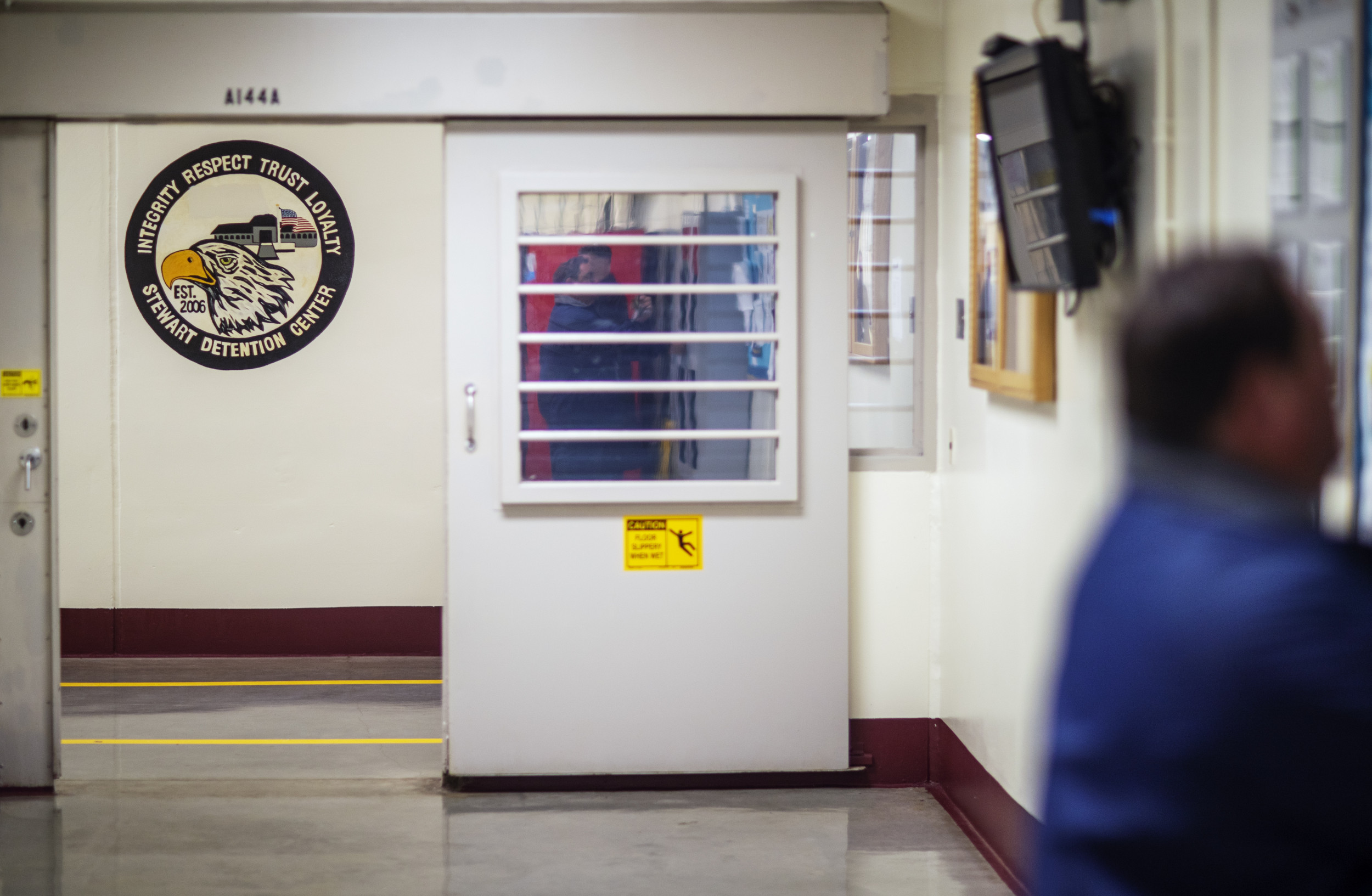
Newsweek confirmed in the ICE detainee tracker that Taylor is currently held at the Stewart Detention Center in Georgia.

Newsweek reached out to ICE for comment via email on Thursday.

Why It Matters

Taylor’s detention and potential deportation come amid an immigration crackdown under the Trump administration, with the president having pledged to launch the largest mass deportation operation in U.S. history. However, Taylor was arrested by ICE days before President Donald Trump‘s second term began.

Immigrants residing in the country both illegally and legally, with valid documentation such as green cards and visas, as well as those with criminal histories, have been detained. Many with past convictions, even from decades ago, have found themselves in ICE custody despite spending years without facing serious immigration problems. Some detainees have reported being held in inhumane and harsh conditions.

What To Know

Taylor came to the United States from Liberia as a child on a medical visa after losing both legs, according to Atlanta news station 11Alive. He has never returned to Liberia and was never granted U.S. citizenship.

On January 15, just five days before Trump took office, ICE agents, with guns reportedly drawn, arrested Taylor, his fiancée, Mildred Pierre told Fox 5 Atlanta. Taylor worked as a barber in Gwinnett County and is the father of seven children.

Taylor was arrested for burglary when he was 16, although he was later pardoned by the Georgia Board of Pardons and Parole in 2010.

“I thought I had a pardon from the state. It was all behind me in the past. They brought it up, and it was shocking to me,” Taylor told Fox 5 from his Stewart Detention Center cell in June. The center is owned by CoreCivic.

11Alive reported that state pardons don’t necessarily apply under federal immigration law, and this one did not meet the necessary thresholds for relief from deportation.

The news station said that Taylor applied for legal permanent status three times, but due to his juvenile conviction, the applications were denied. His family members are U.S. citizens living in America, according to 11Alive.

Pierre told 11Alive this month that Taylor’s August 12 hearing would be his final immigration hearing. Fox 5 reported that earlier this year, Taylor was held without proper medical care, with his prosthetics rubbing against him constantly.

What People Are Saying

Taylor’s fiancée, Mildred Pierre, told Fox 5 Atlanta: “There’s a truck that blocked me from the back, two cars come in the front, guns drawn, ‘Get out the car, get out the car.’ My kids were in the back crying. We didn’t know what was going on. It was like a scene from a movie.”

Sarah Owings, Taylor’s attorney, told Fox 5 Atlanta: “Mr. Taylor has a conviction, that’s true, but it was pardoned. It was pardoned, and moreover, he was only sentenced to probation and time served. He should not be subject to this type of detention. ICE has the ability to release all of them at their discretion.”

Tricia McLaughlin, a spokesperson for the Department of Homeland Security, said in a previous statement shared with Newsweek: “Under Secretary Noem, we are delivering on President Trump’s and the American people’s mandate to arrest and deport criminal illegal aliens to make America safe. Secretary Noem unleashed ICE to target the worst of the worst and carry out the largest deportation operation of criminal aliens in American history.”

What Happens Next

A judge has less than a month to decide whether Taylor will remain in the United States or be deported. His fiancée fears he could die if sent back to Liberia, citing his medical condition and the lack of resources there.

https://www.newsweek.com/ice-pushes-deport-double-amputee-us-over-40-years-2117336

NBC News: U.S. citizen detained by ICE in L.A. says she wasn’t given water for 24 hours

Andrea Velez was charged with assaulting a federal officer while he was attempting to arrest a suspect. The DOJ later dismissed her case.

A U.S. citizen who was detained by immigration agents and accused of obstructing an arrest before her case was ultimately dismissed said she is still traumatized by what happened.

Immigration and Customs Enforcement officers detained Andrea Velez in downtown Los Angeles on June 24. She was charged with assaulting a federal officer while he was attempting to arrest a suspect.

The Justice Department dismissed her case without prejudice. It did not immediately reply to a request for comment Tuesday.

Velez, a production coordinator for a shoe company, recalled seeing federal agents when her mother and sister dropped her off at work.

“It was like a scene,” she told NBC Los Angeles. “They were just ready to attack and chase.”

Velez said someone grabbed her and slammed her to the ground. She said that she tried to tell the agent, who was in plainclothes, that she was a citizen but that he told her she “was interfering with what he was doing, so he was going to arrest me.”

“That’s when I asked him to show me his ID, his badge number,” she said. “I asked him if he had a warrant, and he said I didn’t need to know any of that.”

A federal criminal complaint alleged that an agent was chasing a man and that Velez stepped into the agent’s path and extended her arm “in an apparent effort to prevent him from apprehending the male subject he was chasing.”

The complaint said Velez’s arm hit the agent in the face.

Velez said she denied any wrongdoing and insisted she was a U.S. citizen. She was taken to a detention center in downtown Los Angeles, where she gave officers her driver’s license and her health insurance card, but she was still booked into jail, she said.

She said she spent two days in the detention center, where she had nothing to drink for 24 hours.

Velez said that the ordeal traumatized her and that she has not been able to physically return to work.

“I’m taking things day by day,” she told NBC Los Angeles.

Her attorneys told the station that they are exploring legal options against the federal government.

Her story echoes those of others who have said they were wrongfully detained by immigration agents under President Donald Trump’s push for mass deportations.

Job Garcia, a Ph.D. student and photographer, said he was immigration agents tackled him and threw him to the ground for recording a raid at a Home Depot in Los Angeles. He was held for more than 24 hours before his release. In July, the Mexican American Legal Defense and Educational Fund said it was seeking $1 million in damages, alleging that Garcia was assaulted and falsely imprisoned.

In June, a deputy U.S. marshal was briefly detained in the lobby of a federal building in Tucson, Arizona, because he “fit the general description of a subject being sought by ICE,” the U.S. Marshals Service said in a statement.

And in May, Georgia college student Ximena Arias-Cristobal was granted bond after she was detained by immigration agents after local police pulled over the wrong car during a traffic stop.

https://www.nbcnews.com/news/rcna224493

Newsweek: ICE detains green card holder returning from vacation after 23 years in US

A Filipino immigrant and green card holder with prior criminal charges for distributing controlled substances was detained at an airport and is currently in U.S. Immigration and Customs Enforcement (ICE) custody.

Sonny Lasquite was detained after a vacation in the Bahamas by U.S. Customs and Border Protection (CBP) on July 28 at Charlotte Douglas International Airport in Charlotte, North Carolina, according to relatives who spoke with GMA News Online.

Why It Matters

Lasquite’s arrest was due to a red flag in the federal system linked to a 2012 narcotics case. ICE records reviewed by Newsweek show Lasquite currently being held at the Stewart Detention Center in Stewart County, Georgia.

Lasquite’s detention illustrated how lawful permanent residents could face immigration enforcement after arrests at ports of entry, raising questions about the consequences of past criminal convictions for long-term residents and the humanitarian impact on families that rely on detained relatives for financial and caregiving support.

What To Know

Lasquite reportedly lived in the U.S. for 23 years and worked as a banquet server in Las Vegas.

From roughly December 2010 to about August 2012, Lasquite “intentionally and knowingly” possessed with the intent to distribute Schedule IV narcotics, including diazepam, alprazolam, zolpidem and carisoprodol, according to court records in the Southern District of New York reviewed by Newsweek.

But records indicate that he promptly took responsibility for his actions and cooperated with the federal government in identifying charged and uncharged co-conspirators. A 2014 sentencing memorandum by former U.S. Attorney Preet Bharara said that Lasquite helped stop narcotics distribution practices and led to the prosecutions of others.

“You are, as the government points out, the only defendant who cooperated,” Bharara said on September 9, 2014. “You did that at some risk to yourself. I think there needs to be recognition of that and proportionate sentencing between you and the other defendants.

“I feel pretty confident that you’re not going to commit any crimes in the future, and I join the government in wishing you well and hopefully being able to put this behind you.”

The court ultimately sentenced Lasquite to time served and no additional prison time, ordering him to pay $200.

Lasquite has put that time of his life behind him, according to family and friends, who created a GoFundMe on Saturday to raise $30,000 for legal representation, filing fees, and “essential expenses to fight for Sonny’s right to remain in the U.S. and reunite with his family.”

As of Monday morning, nearly $11,600 had been raised from 56 donations. The fundraiser was started by Vivian Hirano, of Las Vegas, who writes that Lasquite “has had no further legal troubles and has been a law-abiding, contributing member of his community” since his 2012 criminal conviction.

Newsweek reached out to Hirano via the GoFundMe page for comment.

“Sonny Lasquite is more than a name—he is a beloved son, brother, uncle and friend whose kindness has touched countless lives,” the GoFundMe says. “For decades, Sonny has lived peacefully in the United States, working hard, caring for his elderly mother, and always putting others before himself. He is the kind of person who never hesitates to help, greet you with a warm smile, or offer comfort when you need it most.”

Aside from Lasquite’s detention causing his mother’s health to “decline under the weight of this stress,” his own health is reportedly taking a toll. Lasquite has purportedly faced medical neglect during detention, including delayed access to his blood pressure medication and proper care for his recent fever, according to Hirono.

What People Are Saying

Immigration attorney Rosanna Berardi told Newsweek on Monday that cases like these are “not new and have been happening for decades.”

She said: “Under current U.S. immigration law, lawful permanent residents—even those who have lived in the country for most of their lives—remain vulnerable to removal proceedings if they are convicted of certain drug-related offenses. This is true regardless of how much time has passed since the conviction or how significantly they have contributed to their communities in the years afterward.

“Because of this, we strongly encourage our clients to pursue U.S. citizenship as soon as they are eligible. Naturalized citizens cannot be deported for criminal convictions in the same way, providing a crucial safeguard against the devastating consequences of removal.”

Vivian Hirano on Sonny Lasquite’s GoFundMe page: “Sonny is the primary breadwinner of his family, providing both financial and emotional support to his loved ones. His income helps cover essential expenses, including his elderly mother’s medical needs and daily living costs.”

Department of Homeland Security Secretary Kristi Noem on Friday in Illinois called allegations of ICE detaining immigrants without criminal convictions “false,” according to NewsNation: “I’m here today because elected leaders in Illinois are ignoring the law. In fact, they’re being obstructionists when it comes to getting dangerous criminals off of their streets. They’re deciding that dangerous criminals that are murderers, rapists, money launderers, have committed assaults, and that are trafficking children are more important than the families who live in the communities here.”

What Happens Next

Lasquite’s case was pending in immigration custody, and his legal options were constrained by immigration statutes that treat certain controlled-substance convictions as grounds for removal.

https://www.newsweek.com/ice-illegal-immigration-filipino-detained-criminal-2111738

Another article:

https://www.msn.com/en-us/news/crime/outrage-sparked-over-ice-detention-conditions/ss-AA1KGVSw

LA Times: California took center stage in ICE raids, but other states saw more immigration arrests

Ever since federal immigration raids ramped up across California, triggering fierce protests that prompted President Trump to deploy troops to Los Angeles, the state has emerged as the symbolic battleground of the administration’s deportation campaign.

But even as arrests soared, California was not the epicenter of Trump’s anti-immigrant project.

In the first five months of Trump’s second term, California lagged behind the staunchly red states of Texas and Florida in the total arrests. According to a Los Angeles Times analysis of federal Immigration and Customs Enforcement data from the Deportation Data Project, Texas reported 26,341 arrests — nearly a quarter of all ICE arrests nationally — followed by 12,982 in Florida and 8,460 in California.

Even in June, when masked federal immigration agents swept through L.A., jumping out of vehicles to snatch people from bus stops, car washes and parking lots, California saw 3,391 undocumented immigrants arrested — more than Florida, but still only about half as many as Texas.

When factoring in population, California drops to 27th in the nation, with 217 arrests per million residents — about a quarter of Texas’ 864 arrests per million and less than half of a whole slew of states including Florida, Arkansas, Utah, Arizona, Louisiana, Oklahoma, Tennessee, Georgia, Virginia and Nevada.

The data, released after a Freedom of Information Act lawsuit against the government, excludes arrests made after June 26 and lacks identifying state details in 5% of cases. Nevertheless, it provides the most detailed look yet of national ICE operations.

Immigration experts say it is not surprising that California — home to the largest number of undocumented immigrants in the nation and the birthplace of the Chicano movement — lags behind Republican states in the total number of arrests or arrests as a percentage of the population.

“The numbers are secondary to the performative politics of the moment,” said Austin Kocher, a geographer and research assistant professor at Syracuse University who specializes in immigration enforcement.

Part of the reason Republican-dominated states have higher arrest numbers — particularly when measured against population — is they have a longer history of working directly with ICE, and a stronger interest in collaboration. In red states from Texas to Mississippi, local law enforcement officers routinely cooperate with federal agents, either by taking on ICE duties through so-called 287(g) agreements or by identifying undocumented immigrants who are incarcerated and letting ICE into their jails and prisons.

Indeed, data show that just 7% of ICE arrests made this year in California were made through the Criminal Alien Program, an initiative that requests that local law enforcement identify undocumented immigrants in federal, state and local prisons and jails.

That’s significantly lower than the 55% of arrests in Texas and 46% in Florida made through prisons or jails. And other conservative states with smaller populations relied on the program even more heavily: 75% of ICE arrests in Alabama and 71% in Indiana took place via prisons and jails.

“State cooperation has been an important buffer in ICE arrests and ICE operations in general for years,” said Ariel Ruiz Soto, a Sacramento-based senior policy analyst at the Migration Policy Institute. “We’ve seen that states are not only willing to cooperate with ICE, but are proactively now establishing 287(g) agreements with their local law enforcement, are naturally going to cast a wider net of enforcement in the boundaries of that state.”

While California considers only some criminal offenses, such as serious felonies, significant enough to share information with ICE; Texas and Florida are more likely to report offenses that may not be as severe, such as minor traffic infractions.

Still, even if fewer people were arrested in California than other states, it also witnessed one of the most dramatic increases in arrests in the country.

California ranked 30th in ICE arrests per million in February. By June, the state had climbed to 10th place.

ICE arrested around 8,460 immigrants across California between Jan. 20 and June 26, a 212% increase compared with the five months before Trump took office. That contrasts with a 159% increase nationally for the same period.

Much of ICE’s activity in California was hyper-focused on Greater Los Angeles: About 60% of ICE arrests in the state took place in the seven counties in and around L.A. during Trump’s first five months in office. The number of arrests in the Los Angeles area soared from 463 in January to 2,185 in June — a 372% spike, second only to New York’s 432% increase.

Even if California is not seeing the largest numbers of arrests, experts say, the dramatic increase in captures stands out from other places because of the lack of official cooperation and public hostility toward immigration agents.

“A smaller increase in a place that has very little cooperation is, in a way, more significant than seeing an increase in areas that have lots and lots of cooperation,” Kocher said.

ICE agents, Kocher said, have to work much harder to arrest immigrants in places like L.A. or California that define themselves as “sanctuary” jurisdictions and limit their cooperation with federal immigration agents.

“They really had to go out of their way,” he said.

Trump administration officials have long argued that sanctuary jurisdictions give them no choice but to round up people on the streets.

Not long after Trump won the 2024 election and the L.A. City Council voted unanimously to block any city resources from being used for immigration enforcement, incoming border enforcement advisor Tom Homan threatened an onslaught.

“If I’ve got to send twice as many officers to L.A. because we’re not getting any assistance, then that’s what we’re going to do,” Homan told Newsmax.

With limited cooperation from California jails, ICE agents went out into communities, rounding up people they suspected of being undocumented on street corners and at factories and farms.

That shift in tactics meant that immigrants with criminal convictions no longer made up the bulk of California ICE arrests. While about 66% of immigrants arrested in the first four months of the year had criminal convictions, that percentage fell to 30% in June.

The sweeping nature of the arrests drew immediate criticism as racial profiling and spawned robust community condemnation.

Some immigration experts and community activists cite the organized resistance in L.A. as another reason the numbers of ICE arrests were lower in California than in Texas and even lower than dozens of states by percentage of population.

“The reason is the resistance, organized resistance: the people who literally went to war with them in Paramount, in Compton, in Bell and Huntington Park,” said Ron Gochez, a member of Unión del Barrio Los Angeles, an independent political group that patrols neighborhoods to alert residents of immigration sweeps.

“They’ve been chased out in the different neighborhoods where we organize,” he said. “We’ve been able to mobilize the community to surround the agents when they come to kidnap people.”

In L.A., activists patrolled the streets from 5 a.m. until 11 p.m., seven days a week, Gochez said. They faced off with ICE agents in Home Depot parking lots and at warehouses and farms.

“We were doing everything that we could to try to keep up with the intensity of the military assault,” Gochez said. “The resistance was strong. … We’ve been able, on numerous occasions, to successfully defend the communities and drive them out of our community.”

The protests prompted Trump to deploy the National Guard and Marines in June, with the stated purpose of protecting federal buildings and personnel. But the administration’s ability to ratchet up arrests hit a roadblock on July 11. That’s when a federal judge issued a temporary restraining order blocking immigration agents in Southern and Central California from targeting people based on race, language, vocation or location without reasonable suspicion that they are in the U.S. illegally.

That decision was upheld last week by the 9th U.S. Circuit Court of Appeals. But on Thursday, the Trump administration petitioned the Supreme Court to lift the temporary ban on its patrols, arguing that it “threatens to upend immigration officials’ ability to enforce the immigration laws in the Central District of California by hanging the prospect of contempt over every investigative stop.”

The order led to a significant drop in arrests across Los Angeles last month. But this week, federal agents carried out a series of raids at Home Depots from Westlake to Van Nuys.

Trump administration officials have indicated that the July ruling and arrest slowdown do not signal a permanent change in tactics.

“Sanctuary cities are going to get exactly what they don’t want: more agents in the communities and more work site enforcement,” Homan told reporters two weeks after the court blocked roving patrols. “Why is that? Because they won’t let one agent arrest one bad guy in the jail.”

U.S. Border Patrol Sector Chief Gregory Bovino, who has been leading operations in California, posted a fast-moving video on X that spliced L.A. Mayor Karen Bass telling reporters that “this experiment that was practiced on the city of Los Angeles failed” with video showing him grinning. Then, as a frenetic drum and bass mix kicked in, federal agents jump out of a van and chase people.

“When you’re faced with opposition to law and order, what do you do?” Bovino wrote. “Improvise, adapt, and overcome!”

Clearly, the Trump administration is willing to expend significant resources to make California a political battleground and test case, Ruiz Soto said. The question is, at what economic and political cost?

“If they really wanted to scale up and ramp up their deportations,” Ruiz Soto said, “they could go to other places, do it more more safely, more quickly and more efficiently.”

https://www.latimes.com/california/story/2025-08-10/california-was-center-stage-in-ice-raids-but-texas-and-florida-each-saw-more-immigration-arrests