President Donald Trump signed an executive order on Friday that would let the U.S. designate nations as state sponsors of wrongful detention, using the threat of associated sanctions to deter Americans from being detained abroad or taken hostage.
…. two senior administration officials who spoke on condition of anonymity ahead of the order being signed cited China, Afghanistan, Iran and Russia as nations that could potentially face penalties under the new designation.
Tag Archives: iran
CNN: US considers banning Iranian diplomats from shopping at Costco during UN meeting
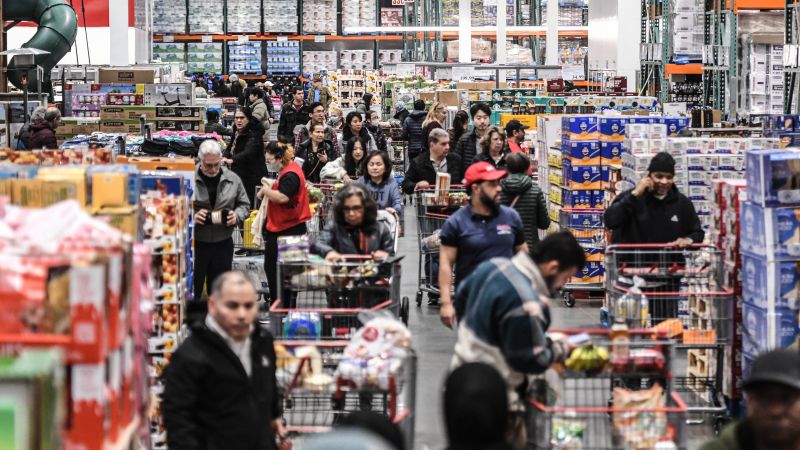
… The movements of Iranian diplomats are severely limited in New York, but one proposal being floated would bar them from shopping at big, members-only wholesale stores like Costco and Sam’s Club without first receiving the express permission of the State Department.
Such stores have been a favorite of Iranian diplomats posted to and visiting New York because they are able to buy large quantities of products not available in their economically isolated country for relatively cheap prices and send them home.
It was not immediately clear if or when the proposed shopping ban for Iran would take effect, but the memo said the State Department also was looking at drafting rules that would allow it to impose terms and conditions on memberships in wholesale clubs by all foreign diplomats in the US….
So what’s to stop them from pre-ordering a shitload of stuff from Amazon and having it delivered to their hotel?
Being so mean and petty seems pointless to me. It only reinforces the idea we are enemies. Smother them with kindness and let them go shopping, and you might change their impressions of the United States.

https://www.cnn.com/2025/09/05/middleeast/us-ban-iranians-shopping-costco-during-un-latam-intl
CNN: End of an era: Billions of packages of ‘cheap’ goods shipped to the US are now subject to steep tariffs
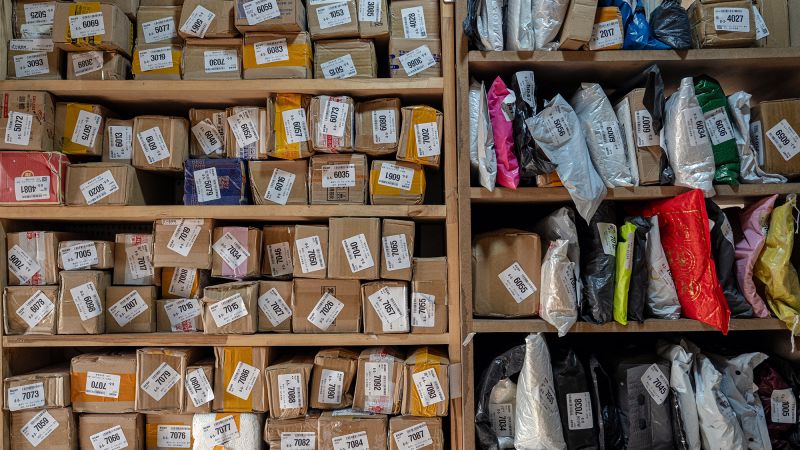
A big change to all the “cheap goods” Americans order just went into effect.
For nearly a century, low-value packages of goods from abroad have entered the United States duty free, thanks to what’s known as the “de minimis rule,” which as of 2015 has applied to packages worth less than $800.
The loophole has reshaped the way countless Americans shop, enabling many small businesses globally to sell goods to US consumers with relative ease and allowing, in particular, ultra-low-cost Chinese e-commerce sites like Shein, Temu and AliExpress to sell everything from clothing to furniture to electronics directly to American shoppers, escaping many duties in place for packages exceeding the $800 threshold.
But those days are over. As of one minute past midnight Eastern Time, all imported goods — regardless of their value — are now subject to 10% to 50% tariff rates, depending on their country of origin. (In certain cases, they could face a flat fee of $80 to $200, but only for the next six months.)
A headache for delivery services
Ahead of the expiration of the de minimis rule, a slew of delivery services across Europe, as well as Japan, Australia, Taiwan and Mexico suspended deliveries to the United States, citing logistical compliance challenges.
International shipper UPS, meanwhile, said in a statement to CNN Thursday: “We stand ready for the new changes and do not anticipate any backlogs or delays.”
DHL, which suspended service for standard parcel shipments from Germany but is continuing to ship international packages to the United States from all other countries it serves, told CNN that shipments “may experience delays during the transitional period as all parties adjust to the changes in tariff policy and regulation.”
The United States Postal Service and FedEx declined to comment on whether customers should anticipate delays.
“Our systems are fully programmed and equipped to support the seamless implementation of these changes. CBP has prepared extensively for this transition and stands ready with a comprehensive strategy, having provided clear and timely guidance to supply chain partners, including foreign postal operators, carriers, and qualified third parties to ensure compliance with the new rules.
Susan Thomas, the acting executive assistant commissioner for Customs and Border Protection’s Office of Trade, told CNN in a statement that the agency’s systems “are fully programmed and equipped to support the seamless implementation of these changes.”
“CBP has prepared extensively for this transition and stands ready with a comprehensive strategy, having provided clear and timely guidance to supply chain partners, including foreign postal operators, carriers, and qualified third parties to ensure compliance with the new rules,” she said.
A potential benefit for some American small businesses
While some small businesses, like some individual consumers, have benefited from the de minimis exemption by purchasing goods duty-free, the end of the exemption may benefit some, too.
For Steve Raderstorf, co-owner of Scrub Identity, which sells scrubs and other medical apparel at two stores located in Indianapolis, the tariff change will “level the playing field” for him and, he believes, other small business owners, he said.
A 2023 report by Coalition for a Prosperous America, a group that advocates for US producers and manufacturers, estimates that e-commerce giants like Amazon and Walmart took in hundreds of billions of dollars in revenue in 2022 through their networks of third-party sellers who took advantage of the loophole.
Raderstorf said almost all the goods he sells are imported. But as a small business, he doesn’t have the ability to set up a third-party network to tap into the exemption. Instead, his imported goods are all subject to applicable tariffs.
Additionally, many of the foreign manufacturers from whom he purchases goods in bulk in order to get a better price have benefited from de minimis by setting up sites to sell directly to people who could have otherwise shopped at his stores.
With de minimis gone, he feels small businesses have a better chance to compete more fairly with mega retailers and also support their local communities more.
“When somebody comes to my door and they want me to support the local football team or baseball team, I have money to do that then, and then it gets back into the community,” he told CNN. “When it goes to China, it never, ever stays in the United States — it’s gone for good.”
Since the de minimis exemption was closed for China and Hong Kong, CBP has seen packages that would have otherwise qualified for duty-free status go down from an average of 4 million a day to 1 million, White House officials told reporters Thursday.
Raderstorf is empathetic to Americans who are concerned about the increased cost of goods — but at the same time, he’s hopeful it’s “going to push them back out into their communities to meet their local retailers.”
Newsweek: Donald Trump Nobel Peace Prize comment raises eyebrows
Acomment suggesting President Donald Trump should be awarded the Nobel Peace Prize has raised eyebrows.
Social media users have reacted to Steve Witkoff, Trump’s special envoy to the Middle East, suggesting that the president has been overlooked for the prestigious award.
Why It Matters
Since 2018, Trump has been nominated for the Nobel Peace Prize, which recognizes an individual or organization that has managed to “advance fellowship between nations,” multiple times but has not won.
Only four U.S. presidents have won the award, which is among the world’s most prominent international honors. President Barack Obama received a Nobel Peace Prize in 2009, eight months into his presidency—a move Donald Trump Jr. described as “affirmative action.”
In the past few months, Trump and his allies have argued in support of the president’s worthiness as a candidate, citing foreign policy interventions his administration has been involved in.
What To Know
Speaking at a Cabinet meeting, Witkoff said: “There’s only one thing I wish for—that the Nobel committee finally gets its act together and realizes that you are the single finest candidate since this Nobel award was ever talked about. Your success is game-changing out in the world today, and I hope everybody wakes up and realizes that.”
Several campaign groups and figures responded negatively to Witkoff’s comments.
The X account Republicans Against Trump wrote, “Nobel Peace Prize for what exactly?”
Call to Activism, a progressive political account, called the applause that followed Witkoff’s comments “North Korea-style” and “terrifying.”
User Alok Bhatt told 91,000 followers, “It is astonishing to see the great American empire crumble before our eyes—brick by brick, piece by piece.”
User Ron Smith, a self-described “proud Democrat,” wrote, “Hard to believe this is not a North Korean cabinet.”
What People Are Saying
Mark Shanahan, who teaches American politics at the University of Surrey in the U.K., told Newsweek: “The Trump Cabinet is an exercise in obsequious forelock tugging where each member aims to outdo the rest in fawning flattery at the feet of the president. For all his talk, Donald Trump has done little to end the cruelly attritional war in Ukraine following Putin’s invasion, while he continues to support Netanyahu’s total war in Gaza.
“Nobel seeks to support fraternity between nations. With his America First policies, 47 is the antithesis of this.”
President Donald Trump complained about the prize on Truth Social in June: “No, I won’t get a Nobel Peace Prize no matter what I do, including Russia/Ukraine, and Israel/Iran, whatever those outcomes may be, but the people know, and that’s all that matters to me.”
White House press secretary Karoline Leavitt said in a July news briefing: “It is well past time that President Trump was awarded the Nobel Peace Prize.”
Representative Claudia Tenney, a Republican from New York, wrote on X in June: “I’ve officially nominated President Trump for the Nobel Peace Prize twice! He has done more for world peace than any modern leader.”
What Happens Next
The deadline to nominate candidates for the 2025 Nobel Peace Prize passed on January 31. Nobel Prize laureates are scheduled to be announced on October 10, with an award ceremony following on December 10 in Oslo, Norway.

https://www.newsweek.com/donald-trump-nobel-peace-prize-steve-witkoff-2119969
Slingshot News: ‘I Thought We’d Have That Settled Easier’: Trump Demonstrates His Incompetence, Defends His Failed Negotiations With Russia During Press Conference
Raw Story: ‘Nuts!’ Ex-GOP lawmaker tees off after Trump calls himself a ‘war hero’
A former member of Congress unloaded on CNN on Tuesday evening after the president referred to himself as a “war hero” during a radio interview.
During an interview with conservative radio host Mark Levin, President Donald Trump described Israeli Prime Minister Benjamin Netanyahu as a “war hero” for his actions in Gaza. Trump added that he should also be known as a war hero because he approved of the bombing mission that destroyed Iran’s nuclear facility.
“Nobody cares, but I am too,” Trump said, referring to himself as a hero. “I sent those planes.”
Adam Kinzinger, a former Air National Guard officer, discussed Trump’s comments on CNN’s “Erin Burnett OutFront.”
“This is nuts!” Kinzinger, who represented Illinois in Congress as a Republican for more than a decade, shouted. “This is nuts, and his people are going to find a way to justify this.”
“Listen, when they were putting out something honoring the Army’s 250th anniversary, they put out a picture of Donald Trump in his military academy uniform,” he continued. “Which has nothing to do with the military except that they drill you.”
“This is nuts. He’s not a war hero,” Kinzinger said. “You can like what he’s done. That’s fine. I hope he gets a resolution in Ukraine, but to put himself on the same level as people who have actually gone out and served this country, not claimed bone spurs, is an offense to anybody who’s served.”
Slingshot News: ‘I Will Find Out’: Pam Bondi Exposes Her Incompetence, Admits She Has Not Secured Sensitive FBI Data In House Hearing
CNN: US military deploying over 4,000 additional troops to waters around Latin America as part of Trump’s counter-cartel mission
The US military is deploying more than 4,000 Marines and sailors to the waters around Latin America and the Caribbean as part of a ramped-up effort to combat drug cartels, two US defense officials told CNN — a dramatic show of force that will give the president a broad range of military options should he want to target drug cartels.
The deployment of the Iwo Jima Amphibious Ready Group (ARG) and the 22nd Marine Expeditionary Unit to US Southern Command, which has not been previously reported, is part of a broader repositioning of military assets to the SOUTHCOM area of responsibility that has been underway over the last three weeks, one of the officials said.
A nuclear-powered attack submarine, additional P8 Poseidon reconnaissance aircraft, several destroyers and a guided-missile cruiser are also being allocated to US Southern Command as part of the mission, the officials said.
A third person familiar with the matter said the additional assets are “aimed at addressing threats to US national security from specially designated narco-terrorist organizations in the region.”
On Friday, the US Navy announced the deployment of the USS Iwo Jima, the 22nd MEU, and the two other ships in the Amphibious Ready Group — the USS Fort Lauderdale and the USS San Antonio — but did not say where they were going.
One of the officials emphasized that the military buildup is for now mostly a show of force, aimed more at sending a message than indicative of any intention to conduct precision targeting of cartels. But it also gives US military commanders — and the president — a broad range of options should Trump order military action. The ARG/MEU, for example, also features an aviation combat element.
The deployment of the Marine Expeditionary Unit, however, has raised concerns among some defense officials who worry that the Marines are not trained to conduct drug interdictions and counter drug-trafficking. If that is part of their mission set, they will have to lean heavily on the Coast Guard, officials said.
MEUs have been instrumental in the past in supporting large-scale evacuation operations; a MEU was stationed for months in the eastern Mediterranean, for example, amid tensions between Israel, Hamas and Iran.
A Marine official told CNN that the MEU “stands ready to execute lawful orders and support the combatant commanders in the needs that are requested of them.”
The US military deployed destroyers to the areas around the US-Mexico border in March to support US Northern Command’s border security mission and reinforce the US’ presence in the western hemisphere. The additional assets being moved now, however, will fall under US Southern Command, and are set to support SOUTHCOM for at least the next several months, one of the officials said.
CNN previously reported that a memo signed by Defense Secretary Pete Hegseth earlier this year stated that the US military’s “foremost priority” is to defend the homeland, and instructed the Pentagon to “seal our borders, repel forms of invasion including unlawful mass migration, narcotics trafficking, human smuggling and trafficking, and other criminal activities, and deport illegal aliens in coordination with the Department of Homeland Security.”
The same memo also formally asked Pentagon officials for “credible military options” to ensure unfettered American access to the Panama Canal, CNN reported at the time.
So when do we invade Mexico, our future 52nd state (after Canada)?

https://www.cnn.com/2025/08/15/politics/us-military-deploying-caribbean-latin-america-cartel-mission
Newsweek: Trump administration announces major tourist visa change
The State Department is proposing a rule requiring some business and tourist visa applicants to post a bond of up to $15,000 to enter the United States, a step critics say could put the process out of reach for many.
According to a notice set for publication on Tuesday in the Federal Register, the department plans a 12‑month pilot program targeting applicants from countries with high visa overstay rates and weak internal document security.
Under the plan, applicants could be required to post bonds of $5,000, $10,000 or $15,000 when applying for a visa.
Why It Matters
This move marks a significant escalation in the Trump administration’s approach to immigration enforcement and revisits a controversial measure briefly introduced during Trump’s first term.
A previous version of the policy was issued in November 2020, but was never fully enacted due to the collapse in global travel during the COVID-19 pandemic. That version targeted about two dozen countries, most of them in Africa, with overstay rates exceeding 10 percent.
What To Know
The new visa bond program will take effect on August 20, according to documents reviewed by Newsweek and a notice previewed Monday on the Federal Register website. The Department of Homeland Security says the goal is to ensure the U.S. government doesn’t incur costs when a visitor violates visa terms.
“Aliens applying for visas as temporary visitors for business or pleasure and who are nationals of countries identified by the department as having high visa overstay rates, where screening and vetting information is deemed deficient, or offering citizenship by investment, if the alien obtained citizenship with no residency requirement, may be subject to the pilot program,” it said.
Under the plan, U.S. consular officers can require a bond from visa applicants who meet certain criteria. This includes nationals of countries with high visa overstay rates, countries with deficient screening and vetting, and those that offer citizenship-by-investment programs, particularly where citizenship is granted without a residency requirement.
Visitors subject to the bond will receive it back upon leaving the U.S., naturalizing as a citizen, or in the event of death. If a traveler overstays, however, the bond may be forfeited and used to help cover the costs associated with their removal.
Citizens of countries in the Visa Waiver Program are exempt, and consular officers will retain the discretion to waive the bond on a case-by-case basis.
What Countries Could End Up Being Affected
The U.S. government has not provided an estimate of how many applicants may be affected. However, 2023 data from U.S. Customs and Border Protection shows that countries with particularly high visa overstay rates include Angola, Liberia, Mauritania, Sierra Leone, Nigeria, Cabo Verde, Burkina Faso, and Afghanistan.
The list of affected countries will be published at least 15 days before the program begins and may be updated with similar notice. In the 2020 version of the pilot, countries such as Afghanistan, Angola, Burkina Faso, Burma (Myanmar), Chad, Congo, Eritrea, Iran, Laos, Liberia, Libya, Sudan, Syria, and Yemen were included.
What People Are Saying
The public notice stated: “The Pilot Program will help the Department assess the continued reliance on the untested historical assumption that imposing visa bonds to achieve the foreign policy and national security goals of the United States remains too cumbersome to be practical.”
Andrew Kreighbaum, a journalist covering immigration, posted on X: “It’s getting more expensive for many business and tourist travelers to enter the U.S. On top of new visa integrity fees, the State Department is imposing visa bonds as high as $15,000.”
What Happens Next
Visa bonds have been proposed in the past but have not been implemented. The State Department has traditionally discouraged the requirement because of the cumbersome process of posting and discharging a bond and because of possible misperceptions by the public.
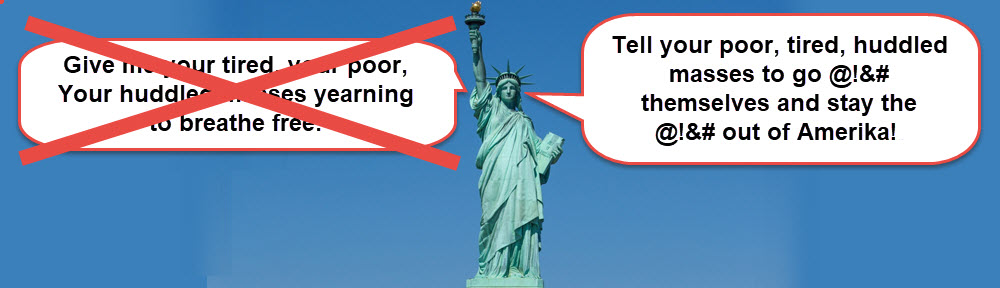
There’s always a country that wants your money — go where you’re wanted and the heck with Amerika!

https://www.newsweek.com/trump-admin-visas-tourist-business-major-change-2108642
Washington Post: He left Iran 40 years ago. He may be deported to Romania. Or Australia.
The withholding of a removal order that Reza Zavvar felt protected him from deportation is now being wielded by the Trump administration to send him to a country he doesn’t know.
Sharp knocks on the front door interrupted Firouzeh Firouzabadi’s Saturday morning coffee. On the porch of her suburban Maryland home were two law enforcement agents and a very familiar pit bull mix named Duke.
“Can you take this dog?” Firouzabadi recalled one of the men saying. “I said, ‘This is my son’s dog. Where is he?’ They wouldn’t say.”
At that moment, her adult son, Reza Zavvar, was handcuffed in the back of an SUV parked two houses down in the Gaithersburg neighborhood where the Iranian-born family has lived since 2009 — apprehended, he later said, that late June day by at least five federal immigration agents in tactical gear who told Zavvar they had been waiting for him to take Duke out for his regular morning walk.
More than a month later, Zavvar, 52, remains in U.S. Immigration and Customs Enforcement custody,part of a surge of arrests of immigrants with standing court orders barring their deportation to their native countries.
The Trump administration has increasingly turned to sending people to third countries. In court papers, ICE said it plans to send Zavvar to Australia or Romania. He has no ties to either place.
Zavvar left Tehran alone when he was 12, arriving in Virginia in 1985 on a student visa secured by his parents as a way to escape eventual conscription into the Iranian army. He eventually received U.S. asylum, and then a green card.
His family joined him and they settled in Maryland, but in his 20s, Zavvar’s guilty pleas in two misdemeanor marijuana possession cases jeopardized his immigration status. In 2007, an immigration judge issued a withholding of removal order, determining it was unsafe for Zavvar to return to Iran. He built a life, went to college and has been working as a white-collar recruiter for a consulting firm.
…
So he pleaded guilty 27 years ago to a couple marijuana possessions charges (legal today in 24-40 states, depending on purpose of usage) and now ICE wants to deport him to a third country (possibly Romania or Australia).
Click one of the links below to read the rest of the article.
https://www.washingtonpost.com/immigration/2025/08/03/immigration-arrests-third-country-removals