Reason: Woman Who Died of Heart Disease in ICE Custody Reportedly Told Son She Wasn’t Allowed to See Doctor for Chest Pains

Questions about the death of Marie Blaise at a South Florida ICE detention center have lingered since she collapsed in April.

A woman who died of a heart attack in a federal immigration detention facility in South Florida told her son over the phone on the day she died that staff refused to let her see a physician for chest pains, her son told a county investigator.

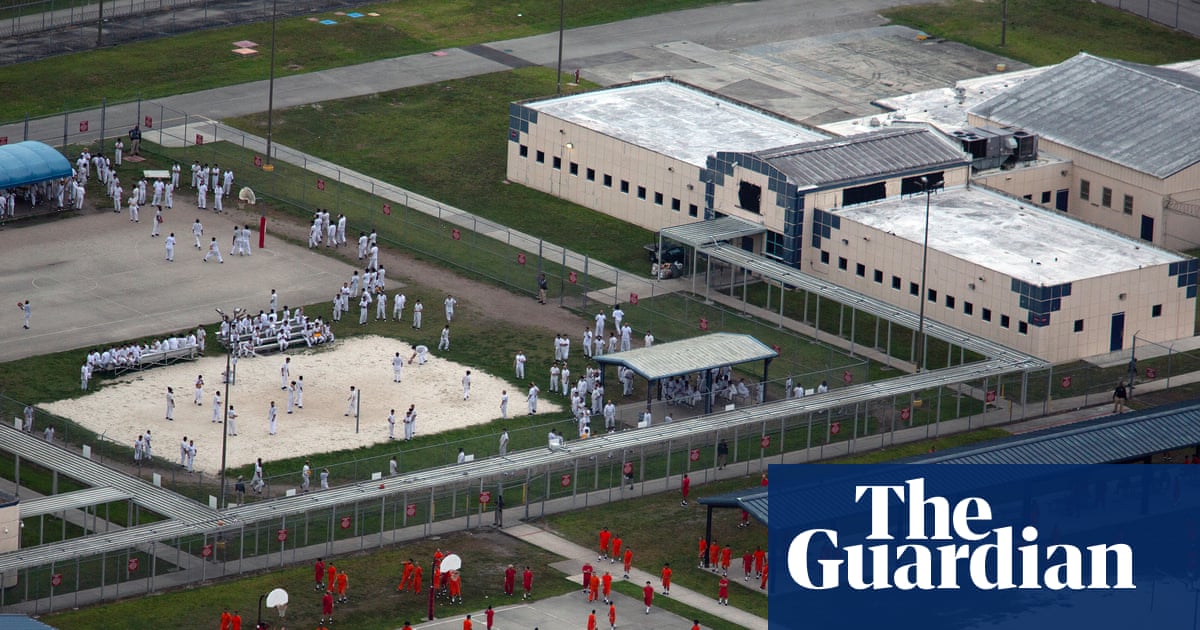
Marie Ange Blaise, a 44-year-old Haitian national, died on April 25 at the Broward Transitional Center (BTC)—a privately run facility in Pompano Beach, Florida, that contracts with Immigration and Customs Enforcement (ICE). A medical examiner’s report obtained by Reason through a public records request concluded that she died of natural causes from cardiovascular disease.

An investigator for the Broward County Medical Examiner’s Office interviewed Blaise’s son, Kervens Blaise, who said his mother reported being denied medical care.

“I asked Kervens when he last spoke with his mother and said on Friday, 4/25/25 at 2:54 pm (California time),” the investigator wrote in the report. “At that time, did his mother complained of any health issues and he states she complained of having chest pains and abdominal cramps, and when she asked the detention staff to see a physician, they refused her. Kervens states his mother has been experiencing the chest pains for about a month now.”

Blaise also reportedly told several other detainees that she wasn’t feeling well that day.

Blaise was first detained by ICE on February 14 and was transferred to several different ICE detention centers before being sent to BTC in early April.

An official ICE narrative of Blaise’s medical history during her detention states that she had a history of high blood pressure and kidney disease, and that she repeatedly refused to take prescribed medication. According to the ICE report, Blaise saw medical providers three times between her arrival at BTC on April 5 and her death on April 25.

However, BTC detainees who witnessed Blaise collapse said there was also a slow staff response. 

In a report on inhumane conditions at South Florida ICE detention centers recently published by several human rights and legal aid groups, a former BTC detainee identified only as “Rosa” told researchers that she heard a scream from a nearby cell and saw Blaise kneeling on the ground.

“We started yelling for help, but the guards ignored us,” Rosa told the report authors. “Finally, one officer approached slowly, looked at her without intervening, and then walked away. After that, it took eight minutes for the medical provider to arrive, and then another 15 or 20 before the rescue team came. By then, she was not moving.”

Lawyers and detainees have repeatedly alleged medical neglect by staff at ICE facilities in South Florida, including BTC, the Krome Detention Center, and the Federal Detention Center Miami. 

Harpinder Chauhan, a British entrepreneur who was detained by ICE this spring and eventually deported, told the report’s researchers that BTC staff regularly refused to give him his insulin. 

Chauhan eventually collapsed while standing in the dinner line at BTC, leading to him being hospitalized for three days. Chauhan’s son said that hospital and ICE staff would not give him any information on his father’s condition, and he eventually learned his father had been registered under a false name.

A former detainee, whose lawyer requested that he only be identified as “A.S.,” tells Reason he spent four days in an overcrowded holding cell with 50 to 60 other people at the Krome Detention Center.

“There was a dude, he passed out. He was crying for his medicine for like two or three days,” A.S. says. “They didn’t give him his medicine until he finally passed out, right before they were gonna put him on the plane.”

Another man detained at Krome told the report’s authors that the only way he could get guards to believe he was suffering from an excruciating hernia was to throw himself on the floor. Prison staff eventually wheeled him to the medical team, where the doctor on duty told him he “likely just had gas” and offered him “a Pepto-Bismol and two Tylenols.” The detainee refused to leave until the doctor eventually agreed to send him to a hospital, where he received a CAT scan that found he had a strangulated abdominal wall hernia. “The doctor [at the hospital] told me that if I had not come in then, my intestines would have likely ruptured,” the man said.

Blaise’s death led to condemnations and calls for investigations from Florida Democrats, such as Rep. Frederica Wilson (D–Miami Gardens).

“Marie is just an example of what is going to continue to happen,” Wilson said after touring BTC in May. “This is something we’re going to continue to see. It’s going to get more crowded. It’s going to continue to have more deaths. It’s going to continue to have more children without their parents.”

https://reason.com/2025/07/30/woman-who-died-of-heart-disease-in-ice-custody-reportedly-told-son-she-wasnt-allowed-to-see-doctor-for-chest-pains

USA Today: Immigrants forced to eat ‘like a dog’ in detention centers

Forced to eat the day’s only meal “like a dog,” with their hands shackled behind their back. Detained for days with nothing but shoes for a pillow and no other bedding ‒ just cold, concrete floors and constant fluorescent lighting. Medical care that denied a man with diabetes insulin for a week and may have contributed to at least one death.  

A Human Rights Watch report says three Miami immigrant detention facilities have subjected people to conditions so inhumane they have become, at times, life-threatening. Many ICE detention facilities are becoming overcrowded and conditions are deteriorating, according to the July 21 report.

The report, which drew from the testimonials of 17 detainees, examined conditions since President Donald Trump took office in January. Investigators say conditions at the Krome North Processing Center, Federal Detention Center and Broward Transitional Center flout international law on holding people in immigrant detention and federal government standards.

The conditions for people held in the detention facilities “are not the way that any legitimate, functioning government should treat people within its custody,” report author and editor Alison Leal Parker, deputy director of the Human Rights Watch’s US Program, said.

While the facilities have had issues predating this administration, Parker said Trump administration officials have been unwilling to uphold standards to properly treat immigrant detainees. The conditions indicate the system is “overwhelmed, overcrowded and chaotic,” she said.

Tricia McLaughlin, assistant secretary for public affairs at the Department of Homeland Security, said claims of subprime conditions at Immigration and Customs Enforcement detention centers are “FALSE.”

“All detainees are provided with proper meals, medical treatment, and have opportunities to communicate with their family members and lawyers,” McLaughlin said in an emailed statement. “Ensuring the safety, security, and well-being of individuals in our custody is a top priority at ICE. ICE has higher detention standards than most U.S. prisons that hold actual U.S. citizens.”

Southern, Republican-led states have emerged as key partners in the Trump administration’s immigration crackdown. Florida stood up a tent city called “Alligator Alcatraz.” Georgia is expanding its largest ICE detention center. And Louisiana is hosting the most dedicated ICE facilities outside Texas.

Time at all three facilities

Entrepreneur Harpinder Singh Chauhan, 56, spent time at all three facilities during nearly four months as a detainee, beginning in February. 

The British national, who first entered the country on an E-2 investor visa in 2016, opened small businesses in Florida. One of them failed ‒ a franchise of Dickey’s Barbecue Pit, which also bankrupted many other franchisees. He and his wife were seeking permanent residency through a valid EB-5 visa petition when their business collapsed.

While Chauhan was never convicted of crimes, he was ordered to pay restitution to Florida for tax issues, court records show. In February, he was turned over to ICE after a routine probation check-in.

At the Krome facility, he spent days in cold, crowded processing cells without beds or showers. He said he was denied medical care, including insulin for his diabetes and an inhaler for his asthma. He used his shoes as a pillow. 

During a tuberculosis outbreak, he said the facility had no soap. Instead, staff made detainees use shampoo to wash their hands. Detainees jokingly said everyone had “Krome’s disease,” a play on Chrohn’s disease, a chronic gastrointestinal illness, Chauhan recalled.

Detainees were beaten for protesting their treatment, and one man was hogtied, the report said. Officials also used solitary confinement as punishment, according to women who spoke to Human Rights Watch. In June, detainees at Krome signaled “SOS” to news cameras from the yard over conditions.

The report said women were placed at Krome, a privately operated men’s facility, where they were crowded in small holding cells without gender-appropriate care or privacy. USA TODAY reported on similar conditions inside Krome, where one man died ‒ an incident Human Rights Watch suspects may have been linked to medical neglect.

Akima, a private Alaska Native Corporation that operates Krome, didn’t respond to USA TODAY’s request for comment. But in response to a Human Rights Watch letter summarizing findings and questions, the company said it couldn’t comment publicly on the specifics of its “engagement” with the government, according to the report.

‘Like a dog’

Midway through his detention, on April 15, Chauhan was placed inside a crowded Federal Detention Center holding cell awaiting transfer without a meal for the day. Styrofoam food containers sat full for hours on other side of the federal prison’s bars.

In the evening, he and others finally received food. But with their hands shackled at their waist, they were forced to eat by putting their faces to bite into potatoes rolling around, rice and dry chicken, he said.

“You’ve got to kind of prop it up with your knees and then eat out of it like a dog,” Chauhan said. Another 21-year-old detainee interviewed by Human Rights Watch also described being forced to eat like an animal.

The 25 to 30 men forced to eat this way were transferred from the facility several hours later, Chauhan said.

Less than a week later, at Broward, Chauhan collapsed in the heat awaiting dinner and was taken to a hospital, with no information given to his family. He had not had his insulin for nearly a week. A 44-year-old Haitian woman, Marie Ange Blaise, died at the facility in April, following a medical emergency that was not treated urgently, according to Human Rights Watch and advocates.

“We strongly believe her death could have been prevented,” Guerline Jozef, director of the nonprofit Haitian Bridge Alliance told USA TODAY at the time. “We will continue to demand accountability and protection for people in ICE custody.”

GEO Group, which operates Broward, denied the report’s allegations, including questions about Chauhan’s account.

The facility has around-the-clock access to medical care, as well as access to visitations, libraries, translation services and amenities, Christopher Ferreira, a spokesperson for the company, said in a statement. Support services are monitored by ICE, including on-site personnel, and other organizations within DHS.

A ‘dark time’ in US

Chauhan was ordered deported and boarded a flight back to the United Kingdom on June 5. His family, including two adult children, stayed in Florida to close what remains of their businesses.

Now living outside London, Chauhan said he plans to keep paying his Florida debt. Even though his family is ready to leave, he hopes to one day return to America.

“Every nation goes through a dark time,” he said. “I feel this is just a test.”

https://www.usatoday.com/story/news/nation/2025/07/24/trump-immigration-detention-conditions-dog/85338970007

Harpar’s Bazaar: What Should Artists Do When Alligator Alcatraz Moves Next Door?

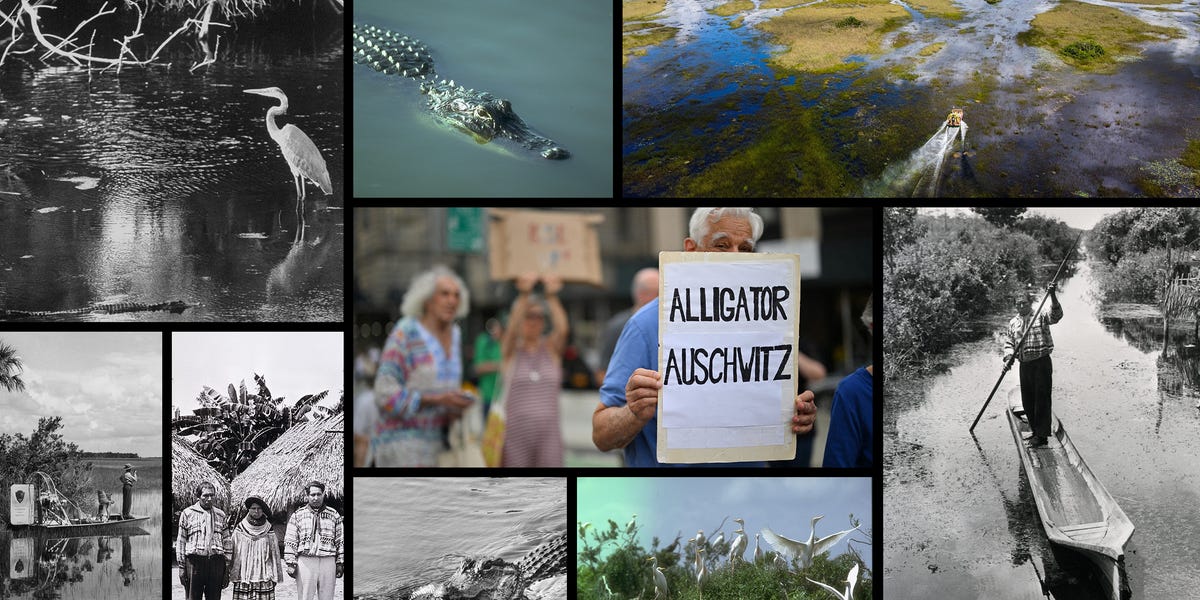
The Florida Everglades are home to a diverse community of artists. The Trump administration targeted this area to build a controversial ICE detention center, and residents are fighting back.

On June 14, Dakota Osceola was wrapping up the day, selling her bead art and necklaces at a festival in Miami, when she heard the news from a friend.

A new immigrant detention facility, to be named Alligator Alcatraz, would be built on a 10,500-foot-long old airport strip inside the Big Cypress National Preserve in the Florida Everglades.

“How is this happening right now?” she thought.

Home of the indigenous Miccosukee and Seminole people, the Everglades are the largest wetland ecosystem in the United States and the land where Osceola’s family grew up. This territory is considered a sacred place to tribe members and a national wildlife treasure to Floridians. But in less than 10 days, a portion of the Everglades was seized by the state and paved over to make room for a new prison built to hold up to 3,000 immigrants, a move supported by the Trump administration as a means to detain undocumented people.

On June 28, in the scorching heat, Osceola decided to go voice her opposition to this detention camp. Grassroots organizations such as Friends of the Everglades and Unidos Immokalee voiced environmental and human-rights concerns. Alongside independent activists, artists from the South Florida community joined with their protest art and signs to defend the home that has inspired them and that they love.

Outside the gates of the detention facility, and in the center of the Everglades, hundreds of Floridians gathered, chanting and holding up signs. Miccosukee tribal elder and environmental activist Betty Osceola, with Love the Everglades Movement, used her megaphone to address the crowd and keep people safe. Demonstrators lined up on the narrow road, north of the Tamiami Trail, as dozens of trucks with machinery entered the old Dade-Collier Airport, where the facility was being built. In the weeks since, different organizations have continued to arrange protests and gatherings weekly in front of these gates. There have been peaceful prayer vigils with no signs allowed, a protest asking to shut down the Everglades concentration camp, and family members of detainees gathered along with grassroots human-rights organizations, and a Catholic archbishop is waiting to see if he can hold a mass at the gates.

Outside the gates of the detention facility, and in the center of the Everglades, hundreds of Floridians gathered, chanting and holding up signs. Miccosukee tribal elder and environmental activist Betty Osceola, with Love the Everglades Movement, used her megaphone to address the crowd and keep people safe. Demonstrators lined up on the narrow road, north of the Tamiami Trail, as dozens of trucks with machinery entered the old Dade-Collier Airport, where the facility was being built. In the weeks since, different organizations have continued to arrange protests and gatherings weekly in front of these gates. There have been peaceful prayer vigils with no signs allowed, a protest asking to shut down the Everglades concentration camp, and family members of detainees gathered along with grassroots human-rights organizations, and a Catholic archbishop is waiting to see if he can hold a mass at the gates.

A member of the Seminole tribe, Osceola was aware of how hard the tribes fought in the 1970s to stop the construction of the old airport due to the environmental damage it would cause to the fragile ecosystem of the Glades. That battle was won when the construction came to a halt due to growing opposition from environmentalist groups. But now, into that abandoned air strip, the construction trucks started coming in, creating more and more traffic inside the Big Cypress National Preserve. Then, a sign with the words “Alligator Alcatraz” went up overnight, sparking sinister national jokes, memes, and merch about the alligators eating anyone who tries to escape this jail.

Protesters had different reasons to voice their opposition to the detention center: It would harm a fragile ecosystem and is not environmentally sound; it is an inappropriate use of FEMA funds; conditions there are inhumane. When Florida lawmakers visited the facility on a limited tour, they described 32 people per cage in the sweltering heat, exposed to bug infestations and fed meager meals, with prisoners crying for help and even one person pleading, “I’m a U.S. citizen!”

An important point ignored in national coverage is that the construction involves a seizure by the state of Miami-Dade-owned land under the guise of an emergency. The Miccosukee tribe joined other environmental groups, such as Love the Everglades, in suing federal and state agencies for failing to conduct an environmental review, as required by federal law, before initiating the project. Meanwhile, the ACLU is suing the Trump administration because of a lack of access to counsel at the detention center.

“I see my relatives, my family, in those cages. They came here undocumented, overstayed their visas, and eventually became citizens,” says Aubrey Brown, a Florida-based storyteller and artist who contributed to the protest sign art. Brown, who shares stories about Florida’s history with her 40,000 followers on social media, couldn’t stay silent and decided to speak up against the detention center, risking backlash. “I’ve always tried to stress that history and politics are inextricably intertwined,” she adds. Challenging the false narrative used by the president to make others believe there is nothing but fierce alligators and swamps in the Everglades, Brown argues, “People must understand that the Everglades is not a wasteland; this is people’s home. The Glades are wild, sacred, and free. It’s where the Seminoles went to hide from being captured, and it is where I go when I want to get away from everything.”

Acting as if no people exist in the Everglades, the federal government decided to seize land belonging to Miami-Dade County, completely ignoring the sovereignty of tribal nations at Big Cypress and that both their ceremonial and ancestral burial grounds stand near the facility.

“When it comes to my Seminole and Miccosukee friends, people treat them like they are not here anymore and are a relic of history,” Brown adds.

Once considered a swing state, Florida is now ground zero for the MAGA base supporting cruel anti-immigration policies. Built undercover, this facility was estimated to cost taxpayers $450 million a year. However, according to a review of purchases, the state has already spent $250 million on it in less than one month.

President Trump said that the facility would cage “some of the most vicious people on the planet” to be deported. Yet, a report released by the Miami Herald debunked this narrative, showing that hundreds of the detainees have no criminal charges.

Kidnapped without a warrant, stripped of their civil rights, and placed into a black hole where attorneys cannot reach their clients, only a third of detainees have a criminal conviction. But the public cannot see the nature of the sentence they received. ICE has so far offered the press only top-level statistics, which do not show whether a sentence is for a traffic violation or a murder attempt. Not only do the reports withhold details about the alleged offenses of each detainee, but ICE has not made public the records specifying how it targets the people it takes to detention centers, especially those without criminal charges. In response, The Guardian has decided to sue the Trump administration for withholding public documents from the press, which are a matter of clear public interest right now.

Maria Theresa Barbist, a Miami-based artist and psychologist who explores trauma, memory, and collective healing in her works, attended and made signs for the protest. “I am from Austria, and we have a dark history there. We have done this before. We have put people in concentration camps, and we know how this story ends. It’s our responsibility as descendants of Nazis never to let that happen again,” she says.

“The Nazis did not start with Auschwitz; they started with driving people out of their homes and putting them into camps. It was not just Jewish people, it was immigrants too,” she adds.

“This is not the first concentration camp being placed; they are just getting warmed up. Project 2025 is going to extend for at least the next four years,” says Eddie Aroyo, an artist who explores themes of power structures and attended the protest. “This is about absolute conquest,” he adds, referring to a conservative white nationalist agenda that opposes abortion and reproductive rights, LGBTQ rights, immigrants’ rights, and racial equity.

Democratic Florida representative Maxwell Frost visited the detention center on July 13 and shared on social media, “I didn’t see any Europeans who overstayed their visa. I saw nothing but Latino men and Haitian men. They are targeting specific types of people. And it’s the type of people that look like me.”

A few miles away from the detention camp, artist and native Floridian Sterling Rook, who attended the protest, is currently completing an artist residency in the Everglades National Park. Hosted by AIRIE (Artists in Residence in Everglades), this program allows artists to explore work related to the environment. The first day he entered the residency was also the day the first buses carrying migrants arrived in the Everglades. “It’s beautiful out here, but now I think about this every day, how 30 miles away from here there are people in tents in a terrible situation,” he says. “I’m not necessarily a political artist, but you become political just by the nature of your situation,” he adds. Rook used his residency time to work on a Glades skiff boat, which is known for navigating the marshy waters of the Everglades.

“As a performance, I would love to ride it out into ‘Alligator Alcatraz,’ maybe leave it there as a symbol of rescue and escape. But I also struggle with self-censorship,” he says.

This self-censorship comes from a place of very real fear about political persecution of artists who speak up. “There are genuine and considerable threats when speaking out against any of these violent governmental policies, especially in Florida,” says Johann C. Muñoz-Tapasco, an artist and organizer affiliated with the local collective Artists for Artists Miami (A4A: MIA). “Numerous artists have chosen to disengage from sought-after exhibition platforms and institutions altogether. Others have lost their jobs and clients. Many more have self-censored as a form of self-preservation.”

Federal and state funding cuts to the arts, combined with the elimination of National Endowment for the Arts grants and Florida’s political climate, have led many artists, organizations, and institutions that depend on this funding to limit freedom of expression, fearing retaliation or even more economic cuts. AIRIE did not respond to my request for a statement on its stance on this issue. The majority of Florida’s art institutions and organizations have remained silent.

A4A: MIA is currently discussing collaborative projects and planning actions against this detention facility, but it recognizes that American artists have been woefully unprepared to respond to the rise of fascism. “Since the postwar era, the ways artists validate their work and fund their practices have been tied to the tastes and whims of those in power,” misael soto, a Miami-based artist, educator, and organizer affiliated with this organization, stated. “Now those at the top whom we’ve been dependent on, on whichever side of the political spectrum, are mostly kneeling to fascism. Artists have to come to terms with how they sustain their practices and how this is intrinsically tied to their art.”

Mae’anna Osceola-Hart, a photographer and member of the Panther Clan and the Seminole tribe, participated in organizing the protest and lives within walking distance of the detention camp. Her grandfather was one of the tribe members who fought the development of the Dade-Collier Airport. These days, the traffic on the Big Cypress reserve is becoming increasingly dangerous, and she describes seeing the wildlife already being displaced. “The deer and bears now walk on the side of the road,” she says.

“My heart sinks, seeing how this concentration camp is affecting the land that protected us indigenous people since time immemorial, the environmental impacts it’s already causing, along with how it’s already harming human beings and their rights. Just yesterday, I saw three cars coming in with people wanting to take a photo in front of the [Alligator Alcatraz] sign, treating it like a roadside attraction,” she says.

“It feels like a fever dream.”
https://www.harpersbazaar.com/culture/features/a65488687/artists-fight-alligator-alcatraz

USA Today: Lawyer details ‘horrendous conditions’ faced by 11th grader detained by ICE

“This kid has been sleeping on a cement floor for five days, no access to a shower; he’s brushed his teeth twice,” said Marcelo Gomes da Silva’s immigration attorney.

Sleeping on a cement floor in a windowless room. Only brushing your teeth twice in five days and never getting to shower. Being mocked by a guard.

These are among the “horrendous conditions” that Massachusetts high school junior Marcelo Gomes da Silva endured while being held by Immigrations and Customs Enforcement, according to his lawyer Robin Nice.

Gomes Da Silva, 18, was arrested by ICE agents on May 31 when he was stopped on his way to volleyball practice with friends in his hometown of Milford. Federal officials said they targeted da Silva’s father, Joao Paulo Gomes-Pereira, who they say is an undocumented immigrant from Brazil, but they detained Gomes da Silva − who came to the United States at the age of 7 with his parents − when they realized he had overstayed his visa.

According to Nice, Gomes Da Silva was subsequently detained for five nights in cells that are intended to hold detainees for hours before being transferred. The cells lack access to basic amenities like beds and showers.

“The Burlington (Massachusetts) facility is not a detention center, it’s a holding cell,” Nice told USA TODAY after a June 5 hearing in Gomes da Silva’s case, which has drawn nationwide attention and fervent local opposition to his detention and possible deportation.

“It’s deplorable,” she added.

Nice first raised the issue in a federal immigration court hearing on whether he would be granted bail.

“He’s being held in just awful conditions no one should be subjected to: sleeping on a cement floor for just a few hours per night,” Nice began, before she was cut off by Immigration Judge Jenny Beverly, who noted the hearing was not the proper venue to raise the issue.

Shackles, teasing, and solitary confinement

Nice provided more details on her client’s confinement in a press conference after the hearing, in which the judge set a $2,000 bond for Gomes da Silva’s release, and in a subsequent interview with USA TODAY.

“This kid has been sleeping on a cement floor for five days, no access to a shower, he’s brushed his teeth twice. He’s sharing a room with men twice his age,” Nice said at the press conference outside the Chelmsford, Massachusetts federal immigration court.

At one point, Gomes da Silva was taken to a hospital emergency room because he was suffering severe headaches and vision loss stemming from a high school volleyball injury days earlier. When he was transferred to and from the hospital, he was handcuffed and kept in leg shackles and then moved to a different room, Nice said.

“He got back to the holding facility at 4 am and then was put in what I would refer to as solitary confinement: it was a room without anyone else, and all of these rooms that people are held in, there is no window,” Nice said. “There is no yard time, because it’s not set up for that.”

“If you are detained in the Burlington ICE facility, you do not see the light of day,” she said. “You don’t know what time it is.”

The isolation that da Silva subsequently endured made him so “desperately lonely” that he took to banging on the walls of his cell to get someone to come talk to him, Nice told USA TODAY. The guards, who he said mostly ignored him, nicknamed him “the knocker” in response.

When Gomes da Silva was held in the room with a larger group, one of the guards played a cruel practical joke on the detainees, Nice said:

“He said when ICE opens the door it means either someone’s coming in or someone’s getting released, so everyone perks up when they open the door. So he sees in a little slit in the door window, one ICE officer motion to another and says ‘watch this,’ and so one ICE officer opens the door to the cell and just stands their for a minute and then says, ‘psych!’ And closes the door. And everyone had just perked up,” Nice recounted.

The isolation in the ICE holding facility extended beyond its walls, Nice said. There was no way for her to call her client there, and he could only make one call for two minutes per day − and not even every day.

Nice wasn’t able to get in to see Gomes da Silva until the fifth day of his confinement. He was so shut off from the outside world that he didn’t know his varsity volleyball team had lost in the semi-finals of the state tournament, even though the match drew media coverage.

ICE did not respond to USA TODAY’s request for comment on Nice’s allegations.

In a statement on June 2, Patricia Hyde, acting field director for ICE Enforcement and Removal Operations’ in Boston defended Gomes da Silva’s detention and said the agency intends to pursue deportation proceedings.

“When we go into the community and find others who are unlawfully here, we’re going to arrest them,” Hyde said. “He’s 18 years old and he’s illegally in this country. We had to go to Milford looking for someone else and if we come across someone else who is here illegally, we’re going to arrest them.”

‘Nobody deserves to be down there’

Later on June 5, Gomes da Silva himself addressed reporters after posting the $2,000 bond and being released.

“Nobody deserves to be down there,” da Silva told reporters. “You sleep on concrete floors. The bathroom  I have to use the bathroom in the open with like 35-year-old men. It’s humiliating.”

Gomes da Silva also said they were given only crackers for lunch and dinner. Nice told USA TODAY he was also fed what he described as an undefined “mush” that was “like oatmeal, but not oatmeal.”

A twice-weekly churchgoer, Gomes da Silva asked the guards for a bible but was not provided with one.

Beside him were U.S. Reps. Seth Moulton and Jake Auchincloss, both Democrats from Massachusetts, who said they returned from Washington, D.C., on Thursday to speak with da Silva and to inspect the detention center.

Consequences of an immigration crackdown

The Trump administration has sought to ramp up deportations of undocumented immigrants, including those like da Silva who were brought here as children and have no criminal record. ICE reported holding 46,269 people in custody in mid-March, well above the agency’s detention capacity of 41,500 beds.

USA TODAY has previously reported on allegations of conditions in ICE detention similar to what Gomes da Silva and Nice described.

In March, four women held at the Krome North Processing Center in Miami said they were chained for hours on a prison bus without access to food, water or a toilet. They also alleged they were told by guards to urinate on the floor, slept on a concrete floor, and only got one three-minute shower over the course of three or four days in custody.

The allegations come after two men at Krome died in custody on Jan. 23 and Feb. 20.

https://www.usatoday.com/story/news/politics/2025/06/05/marcelo-gomes-da-silva-ice-conditions/84057203007

Guardian: Migrants at Ice jail in Miami made to kneel to eat ‘like dogs’, report alleges

Incident in which migrants were shackled with hands tied of one succession of alleged abuses at jails in Florida

Migrants at a Miami immigration jail were shackled with their hands tied behind their backs and made to kneel to eat food from styrofoam plates “like dogs”, according to a report published on Monday into conditions at three overcrowded south Florida facilities.

The incident at the downtown federal detention center is one of a succession of alleged abuses at Immigration and Customs Enforcement Agency (Ice) operated jails in the state since January, chronicled by advocacy groups Human Rights Watch, Americans for Immigrant Justice, and Sanctuary of the South from interviews with detainees.

Dozens of men had been packed into a holding cell for hours, the report said, and denied lunch until about 7pm. They remained shackled with the food on chairs in front of them.

“We had to eat like animals,” one detainee named Pedro said.

Degrading treatment by guards is commonplace in all three jails, the groups say. At the Krome North service processing center in west Miami, female detainees were made to use toilets in full view of men being held there, and were denied access to gender-appropriate care, showers, or adequate food.

The jail was so far beyond capacity, some transferring detainees reported, that they were held for more than 24 hours in a bus in the parking lot. Men and women were confined together, and unshackled only when they needed to use the single toilet, which quickly became clogged.

“The bus became disgusting. It was the type of toilet in which normally people only urinate but because we were on the bus for so long, and we were not permitted to leave it, others defecated in the toilet,” one man said.

“Because of this, the whole bus smelled strongly of feces.”

When the group was finally admitted into the facility, they said, many spent up to 12 days crammed into a frigid intake room they christened la hierela – the ice box – with no bedding or warm clothing, sleeping instead on the cold concrete floor.

There was so little space at Krome, and so many detainees, the report says, that every available room was used to hold new arrivals.

“By the time I left, almost all the visitation rooms were full. A few were so full men couldn’t even sit, all had to stand,” Andrea, a female detainee, said.

At the third facility, the Broward transitional center in Pompano Beach, where a 44-year-old Haitian woman, Marie Ange Blaise, died in April, detainees said they were routinely denied adequate medical or psychological care.

Some suffered delayed treatment for injuries and chronic conditions, and dismissive or hostile responses from staff, the report said.

In one alleged incident in April at the downtown Miami jail, staff turned off a surveillance camera and a “disturbance control team” brutalized detainees who were protesting a lack of medical attention to one of their number who was coughing up blood. One detainee suffered a broken finger.

All three facilities were severely overcrowded, the former detainees said, a contributory factor in Florida’s decision to quickly build the controversial “Alligator Alcatraz” jail in the Everglades intended to eventually hold up to 5,000 undocumented migrants awaiting deportation.

Immigration detention numbers nationally were at an average of 56,400 per day in mid-June, with almost 72% having no criminal history, according to the report.

The daily average during the whole of 2024 was 37,500, HRW said.

The groups say that the documented abuses reflect inhumane conditions inside federal immigration facilities that have worsened significantly since Trump’s January inauguration and subsequent push to ramp up detentions and deportations.

“The anti-immigrant escalation and enforcement tactics under the Trump administration are terrorizing communities and ripping families apart, which is especially cruel in the state of Florida, which thrives because of its immigrant communities,” said Katie Blankenship, immigration attorney and co-founder of Sanctuary of the South.

“The rapid, chaotic, and cruel approach to arresting and locking people up is literally deadly and causing a human rights crisis that will plague this state and the entire country for years to come.”

The Guardian has contacted Ice for comment.

https://www.theguardian.com/us-news/2025/jul/21/migrants-miami-ice-jail-abuses

Sun Herald: Tenth Death in ICE Custody Sparks Outrage

Immigration and Customs Enforcement (ICE) has launched an investigation into the death of Canadian citizen Johnny Noviello. He was reportedly found unresponsive at a Federal Detention Center in Miami. Noviello’s death has marked the tenth in ICE custody this year and the fourth in Florida.

ICE stated, “ICE remains committed to ensuring that all those in its custody reside in safe, secure, and humane environments. Comprehensive medical care is provided from the moment individuals arrive and throughout the entirety of their stay.”r

Bullshit! Way too many people have been saying otherwise.

ICE added, “All people in ICE custody receive medical, dental and mental health intake screening within 12 hours of arriving at each detention facility, a full health assessment within 14 days of entering ICE custody or arrival at a facility, access to medical appointments and 24-hour emergency care. At no time during detention is a detained illegal alien denied emergent care.”

More bullshit — see above.

ICE policies under President Donald Trump have drawn sharp criticism nationwide. ICE notified the Canadian consulate of Noviello’s death, though the consulate has not responded publicly. Noviello entered the U.S. in 1988 and became a lawful permanent resident in 1991.

https://www.msn.com/en-us/news/crime/tenth-death-in-ice-custody-sparks-outrage/ss-AA1IUBPZ

Rolling Stone: ICE Raids Aren’t Just a Latino Issue – Black Communities Are Also at Risk

“It’s not just Mexican people they are looking for,” one TikToker told her audience, “it’s all immigrants that are obviously not white” 

When ICE detained Rodriguez in February, weeks after filing her green card application, there was no consideration that she’d just given birth two weeks prior. I was just taken away from the child. I was leaking breast milk all over. I was still bleeding because I just had a baby and was on medication but I didn’t get those back.‘”

On Feb. 18, two weeks after having her son via C-section, Monique Rodriguez was battling postpartum depression. The Black mother of two, who was born and raised in St. Catherine Parish in Jamaica, had come to the U.S. in 2022 on a six-month visa and settled in Florida with her husband. But after finding herself alone and overwhelmed from the lack of support, she spiraled. “My husband is American and a first-time dad and was scared of hurting the baby. He kept pushing the baby off on me, which I didn’t like. I was in pain and I was tired and overwhelmed. I got frustrated and I hit my husband,” she says. A family member called the police, resulting in Rodriguez’s arrest. Suddenly, a private domestic dispute led to more serious consequences: When Rodriguez’s husband arrived to bail her out the following day, Immigration and Customs Enforcement was waiting to detain her. Despite being married and having a pending Green Card application, she became one of thousands of immigrants deported this year because of contact with police.

Since Donald Trump took office for the second time, ICE has been raiding immigrant communities across the nation. Prior to the raids, Black immigrants, like Rodriguez, have historically been targeted at higher rates due to systemic racism. With a host of complications, including anti-blackness and colorism in the Latino community — which often leaves Black immigrants out of conversations around protests and solidarity — the future is bleak. And Black immigrants and immigration attorneys are predicting a trickle-down effect to Black communities in America, making them vulnerable even more. 

On June 6, protests broke out in Los Angeles — whose population is roughly half Hispanic, and one in five residents live with an undocumented person. On TikTok, Latino creators and activists called on Black creators and community members to protest and stand in solidarity. But to their disappointment, many Black Americans remained silent, some even voicing that the current deportations were not their fight. “Latinos have been completely silent when Black people are getting deported by ICE,” says Alexander Duncan, a Los Angeles resident who made a viral TikTok on the subject. “All of a sudden it impacts them and they want Black people to the front lines.” Prejudice has long disconnected Black and Latino communities — but the blatant dismissal of ICE raids as a Latino issue is off base. 

For some Black Americans, the reluctancy to put their bodies on the line isn’t out of apathy but self-preservation. Duncan, who moved from New York City to a predominantly Mexican neighborhood in L.A., was surprised to find the City of Angels segregated. “One of my neighbors, who has done microaggressions, was like ‘I haven’t seen you go to the protests,” he tells Rolling Stone. “I said, ‘Bro, you haven’t spoken to me in six months. Why would you think I’m going to the front lines for you and you’re not even a good neighbor?’” 

Following the 2024 elections, many Black Democratic voters disengaged. Nationally, the Latino community’s support for Trump doubled from 2016, when he first won the presidency. Despite notable increases of support for Trump across all marginalized demographics, Latino’s Republican votes set a new record. “Anti-Blackness is a huge sentiment in the Latino community,” says Cesar Flores, an activist and law student in Miami, who also spoke on the matter via TikTok. “I’ve seen a lot of Latinos complain that they aren’t receiving support from the Black community but 70 percent of people in Miami are Latino or foreign born, and 55 percent voted for Trump.” Although 51 percent of the Latino community voted for Kamala Harris overall, Black folks had the highest voting percentage for the Democratic ballot, at 83 percent. For people like Duncan, the 48 percent of Latinos who voted for Trump did so against both the Latino and Black community’s interest. “The Black community feels betrayed,” says Flores. “It’s a common misconception that deportations and raids only affect Latinos, but Black folks are impacted even more negatively by the immigration system.” 

The devastation that deportation causes cannot be overstated. When ICE detained Rodriguez in February, weeks after filing her green card application, there was no consideration that she’d just given birth two weeks prior. “I was just taken away from the child. I was leaking breast milk all over. I was still bleeding because I just had a baby and was on medication but I didn’t get those back.” Rodriguez thought her situation was unique until she was transported to a Louisiana detention center and met other detained mothers. “I was probably the only one that had a newborn, but there were women there that were ripped away from babies three months [to] 14 years old,” says Rodriguez. 

On May 29, her 30th birthday, Rodriguez was one of 107 people sent to Jamaica. Around the same time, Jermaine Thomas, born on an U.S. Army base in Germany, where his father served for two years, was also flown there. Though his father was born in Jamaica, Thomas has never been there, and, with the exception of his birth, has lived within the U.S. all of his life. “I’m one of the lucky ones,” says Rodriguez, who is now back in Jamaica with her baby and husband, who maintain their American citizenships. “My husband and his mom took care of the baby when I was away. But there’s no process. They’re just taking you away from your kids and some of the kids end up in foster care or are missing.” 

In January, Joe Biden posthumously pardoned Marcus Garvey, America’s first notable deportation of a Jamaican migrant in 1927. His faulty conviction of mail fraud set a precedent for convicted Black and brown migrants within the U.S. 

“Seventy-six percent of Black migrants are deported because of contact with police and have been in this country for a long time,” says Nana Gyamfi, an immigration attorney and the executive director of the Black Alliance For Just Immigration. A 2021 report from the U.S. Committee for Refugees and Immigrants found that while only seven percent of the immigrant population is Black, Black immigrants make up 20 percent of those facing deportation for criminal convictions, including low-level, nonviolent offences. “If you’re from the Caribbean it’s even higher,” says Gyamfi. “For Jamaicans, it’s 98 percent higher. People talk about the Chinese Exclusion Act, but I’ve recently learned that the first people excluded from this country were Haitians.”

On June 27, the Trump administration announced the removal of Temporary Protective Status (TPS) for Haitians starting in September, putting thousands of migrants in jeopardy given Haiti’s political climate. Though a judge ruled it unconstitutional, the threat to Black migrants remains. “You have Black U.S. citizens being grabbed [by ICE] and held for days because they are racially profiling,” says Gyamfi, referring to folks like Thomas and Peter Sean Brown, who was wrongfully detained in Florida and almost deported to Jamaica, despite having proof of citizenship. “Black people are being told their real IDs are not real.” With much of the coverage concerning the ICE raids being based around Latino immigrants, some feel disconnected from the issue, often forgetting that 12 percent of Latinos are Black in the United States. “A lot of the conversation is, ‘ICE isn’t looking for Black people, they’re looking for Hispanics,’” Anayka She, a Black Panamanian TikTok creator, said to her 1.7 million followers. “[But] It’s not just Mexican people they are looking for, it’s all immigrants that are obviously not white.” 

“A lot of times, as Black Americans, we don’t realize that people may be Caribbean or West African,” she tells Rolling Stone. Her family moved to the U.S. in the 1980s, after her grandfather worked in the American zone of the Panama Canal and was awarded visas for him and his family. “If I didn’t tell you I was Panamanian, you could assume I was any other ethnicity. [In the media], they depict immigration one way but I wanted to give a different perspective as somebody who is visibly Black.” America’s racism is partly to blame. “Los Angeles has the largest number of Belizeans in the United States but people don’t know because they get mixed in with African Americans,” says Gyamfi. “Black Immigrants are in an invisibilized world because in people’s brains, immigrants are non Black Latinos.”

The path forward is complex. Rodriguez and Sainviluste, whose children are U.S. citizens, hope to come back to America to witness milestones like graduation or marriage. “I want to be able to go and be emotional support,” says Rodriguez. 

Yet she feels conflicted. “I came to America battered and bruised, for a new opportunity. I understand there are laws but those laws also stated that if you overstayed, there are ways to situate yourself. But they forced me out.” 

Activists like Gyamfi want all Americans, especially those marginalized, to pay attention. “Black folks have been feeling the brunt of the police-to-deportation pipeline and Black people right now are being arrested in immigration court.” In a country where mass incarceration overwhelmingly impacts Black people, Gyamfi sees these deportations as a warning sign. “Trump just recently brought up sending U.S. citizens convicted of crimes to prison colonies all over the world. In this climate, anyone can get it.” 

https://www.rollingstone.com/culture/culture-commentary/ice-raids-latino-issue-black-communities-1235384699

Miami Herald: Exclusive: Hundreds at Alligator Alcatraz have no criminal charges, Miami Herald learns

Hundreds of immigrants with no criminal charges in the United States are being held at Alligator Alcatraz, a detention facility state and federal officials have characterized as a place where “vicious” and “deranged psychopaths” are sent before they get deported, records obtained by the Miami Herald/Tampa Bay Times show.

Mixed among the detainees accused and convicted of crimes are more than 250 people who are listed as having only immigration violations but no criminal convictions or pending charges in the United States. The data is based on a list of more than 700 people who are either being held under tents and in chain link cells at Florida’s pop-up detention center in the Everglades or appear slated for transfer there.

A third of the detainees have criminal convictions. Their charges range from attempted murder to illegal re-entry to traffic violations. Hundreds of others only have pending charges. The records do not disclose the nature of the alleged offenses, and reporters have not independently examined each individual’s case.

The information — subject to change as the population of the facility fluctuates — suggests that scores of migrants without criminal records have been targeted in the state and federal dragnet to catch and deport immigrants living illegally in Florida.

Nationally, nearly half of detainees in ICE custody as of late June were being held for immigration violations and did not have a criminal conviction or charge, according to data from Syracuse UniversityPolls have shown that American voters support the deportation of criminals but are less supportive of the arrest and detention of otherwise law-abiding undocumented immigrants. South Florida’s congressional representatives have called on the Trump administration to be more compassionate in its efforts to round up and deport immigrants with status issues.

“That place is supposedly for the worst criminals in the U.S.,” said Walter Jara, the nephew of a 56-year-old Nicaraguan man taken to the facility following a traffic stop in Palm Beach County. The list obtained by the Herald/Times states that his uncle, Denis Alcides Solis Morales, has immigration violations and makes no mention of convictions or pending criminal charges. Jara said his uncle arrived here legally in 2023 under a humanitarian parole program, and has a pending asylum case.

Reporters sent the list to officials at the Department of Homeland Security and U.S. Immigration and Customs Enforcement. In a statement, DHS Assistant Secretary Tricia McLaughlin said the absence of a criminal charge in the United States doesn’t mean migrants detained at the site have clean hands.

“Many of the individuals that are counted as ‘non-criminals’ are actually terrorists, human rights abusers, gangsters and more; they just don’t have a rap sheet in the U.S.,” McLaughlin told the Herald/Times. “Further, every single one of these individuals committed a crime when they came into this country illegally. It is not an accurate description to say they are ‘non-criminals.’”

McLaughlin said the Trump administration is “putting the American people first by removing illegal aliens who pose a threat to our communities” and said “70% of ICE arrests have been of criminal illegal aliens with convictions or pending charges.”

She added that the state of Florida oversees the facility, not ICE, an argument echoed in court by Thomas P. Giles, a top official involved in enforcement and removal operations.

“The ultimate decision of who to detain” at Alligator Alcatraz “belongs to Florida,” he wrote as part of the federal government’s response to a lawsuit challenging the detention facility on environmental grounds.

A spokesperson for ICE referred reporters to Florida’s Division of Emergency Management, which oversees the detention facility. The Florida agency did not respond to a request for comment.

The records offer a glimpse into who is being sent to Alligator Alcatraz. The network of trailers and tents, built on an airstrip off of U.S. Highway 41, has been operating for a little more than a week. It is already housing about 750 immigrant detainees, a figure that state officials shared with Democratic state Sen. Carlos Guillermo-Smith, one of several Florida lawmakers who toured the site on Saturday afternoon.

The records obtained by the Herald/Times show detainees are from roughly 40 countries around the world. Immigrants from Mexico, Guatemala and Cuba made up about half the list. Ages range from 18 to 73. One is listed as being from the United States. Reporters were unable to locate his family or attorney.

Lawmakers who visited the facility Saturday said they saw detainees wearing wristbands, which state officials explained were meant to classify the severity of their civil or criminal violations. The colors included yellow, orange and red — with yellow being less severe infractions and red meaning more severe offenses, said state Rep. Anna Eskamani, D-Orlando.

When the detention facility opened on July 1, President Donald Trump visited the site and said it would soon house “some of the most vicious people on the planet.” He and Gov. Ron DeSantis have said the detention center is creating more space to house undocumented immigrants who otherwise would have to be released due to a lack of beds.

The state has refused to make public a roster of detainees at Alligator Alcatraz, instead offering selective information about who is being detained there. On Friday, Florida Attorney General James Uthmeier’s office released the names of six men convicted of crimes to Fox News, and later to the Herald/Times upon request. The charges against the men — all included on the list obtained by the Herald/Times — ranged from murder to burglary.

“This group of murderers, rapists, and gang members are just a small sample of the deranged psychopaths that Florida is helping President Trump and his administration remove from our country,” Uthmeier’s spokesman, Jeremy Redfern, said in a statement.

One of those men is Jose Fortin, a 46-year-old from Honduras who was arrested in 2017 on attempted murder charges. Records show Fortin was deported to his home country in August 2019. A month later, he re-entered the country illegally. Border patrol agents picked him up in Texas.

Another man identified as a detainee by Uthmeier’s office, Luis Donaldo Corado, was convicted of burglary and petty theft after he was accused of being a “peeping tom” — watching a woman through her apartment window in Coral Gables. And Eddy Lopez Jemot, a 57-year-old Cuban man, was accused of killing a woman and setting her house on fire in Key Largo in 2017. The state dropped homicide charges against him in a plea deal this year and convicted him of arson.

But other detainees left off the attorney general’s list face lesser charges — such as traffic violations, according to attorneys and family members. An attorney told the Herald/Times her client was detained by federal immigration agents after a routine-check in at an ICE field office. Some are asylum seekers.

Solís Morales, the 56-year-old Nicaraguan, ended up in Alligator Alcatraz after he was unexpectedly detained on his way to a construction job in Palm Beach County on July 1, according to Jara, his nephew. He was a passenger in a Ford F-150 when the driver was pulled over by the Florida Highway Patrol for an unsecured load, Jara told the Herald/Times on Saturday.

Solís Morales arrived in the United States from Nicaragua in 2023 under humanitarian parole and has a pending asylum case, Jara said.

Miami immigration attorney Regina de Moraes said she’s representing a 37-year-old Brazilian man being held at Alligator Alcatraz who entered the United States lawfully on a tourist visa in 2022 and then applied for asylum, which is pending.

She said the man, who has a five-year work permit and owns a solar panel business in the Orlando area, was arrested on a DUI charge in 2024. While he was attending a probation hearing on June 3, he was detained by the Orange County Sheriff’s office, which is participating in a federal immigration program known as 287(g). He was transferred from there to Alligator Alcatraz on Thursday, according to information provided to her by the man’s sister.

De Moraes, a seasoned immigration lawyer, said she doesn’t understand why the Brazilian man was transferred to the state-operated detention facility in the Everglades. She asked the Herald/Times not to identify her client.

“He’s not subject to mandatory detention and he’s not subject to removal because he has a pending asylum application,” de Moraes told the Herald/Times. “He has one DUI and he’s not a threat to others. This is ridiculous. This is a waste of time and money. … He’s not the kind of person they should be picking up.”

“They should be picking up people with sexual battery or armed robbery records,” de Moraes said.

https://www.miamiherald.com/news/local/immigration/article310541810.html

Associated Press: The Miccosukee Tribe of Florida wants to join a federal lawsuit against ‘Alligator Alcatraz’

The Miccosukee Tribe of Indians of Florida is seeking to join a federal lawsuit aimed at halting the construction and operation of a new immigration detention facility in the Everglades, which tribal members consider their sacred ancestral homelands.

Miccosukee leaders had already condemned the makeshift compound of trailers and tents that rose out of the swamp in a matter of days. But the filing Monday of a motion to intervene in the case initially brought by environmental groups signals a new level of opposition by the tribe, which is also a major political donor in the state.

Republican Gov. Ron DeSantis’ administration rapidly built the facility, which state officials have dubbed “Alligator Alcatraz,” on an isolated, county-owned airstrip inside the Big Cypress National Preserve, about 45 miles (72 kilometers) west of downtown Miami.

The Miccosukee have lived on and cared for the lands of Big Cypress “since time immemorial,” the filing reads, noting that the tribe played an integral role in pushing for the creation of the national preserve, the country’s first.

“The area now known as the Preserve is a core piece of the Tribe’s homeland. Today, all of the Tribe’s active ceremonial sites and a significant majority of the Tribe’s traditional villages (sometimes known as “clan camps”) are within the Preserve,” the filing reads.

To DeSantis and other state officials, locating the facility in the rugged and remote Everglades is meant as a deterrent, a national model for how to get immigrants to “self-deport.” The Republican Party of Florida has taken to fundraising off the detention center, selling branded T-shirts and beer koozies emblazoned with the facility’s name. Officials have touted the harshness of the area, saying there’s “not much” there other than the wildlife who call it home.

In fact, the Miccosukee have lived on those lands for centuries, the tribe’s attorneys wrote in their motion, which notes that there are 10 tribal villages within a three-mile (4.8-kilometer) radius of the detention center, one of which is approximately 1,000 feet (304 meters) from the facility.

The preserve is a place where tribal members continue to hunt, trap and fish, as well as catch the school bus, hold sacred rituals and bury their loved ones.

“The facility’s proximity to the Tribe’s villages, sacred and ceremonial sites, traditional hunting grounds, and other lands protected by the Tribe raises significant concerns about environmental degradation and potential impacts,” the filing reads.

The lawsuit originally filed by the Friends of the Everglades and the Center for Biological Diversity seeks to halt the project until it undergoes a stringent environmental review as required by federal and state law. There is also supposed to be a chance for public comment, the plaintiffs argue.

As of Tuesday afternoon, the judge in the case had not acted on the groups’ requests for a temporary restraining order and preliminary injunction to stop activity at the site.

The state raced to build the facility at the isolated airfield before the first detainees arrived on July 3. Streams of trucks carrying supplies like portable toilets, asphalt and construction materials drove into the facility’s gates around the clock as workers assembled a network of massive tents that officials said could ultimately house 5,000 detainees.

What had been an internationally designated “dark sky” park far away from urban development is now blasted by lights so powerful, the glow can be see from 15 miles (24.1 kilometers) away, the environmental groups said.

The area’s hunting and fishing stocks could be so significantly impacted, attorneys argue the tribe’s traditional rights — guaranteed by federal and state law — could be “rendered meaningless.”

https://apnews.com/article/alligator-alcatraz-lawsuit-miccosukee-tribe-florida-immigration-164069ac7e4cddc1f7278b218b9cf8f7

Daily Beast: Florida City Ends ICE Deal Ahead of Trump’s ‘Alligator Alcatraz’ Visit

Key West, home to the southernmost point in the continental U.S., voted to end its cooperation agreement with ICE.

A Florida city welcomed President Donald Trump to the state Tuesday by making life harder for his ICE goons.

Hours before Trump touched down at Florida’s so-called “Alligator Alcatraz,” city commissioners in Key West voted 6-1 in favor of scrapping an agreement requiring local police to coordinate with federal immigration officials.

The vote “basically invalidated the city’s most recent agreement with ICE,” which was reached in March, reported Local 10.

“People who are seeking political asylum are important members of our community,” Commissioner Samuel Kaufman said, according to WLRN. “We have thousands of them here, by the way. And they deserve the respect that anybody else does.”

Florida’s southernmost city, less than 100 miles from the Cuban coast, is also among its most progressive. Commissioner Donald Lee said that the city’s police chief, Sean Brandenburg, signed the deal to cooperate with ICE because he had a proverbial “gun” to his head from both federal and state officials. The Florida city of Fort Myers has refused to sign an agreement, and its leaders have been threatened with removal from office.

Key West residents went into uproar last month when a beloved local hairstylist, who a city cop stopped as he rode his e-bike to work, was placed in ICE custody and detained for weeks.

Lee Stinton, a Northern Ireland national, holds an employment authorization card and has applied for a green card, according to Keys Weekly. Still, his traffic infraction reportedly warranted the involvement of ICE agents, who allegedly harassed him and tossed him in a detention center in Miami, where a Canadian citizen, 49, and a Cuban national, 75, died in custody within the last week.

“The ICE agent that got involved in his traffic stop—and I’m still not sure how that happened, whether he was riding with the police officer or showed up separately—saw the photo of the two of us on Lee’s phone’s lock screen, and assumed I was Haitian,” Davis said. “He asked Lee, ‘Is that your boyfriend? We’ll go find him as well and get two for one.’”

https://www.thedailybeast.com/florida-city-ends-ice-deal-ahead-of-trumps-alligator-alcatraz-visit