Money Talks News: Trump’s Tariffs Could Send Your Insurance Premiums Skyrocketing
Reply
“Daily Blast” Podcaster Greg Sargent reports rural Trump voters are starting to feel the pain from their November vote for President Donald Trump.
“There’s the Trump tariffs, which hit farm country hard. There are these enormous health care cuts, … which are creating these huge problems for rural hospitals across the country. Again, that’s a real lifeline in those places. Many of them have very little access to health care,” Sargent told guest Lynlee Thorne, political director for organizing network RuralGroundGame.org.
Thorne’s organization calls and visits registered Western Virginia voters who don’t consistently participate in recent elections, alerting them of upcoming cuts to Medicaid and the insurance marketplaces as well as cost increases from Trump’s tariffs.
She said breaking the news to residents has not been easy for the organization’s field workers.
“People are stunned that this is happening,” Thorne told Sargent. “Sometimes our volunteers are emotionally struggling because they feel like they are breaking horrific news to people in real time. And people are p—— and scared and feel a little blindsided. So, while those of us who have been paying attention are well aware of these cuts, this is devastating news to a lot of people in rural spaces.
A recent New York Times article covered the anger of Sen. Lisa Murkowski (R-Alaska) at her fellow Republicans’ willingness to eliminate pivotal public radio broadcasts her largely rural state, and others. Public radio is often the only lifeline to local news and weather because piped in music and talk radio — which is frequently the only signal on rural station radios — rarely alerts listeners to hazardous storms and local events.
Murkowski told the Times she was outraged by her co-workers readiness to deprive their voters of critical information for Trump.
“You had, I think, a blind allegiance to the president’s desires when it came to the Corporation for Public Broadcasting,” Murkowski told the Times. “… what I … object to is when we, as the authorizers and the appropriators, do our job, and then we have the White House come around and say: ‘We don’t care what you did. We want you to do this.’”
Sargent said for years Republican lawmakers “could be counted on to defend their constituents a little bit” despite their prejudice against public radio. But now “Trump comes along and waves a magic wand, they just fall in line.”
“It’s a real gut punch,” said Thorne. “And I think something for people to keep in mind is that it’s not just the radio stations — because a lot of rural people even now cannot get radio reception in their rural area from their home. So often when there is a crisis or a power outage or something similar, people are having to go to their neighbors who might be able to get radio reception and hear that news through the grapevine.”
Hear the “Daily Blast” podcast and read an edited podcast transcript at this link.
In just a few months since returning to the White House, President Donald Trump has claimed remarkable powers to reshape global trade and has erected some huge barriers to imports into the United States.
Trump has done all of that while repeatedly revealing how little he knows about what he imagines he can design. By now, it is obvious that Trump does not understand what trade deficits are, does not know that Americans bear the cost of his tariffs, and does not comprehend how American manufacturing is dependent on global supply chains.
But what if the problem actually runs deeper than that? What if the man who has been entrusted by the Republican Party to reshape huge swaths of the national economy and the flow of global trade is suffering from the same sort of cognitive decline that marked Joe Biden’s time in office?
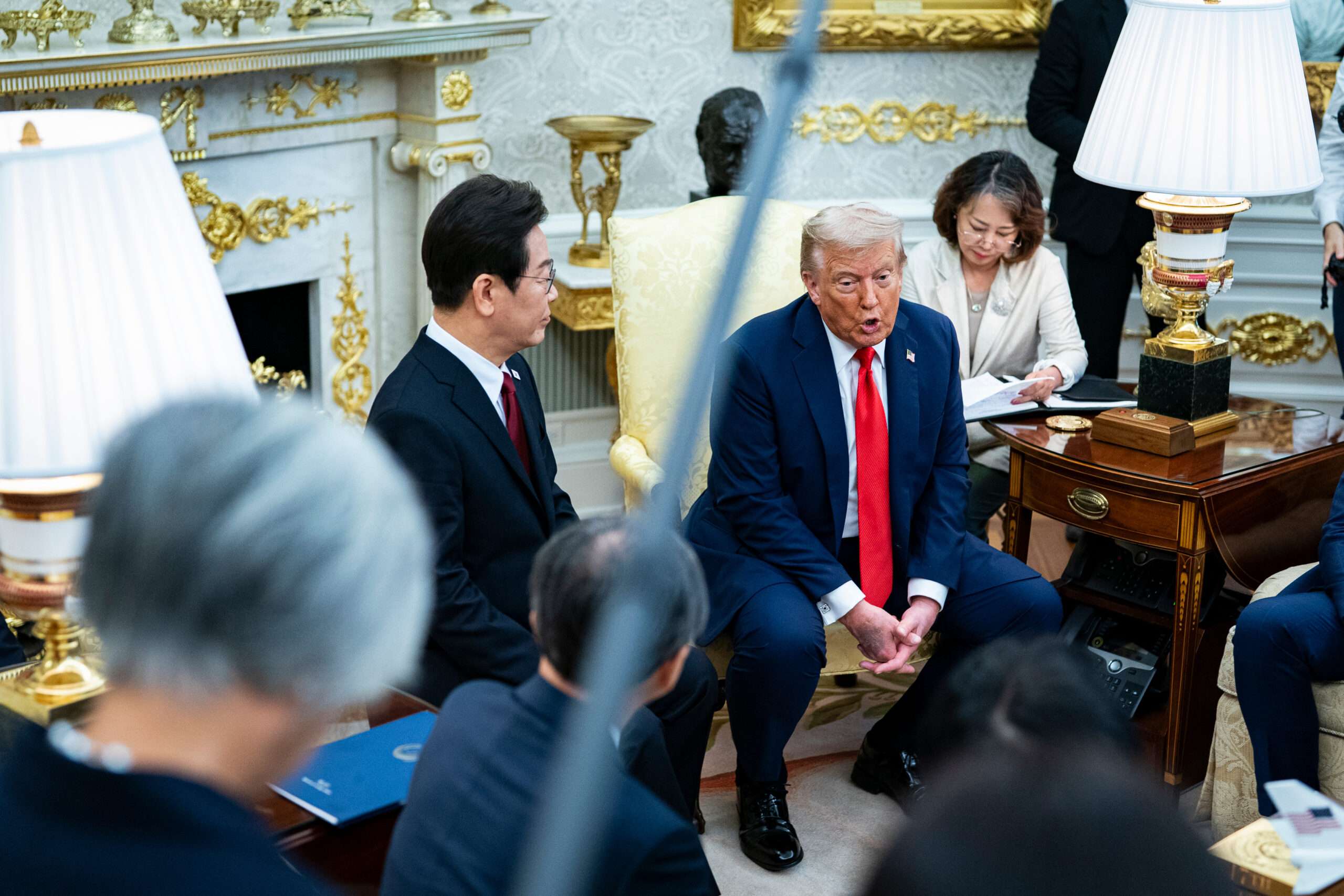
It’s an unsettling question, but one that ought to be pondered in the wake of what happened on Monday in the Oval Office. While hosting South Korean President Lee Jae Myung and taking questions from reporters, Trump went off on a long, nonsensical tangent about magnets and what he apparently believes is a two-decade-long conspiracy orchestrated by the Chinese government.
“They have to give us magnets,” Trump began. “If they don’t give us magnets, then we have to charge them 200 percent tariff for something, you know?”
Alas, there’s the old fallacy at the root of so much of Trump’s trade policies. In effect, the president is promising to place higher taxes on Americans if the Chinese government doesn’t do what he wants. How that’s supposed to work remains unclear as ever.
Aside from that nonsense, however, there is a discernible point here: The trade of rare earth metals, including some that are used to make high-end magnets, is a crucial part of the U.S.-China trade war. In April, China added those items to its export restriction list in response to Trump’s threat of higher tariffs on Chinese goods. The inability to import those magnets is a serious problem for American automakers and other industries. It’s almost like trade wars have unintended consequences.
After that, things got truly unhinged.
“You know, China intelligently went and they sort of took a monopoly of the world’s magnets, and nobody needed magnets until they convinced everybody 20 years ago, ‘Let’s all do magnets,'” Trump continued.
To be clear, the concept of magnetism is not something that the Chinese invented in the early 2000s. It’s also not true that “nobody needed magnets” before then, even though global demand for rare earth metals has increased in the digital age, since they are essential for manufacturing the advanced electronics that power everything from televisions to fighter jets
This ought to illustrate to Trump why launching a trade war with China (and much of the rest of the world) is such a terrible idea. From cocoa beans to bananas to rare earth metals like samarium and yttrium, there are tons of commodities that do not exist in sufficient quantity in the United States to meet consumers’ and business’ needs. The free market has found ways to solve that imbalance, but Trump’s trade policies are making those solutions more expensive and difficult.
But not to worry, Trump explained, because America is now “heavy into the world of magnets now—only from a national security standpoint.”
“But we have a much more powerful thing, and that’s tariffs,” he added. “We’re going to have a lot of magnets in a pretty short period of time.”
Well, that’s a relief, I guess? It sounds like he’s got it all under control, though anyone listening to those remarks would understandably wonder what “it” is.
Incredibly, this isn’t even the craziest thing Trump has ever said on the subject of magnets.
At a campaign rally last year, Trump claimed that “all I know about magnets is this: Give me a glass of water, let me drop it on the magnets, that’s the end of the magnets.”
Magnets, to be clear, work just fine when they are wet. They also work underwater. (In fairness, Trump is not the first prominent figure in American culture to wonder about these things.)
Of course, Trump has never been someone who speaks with particular clarity. His unscripted remarks are often meandering, unfocused, and riddled with inaccuracies and strange non sequiturs. He believes himself to be an expert in everything from global macroeconomics to the hydraulic systems on naval ships.
Even by those standards, however, Monday’s business with the magnets stands out.
Indeed, if you walked past someone in the street who was repeating Trump’s words verbatim, you’d likely keep a healthy distance and possibly wonder what substance they’d most recently been using. If an elderly loved one—a parent or a grandparent, maybe—said the same things privately that Trump said in front of television cameras on Monday, you’d probably wonder if something was wrong. Maybe you’d encourage them to see a doctor.
But this isn’t a bum in the park or your grandfather that we’re talking about. This is the person who currently wields more power than any other human being on the planet, and who is using that power in novel and expansive ways to reshape the economy. Whatever the appropriate response might be in those other situations, shouldn’t it be significantly elevated here?
I am not saying that Trump is a moron, or senile, or in a state of mental decline. But we ought to ponder with some seriousness the same question that Reason‘s Jacob Sullum asked a few months ago during a similarly bizarre incident: If Trump were any of those things, how would we know?
https://reason.com/2025/08/27/does-it-matter-that-donald-trump-is-confused-by-magnets

https://www.msn.com/en-us/news/world/could-tariffs-ruin-christmas/vi-AA1DdJvl

https://www.msn.com/en-us/money/news/tariffs-bring-japanese-automakers-to-breaking-point/vi-AA1LaNYE
Diann Valentine, 55, founder of Slayyy Hair, first felt the impact of tariffs when a 145% levy on Chinese imports hit, resulting in a $300,000 bill to clear 26,000 units of braiding hair at the Los Angeles port in May. Since then, she has raised the prices of her braiding hair and drawstring ponytail extensions by 20%. Valentine was also forced to lay off four employees and now works 16-hour days to keep her two Glow+Flow beauty supply stores in Inglewood and Hawthorne, California, running smoothly.
“To lose that kind of money at this stage has been devastating,” Valentine said.
“We’re being impacted at every level,” said Dajiah Blackshear-Calloway, 34, a salon owner based in Smyrna, Georgia. “I’m either having to eat that cost or pass that expense along to my clients, which affects their budgets and their pockets as well.”
Blackshear-Calloway’s salon, staffed by two stylists, offers a range of services from $50 natural hairstyles to $745 tape-in weave extensions. Her most popular services include $254 sew-in weaves and $125 quick weaves, where extensions are glued onto a stocking cap.
However, tariffs have driven up the cost of a package of hair imported from Vietnam from $190 in May to $290, while a bottle of hair glue from China jumped from $8 to $14.99 at her local supply store. To avoid passing these costs on to clients, Blackshear-Calloway now asks them to bring their own hair, making a quick weave $140 without hair, compared to $400 with hair provided.
Diann Valentine, 55, founder of Slayyy Hair, first felt the impact of tariffs when a 145% levy on Chinese imports hit, resulting in a $300,000 bill to clear 26,000 units of braiding hair at the Los Angeles port in May. Since then, she has raised the prices of her braiding hair and drawstring ponytail extensions by 20%. Valentine was also forced to lay off four employees and now works 16-hour days to keep her two Glow+Flow beauty supply stores in Inglewood and Hawthorne, California, running smoothly.
“To lose that kind of money at this stage has been devastating,” Valentine said.
Tariffs are hitting Black business owners particularly hard, including many salon owners. Andre Perry, a senior fellow at the Brookings Institution, notes that the wealth gap leaves Black entrepreneurs, especially those in low-margin industries like consumer goods or haircare services, in financially vulnerable positions, with tariffs further eroding their profits.
“Many Black entrepreneurs started off with less wealth,” Perry said.
Black businesses have endured for generations through innovation and resilience, and it will take that same spirit to navigate the challenges Americans now face due to Trump’s tariffs. Industry experts have been offering tips for small business owners affected by the tariffs, including communicating openly with customers, reassessing supply chains, streamlining operations to address inefficiencies, consulting a financial advisor, and exploring business credit lines.

A retired American general tore into President Donald Trump and said his latest threats to send the National Guard into Democratic-run cities are merely a tactic to distract his base and the media, likening it to “catnip.”
Major General William Enyart joined MSNBC on Monday afternoon to discuss Illinois Gov. J.B. Pritzker’s (D) blistering speech, hitting back at Trump’s plans to send troops to Chicago.
“A barnburner of a speech from Illinois Gov. J.B. Pritzker, who told the people of Illinois in no uncertain terms that what Donald J. Trump plans to do in his city is, ‘unprecedented, illegal, unconstitutional, and un-American,’ urging him publicly with the city’s business, faith and elected officials, ‘Do not come to Chicago,'” noted host Nicolle Wallace.
She added that Pritzker made a “salient, indisputable fact” that 13 of the top 20 cities when it comes to homicide rates are led by Republicans. Additionally, eight Republican-led states have the top homicide rates.
Enyart said Pritzker made a “spot-on speech.”
“Trump desperately needs to cling on to power. And I think the reason that he is taking these actions is distraction, distraction, distraction,” he said.
Enyart then hit back at Trump’s claims with statistics of his own.
“The price of hamburger a year ago today: $5.35 a pound. Hamburger today: $6.98 a pound. That’s a 33% increase. Coffee $6.32 a year ago. Today, it’s $8.41 a pound, another 30-plus percent. Food prices have gone up every single month, but one, since Trump took office,” he noted.
Enyart called out Trump for vowing to drive food prices down.
“Yet another lie. He can’t afford to face truth. And that’s why he has to have distraction,” he railed.
Enyart called Trump’s use of the National Guard in Washington, D.C., and proposal to do the same in Chicago simply that.
“He is doing it in order to provide a distraction to his base and to, frankly, to most of the news media so they’ll chase that catnip,” he said, calling Trump’s tariffs a “failure,” along with his negotiations with Russian President Vladimir Putin.
“Corn prices have cratered. Corn prices are 40% down from what they were under the Biden administration,” he added.
Soybean prices for farmers, he added, are down more than 50% since Biden’s administration.
” China used to buy 60% of their soybeans from the United States farmers. Today? 20%. Brazil took those. Why? Trump’s tariffs. His policies are incredibly unpopular, and so he needs to put on a show. He is a mastermind at showmanship, and that’s what he is doing.”
Michigan Gov. Gretchen Whitmer met privately in the Oval Office with President Donald Trump to make a case he did not want to hear: the automotive industry he said he wants to save were being hurt by his tariffs.
The Democrat came with a slide deck to make her points in a visual presentation. Just getting the meeting Tuesday with the Republican president was an achievement for someone viewed as a contender for her party’s White House nomination in 2028.
Whitmer’s strategy for dealing with Trump highlights the conundrum for her and other Democratic leaders as they try to protect the interests of their states while voicing their opposition to his agenda. It’s a dynamic that Whitmer has navigated much differently from many other Democratic governors.
The fact that Whitmer had “an opening to make direct appeals” in private to Trump was unique in this political moment, said Matt Grossman, a Michigan State University politics professor.
It was her third meeting with Trump at the White House since he took office in January. This one, however, was far less public than the time in April when Whitmer was unwittingly part of an impromptu news conference that embarrassed her so much she covered her face with a folder.
On Tuesday, she told the president that the economic damage from the tariffs could be severe in Michigan, a state that helped deliver him the White House in 2024. Whitmer also brought up federal support for recovery efforts after an ice storm and sought to delay changes to Medicaid.
Trump offered no specific commitments, according to people familiar with the private conversation who were not authorized to discuss it publicly and spoke only on condition of anonymity to describe it.
Whitmer is hardly the only one sounding the warning of the potentially damaging consequences, including factory job losses, lower profits and coming price increases, of the import taxes that Trump has said will be the economic salvation for American manufacturing.
For Americans concerned about inflation and consumer costs, recent developments have been discouraging. Two weeks ago, for example, the public learned that the Consumer Price Index climbed unexpectedly in June, amid signs that Donald Trump’s trade tariffs were pushing prices higher.
This week, the disappointing news continued as the Commerce Department reported the Personal Consumption Expenditures price index — a metric that’s closely watched by the Federal Reserve for evidence of inflation — is also climbing, and as The New York Times reported, the data represented “the latest sign that President Trump’s tariffs are starting to bleed through into consumer prices.”
Then Trump sat down with New York Post columnist Miranda Devine and made a rather specific claim, not only about the key economic issue, but about his perceived successes.
“You know, if you think, inflation, I’ve already taken care of,” the president claimed. “Prices are way down for everything — groceries, everything.”
Certainly this is the official White House line, with a variety of administration officials pushing nearly identical rhetoric.
But reality won’t budge. As the Trump administration’s own data shows, grocery costs have gone up since the president returned to the Oval Office, not down.
A couple of weeks ago at a White House event for a Republican audience, Trump said Democrats “lie” when they say the prices of food and groceries have gone up, but as a CNN report noted soon after, “Nonsense. It’s correct, not a lie, to say overall prices, grocery prices and food prices in general are up during this presidency.”
This was one of the critical issues of the 2024 race, and the Republican president is clearly failing — both to deliver the results he promised and to tell the truth about reality.
Throughout last year, then-candidate Trump was repeatedly asked about his plan to lower consumer prices. Common sense suggested he would’ve prepared at least some kind of coherent answer, but that never happened. He simply said it would all work out wonderfully once he returned to power.
As prices climb, the president could acknowledge the facts and perhaps even accept some responsibility, but he prefers to play make-believe.
Topline
President Donald Trump lashed out at both Russia and India in a Truth social post at midnight on Thursday, as he doubled down on the 25% tariffs he placed on New Delhi—along with an unspecified “penalty” for its continued trade with Moscow—and attacked former Russian president and key Putin ally, Dmitry Medvedev, who warned that Trump’s ultimatums against his country were a “step towards war.”
Key Facts
In a post on his Truth Social platform, the president wrote: “I don’t care what India does with Russia. They can take their dead economies down together, for all I care.”
Trump claimed the U.S. has done “very little business with India” as their Tariffs are “among the highest in the World,” and added: “Likewise, Russia and the USA do almost no business together.”
While announcing his plan to impose a 25% tariff on India, Trump pointed out that the country has “always bought a vast majority of their military equipment from Russia” and is the “largest buyer” of Russian energy after China.
This was the first instance of the president following through with his threat to impose “secondary tariffs” on Russia’s key trading partners unless Moscow agrees to end its war in Ukraine.
Trump, however, didn’t specify what this penalty would entail.
What Do We Know About Trump’s Deadline For Russia?
Earlier this month, Trump threatened to impose 100% “secondary” tariffs on Russia, unless it managed to secure a deal to end the war in Ukraine in 50 days. These secondary tariffs would target countries like India and China, which are among Russia’s key trading partners. However, the president revised his deadline on Monday during his visit to Scotland and said Moscow now has 10 to 12 days to take steps towards ending its conflict with Ukraine.
What Has Medvedev Said About Trump’s Deadline For Russia?
When Trump announced the first deadline, Medvedev mocked it in a post on X, saying: “Trump issued a theatrical ultimatum to the Kremlin. The world shuddered, expecting the consequences. Belligerent Europe was disappointed. Russia didn’t care.” After Trump shortened the deadline on Monday, Medvedev responded, tweeting: “Trump’s playing the ultimatum game with Russia…He should remember 2 things: 1. Russia isn’t Israel or even Iran. 2. Each new ultimatum is a threat and a step towards war. Not between Russia and Ukraine, but with his own country. Don’t go down the Sleepy Joe road!”
What Did Trump Say About Medvedev?
The president had not commented on Medvedev’s earlier post, but his Thursday midnight post appears to respond to the former Russian president’s “step towards war” remark. After pointing out that Russia and the U.S. do almost no business together, Trump said: “Let’s keep it that way, and tell Medvedev, the failed former President of Russia, who thinks he’s still President, to watch his words. He’s entering very dangerous territory!” Medvedev, who had not shied away from nuclear saber-rattling in the past few years, has not yet responded to Trump’s remarks.