Defense One: How Trump’s DC takeover could supercharge surveillance

The emergency declaration, combined with new tech, will give government broad new abilities to watch and monitor citizens.

President Trump’s declaration of a “crime emergency” in Washington, D.C., will further entwine the U.S. military—and its equipment and technology—in law-enforcement matters, and perhaps expose D.C. residents and visitors to unprecedented digital surveillance. 

Brushing aside statistics that show violent crime in D.C. at a 30-year low, Trump on Monday described a new level of coordination between D.C. National Guard units and federal law enforcement agencies, including the FBI, ICE, and and the newly federalized D.C. police force

“We will have full, seamless, integrated cooperation at all levels of law enforcement, and will deploy officers across the district with an overwhelming presence. You’ll have more police, and you’ll be so happy because you’re being safe,” he said at a White House press conference. 

Defense Secretary Pete Hegseth, standing beside Trump, promised close collaboration between the Pentagon and domestic authorities. “We will work alongside all DC police and federal law enforcement to ensure this city is safe.” 

What comes next? The June 2020 deployment of National Guard units to work alongside D.C. police offers a glimpse: citywide use of sophisticated intelligence-gathering technologies normally reserved for foreign war zones.

Some surveillance platforms will be relatively easy to spot, such as spy aircraft over D.C.’s closely guarded airspace. In 2020, authorities deployed an RC-26B, a military-intelligence aircraft, and MQ-9 Predator drones. The FBI contributed a Cessna 560 equipped with “dirtboxes”: devices that mimic cell towers to collect mobile data, long used by the U.S. military to track terrorist networks in the Middle East.

Other gear will be less obvious.The 2020 protests saw expanded use of Stingrays, another type of cellular interception device. Developed to enable the military to track militants in Iraq and Afghanistan, Stingrays were used by the U.S. Secret Service in 2020 and 2021 in ways that the DHS inspector general found broke the law and policies concerning privacy and warrants. Agency officials said “exigent” circumstances justified the illicit spying.

Now, with federal agencies and entities working with military personnel under declared-emergency circumstances, new gear could enter domestic use. And local officials or the civilian review boards that normally oversee police use of such technologies may lack the power to prevent or even monitor it. In 2021, the D.C. government ended a facial-recognition pilot program after police used it to identify a protester at Lafayette Square. But local prohibitions don’t apply to federalized or military forces. 

Next up: AI-powered surveillance 

How might new AI tools, and new White House measures to ease sharing across federal entities, enable surveillance targeting?

DHS and its sub-agencies already use AI. Some tools—such as monitoring trucks or cargo at the border for contraband, mapping human trafficking and drug networks, and watching the border—serve an obvious public-safety mission. Last year, DHS used AI and other tools to identify 311 victims of sexual exploitation and to arrest suspected perpetrators. They also helps DHS counter the flow of fentanyl; last October, the agency cited AI while reporting a 50 percent increase in seizures and an 8 percent increase in arrests.

TSA uses facial recognition across the country to match the faces and documents of airline passengers entering the United States in at least 26 airports, according to 2022 agency data. The accuracy has improved greatly in the past decade, and research suggests even better performance is possible: the National Institute of Standards and Technology has shown that some algorithms can achieve 99%-plus accuracy under ideal conditions. 

But conditions are not always ideal, and mistakes can be costly. “There have been public reports of seven instances of mistaken arrests associated with the use of facial recognition technology, almost all involving Black individuals. The collection and use of biometric data also poses privacy risks, especially when it involves personal information that people have shared in unrelated contexts,” noted a Justice Department report in December. 

On Monday, Trump promised that the increased federal activity would target “known gangs, drug dealers and criminal networks.” But network mapping—using digital information to identify who knows who and how—has other uses, and raises the risk of innocent people being misidentified. 

Last week, the ACLU filed a Freedom of Information Act request concerning the use of two software tools by D.C.’s Homeland Security and Emergency Management Agency. Called Cobwebs and Tangles, the tools can reveal sensitive information about any person with just a name or email address, according to internal documents cited in the filing.

Cobwebs shows how AI can wring new insights from existing data sources, especially when there are no rules to prohibit the gathering of large stores of data. Long before the capability existed to do it effectively, this idea was at the center of what, a decade ago, was called predictive policing

The concept has lost favor since the 2010s, but many law-enforcement agencies still pursue versions of it. Historically, the main obstacle has been too much data, fragmented across systems and structures. DHS has legal access to public video footage, social media posts, and border and airport entry records—but until recently, these datasets were difficult to analyze in real time, particularly within legal constraints.

That’s changing. The 2017 Modernizing Government Technology Act encouraged new software and cloud computing resources to help agencies use and share data more effectively, and in March, an executive order removed several barriers to interagency data sharing. The government has since awarded billions of dollars to private companies to improve access to internal data.

One of those companies is Palantir, whose work was characterized by the New York Times as an effort to compile a “master list” of data on U.S. citizens. The firm disputed that in a June 9 blog post: “Palantir is a software company and, in the context of our customer engagements, operates as a ‘data processor’—our software is used by customers to manage and make use of their data.”

In a 2019 article for the FBI training division, California sheriff Robert Davidson envisioned a scenario—now technologically feasible—in which AI analyzes body-camera imagery in real time: “Monitoring, facial recognition, gait analysis, weapons detection, and voice-stress analysis all would actively evaluate potential danger to the officer. After identification of a threat, the system could enact an automated response based on severity.”

The data DHS collects extends well beyond matching live images to photos in a database or detecting passengers’ emotional states. ICE’s Homeland Security Investigations unit, for instance, handles large volumes of multilingual email. DHS describes its email analytics program as using machine learning “for spam classification, translation, and entity extraction (such as names, organizations, or locations).”

Another DHS tool analyzes social-media posts to gather “open-source information on travelers who may be subject to further screening for potential violation of laws.” The tool can identify additional accounts and selectors, such as phone numbers or email addresses, according to DHS documentation.

Meanwhile, ICE’s operational scope has expanded. The White House has increased the agency’s authority to operate in hospitals and schools, collect employment data—including on non-imigrants, such as “sponsors” of unaccompanied minors—and impose higher penalties on individuals seen as “interfering” with ICE activities. Labor leaders say they’ve been targeted for their political activism. Protesters have been charged with assaulting ICE officers or employees. ICE has installed facial-recognition apps on officers’ phones, enabling on-the-spot identification of people protesting the agency’s tactics. DHS bulletins sent to local law enforcement encourage officers to consider a wide range of normal activity, such as filming police interactions, as potential precursors to violence.

Broad accessibility of even legally collected data raises concerns, especially in an era where AI tools can derive specific insights about people. But even before these developments, government watchdogs urged greater transparency around domestic AI use. A December report by the Government Accountability Office includes several open recommendations, mostly related to privacy protections and reporting transparency. The following month, DHS’s inspector general warned that the agency doesn’t have complete or well-resourced oversight frameworks. 

In June, Sen. Ed Markey, D-Mass., and several co-signers wrote to the Trump White House, “In addition to these concerning uses of sentiment analysis for law enforcement purposes, federal agencies have also shown interest in affective computing and deception detection technologies that purportedly infer individuals’ mental states from measures of their facial expressions, body language, or physiological activity.” 

The letter asks the GAO to investigate what DHS or Justice Department policies govern AI use and whether those are being followed. Markey’s office did not respond to a request for comment.

Writing for the American Immigration Council in May, Steven Hubbard, the group’s senior data scientist, noted that of DHS’ 105 AI applications, 27 are “rights-impacting.”

“These are cases that the OMB, under the Biden administration, identified as impacting an individual’s rights, liberty, privacy, access to equal opportunity, or ability to apply for government benefits and services,” Hubbard said.

The White House recently replaced Biden-era guidance on AI with new rules meant to accelerate AI deployment across the federal government. While the updated guidelines retain many safety guardrails, they do include some changes, including merging “privacy-impacting” and “safety-impacting” uses of AI into a single category: “high impact.”

The new rules also eliminate a requirement for agencies to notify people when AI tools might affect them—and to offer an opt-out.

Precedents for this kind of techno-surveillance expansion can be found in countries rarely deemed models for U.S. policy. China and Russia have greatly expanded surveillance and policing under the auspices of security. China operates an extensive camera network in public spaces and centralizes its data to enable rapid AI analysis. Russia has followed a similar path through its “Safe Cities” program, integrating data feeds from a vast surveillance network to spot and stop crime, protests, and dissent.

So far, the U.S. has spent less than these near-peers, as a percent of GDP, on surveillance tools, which are operated under a framework, however strained, of rule-of-law and rights protections that can mitigate the most draconian uses.

But the distinction between the United States and China and Russia is shrinking, Nathan Wessler, deputy director with the ACLU’s Speech, Privacy, and Technology Project, said in July. “There’s the real nightmare scenario, which is pervasive tracking of live or recorded video, something that, by and large, we have kept at bay in the United States. It’s the kind of thing that authoritarian regimes have invested in heavily.” 

Wessler noted that in May, the Washington Post reported that New Orleans authorities were applying facial recognition to live video feeds. “At that scale, that [threatens to] just erase our ability to go about our lives without being pervasively identified and tracked by the government.”


https://www.defenseone.com/threats/2025/08/how-trumps-dc-takeover-could-supercharge-surveillance/407376

The Atlantic: The President’s Police State

Trump is delivering the authoritarian government his party once warned about.

For years, prominent voices on the right argued that Democrats were enacting a police state. They labeled everything—a report on homegrown extremismIRS investigations into nonprofits—a sign of impending authoritarianism. Measures taken by state governments to combat the spread of COVID? Tyranny. An FBI search of Mar-a-Lago? The weaponization of law enforcement.

Now that a president is actually sending federal troops and officers out into the streets of the nation’s cities, however, the right is in lockstep behind him. This morning, Donald Trump announced that he was declaring a crime emergency, temporarily seizing control of the Washington, D.C., Metropolitan Police Department and deploying the D.C. National Guard to the nation’s capital.

“This is liberation day in D.C.,” Trump said. Nothing says liberation like deploying hundreds of uniformed soldiers against the wishes of the local elected government. District residents have made clear that they would prefer greater autonomy, including congressional representation, and they have three times voted overwhelmingly against Trump. His response is not just to flex power but to treat the District of Columbia as the president’s personal fiefdom.

Trump’s move is based on out-of-date statistics. It places two officials without municipal policing experience in positions of power over federalization and the MPD, and seems unlikely to significantly affect crime rates. What the White House hopes it might achieve, Politicoreports, is “a quick, visually friendly PR win.” Trump needs that after more than a month of trying and failing to change the subject from his onetime friend Jeffrey Epstein.

But what this PR stunt could also do is create precedent for Trump to send armed forces out into American streets whenever he declares a spurious state of emergency. Some of Trump’s supporters don’t seem to mind that fact: “Trump has the opportunity to do a Bukele-style crackdown on DC crime,” Christopher Rufo, the influential conservative personality, posted on X, referring to Nayib Bukele, the Trump ally who is president of El Salvador. “Question is whether he has the will, and whether the public the stomach. Big test: Can he reduce crime faster than the Left advances a counternarrative about ‘authoritarianism’? If yes, he wins. Speed matters.”

Rufo seems to view everything in terms of a political battle to be won via narratives; the term authoritarianism appears to mean nothing to him, and maybe it never meant anything to others on the right who assailed Barack Obama, Joe Biden, and Democratic governors. It does have a real meaning, though, and Bukele is its poster boy. Despite the constitution having banned it, he ran for a second term in office; his party then changed the constitution to allow “indefinite” reelection. Lawmakers in his party also brazenly removed supreme-court justices, and his government has forced journalists into exile and locked up tens of thousands of people without due process. This is apparently the America that Chris Rufo wants.

To justify the crackdown, Trump has cited an alleged carjacking attempt that police records say injured the former DOGE employee Edward “Big Balls” Coristine. But MPD has already arrested two Maryland 15-year-olds for unarmed carjacking. That’s good news. Carjacking is a serious crime and should be punished. But Trump has used the incident to claim that violent crime is skyrocketing in Washington. This is, put simply, nonsense. During a press conference today, Trump cited murder statistics from 2023, and said that carjackings had “more than tripled” over the past five years. He didn’t use more recent numbers because they show that these crimes are down significantly in Washington. Murder dropped 32 percent from 2023 to 2024, robberies 39 percent, and armed carjackings 53 percent. This is in line with a broad national reduction in crime. MPD’s preliminary data indicate that violent crime is down another 26 percent so far this year compared with the same timeframe in 2024, though as the crime-statistics analyst Jeff Asher writes, this drop is probably overstated.

Trump’s descriptions of Washington as a lawless hellscape bear little resemblance to what most residents experience. Not only is D.C. not “one of the most dangerous cities anywhere in the World,” as Trump claims, but his prescription seems unlikely to help. He said he is appointing Attorney General Pam Bondi and Terry Cole, the head of the Drug Enforcement Administration, to help lead the federalization effort and MPD, but neither has any experience with municipal policing. They have not said what they will do differently. If the administration deploys its forces to high-profile areas such as the National Mall, they won’t have much impact on violent crime, because that’s not where it happens; if they go to less central areas with higher crime rates, they won’t get the PR boost they seek, because tourists and news cameras aren’t there.

Throughout his two presidencies, Trump has treated the military as a prop for making statements about which issues he cares about—and which he doesn’t. He deployed the D.C. National Guard during protests after the murder of George Floyd in summer 2020. Earlier this summer, he federalized the California National Guard and sent Marines to Los Angeles to assist with immigration enforcement, but they were sent home when it became clear that they had nothing to do there. Yet according to testimony before the January 6 panel, Trump did not deploy the D.C. National Guard when an armed mob was sacking the U.S. Capitol in 2021 to try to help Trump hold on to power.

Good policing is important because citizens deserve the right to live in safety. Recent drops in crime in Washington are good news because the district’s residents should be able to feel safe. But Trump’s militarization of the city, his seizure of local police, and his lies about crime in Washington do the opposite: They are a way to make people feel unsafe, and either quiet residents’ dissent or make them support new presidential power grabs. Many of Trump’s defenders are angry when he’s called an authoritarian, but not when he acts as one.

https://www.theatlantic.com/newsletters/archive/2025/08/trump-national-guard-dc/683839

MovieMaker: South Park Keeps Up Kristi Noem Mockery With Pet Store Massacre Sequence

South Park kept up its mockery of Kristi Noem by sharing an unaired sequence in which the Homeland Security Secretary visits a pet store and opens fire on the animals.

The sequence is a riff on Noem telling the story in her memoir, No Going Back, of the time she shot and killed an “untrainable” dog named Cricket because he was misbehaving and killing a local family’s chickens.

“I hated that dog,” she wrote, adding that killing Cricket “was not a pleasant job, but it had to be done.” She uses her killing of the dog as a metaphor for her willingness to perform unpleasant tasks.

Her current job includes overseeing ICE raids, which earned her derision in last week’s episode of South Park, in which a cartoon version of Noem was shown shooting and killing dogs in in an instruction video for Immigration and Customs Enforcement.

Mocking her dramatic appearance makeover before she joined the Trump Administration, South Park also showed the former South Dakota governor in heavy makeup. At one point her face melts from apparently deflated Botox.

South Park shared the new pet shop end-credit sequence on X, explaining that it didn’t air on Comedy Central, but does appear on Paramount+.

Noem responded to last week’s episode of South Park on conservative commentator Glenn Beck’s podcast: “It’s so lazy to just constantly make fun of women for how they look. … If they wanted to criticize my job, go ahead and do that. But clearly they can’t — they just pick something petty like that.”

Noem became the head of the DHS in January, and has been accused of staging reality show-type events to draw headlines.

Washington Post: Top Hegseth aide tried to oust senior White House liaison from Pentagon

The unusual dispute received White House intervention and appears rooted in deeper frustrations over failed attempts to fill jobs on the defense secretary’s staff.

Defense Secretary Pete Hegseth’s acting chief of staff tried and failed to oust a senior White House liaison assigned to the Pentagon, people familiar with the matter said Monday, detailing an unusual dispute that marks the latest instance of infighting among a staff plagued by disagreement and distrust.

The clash last week between Ricky Buria, Hegseth’s acting chief of staff, and Matthew A. McNitt, who coordinates personnel policy as White House liaison at the Pentagon, appears rooted in Buria’s frustration with pushback from the White House as he has attempted to fill positions in the defense secretary’s office. It coincides, too, with the White House’s refusal to let Buria take over the powerful chief of staff job on a permanent basis.

Those familiar with the situation, which has not been previously reported, spoke on the condition of anonymity to avoid reprisal by the Trump administration.

The dispute between Buria and McNitt appears to have shaken a fragile agreement between Hegseth and the White House, which allowed Buria to serve as chief of staff only unofficially after several other people were considered for the position but declined to take it, the people familiar with the matter said. Officials at the White House, they said, intervened when Buria tried to get rid of McNitt, effectively blocking the move.

Anna Kelly, a White House spokeswoman, said in a statement that Trump is “fully supportive of Secretary Hegseth and his efforts to restore a focus on warfighters at the Pentagon,” rather than diversity efforts and “woke initiatives.”

Ninety percent of political appointments in the Defense Department have been filled, Kelly said, “and all personnel, including Matt McNitt, reflect the administration’s shared mission to ensure our military is the most lethal fighting force in the world.”

The statement did not reference Buria.

It is not clear whether Hegseth supported or approved Buria’s attempt to remove McNitt from the Pentagon, or whether the secretary was even made aware of the power play in advance.

Sean Parnell, a Pentagon spokesman and senior adviser to Hegseth, declined to address questions about the situation, issuing a brief statement instead downplaying the intra-staff upheaval.

“When the Fake News Media has nothing to report to the American people, they resort [to] blog posting about water cooler gossip to meet their quota for clicks,” the statement said. “This kind of nonsense won’t distract our team from our mission.”

McNitt, who served in a handful of roles during the first Trump administration, could not be reached for comment. Buria did not respond to a request for comment.

Their dispute is the latest in a series of fights that has consumed the Pentagon over the first six months of President Donald Trump’s return to office. Hegseth’s tenure has been marked by abrupt firings, personality clashes, threats and other forms of dysfunction that have drawn scrutiny from Capitol Hill and continue to be closely monitored by the White House.

Buria has been at the center of much of the turmoil, seeking to isolate Hegseth from other senior advisers on his staff and assert control over the Pentagon’s inner workings, people familiar with the issues have said. A recently retired Marine Corps colonel, he has served as the de facto chief of staff since April, after Hegseth’s initial choice for the job, Joe Kasper, voluntarily departed to return to the corporate world.

Buria’s rapid transition from nonpartisan military officer to political warrior has stunned people who know him and raised questions among some Trump administration officials who remain skeptical of his warm relations with Biden administration appointees in the Pentagon while he served as a junior military aide for then-Defense Secretary Lloyd Austin.

Hegseth and Buria have clashed repeatedly with top generals and admirals serving in some of the Pentagon’s senior-most positions.

Most recently, the secretary rescinded the planned promotion of Army Lt. Gen. Douglas Sims, whose last day as director of the Joint Staff was last week. The decision, first reported last month by the New York Times, was made despite a direct appeal to Hegseth from Gen. Dan Caine, chairman of the Joint Chiefs of Staff.

The director’s job, widely considered one of the military’s most important, is being filled on a temporary basis by Marine Corps Maj. Gen. Stephen Liszewski, people familiar with the matter said. Trump in June nominated Navy Vice Adm. Fred Kacher to replace Sims, and he awaits Senate confirmation.

Hegseth, fixated on trying to stop a succession of embarrassing leaks to the news media, earlier this year threatened to have a polygraph test conducted on Sims, a detail reported earlier by the Wall Street Journal. The secretary’s team did briefly conduct polygraph tests against some Pentagon officials in April and early May, but the effort was stopped at the direction of the White House after Patrick Weaver, a political appointee on Hegseth’s team, complained that Buria wanted him to submit to testing despite Weaver’s history of supporting Trump’s agenda.

Buria also has faced scrutiny alongside Hegseth over the secretary’s use of the unclassified chat app Signal. The Defense Department’s independent inspector general has received evidence that Hegseth’s Signal account in March shared operational details about a forthcoming bombing campaign in Yemen, information taken from a classified email labeled “SECRET/NOFORN.”

That designation means defense officials believed disclosure of the information to the wrong parties could damage national security. Among those who received the information were other top Trump administration officials, but also Hegseth’s wife, Jennifer, and personal attorney, Tim Parlatore.

The inspector general’s review is, in part, attempting to establish who posted in those group chats the highly sensitive information shared under Hegseth’s name, people familiar with the matter said. In addition to the defense secretary, Buria had access to Hegseth’s personal phone and sometimes posted information on his behalf, officials have said.

Last week, Hegseth’s team at the Pentagon lashed out at the inspector general’s office in what appeared to be an attempt to undermine the inquiry’s legitimacy even before its findings are made public.

https://www.washingtonpost.com/national-security/2025/08/04/hegseth-buria-white-house-liaison-mcnitt

Newsweek: Trump administration announces major tourist visa change

The State Department is proposing a rule requiring some business and tourist visa applicants to post a bond of up to $15,000 to enter the United States, a step critics say could put the process out of reach for many.

According to a notice set for publication on Tuesday in the Federal Register, the department plans a 12‑month pilot program targeting applicants from countries with high visa overstay rates and weak internal document security.

Under the plan, applicants could be required to post bonds of $5,000, $10,000 or $15,000 when applying for a visa.

Why It Matters

This move marks a significant escalation in the Trump administration’s approach to immigration enforcement and revisits a controversial measure briefly introduced during Trump’s first term.

A previous version of the policy was issued in November 2020, but was never fully enacted due to the collapse in global travel during the COVID-19 pandemic. That version targeted about two dozen countries, most of them in Africa, with overstay rates exceeding 10 percent.

What To Know

The new visa bond program will take effect on August 20, according to documents reviewed by Newsweek and a notice previewed Monday on the Federal Register website. The Department of Homeland Security says the goal is to ensure the U.S. government doesn’t incur costs when a visitor violates visa terms.

“Aliens applying for visas as temporary visitors for business or pleasure and who are nationals of countries identified by the department as having high visa overstay rates, where screening and vetting information is deemed deficient, or offering citizenship by investment, if the alien obtained citizenship with no residency requirement, may be subject to the pilot program,” it said.

Under the plan, U.S. consular officers can require a bond from visa applicants who meet certain criteria. This includes nationals of countries with high visa overstay rates, countries with deficient screening and vetting, and those that offer citizenship-by-investment programs, particularly where citizenship is granted without a residency requirement.

Visitors subject to the bond will receive it back upon leaving the U.S., naturalizing as a citizen, or in the event of death. If a traveler overstays, however, the bond may be forfeited and used to help cover the costs associated with their removal.

Citizens of countries in the Visa Waiver Program are exempt, and consular officers will retain the discretion to waive the bond on a case-by-case basis.

What Countries Could End Up Being Affected

The U.S. government has not provided an estimate of how many applicants may be affected. However, 2023 data from U.S. Customs and Border Protection shows that countries with particularly high visa overstay rates include Angola, Liberia, Mauritania, Sierra Leone, Nigeria, Cabo Verde, Burkina Faso, and Afghanistan.

The list of affected countries will be published at least 15 days before the program begins and may be updated with similar notice. In the 2020 version of the pilot, countries such as Afghanistan, Angola, Burkina Faso, Burma (Myanmar), Chad, Congo, Eritrea, Iran, Laos, Liberia, Libya, Sudan, Syria, and Yemen were included.

What People Are Saying

The public notice stated: “The Pilot Program will help the Department assess the continued reliance on the untested historical assumption that imposing visa bonds to achieve the foreign policy and national security goals of the United States remains too cumbersome to be practical.”

Andrew Kreighbaum, a journalist covering immigration, posted on X: “It’s getting more expensive for many business and tourist travelers to enter the U.S. On top of new visa integrity fees, the State Department is imposing visa bonds as high as $15,000.”

What Happens Next

Visa bonds have been proposed in the past but have not been implemented. The State Department has traditionally discouraged the requirement because of the cumbersome process of posting and discharging a bond and because of possible misperceptions by the public.

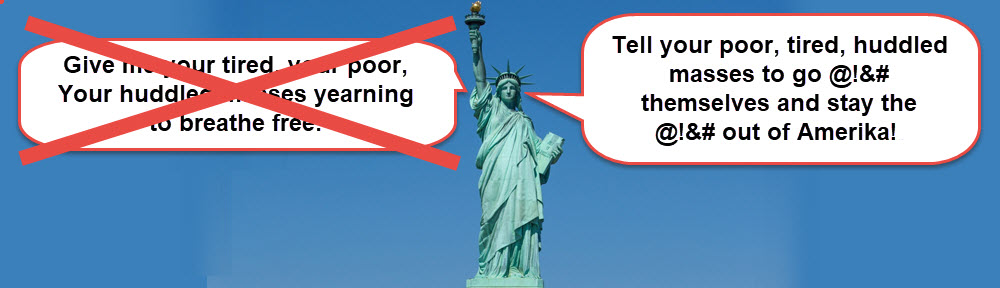
There’s always a country that wants your money — go where you’re wanted and the heck with Amerika!

https://www.newsweek.com/trump-admin-visas-tourist-business-major-change-2108642

Newsweek: ICE detains woman in green card process and son at Canadian border

A New Zealand woman and her youngest son, living in Washington, were detained by U.S. Immigration and Customs Enforcement (ICE) on the Canadian border after dropping her other children off in Vancouver.

Sarah Shaw, who is waiting for a green card, and her son Isaac, 6, were arrested despite having some immigration documents. She is now being held in a detention facility in Texas.

Newsweek reached out to ICE and Shaw’s attorney for comment via email Monday morning.

Why It Matters

Since President Donald Trump‘s return to the White House in January, ICE has been seen to take a tougher stance on immigration enforcement, including against those with legal status. This has led to increased uncertainty around international travel for green card holders and those with other long-term visas.

What To Know

A GoFundMe page set up by Shaw’s friend, Victoria Besancon, explained that the mother of three had fully prepared for a quick trip across the U.S.-Canadian border on July 24 to drop off her two eldest children at Vancouver’s airport. They were headed back to New Zealand for a visit with their grandparents.

While crossing into Canada had been fine, on the return trip, immigration officials detained Shaw and Isaac.

Originally entering the U.S. sponsored by her ex-husband, Shaw is now in the process of seeking a green card independently under a domestic violence survivor’s provision. According to the GoFundMe, Shaw had work authorization but not travel permissions just yet, as part of what is known as a “combo card”, while her son did.

Her attorney, Minda Thorward, told NBC King 5 news that under previous administrations, Shaw would likely have been quickly paroled back into the U.S. by Customs and Border Protection (CBP), but that this had clearly shifted under Trump.

Despite Isaac having travel permissions, ICE still holds him in detention, with Shaw also held at the Dilley Immigration Processing Center in South Texas.

Besancon wrote on her GoFundMe page that Shaw works for the Washington State Department of Children, Youth, and Families (DCYF) and was set to begin grad school soon. The funding, sitting at over $33,000 Monday morning, was to cover legal fees and essentials, after she was forced to burn through savings for legal representation.

Shaw’s case is not the first of its kind, with multiple legal residents reported to have been detained by ICE in recent months. While some have known criminal records or histories, which can be reason to withdraw visas, others have claimed that they simply made mistakes with paperwork and should be released.

What People Are Saying

Victoria Besancon, Shaw’s friend, speaking to NBC King 5: “Sarah had been waiting on some travel documents to be approved. But once her visa and her children’s visas were cleared, she felt comfortable taking them to Canada. We assumed everything was fine.

“The main thing Sarah has expressed throughout this ordeal is just absolute shock and devastation. She truly believed she had done everything that was required of her.”

DHS Assistant Secretary Tricia McLaughlin, in a recent statement on immigration enforcement: “The fact of the matter is those who are in our country illegally have a choice—they can leave the country voluntarily or be arrested and deported. The United States taxpayer is generously offering free flights and a $1,000 to illegal aliens who self-deport using the CBP Home app. If they leave now, they preserve the potential opportunity to come back the legal, right way. The choice is theirs.”

What’s Next

Shaw is yet to show up on ICE’s inmate detainee locator, with her friends and legal team urging the agency to release her and her son.

https://www.newsweek.com/domestic-violence-survivor-detained-ice-us-canada-border-2111838

Alternet: Donald Trump just debunked his own lie — and it should get him sued | Opinion

Walmart, Apple , and Amazon, the most successful companies in the U.S., base their corporate strategies on data: consumer behavior data, market research, financial, product, and competitive analysis data.

Any CEO who deliberately relied on falsified data, or who demanded cooked books, would be fired immediately — and likely sued by the Board of Directors.

Any CEO of any company who tried to manipulate the appearance of short-term success for his own personal gain, at the expense of long-term viability for the company, would also be fired and likely sued for malfeasance, and worse.

A successful CEO knows that falsifying economic or financial data can lead to charges of securities fraudwire fraud, and other financial crimes, because false data can ruin investors, corporations, and markets overnight.

Enter Donald Trump, whose self-proclaimed governing philosophy is “running the country like it’s a business.” Debunking the lie of his own manufactured image as a “successful businessman,” last Friday Trump angrily fired the Bureau of Labor Statistics (BLS) Commissioner because he didn’t like her data — even as he wears 34 felony convictions for falsifying records.

Dr. Erika McEntarfer, a widely respected statistician, enjoyed bipartisan support, including confirmation votes from Marco Rubio and JD Vance. Appointed commissioner under the Biden administration, she holds a Ph.D. in economics from Virginia Tech, and served at the Census Bureau for two decades under both parties prior to her BLS appointment.

By federal law, McEntarfer’s appointment ends in 2028. Trump fired her anyway because he was embarrassed by jobs data that didn’t match his own hype.

In May, the White House said that April’s jobs report “proved” that Trump was “revitalizing” the economy. In June, Trump posted, “GREAT JOBS NUMBERS.” After the Labor Department released revised jobs figures for those months — a common practice because jobs reports are sample projections that get adjusted when actual employer data come in — Trump fired the messenger.

Trump’s penchant for hiding and falsifying data has put American corporations and the economy in more danger. Just as he scrubbed government websites of climate data to bolster his fossil fuel donors, just as he ordered the Smithsonian to remove an exhibit accurately reflecting his own impeachments, Trump thinks reality is whatever he says it is.

As he fantasizes about returning America to the Gilded Age, where robber barons extracted the earth’s resources for unimaginable profit while laborers worked for starvation wages, he’s forgetting that his oligarch donors need accurate economic data too. At least oligarchs creating real products and delivering real services—as opposed to merely speculating in Trump’s image—need real, reliable, and uncooked data.

McEntarfer should sue

When Trump fired McEntarfer in a social media post, he declared that her numbers were “phony.” He wrote on Friday, “In my opinion, today’s Jobs Numbers were RIGGED in order to make the Republicans, and ME, look bad,” adding: “But, the good news is, our Country is doing GREAT!”

He said the numbers had been manipulated for political purposes, and announced he fired McEntarfer as a result.

Trump also baselessly accused McEntarfer of manipulating jobs numbers before the November election to advantage Kamala Harris. Trump said to reporters, “I believe the numbers were phony, just like they were before the election, and there were other times. So you know what I did? I fired her, and you know what? I did the right thing.”

When asked what his source was, he said, “my opinion,” confirming that there was no evidence to back up his reckless claims, claims that permanently tanked the reputation of a celebrated career professional.

Presidents not immune from civil prosecution

No doubt Trump slurred McEntarfer based on his own “opinion” to avoid defamation liability, but an opinion that implies a false fact is still defamatory, it is still actionable, and presidents are not immune from civil lawsuits for defamation.

The four legal elements of defamation are easily found here: false statement; publication; negligence in repeating the falsehood; and reputational harm.

More, a president has immunity from civil lawsuits only for actions taken in furtherance of his core constitutional powers. One of the main “core constitutional powers” of a president is ensuring the faithful execution of laws, such that acting to impede the execution of federal law would fall outside core official responsibilities. (As an aside, even under the disastrous Trump v. US criminal immunity ruling, Trump’s J6 conduct would likely have fallen outside his core function, had it proceeded to trial.)

Trump knowingly and intentionally lied about the BLS commissioner in a manner that directly conflicts with the Department of Labor’s statutory mission; as such, it was not a “core Constitutional function.” Announcing that previous labor reports were “falsified” causes immediate reputational harm to the Commissioner, the Department of Labor, and the US economy overall. It directly impedes the accurate compilation of labor data, a charge mandated by the Wagner-Peyser Act of 1933 as well as the Fair Labor Standards Act.

By implicitly directing that all future US data should be falsified to suit his own political narrative, Trump’s statements not only harm America’s economy, but they hinder rather than aid the faithful execution of laws.

As McEntarfer’s predecessor puts it, McEntarfer’s “totally groundless firing” sets a dangerous precedent and “undermines the statistical mission of the bureau.”

“We need accurate Jobs Numbers,” Trump told reporters, suggesting McEntarfer’s jobs numbers weren’t.

“She will be replaced with someone much more competent and qualified,” he added, suggesting McEntarfer was neither.

Missing the risible irony as he seeks manipulated jobs data for his own political purposes, Trump added, “Important numbers like this must be fair and accurate, they can’t be manipulated for political purposes.”

https://www.alternet.org/alternet-exclusives/trump-lie-debunked

Independent: Trump team weighs releasing Ghislaine Maxwell’s interview with DOJ officials over Epstein case: report

It was not previously known that such a recording existed, but a final decision in whether to release it or not has yet to be made

The Trump administration is considering publicly releasing an audio recording of an interview with Ghislaine Maxwell and senior officials from the Department of Justice about Jeffrey Epstein, according to a new report.

It was not previously known that such a recording existed, and officials are currently discussing whether or not to release a transcript of the discussion between the British socialite and Deputy Attorney General Todd Blanche.

Maxwell, 63, was the disgraced financier’s ex-girlfriend, and is currently serving a 20-year prison sentence after her 2021 conviction for her role in a scheme to sexually exploit and abuse multiple girls. Her attorneys have taken an appeal of her conviction to the Supreme Court.

The interview between the socialite and the DOJ came following ongoing pressure on the administration to be more transparent over the Epstein case, following a July 6 memo which stated that convicted pedophile died by suicide in 2019 and there was no evidence to support the existence of a so-called “client list.” Such claims caused uproar among the MAGA faithful.

Sources told CNN that the audio recording was currently being transcribed and digitized, but that some parts that may reveal sensitive information – like the names of victims – would need to be redacted.

The outlet reported that as of Tuesday morning, a final decision on whether to release the recording and the transcript, had not been made.

CNN also reported that, per its sources, some within the administration were concerned that making details from the interview public would bring the Epstein controversy back into the public spotlight, when many officials close to the president believe the story has largely died down.

When asked for comment by The Independent, the administration denied that any such decisions were being made about the transcript, and that Trump had already addressed the issue.

In a statement, Steven Cheung, White House Communications Director, said: “This is nothing more than CNN trying desperately to create news out of old news. He already addressed this issue in an interview with Newsmax, a real news outlet that routinely gets better ratings than CNN.”

Discussions about the recordings and transcript come after the DoJ admitted that the grand jury transcripts in Maxwell’s criminal case, contain mostly publicly available information.

Trump previously asked Attorney General Pam Bondi to make public “any and all pertinent” grand jury transcripts in both the Epstein and Maxwell cases, in order to stymie the ongoing furore.

A judge overseeing Maxwell’s case asked the government to provide more information to the court. The department provided a version of the transcripts that identifies which information is not publicly available. However, Bondi admitted in a Monday filing that “much” of the information in the transcripts was already made publicly available.

https://www.the-independent.com/news/world/americas/us-politics/ghislaine-maxwell-doj-interview-epstein-b2802282.html

Irish Star: White House orders NASA to deliberately destroy two important satellites monitoring climate change

NASA has been given orders by the White House to destroy two major satellites in space that are used by farmers, scientists, as well as oil and gas companies.

NASA has been given orders by the White House to destroy two major satellites in space that are used by farmers, scientists, as well as oil and gas companies.

According to NPR, the data from the satellites provides detailed information about carbon dioxide and crop health. The outlet stated that the objects are the only two federally used satellites that provide information built to specifically monitor planet-warming greenhouse gases.

It is currently unclear why the Trump administration seeks to destroy the satellites, as they are state-of-the-art and were expected to last for several more years. In 2023, an official data review found that the data stored there was “of exceptionally high quality,” and they recommended continuing the mission for at least three more years. It comes after a chilling map revealed the US regions where 75% of people will die in a nuclear World War 3.

Both missions, known as the Orbiting Carbon Observatories, reportedly used identical measurement devices to measure carbon dioxide and plant growth around the globe. While the devices were identical, one of the satellites is actually attached to the International Space Station.

Should NASA choose to comply with the directive, the standalone satellite will burn up in the Earth’s atmosphere. The mission has since been dubbed Phase F, per David Crisp, a longtime NASA scientist who designed the instruments and managed the missions until he retired in 2022.

“What I have heard is direct communications from people who were making those plans, who weren’t allowed to tell me that that’s what they were told to do,” Crisp said to NPR. “But they were allowed to ask me questions.”

“They were asking me very sharp questions. The only thing that would have motivated those questions was [that] somebody told them to come up with a termination plan,” he added. According to Crisp, it makes no sense why Trump would order the termination of the satellites.

Crisp commented that it makes “no economic sense to terminate NASA missions that are returning incredibly valuable data.” According to the expert, maintaining the two observatories only costs $15 million per year, barely a dent in the agency’s $25.4 billion budget.

Two other NASA scientists have confirmed that the Trump administration had contacted mission leaders to make plans for the termination of other projects that would lose funding under Trump’s proposed budget for the next fiscal year.

Several scientists have expressed outrage at the proposal and argued that it could precipitate an end to the US’s leadership in space.To prevent this, lawmakers have attempted to draw up a counter to Trump’s plan to keep NASA’s budget roughly in line.

“We rejected cuts that would have devastated NASA science by 47 percent and would have terminated 55 operating and planned missions,” said Senator and top appropriator Chris Van Hollen, per Bloomberg. “Eliminating funds or scaling down the operations of Earth-observing satellites would be catastrophic and would severely impair our ability to forecast, manage, and respond to severe weather and climate disasters House representative and Committee on Science, Space and Technology ranking member Zoe Lofgren

“The Trump administration is forcing the proposed cuts in its FY26 budget request on already appropriated FY25 funds,” she added. “This is illegal.”

It comes after a Trump family member revealed his body is “rotting inside” as she delivered a terrifying update on the president’s health.

https://www.irishstar.com/news/us-news/white-house-orders-nasa-deliberately-35680658

CBS News: Border agents directed to stop deportations under Trump’s asylum ban, sources say

U.S. border agents have been directed to stop deporting migrants under President Trump’s ban on asylum claims, following a federal court order that said the measure could not be used to completely suspend humanitarian protections for asylum-seekers, two Department of Homeland Security officials told CBS News.

The move effectively lifts a sweeping policy that had closed the American asylum system to those entering the U.S. illegally or without proper documents. It’s a measure the second Trump administration has credited for a steep drop in illegal immigration at the U.S.-Mexico border, where officials last month reported the lowest monthly level of migrant apprehensions on record.

Mr. Trump’s asylum crackdown was unprecedented in scope. The proclamation underpinning it, issued just hours after he returned to the White House in January, gave U.S. border officials the power to summarily deport migrants without allowing them to request asylum, a right enshrined in American law for decades. 

Mr. Trump said the extraordinary action was necessary due to what he called an “invasion” of migrants under the Biden administration, which faced record levels of illegal crossings at the southern border until it too restricted asylum last year. 

On Friday, a federal appeals court lifted its pause on a lower judge’s ruling that found Mr. Trump’s decree violated U.S. asylum laws. While the appellate court narrowed the lower court’s order, saying Mr. Trump’s proclamation could be used to pause access to the asylum system, it also ruled the U.S. government could not disregard other laws that bar officials from deporting migrants to places where they could be tortured or persecuted.

Those laws require the U.S. to grant legal protections — known as “withholding of removal” and protection under the United Nations Convention Against Torture — to migrants who prove they would likely face persecution or torture if deported to their home countries. Unlike asylum, those protections do not allow recipients to get permanent U.S. residency or protect them from being deported to a third party country.

Officials at Customs and Border Protection were instructed this weekend to halt deportations under Mr. Trump’s proclamation and to process migrants under U.S. immigration law, which affords foreigners on American soil the right to request humanitarian refuge, the two DHS officials said, requesting anonymity to discuss an internal directive.

CBP officials received instructions to process migrants through different mechanisms, including through a fast-track deportation procedure known as expedited removal, according to the DHS officials. While expedited removal allows for relatively quick deportations, migrants processed under the policy are also allowed to apply for asylum if they convince officials that their fears of being harmed if deported are credible.

For months, U.S. border agents had been using Mr. Trump’s asylum ban to swiftly deport those crossing into the country illegally to Mexico, their home countries and, in some cases, third party nations that had agreed to accept them. Internally, officials have dubbed those deportations “212(f) repatriations,” in reference to the legal authority Mr. Trump invoked in his proclamation.

While the lifting of Mr. Trump’s order may reopen the U.S. asylum system, those caught crossing the southern border illegally will likely remain detained while officials vet their claims. The Trump administration has largely stopped the practice of releasing migrants into the U.S. while they await their court dates, limiting releases to cases involving extraordinary circumstances. 

The Justice Department could also try to get Friday’s court order suspended by the Supreme Court, in a bid to revive Mr. Trump’s asylum ban.

In a statement to CBS News late Monday, CBP said Friday’s court order affirmed “the President’s authority to deny asylum to aliens participating in an invasion into the United States.”

CBP said the Trump administration is “committed to ensuring that aliens illegally entering the United States face consequences for their criminal actions.”

“This includes prosecution to the fullest extent of the law and rapid removal from the United States,” the agency added. “CBP will continue to process illegal/inadmissible aliens consistent with law, including mandatory detention and expedited removal.”  

After soaring to record levels in late 2023, illegal border crossings dropped sharply in former President Biden’s last year office, following increased efforts by Mexico to interdict U.S.-bound migrants and an order issued by Biden in June 2024 to restrict access to the American asylum system. But they have plunged even further since Mr. Trump took office for a second time.

In July, Border Patrol encountered just 4,600 migrants along the southern border, the lowest monthly tally ever publicly reported by the agency. It’s also a figure the Biden administration recorded in 24 hours on many days.

https://www.cbsnews.com/news/border-agents-directed-to-stop-deportations-under-trumps-asylum-ban-after-court-order