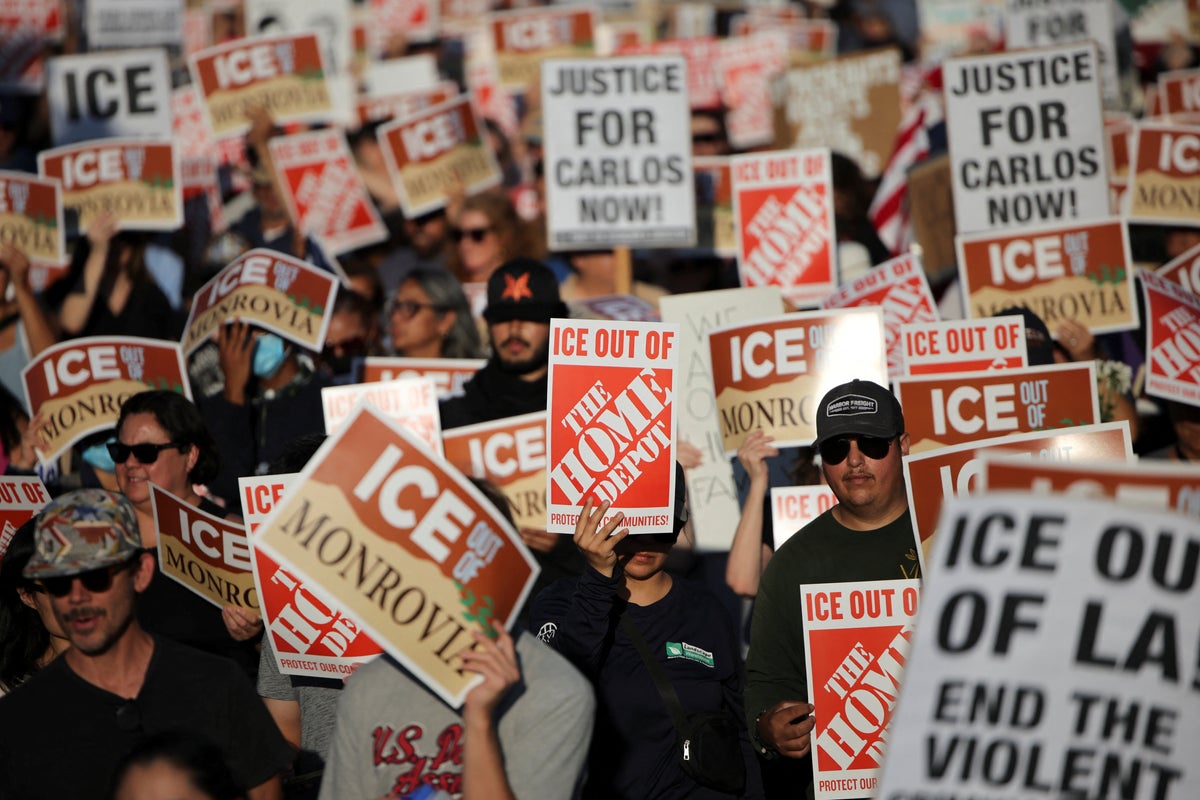
The Guardian reports prominent conservatives are attacking U.S. Attorney General Pam [“Bimbo #3”] Bondi for pledging to “absolutely target” people who use “hate speech” in the wake of the killing of MAGA influencer Charlie Kirk.
[“Bimbo #3”] Bondi declared on a podcast hosted by Katie Miller, the wife of the right-wing White House deputy chief of staff Stephen Miller, that there is “free speech and then there’s hate speech, and there is no place, especially now, especially after what happened to Charlie, in our society”.
The U.S. attorney also went so far as to threaten to prosecute an Office Depot employee who allegedly refused to print flyers for a vigil for Kirk.
But legal experts and conservative pundits are condemning the comments because there is no “hate speech” exception in the First Amendment right to speech, so targeting people for frank or even hurtful comments is unconstitutional.
“Get rid of her. Today. This is insane. Conservatives have fought for decades for the right to refuse service to anyone. We won that fight. Now Pam [“Bimbo #3”] Bondi wants to roll it all back for no reason,” said conservative pundit Matt Walsh posting on X
Conservative commentator Erick Erickson, also writing on X, said: “Our Attorney General is apparently a moron. ‘There’s free speech and then there is hate speech.’ No ma’am. That is not the law.”
Savanah Hernandez, a commentator with Turning Point, described [“Bimbo #3”] Bondi’s statement as the “most destructive phrase that has ever been uttered … She needs to be removed as attorney general now.”
Heidi Kitrosser, a Northwestern University law professor, told the Guardian that [“Bimbo #3”] Bondi’s talk of targeting people who use “hate speech” is not legal because the “first amendment creates very, very strong protections from punishment for speech that’s offensive or for speech with which people disagree.”
“The bar for punishing speech based on content, and especially based on viewpoint, is extremely, extremely high,” Kitrosser said.
Tag Archives: Attorney General Pam Bondi
MSNBC: ‘So absurd’: Chris Hayes blasts MAGA crackdown on free speech
“The Trump administration is announcing their intention—loud and clear—that they want to use every tool of the state at their disposal to suppress domestic political dissent,” says Chris Hayes.
‘I’ve Asked Pam To Look Into That’: Trump Openly Discusses Plans To Dismantle Democracy, Says All His Critics Should Be ‘Put In Jail’
Donald Trump signed a memorandum to deploy troops in Memphis, Tennessee several days ago from the Oval Office. During his gaggle with the press, Trump threw a temper tantrum over protestors who crashed his recent restaurant visit in D.C. Trump stated that he asked U.S. Attorney General Pam Bondi to look into whether or not these protestors can be charged under the Racketeer Influenced and Corrupt Organizations (RICO) Act and put in jail. “They should be put in jail. What they’re doing to this country is really subversive,” Trump remarked.
Washington Post: A D.C. neighborhood long home to immigrants pushes back against ICE arrests
The text messages ricocheted across Mount Pleasant, a historically diverse enclave two miles north of the White House, moments after someone said they saw federal agents stopping a Latino immigrant driving his daughter to school.
“At a raid now at mt p and Lamont!!!” popped up on Phaedra Siebert’s phone a few blocks from the intersection, she recalled later. Sprinting over, the former museum curator joined a crowd that was screaming at officers they assumed were with U.S. Immigration and Customs Enforcement.
“Shame on you!” they chanted. “Shame on you!”
“We’ve got ICE out here!” someone yelled. “ICE here!”
President Donald Trump’s crackdown on crime in D.C. roiled large swaths of the nation’s capital, as Washingtonians encountered police checkpoints, armed National Guard troops and masked immigration agents. Although the president’s 30-day emergency ended Wednesday, the heightened pace of immigration arrests has continued in the city.
In Mount Pleasant, a left-leaning neighborhood whose large Latino population has long been part of the community’s fabric, residents have responded out of a sense of kinship to the sight of ICE agents swooping in, presumably to apprehend people living and working there suspected of being in the country illegally.
On weekday mornings, those upset by the arrests volunteer to chaperone groups of children walking to schools. Others patrol the streets, some while walking their dogs and riding bikes. Everyone is on the lookout for agents in unmarked SUV’s with tinted windows and out of state license plates that are hard to miss against a backdrop of elegant brick rowhouses and apartment buildings and a colorful low-rise commercial corridor.
If something catches their attention, they blow homemade whistles — their high-pitched trill echoing through the streets — and text warnings to hundreds of neighbors, many of them on a messaging system the man behind it likened to a “bat signal.”
“Can we stop ICE from coming? No,” said Rick Reinhard, who has lived in Mount Pleasant for more than 50 years and helped launch the network, among several residents use to communicate. “But can we make it uncomfortable? … Yeah.”
Mount Pleasant residents have their reasons for focusing their concern on ICE. In the month since the start of Trump’s crackdown, according to White House officials, law enforcement has apprehended slightly more than 1,000 immigrants across D.C., accounting for about 38 percent of the arrests they have reported for the period.
Following Trump’s emergency declaration on Aug. 11, Attorney General Pam Bondi said D.C.’s lenient policies toward immigrants, which prohibited police from cooperating in ICE arrests, made the city more dangerous. Immigration agents intensified enforcement in areas such as Columbia Heights and Mount Pleasant, neighborhoods popular among the city’s 95,000 immigrants, more than a quarter of them estimated to be undocumented.
Siebert, 54, was on her own self-styled walking patrol Aug. 28 just before 8 a.m. when she saw the text about agents detaining the man at the corner of Mount Pleasant and Lamont streets.
As she arrived, she said, she saw that the officers already had the man in handcuffs and that his daughter was weeping. Loren Galesi, who also lives in the neighborhood, had positioned herself in front of what she thought was an agent’s car, an act of protest she later described as “so out of character for me.”
“In a political city, we’re not political,” Galesi, 42, a graduate student in history at Georgetown University, said of herself and her husband, who moved to Mount Pleasant with their two children in 2021. “I vote every four years, that’s the extent to my involvement.”
Something changed in her after the start of Trump’s crackdown, said Galesi, as she witnessed “these masked agents show up and take our neighbors away.”
At the intersection that morning, Galesi saw the agents place the man in a car and drive off. Her friend, Liz Sokolov, 50, an educator who had been on her own patrol when she came upon the crowd, was in tears. “It just feels like you’re living in a country you don’t recognize,” Sokolov said later.
She tried to comfort herself with the thought that the detained man “knew we didn’t want him taken away and knew we were using our voices to help.” Yet, a litany of unsettling questions remained, not the least of which was when the agents would return.
Everyone is scared
The ICE raids — and the possibility of more in the future — has caused fear in the neighborhood, a sloping pocket just off 16th Street NW with a diverse population of lawyers, policy analysts, Capitol Hill staffers, and blue collar workers, many of them immigrants from El Salvador.
The neighborhood has faced a variety of crises over the years, including a 1991 riot that began when a police officer shot a Salvadoran immigrant. A five alarm fire in an apartment building in 2008 displaced 200 low income Latino families. The pandemic delivered another wave of pain five years ago.
Six days after Trump’s Aug. 11 emergency declaration, the administration made it known that Mount Pleasant was on its radar. On social media, ICE posted a video of agents descending on a neighborhood plaza and ripping down a banner that used a Spanish epithet to denigrate the agency.
“We’re taking America back, baby,” an agent says in the video, his face concealed by sunglasses, a hat, and a black gaiter.
Residents replaced the banner with another — “No Deportations in Mt. Pleasant,” it read — though their defiance did not salve the general unease.
“People are really, really scared; they don’t want to go to their jobs, they don’t want to go shopping,” said Yasmin Romero-Castillo, head of a local tenants association who buys groceries for residents too afraid to leave their apartments.
As she spoke, she sipped tea at Dos Gringos, a cafe whose owner, Alex Kramer, has been a Mount Pleasant fixture since 1994. Kramer said her business suffered during the crime emergency because employees from nearby shops weren’t going to work and dropping in for coffee. “The neighborhood is dead; they have killed the vibe,” Kramer said. “You listen for the whistles and the helicopters. Everyone is scared. I’m scared.”
The shrill of a whistle and a woman shouting, “Get your hands off of her!” is what caught Claudia Schlosberg’s attention on Labor Day as she watered her garden.
Schlosberg, 71, a civil rights and health care attorney who has lived in Mount Pleasant since 1978, dropped her hose and ran to the corner where U.S. Park Police officers and other agents were questioning the driver of a van and her passenger.
The officers, Schlosberg said, smashed the window, pulled the passenger out and whisked him away. A woman who questioned the arrest had been pulled off her bicycle and over to the sidewalk by a man in a vest marked “Police.” As she tried to video, Schlosberg said the same man threatened her with pepper spray and ordered her to move back.
“What are you doing?” Schlossberg recalled responding. “Why are you doing this? Get out of here!”
Two days later, Schlosberg was part of a group of 50 residents who went to a local library, expecting to voice their concerns over the immigration arrests at a meeting with someone from the office of D.C. Mayor Muriel E. Bowser (D).
Many in the neighborhood were already displeased that Bowser had signed an executive order directing her police force to coordinate with federal authorities indefinitely, though the mandate did not include ICE.
They never got to share those sentiments. Anthony Robertson, a Bowser staffer, showed up only to depart quickly without taking questions. “It really feels like there’s no one we can turn to protect our community,” Schlosberg said.
A mayoral spokesperson, in a statement, did not directly address the reason for Robertson’s departure but said the administration would “continue to work with the community” through “the appropriate senior officials who can provide the most relevant and timely information.”
The ‘eyes and ears’ of the community
Even before Trump took office in January, Reinhard contemplated ways to organize Mount Pleasant, figuring that the neighborhood’s immigrant population could be vulnerable if the president carried out a campaign threat to takeover the city.
By the spring, Reinhard, a photographer with a history of activism in the neighborhood, had started a texting network and recruited a few people. Then came Trump’s emergency declaration and membership on the channel ticked up: 50 people, then 80, then 100, then 200 and more.
Recruits are vetted to ensure they don’t work for the Trump administration, as well as law enforcement and news organizations, and are encouraged not to talk to outsiders about the channel. “There’s so much concern that they could seize our phones and infiltrate a group chat,” Galesi said. “There’s a strong sense that if you don’t live here, we can’t trust you.”
One neighborhood restaurant owner described the messaging system as the “eyes and ears” of Mount Pleasant. “As soon as someone posts they’ve seen something, someone will be like, ‘I’ll be there in five minutes,’” said the owner, who spoke on the condition of anonymity, fearful of drawing unwelcome attention to the restaurant. “It’s almost like a constant patrol. Instead of walkie-talkies, they’re using their phones.”
Others started their own chat groups, including Sokolov, who worried that a local day care center could be vulnerable because it caters to immigrants families. A friend with a 3D printer volunteered to make nearly 200 whistles they distributed across Mount Pleasant.
Siebert started her patrols weekday mornings, beginning at 6:45 a.m. She has become adept, she said, at spotting unmarked police SUVs, “usually black or charcoal,” with their darkened windows and concealed emergency lights.
“I’m glad to be doing something of use when it’s easy to feel entirely impotent,” she said. “I’m also glad to find a way to use my privilege as a nice White lady. People don’t clock me as a someone patrolling the patrollers but this is what we do. One of my tools is blonde hair.”
By the end of the first week of September, the visits from federal agents seemed to subside. Residents remained on alert, though. Their messaging systems still hummed. Patrols persisted.
As parents picked up children at the Bancroft Elementary School one afternoon, a man pointed down the street as he walked his Chihuahua and shouted, “Hey everybody! Be careful! ICE is out there!”
Heads turned, footsteps quickened.
“They’re down the street!” the man repeated. “They’re down there!”
At the end of the block, there was no sign of ICE or any other law enforcement, for that matter. “A UPS man said he’d seen them outside an alley,” the man explained. “And in another alley.”
He shrugged and moved on.
A few feet away, a boy turned to a stranger.
“What’s ICE?” he asked, his brow furrowed before he resumed his walk home.
MSNBC: Maddow Blog | FBI’s Kash Patel faces criticisms from within the Trump administration
The FBI director is facing all kinds of criticisms, including some from within the bureau that Patel ostensibly leads.
Kash Patel’s difficulties at the FBI certainly didn’t start last week, but his handling of Charlie Kirk’s shooting death hasn’t exactly helped the bureau’s hapless director.
On Wednesday afternoon, for example, Patel suggested via social media that Kirk’s shooter had been captured. That wasn’t just wrong, it also had the potential to undermine the investigation: People might’ve been discouraged from calling in tips after they saw the FBI director told the public that the suspect was no longer at large.
Patel was forced to walk back his mistake soon after, but the incident quickly led to criticisms from both the left and the right. Just as notable, however, were relevant details that soon followed. NBC News reported on Friday:
FBI Director Kash Patel was dining at Rao’s in New York on Wednesday night after the fatal shooting of Charlie Kirk, two sources familiar with his whereabouts told NBC News. Patel had posted on X at 6:21 p.m. ET that the ‘subject’ in Kirk’s killing was ‘in custody.’ Rao’s, a well-known restaurant that is notoriously tough to get into, opens at 7 p.m. Then, at 7:59 p.m., Patel posted a follow-up post that the ‘subject in custody has been released after an interrogation by law enforcement.’
The reporting on his whereabouts certainly didn’t make Patel look any better, but the details also suggest that there were people within the FBI who were eager to alert the public to the embarrassing details of Patel’s mistake.
Around the same time, a current law enforcement official who spoke on condition of anonymity told NBC News that the “horrific event” of Kirk’s killing showcased Patel’s “public inability to meet the moment as a leader.”
Two days later, Fox News published a report with a headline that said “knives are out” for Patel — a Shakespearean metaphor suggesting that at least some of the director’s opponents are coming for him from within the FBI. The same report quoted one insider who added that the White House, Attorney General Pam Bondi and Deputy Attorney General Todd Blanche “have no confidence in Kash.”
That reporting has not been independently verified by MSNBC or NBC News, and the president himself continues to offer public praise for the FBI director.
Yet, as the ground beneath Patel’s feet appears less certain, former Missouri Attorney General Andrew Bailey is poised to be sworn in as the FBI’s first co-deputy director, a move that continues to be bizarre (since the FBI already has a deputy director in former podcast personality Dan Bongino) and that probably won’t help quiet the whispers about Patel’s future.
Slingshot News: ‘Largely A Thousand Miles Of Ocean’: Trump Embarrasses Himself, Shows That He’s Clueless About Ukraine’s Geography During Press Briefing
Donald Trump held a press briefing at the White House several weeks ago announcing military deployment in Washington, D.C. During his gaggle with the press, Trump ignorantly claimed that Ukraine is “largely a thousand miles of ocean.” Ukraine is bordered by the Black Sea and the Sea of Azov, neither of which is ocean.
Slingshot News: ‘Not When I’m In Charge’: Donald Trump Makes A Fool Of Himself, Believes He Has China Cornered During Press Conference
During a press conference at the White House several weeks ago announcing his police takeover of Washington, D.C., Donald Trump stated that China will never beat the U.S. in trade for as long as he’s president. Meanwhile, Trump is always chickening out with 90-day tariff pauses.
Slingshot News: ‘We’re Allowed’: Trump Claims He Is Above The Law, Says He Can Attack Harvard All He Wants In Interview
President Donald Trump claimed that he is above the law, saying that he can attack Harvard University all that he wants. Trump is not legally allowed to withhold federal funds from Harvard.
Independent: Federal agents to ‘flood the zone’ after Supreme Court opens door for racial profiling in Los Angeles immigration raids
The Trump administration is vowing to “FLOOD THE ZONE” after the Supreme Court opened the door for federal law enforcement officers to roam the streets of Los Angeles to make immigration arrests based on racially profiling suspects.
A 6-3 decision from the nation’s high court Monday overturned an injunction that blocked federal agents from carrying out sweeps in southern California after a judge determined they were indiscriminately targeting people based on race and whether they spoke Spanish, among other factors.
The court’s conservative majority did not provide a reason for the decision, which is typical for opinions on the court’s emergency docket.
In a concurring opinion, Trump-appointed Justice Brett Kavanaugh said that “apparent ethnicity alone cannot furnish reasonable suspicion” but it can be a “relevant factor” for immigration enforcement.
Attorney General Pam Bondi called the ruling a “massive victory” that allows Immigration and Customs Enforcement agents to “continue carrying out roving patrols in California without judicial micromanagement.”
The Department of Homeland Security said its officers “will continue to FLOOD THE ZONE in Los Angeles” following the court’s order.
“This decision is a victory for the safety of Americans in California and for the rule of law,” the agency said in a statement accusing Democrat Mayor Karen Bass of “protecting” immigrants who have committed crimes.
Federal law enforcement “will not be slowed down and will continue to arrest and remove the murderers, rapists, gang members and other criminal illegal aliens that Karen Bass continues to give safe harbor,” according to Homeland Security assistant secretary Tricia McLaughlin.
The court’s opinion drew a forceful rebuke from liberal Justice Sonia Sotomayor, the first Hispanic justice on the bench, who accused the conservative justices of ignoring the Fourth Amendment, which protects against unlawful protects against unlawful searches and seizures
“We should not have to live in a country where the Government can seize anyone who looks Latino, speaks Spanish, and appears to work a low wage job,” she wrote in a dissenting opinion.
“The Fourth Amendment protects every individual’s constitutional right to be “free from arbitrary interference by law officers,’” she added. “After today, that may no longer be true for those who happen to look a certain way, speak a certain way, and appear to work a certain type of legitimate job that pays very little.”
Immigration raids throughout the Los Angeles area in June sparked massive protests demanding the Trump administration withdraw ICE and federal agents from patrolling immigrant communities.
In response, Trump federalized National Guard troops and sent in hundreds of Marines despite objections from Democratic city and state officials. The administration deployed roughly 5,000 National Guard soldiers and Marines to the Los Angeles area, assisting with more than 170 law enforcement operations carried out by federal agencies, according to the Department of Defense.
The Pentagon has ended most of those operations, but hundreds of National Guard members remain active in southern California.
California Governor Gavin Newsom sued the administration, alleging the president illegally deployed the troops in violation of a 140-year-old law that prohibits the military from performing domestic law enforcement operations.
ACLU legal director Cecillia Wang, representing groups who sued to block indiscriminate raids in Los Angeles, said the Supreme Court order “puts people at grave risk.”
The order allows federal agents “to target individuals because of their race, how they speak, the jobs they work, or just being at a bus stop or the car wash when ICE agents decide to raid a place,” she said.
“For anyone perceived as Latino by an ICE agent, this means living in a fearful ‘papers please’ regime, with risks of violent ICE arrests and detention,” Wang added.
In his lengthy concurring opinion, Kavanaugh suggested that the demographics of southern California and the estimated 2 million people without legal permission living in the state support ICE’s sweeping operations.
He also argued that because Latino immigrants without legal status “tend to gather in certain locations to seek daily work,” work in construction, and may not speak English, officers have a “reasonable suspicion” to believe they are violating immigration law.
Sotomayor criticized Kavanaugh’s assessment that ICE was merely performing “brief stops for questioning.”
“Countless people in the Los Angeles area have been grabbed, thrown to the ground and handcuffed simply because of their looks, their accents and the fact they make a living by doing manual labor,” she wrote. “Today, the court needlessly subjects countless more to these exact same indignities.”
Because the court did not provide a reasoning behind the ruling, it is difficult to discern whether the justices intend for the order to have wider effect, giving Donald Trump a powerful tool to execute his commands for millions of arrests for his mass deportation agenda.
Bass warned that the ruling could have sweeping consequences.
“I want the entire nation to hear me when I say this isn’t just an attack on the people of Los Angeles, this is an attack on every person in every city in this country,” she said in a statement.
Associated Press: Trump’s US Open visit sparks boos and long security lines
President Donald Trump was loudly booed at the men’s final of the U.S. Open on Sunday, where extra security caused by his visit led to lines long enough that many people missed the start of play, even after organizers delayed it.
Wearing a suit and long, red tie, Trump briefly emerged from his suite about 45 minutes before the match started and heard a mix of boos and cheers from an Arthur Ashe Stadium that was still mostly empty. No announcement proceeded his appearance, and it was brief enough that some in the crowd missed it.
Trump appeared again to more boos before the National Anthem. Standing in salute, the president was shown briefly on the arena’s big screens during the anthem, and offered a smirk that briefly made the boos louder.
When the anthem was over, the Republican pointed to a small group of supporters seated nearby, then sat on the suite’s balcony to watch the match intently. He mostly didn’t applaud, even following major points that energized the rest of the crowd as Spain’s Carlos Alcaraz bested Jannik Sinner of Italy.
Trump was shown on the big screen again after the first set ended, and elicited a roar of louder boos and some piercing whistles. He raised his left fist in salute as the noise continued in the stadium, which with a capacity of 24,000 is one of the largest in tennis.
The president later moved back inside the suite, where he was seen seated at a table with family members and appeared to be eating, but he was back in his seat shortly before match point. Cameras briefly flashed on Trump as Alcaraz celebrated, but his reaction to the conclusion was as muted as it had been throughout most of the match. This time, there was little crowd reaction, too.
Organizers pushed the start of the match back half an hour to give people more time to pass through enhanced screening checkpoints reminiscent of security at airports. Still, thousands of increasingly frustrated fans remained in line outside as the match got underway. Many seats, especially those in upper rows, stayed empty for nearly an hour.
The Secret Service issued a statement saying that protecting Trump “required a comprehensive effort” and noting that it “may have contributed to delays for attendees.”
“We sincerely thank every fan for their patience and understanding,” it said.
Trump attended the final as a guest of Rolex, despite imposing steep tariffs on the Swiss watchmaker’s home country. The U.S. Tennis Association also tried to limit negative reaction to Trump’s attendance being shown on ABC’s national telecast, saying in a statement before play began: “We regularly ask our broadcasters to refrain from showcasing off-court disruptions.”
The reactions to Trump didn’t ultimately constitute big disruptions, though.
Going to the U.S. Open was the latest example of Trump having built the bulk of his second term’s domestic travel around attending major sports events rather than hitting the road to make policy announcements or address the kind of large rallies he so relished as a candidate.
Since returning to the White House in January and prior to Sunday’s U.S Open swing, Trump has gone to the Super Bowl in New Orleans and the Daytona 500, as well as UFC fights in Miami and Newark, New Jersey, the NCAA wrestling championships in Philadelphia and the FIFA Club World Cup final in East Rutherford, New Jersey. Some of those crowds cheered him, but people booed him at other events.
The president accepted Rolex’s invitation despite his administration imposing a whopping 39% tariff on Swiss products. That’s more than 2 1/2 times higher than levies on European Union goods exported to the U.S. and nearly four times higher than on British exports to the U.S.
The White House declined to comment on Trump accepting a corporate client’s invitation at the tournament, but the president has had few qualms about blurring lines between political and foreign policy decisions and efforts to boost the profits of his family business. He’s tirelessly promoted his cryptocurrency interests and luxury golf properties, and even announced that the U.S. will host the Group of 20 summit in December 2026 at his Doral golf resort in Florida.
No large street protests against Trump could be seen from the tournament’s main stadium on Sunday. But attendees also steered clear of wearing any of the the Republican’s signature “Make America Great Again” caps.
A 58-year-old tennis fan originally from Turin, Italy, came from her home in the Boston area to watch the final and said that when she bought a U.S. Open cap, she went with a fuchsia-hued one so it wouldn’t be mistaken for the signature darker color of MAGA hats.
“I was careful not to get the red one,” said the fan, who declined to give her name because of her employer’s rules about being publicly quoted.
Among those attending with Trump were White House press secretary Karoline Leavitt, Attorney General Pam Bondi, Treasury Secretary Scott Bessent, special envoy Steve Witkoff and Susie Wiles, the White House chief of staff. Trump spent various portions of the match engaged in conversation with many of those around him.
Elsewhere in the crowd were a slew of celebrities — some of whom publicly backed then-Vice President Kamala Harris during last year’s election. Among them were Pink, Bruce Springsteen and Shonda Rhimes. In pre-match interviews shown on large stadium screens with the likes of Martha Stewart and Jon Hamm, the questions asked stuck to tennis and pop culture — not Trump and politics.
The president nonetheless was excited enough about his trip to tell reporters on Air Force One during the flight to New York when the plane flew over Ashe stadium — though the covered roof kept those inside from reacting.
Trump was once a U.S. Open mainstay, but hadn’t attended since he was booed at a quarterfinals match in September 2015, months after launching his first presidential campaign.
The Trump Organization once controlled its own U.S. Open suite, which was adjacent to the stadium’s television broadcasting booth, but suspended it in 2017, during the first year of Trump’s first term. The family business is now being run by Trump’s sons with their father back in the White House.
Trump was born in Queens, home of the U.S. Open, and for decades was a New York-area real estate mogul and, later, a reality TV star. Attending the tournament before he was a politician, he usually sat in his company’s suite’s balcony during night matches and was frequently shown on the arena’s video screens.
https://apnews.com/article/trump-us-open-sporting-events-boos-5a80b02c78403f1f2f87a30852ffb0f5