Slingshot News: ‘I Can’t Think Of Any President’: Trump Disrespects His Predecessors, Says He’s The Only US President Who ‘Stopped’ Wars [Video]
Reply
After decades of gradual growth, the number of Black students enrolling at many elite colleges has dropped in the two years since the Supreme Court banned affirmative action in admissions, leaving some campuses with Black populations as small as 2% of their freshman class, according to an Associated Press analysis.
New enrollment figures from 20 selective colleges provide mounting evidence of a backslide in Black enrollment. On almost all of the campuses, Black students account for a smaller share of new students this fall than in 2023. At Princeton and some others, the number of new Black students has fallen by nearly half in that span.
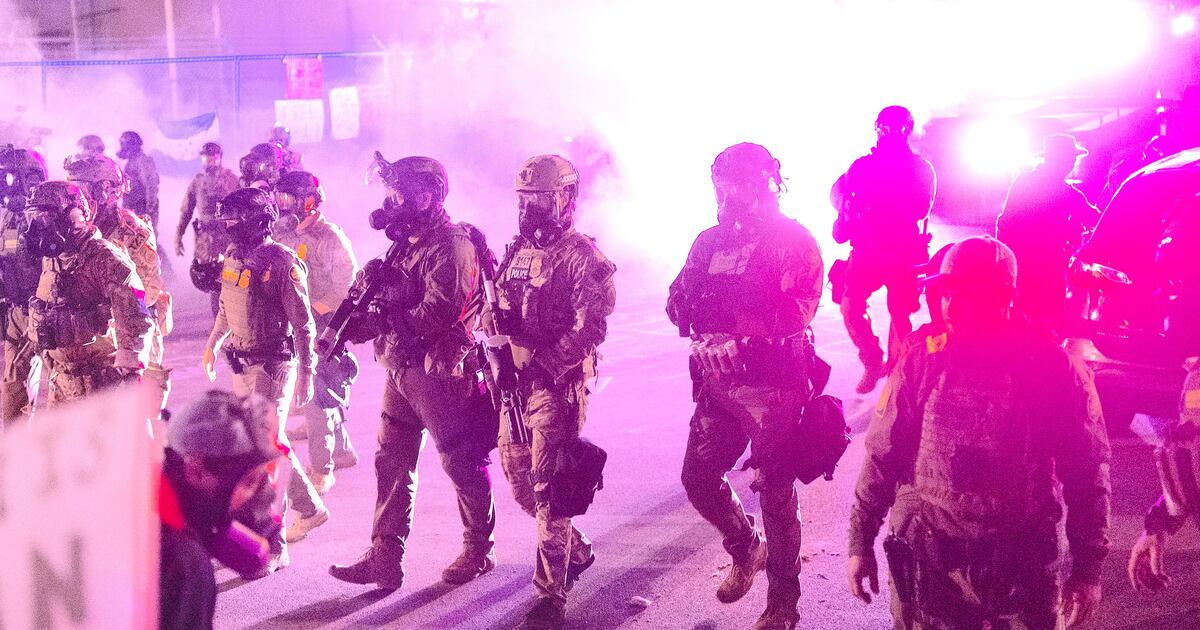
The number of weapons bought by U.S. Immigration and Customs Enforcement has reportedly surged 700 percent under President Donald Trump—and even includes chemical agents and warheads.
Federal purchasing logs show ICE spent $71,515,762 on “small arms, ordnance, and ordnance accessories,” including military supplies, weapons, and ammunition, in the nine months between Jan. 20 and Oct. 18.

A new House GOP proposal would withhold funding from U.S. jurisdictions that celebrate Indigenous Peoples Day instead of Columbus Day.
It comes after President Donald Trump signed a proclamation last week declaring Oct. 13 Columbus Day in honor of the famed explorer as well as the heritage of Italian Americans across the U.S.
“This is about every son and daughter of Italy, every Knights of Columbus, every pasta dinner on Sunday, and every communion — everything that makes our culture who we are, from Philadelphia to San Francisco,” Rep. Michael Rulli, R-Ohio, told Fox News Digital in an interview.
“Every Little Italy neighborhood of this country celebrates Christopher Columbus. It’s so much more than the man. It’s the people.”
Rulli’s new bill would both reaffirm Columbus Day as a federal holiday and punish cities and states that replaced the celebration of it with Indigenous Peoples Day.
“We are not going to allow any American municipality to think that they have power over the federal government,” he said.
In 2021, then-President Joe Biden formally recognized the second Monday in October as both Columbus Day and Indigenous Peoples Day.
The move was lauded by progressive activists and historians who saw Christopher Columbus as the harbinger of a genocide against the land’s indigenous people, millions of whom were killed amid American colonization.
But Rulli argued that Columbus Day was about honoring Italian Americans’ heritage, pointing out that part of the motivation for its founding in 1892 was the extrajudicial lynching of 11 Italian Americans in New Orleans after the death of a local police chief.
He added his legislation was not meant to undercut the significance of Native Americans — whom he said deserve their own day of significance.
“I mean, the Native Americans are some of the most amazing, dynamic cultural people that make up the fabric of America. But they need their own special day,” Rulli said. “And I would be willing to do that. I’m saying right now, I would be willing to get the indigenous people their own day, but not this day.”
He further accused the Biden administration of undercutting the legacy of both peoples by declaring both holidays on the same day, while praising Trump for restoring Columbus Day’s original meaning.
“I don’t care what party you’re in … if you come from Italian American descent, you love what President Trump did. It was a wonderful olive branch to all Italian Americans,” Rulli said.
“By no means, no way, shape or form, is this bill meant to offend any of the indigenous people. They deserve their own day. We will get them their own day, but not Columbus Day. This has already been embedded in our fabric for 130 years,” he said.

Earlier this year, the Trump administration ended programs that gave a break to people who had fallen behind on their student loans. Now, those borrowers have to start paying again — and the government can take money directly from paychecks, tax refunds, or Social Security checks to collect what’s owed.
These changes don’t just impact a small minority. As of July, 5.8 million Americans of all ages could be in technical default, according to TransUnion. That’s one in every three people who have outstanding federal student loans.
If you’ve ever attended college, there’s a significant chance this impacts you. Here’s what you need to know.
….
Maurene Comey, a former federal prosecutor who brought criminal cases against Jeffrey Epstein associate Ghislaine Maxwell and music mogul Sean “Diddy” Combs, has sued President Donald Trump’s administration over her abrupt July firing, court records showed on Monday.
Comey, the eldest daughter of former FBI director and longtime Trump adversary James Comey, said in a lawsuit filed in Manhattan federal court against the Justice Department and the Executive Office of the President that she was not provided any cause for her removal.
“Defendants fired Ms. Comey solely or substantially because her father is former FBI Director James B. Comey,” Maurene Comey’s lawyers wrote in the lawsuit.
The Justice Department did not immediately respond to a request for comment.
Comey’s lawsuit could test the administration’s ability to swiftly fire line prosecutors, as the Republican president’s critics warn that he is seeking to politicize the Justice Department.
The Justice Department has been firing prosecutors who have worked on cases involving Trump or his political allies. Trump and his allies say the Justice Department was “weaponized” against conservatives during Democratic former President Joe Biden’s administration.
It could also test whether the administration can take action against line prosecutors who are not politically appointed and whose careers with the Justice Department frequently span both Republican and Democratic administrations.
Comey is asking a judge to reinstate her into her former role as a prosecutor with the Manhattan U.S. Attorney’s office, which has long enjoyed an unusual degree of independence from Justice Department officials in D.C.

President Trump was operating within his constitutional powers as commander in chief when he ordered the U.S. military to destroy a vessel in the Caribbean, administration officials said, describing the drugs it was allegedly smuggling as an imminent national security threat.
But that claim was sharply disputed by legal experts and some lawmakers, who said that Trump exceeded his legal authority by using lethal military force against a target that posed no direct danger to the U.S. and doing so without congressional authorization.
The disagreement since Trump announced the deadly attack Tuesday underscored how much of a departure it represents from decades of U.S. counternarcotics operations—and raised questions about whether drug smugglers can be treated as legitimate military targets.
“Every boatload of any form of drug that poisons the American people is an imminent threat. And at the DOD, our job is to defeat imminent threats,” Defense Secretary Pete Hegseth told reporters Thursday during a visit to an Army base in Georgia. “A drug cartel is no different than al Qaeda, and they will be treated as such.”
Trump administration officials said Tuesday’s strike, which killed 11 people on the boat, was just the opening salvo in an expanded campaign to dismantle the drug cartels they say pose a major threat to Americans.
But in importing tactics from the post-9/11 war against terrorist groups to use against drug cartels, some former officials said, Trump is trampling on longstanding limits on presidential use of force and asserting legal authorities that don’t exist.
The casualties “weren’t engaged in anything like a direct attack on the United States” and weren’t afforded a trial to determine their guilt, said Frank Kendall, who served as the secretary of the Air Force during the Biden administration and holds a law degree. “Frankly, I can’t see how this can be considered anything other than a nonjudicial killing outside the boundaries of domestic and international law.”
Unlike the interdictions which are usually conducted by the U.S. Coast Guard, the strike was carried out without warning shots, and no effort was made to detain the ship, apprehend its crew, or confirm the drugs on board. “Instead of interdicting it, on the president’s orders they blew it up,” Secretary of State Marco Rubio said in Mexico City on Wednesday.
Trump said U.S. forces “positively identified” the crew before the attack as members of Venezuelan crime syndicate Tren de Aragua, calling them “narcoterrorists.” Tren de Aragua is among the Latin American cartels and gangs that Trump has designated as foreign terrorist organizations since February.
The White House has provided no further information on the operation against the boat or detailed the legal arguments that it claims support it. Nor have officials disclosed where the strike took place, the identities of the casualties or the weapons used.
Some Trump administration officials suggest that by designating the drug cartels as foreign terrorist organizations, the Pentagon has the leeway to treat the groups as it would foreign terrorists. As commander in chief, Trump has the power to order military action against imminent threats without congressional authorization, they said.
The strike “was taken in defense of vital U.S. national interests and in the collective self-defense of other nations,” White House spokeswoman Anna Kelly said, adding that the strike occurred in international waters and “was fully consistent with the law of armed conflict.”
But Geoffrey Corn, a retired lieutenant colonel who was the Army’s senior adviser on the law of war, said: “I don’t think there is any way to legitimately characterize a drug ship heading from Venezuela, arguably to Trinidad, as an actual or imminent armed attack against the United States, justifying this military response.”
Corn, a law professor at Texas Tech University, noted that critics have condemned U.S. drone strikes since 2001 against militants in Afghanistan, Iraq and other countries as extrajudicial killings, but those strikes were legitimate, he said, because the U.S. was engaged in an armed conflict under the laws of war against al Qaeda and other terrorist groups.
Brian Finucane, a former State Department lawyer who is now at the International Crisis Group, said that designation of drug cartels as terrorist groups doesn’t authorize the use of military force against them. Rather it enables the U.S. to levy sanctions and pursue criminal prosecutions against individuals who support the groups.
Nor can military action be justified under the law Congress passed authorizing the use of force against al Qaeda and related terrorist groups following the Sept. 11, 2001, terrorist attacks, experts said.
For the military to use force, “there needs to be a legitimate claim of self-defense in international waters, an action that is necessary and proportional in response to an armed attack or imminent armed attack,” said Juan Gonzalez, who served as the National Security Council’s senior director for Western Hemisphere affairs during the Biden administration. “That clearly didn’t happen.”
The attack was the U.S. military’s first publicly acknowledged airstrike in Central or South America since the U.S. invasion of Panama in 1989. The White House released a grainy black-and-white video that showed the destruction of a small boat, which it celebrated as a blunt warning for drug traffickers throughout the region.
Trump administration officials have offered conflicting accounts of the episode. On Tuesday, Rubio said the drugs the vessel was carrying “were probably headed to Trinidad or some other country in the Caribbean” and could “contribute to the instability these countries are facing,” differing from Trump’s statement that the vessel was “heading to the United States.” On Wednesday, Rubio suggested that the shipment was “eventually” headed to the U.S.
No state in the region has publicly appealed for the U.S. to take military action against the cartels as an act of collective self-defense, Corn said.
On Thursday, two Venezuelan F-16 jet fighters flew near one of the U.S. Navy warships that have been positioned near the county. The Pentagon criticized the apparent show of force as a “highly provocative move” and warned Venezuela not to interfere with its “counter narco-terror operations.”
In the past, some U.S. counternarcotics strikes have ended in tragedy. In 2001, Peruvian and U.S. counterdrug agents mistook a small plane carrying American missionaries over the Peruvian Amazon as belonging to drug traffickers. The Peruvian Air Force shot down the plane, killing a 35-year-old woman and her infant daughter.
The U.S. has limited intelligence on small drug boats leaving Venezuela, from which the Drug Enforcement Administration was expelled in 2005 under then-President Hugo Chávez, said Mike Vigil, a former DEA director of international operations.
“The United States doesn’t really have the capability to develop good intelligence about these embarkations,” he said. “You don’t just send a missile and destroy a boat. It is the equivalent of a police officer walking up to a drug trafficker on the street and shooting him.”
In Quito, Ecuador, on Thursday, Rubio announced the designation of two more criminal groups—the Ecuadorean Los Choneros and Los Lobos—as foreign terrorist organizations. He said U.S. partners in the region would participate in operations to use lethal force against drug cartels.
A senior Mexican naval officer with decades of service and experience boarding drug vessels said actions like the one taken Tuesday by the U.S. would never be allowed by its Mexican counterpart, which has been trained in interdiction procedures by the U.S. Coast Guard.
“There is never a direct attack unless you are attacked,” he said. “As commander of the ship, I would get into serious trouble. I could be accused of murder.”