CBS News: Kristi Noem says “Alligator Alcatraz” to be model for ICE state-run detention centers

Perhaps coming soon to Arizona, Nebraska and Louisiana?

Homeland Security Secretary Kristi Noem says “Alligator Alcatraz” will serve as a model for state-run migrant detention centers, and she told CBS News in an interview that she hopes to launch a handful of similar detention centers in multiple airports and jails across the country, in the coming months. Potential sites are already under consideration in Arizona, Nebraska and Louisiana. 

“The locations we’re looking at are right by airport runways that will help give us an efficiency that we’ve never had before,” Noem said, adding that she’s appealed directly to governors and state leaders nationwide to gauge their interest in contributing to the Trump administration’s program to detain and deport more unauthorized migrants. 

“Most of them are interested,” Noem said, adding that in states that support President Trump’s mission of securing the southern border, “many of them have facilities that may be empty or underutilized.”

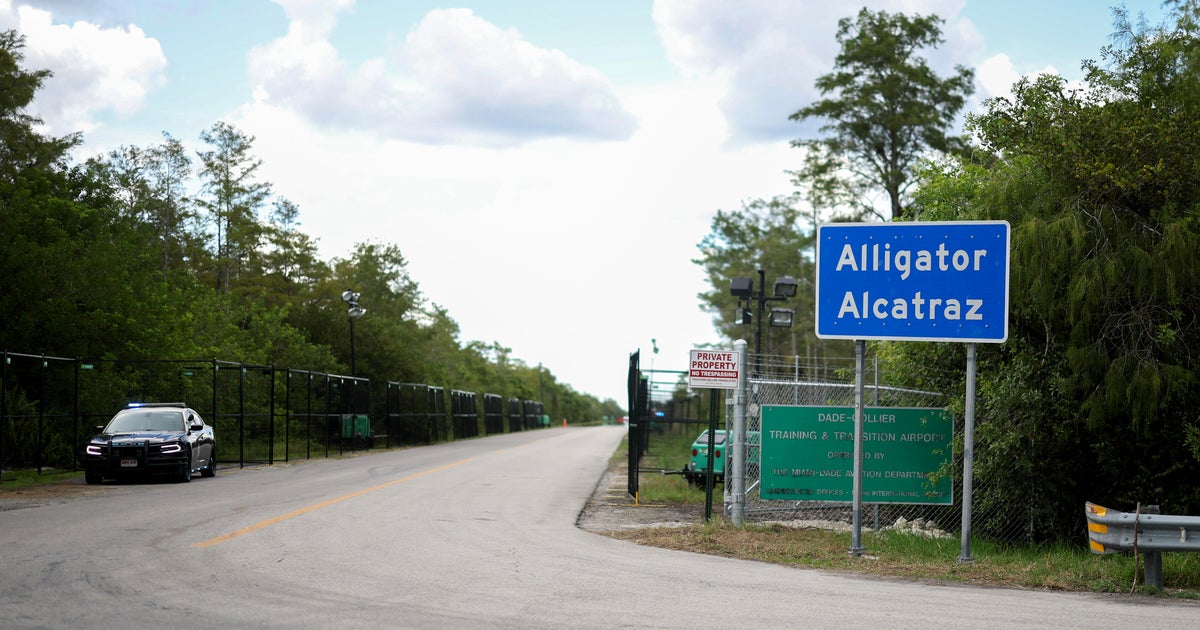
The Department of Homeland Security strategy builds on the opening of a 3,000-bed immigration detention center at a jetport in South Florida last month. Dubbed Alligator Alcatraz by state and federal officials, the makeshift facility will cost an estimated $450 million to operate in its first year. Up and running in just 8 days, the tents and trailers at Dade-Collier Training and Transition Airport are surrounded by 39 square miles of isolated swampland, boasting treacherous terrain and wildlife  

Last month, President Trump toured the facility, seeing rows of bunk beds lined up behind chain fences and encircled by razor wire. Mr. Trump joked to reporters there that “we’re going to teach them how to run away from an alligator if they escape prison.” Asked if the temporary facility would be a model of what’s to come, the president said he’d like to see similar operations in “many states.”

The Arizona’s governor’s office told CBS News it has not been approached about a state-run facility. 

Nebraska Gov. Jim Pillen’s office said in a statement that his administration “continues to be in communication with federal partners on how Nebraska can best assist in these efforts,” but added that for now, “it is premature to comment” and the governor would “make details public at the appropriate time.”

For her part, Noem called the Alligator Alcatraz model “much better” than the current detention prototype, which largely contracts out its Immigration and Customs Enforcement detention capacity to for-profit prison companies and county jails. ICE is an agency that falls under DHS. This model relies on intergovernmental service agreements (IGSAs) negotiated and signed between ICE and individual localities. She called the Florida facility — with an eventual price tag of $245 per inmate bed, per night, according to DHS officials — a cost-effective option. “Obviously it was much less per-bed cost than what some of the previous contracts under the Department of Homeland Security were.”

According to the Office of Homeland Security Statistics, the estimated average daily cost of detaining an adult migrant in fiscal year 2024 was about $165, though the actual cost of detention typically varies based on region, length of stay and facility type.

Still, Noem argued that the new venues, all with close proximity to airports or runways, will help ICE to cut costs by “facilitating quick turnarounds.” 

“They’re all strategically designed to make sure that people are in beds for less days,” Noem said, adding that some of the facilities being considered are still undergoing vetting by the department and subject to ongoing negotiations. “It can be much more efficient once they get their hearings, due process, paperwork.”

Unlike Alligator Alcatraz, which uses funds from a shelter, food and transportation program run by the Federal Emergency Management Agency (FEMA). Noem said the state-based initiative will tap into a new $45 billion funding pool for ICE prompted by President Trump’s “big, beautiful bill”, which was signed into law last month. The pool of money is allocated specifically to the expansion of ICE’s detention network and will nearly double the agency’s bedspace capacity of 61,000 beds, based on cost analysis. As of Saturday, ICE was holding just over 57,000 individuals in its detention network in more than 150 facilities nationwide.

Noem — who has implemented a department-wide policy across DHS of personally approving each and every contract and grant over $100,000 — said keeping ICE detention contracts to a duration of under five years is now “the model we’ve pushed for.” For instance, she added, Alligator Alcatraz is a one-year contract that can be renewed. 

“For me personally, the question that I’ve asked of every one of these contracts is, why are we signing 15-year deals?” Noem said. “I have to look at our mission. If we’re still building out and processing 100,000 detention beds 15 years from now, then we didn’t do our job.”

The new policy is a departure from earlier agreements made under the Trump administration. In February, ICE signed a 15-year, $1 billion deal with the GEO Group, a private prison company, to reopen Delaney Hall, a two-story, 1,000-bed facility that ranks among the largest detention centers in the Northeast.

Still, Noem said she doesn’t feel the U.S. is moving away from a private detention model. “I mean, these are competitive contracts,” she said. “I want everybody to be at the table, giving us solutions. I just want them to give us a contract that actually does the job — a contract that doesn’t put more money in their pockets while keeping people in detention beds just for the sake of that contract.”

But Alligator Alcatraz has also come under fire from attorneys claiming that both the Trump and DeSantis administrations are holding detainees without charge or access to immigration courts, violating their constitutional rights. Attorneys argued in a legal filing last month that unauthorized migrants held at the Florida-run site have no legal recourse to challenge their detention. 

Lawyers and experts have also called into question the very legality of a state-run immigration detention center, given the federal government’s authority over immigration enforcement. Opening the detention center in the Everglades under Florida’s emergency state powers marked a departure from the federal government’s role of housing migrant detainees, an option typically reserved for those who’ve recently entered the country illegally or those with criminal convictions. 

A U.S. district judge last week ordered state and federal officials to provide a copy of the agreement showing “who’s running the show” at the Everglades immigrant-detention center. 

“Florida does not have the legal authority to detain undocumented immigrants in the absence of a contract with ICE,” said Kevin Landy, the director of detention policy and planning for ICE under President Barack Obama. “A state government can’t do that.” 

Detainees held at Alligator Alcatraz have also claimed unsanitary and inhumane conditions, including food with maggots, denial of religious rights and limited access to both legal assistance and water. Florida officials have denied the accusations. 

Still, tucked away in the Florida Everglades 45 miles west of Miami, if its location sounds treacherous, Noem concedes, that’s kind of the point. “There definitely is a message that it sends,” the secretary said. “President Trump wants people to know if you are a violent criminal and you’re in this country illegally, there will be consequences.”

Noem offered that deterrence is an effective strategy based on U.S. gathered intelligence “from three letter agencies, from other intelligence officials throughout the federal government and in a lot of the Latin American and South American countries” that indicates “overwhelmingly, what encourages people to go back home voluntarily is the consequences.”

“They see the laws being enforced in the United States,” Noem said. “They know when they are here illegally and if they are detained, they’ll be removed. They see that they may never get the chance to come back to America. And they’re voluntarily coming home.”

The DHS secretary met with Mexican President Claudia Sheinbaum in March. “One of the questions I asked President Scheinbaum when I was in Mexico is, ‘Do you have any idea how many people may have come back to Mexico that we may not know about,'” Noem said. 

“[Sheinbaum] said 500,000 to 600,000 people have come back to Mexico voluntarily since President Trump’s been in office,” Noem continued, explaining that the Mexican president believes her reluctant citizens fear losing the chance to return to the U.S. on a visa or work program.

It’s a datapoint she solicits from many of the foreign leaders she meets with, including Ecuadorian President Daniel Noboa, who shared a 90-minute lunch with the DHS secretary in Quito, last Thursday. “I asked him the same question,” Noem recalled. “He doesn’t have as many illegal immigrants in the United States as in Mexico and Venezuela, but he said he thinks over 100,000 of his citizens have come back to Ecuador. And that’s a huge number.” 

Noem reasoned that her Ecuadorian counterpart’s rough estimate is based on two factors — a strengthening Ecuadorian economy and a DHS television campaign launched across Latin and South America, warning prospective migrants not to enter or remain in the U.S. illegally. 

“He was very proud of the fact that he’s doing better with his economy. So there’s jobs,” Noem recounted. “But he said, you know, our ads are running in Ecuador. We’re telling people that, if you have family in the United States that are there illegally, it’s time to come home.”
https://www.cbsnews.com/news/alligator-alcatraz-model-kristi-noem-homeland-security

Fresno Bee: Some Californians carry passports in fear of ICE. ‘We’re being racially profiled’

With the Trump administration’s directive that federal immigration agents arrest 3,000 people per day as part of a massive deportation campaign, some U.S. citizens are taking the extraordinary step of carrying their passports to avoid being profiled and detained.

For some Fresno residents, it’s an obvious choice. They say it’s the simplest way to prove citizenship in case of encounters with U.S. Customs and Immigration Enforcement agents.

For others, the decision is rooted in fear and distrust of the federal government and law enforcement due to being erroneously profiled for being Latino in the past.

“This is the first time I renewed my passport not for travel but for proof of citizenship,” said Fresno resident Paul Liu.

There’s growing concern about how ICE is ensnaring citizens in its deportation operations. A 2021 report from the U.S. Government Accountability Office found that, between 2015 to 2020, ICE arrested 674 U.S. citizens, detained 121 and deported an estimated 70 citizens.

Liu’s passport expired in January 2024. He renewed in February one month after Trump took office.

Liu, 52, said his decision is inspired by his family’s experience in China. His great-uncle sympathized with the Nationalist Party that opposed the Communist Party of China. As far as Liu’s family knows, his uncle was disappeared by the government and wasn’t seen until 30 years later by a sister who recognized him working on a chain gang in the city.

“I see what an oppressive regime has done to our family,” he said. “I’m just convinced that now, the onus is on anyone who’s not white, male and MAGA to prove they belong in this country.”

The REAL ID or a valid passport is required for domestic travel as of May, but American citizens are not otherwise required to carry a national form of identification.

To avoid potential detention and arrest, immigration lawyer Olga Grosh of Pasifika Immigration Law Group, LLP said people can consider having evidence of valid immigration status handy, or a copy of these documents in your wallet if concerned about about loss or theft.

“But does a citizen have to live in fear of being kidnapped by their own government?” Grosh said. “There has been a shift from it being the government burden to show to a judge that a person should be detained under the law, to citizens proving that they shouldn’t be detained by unidentified agents.”

Click the links below to read the rest of the article:

https://www.msn.com/en-us/news/us/some-californians-carry-passports-in-fear-of-ice-we-re-being-racially-profiled/ar-AA1JPvLq

Washington Post: ICE crackdown imperils Afghans who aided U.S. war effort, lawyers say

Two former Afghan interpreters for U.S. forces face deportation despite following immigration processes, according to attorneys for the men.

One former interpreter for U.S. forces in Afghanistan was detained by immigration agents in Connecticut last month after he showed up for a routine green card appointment. A second was arrested in June, just minutes after attending his first asylum hearing in San Diego.

As the administration seeks to fulfill President Donald Trump’s pledge to carry out the largest deportation operation in U.S. history, attorneys for the men say their clients — Afghans who fear retribution from the Taliban for their work assisting the United States in its 20-year war in Afghanistan — have found themselves in the crosshairs of U.S. Immigration and Customs Enforcement. The attorneys provided The Washington Post with military contracts and certificates, asylum and visa applications, recommendation letters and other records that described both men’s work on behalf of U.S. forces during the war.

After Kabul fell to the Taliban in August 2021, President Joe Biden’s administration moved to resettle Afghans who had worked for the U.S. government through the Special Immigrant Visa (SIV) program, which grants lawful permanent resident status and a pathway to U.S. citizenship. As of April, about 25,000 Afghans had received an SIV, and another 160,000 had pending applications, said Adam Bates, an attorney with the International Refugee Assistance Program who analyzed State Department data.

But the Trump administration is rolling back programs created to assist more than 250,000 Afghans — including the allies who worked for U.S. forces and other refugees who fled after the Taliban takeover. And while administration officials say SIV processing will continue, advocates for Afghans who served with U.S. troops fear the curtailment of programs they depend on, along with Trump’s ambitious deportation plan, jeopardizes those still vying for SIV protection.

They point to the arrests of Zia, 36, and Sayed Naser, 33, whose attorneys argue they followed proper immigration processes. The Post agreed to withhold the last names of both men because of the ongoing threats to their lives from the Taliban.

“Zia is not an outlier,” his attorney Lauren Cundick Petersen said during a news conference last month. “We’re witnessing the deliberate redefinition of legal entry as illegal for the purpose of meeting enforcement quotas.”

Matt Zeller, an Army veteran whose Afghan interpreter saved his life in a 2008 firefight, co-founded the nonprofit No One Left Behind to help resettle Afghans. He said he fears the immigration crackdown will unwind that effort.

“The Trump administration knows what’s going to happen to these folks. They’re not stupid. They understand that the Taliban is going to kill them when they get back to Afghanistan,” Zeller said. “They just don’t care.”

In response to questions from The Post, White House spokeswoman Abigail Jackson said the administration’s top immigration enforcement priority is “arresting and removing the dangerous violent, illegal criminal aliens that Joe Biden let flood across our Southern Border — of which there are many.”

“America is safer because of President Trump’s immigration policies,” she said.

All King Donald and his cronies care about is deporting foreigner, any foreigners.

Click one of the links below to read the rest of the article.

https://www.washingtonpost.com/nation/2025/08/03/afghanistan-immigrants-trump-deportations


https://www.msn.com/en-us/news/us/ice-crackdown-imperils-afghans-who-aided-u-s-war-effort-lawyers-say/ar-AA1JOsYf

Washington Examiner: Federal court halts Trump’s asylum crackdown at US-Mexico border

A panel of federal judges blocked President Donald Trump‘s day-one proclamation restricting asylum claims at the United States-Mexico border.

One of the first proclamations of Trump’s second term was Proclamation 10888—Guaranteeing the States Protection Against Invasion. The move forbade migrants from claiming asylum when crossing the border at any place outside a port of entry, and restricted requirements to claim asylum for those entering through said ports of entry. In July, U.S. District Judge Randolph Moss, an Obama appointee, ruled that Trump had exceeded his authority with the move.

The 3-judge panel from the U.S. Court of Appeals for the D.C. Circuit put an administrative pause on Moss’s ruling, which was lifted after their decision Friday.

In his 128-page ruling, Moss argued that Trump’s unilateral moves violated the Immigration and Nationality Act, which provides the “sole and exclusive” means for deporting illegal immigrants. Trump’s proclamation had set up “an alternate immigration system” that violated the law, he claimed, rejecting the government’s argument that an out-of-control border necessitated the move.

“Nothing in the INA or the Constitution grants the President … the sweeping authority asserted in the Proclamation and implementing guidance,” Moss wrote. “An appeal to necessity cannot fill that void.”

Though he argued that an emergency doesn’t excuse the move, he seemed to cede that there was, in fact, an emergency.

“The Court recognizes that the Executive Branch faces enormous challenges in preventing and deterring unlawful entry into the United States and in adjudicating the overwhelming backlog of asylum claims of those who have entered the country,” Moss wrote. “But the INA, by its terms, provides the sole and exclusive means for removing people already present in the country.”

The White House was quick to respond, arguing that the ruling violated the recent Supreme Court decision limiting the ability of district judges to issue nationwide injunctions on federal government policies.

“A local district court judge has no authority to stop President Trump and the United States from securing our border from the flood of aliens trying to enter illegally. The judge’s decision — which contradicts the Supreme Court’s ruling against granting universal relief — would allow entry into the United States of all aliens who may ever try to come to in illegally,” White House spokesperson Abigail Jackson said in a statement obtained by Politico.

Department of Homeland Security Spokeswoman Tricia McLaughlin derided Moss as a “a rogue district judge” who was “threatening the safety and security of Americans.”

The Washington Examiner reached out to the Department of Homeland Security for further comment.

Moss’s ruling is the latest of several major legal moves against Trump’s immigration agenda. On Friday, U.S. District Judge Jia Cobb of the District of Columbia ruled that the Trump administration’s use of expedited removal exceeded the Department of Homeland Security’s legal authority.

Cobb blocked three actions from the Trump administration: a Jan. 23 DHS memo directing immigration officials to apply expedited removal as broadly as possible; a Feb. 18 ICE directive authorizing officers to consider expedited removal for “paroled arriving aliens”; and a March 25 DHS notice terminating the Biden-era parole programs for Cubans, Haitians, Nicaraguans, and Venezuelans.

Newsweek: Trump admin warns DACA recipients to self-deport

The Trump administration advised Deferred Action for Childhood Arrivals (DACA) recipients to self-deport and warned that they are “not automatically protected from deportation.”

Tricia McLaughlin, assistant secretary of Homeland Security, told Newsweek the warning is “not new or news.”

“Illegal aliens who claim to be recipients of Deferred Action for Childhood Arrivals [DACA] are not automatically protected from deportations,” she said. “DACA does not confer any form of legal status in this country. Any illegal alien who is a DACA recipient may be subject to arrest and deportation for a number of reasons, including if they’ve committed a crime.”

Diana Crofts-Pelayo, a spokesperson for California Governor Gavin Newsom, whose state contains the highest number of DACA recipients, told Newsweek the move “highlights the Trump administration’s hypocrisy” and shows that “they do not want to detain and deport the worst of the worst.”

“Their chaos campaign is all about detaining and deporting as many people as possible without a regard to people’s legal rights, including intercepting Americans, Dreamers, kids, people with legal protections and those following immigration rules and even U.S.-born citizens into their indiscriminate dragnet.,” she said. “It’s dangerous precedent when deportations matter more than basic rights or a functional U.S. immigration system.”

Why It Matters

President Donald Trump pledged to undertake the largest mass deportation effort in U.S. history on the campaign trail and quickly moved to increase immigration enforcement upon his return to the White House. However, he has offered mixed signals on DACA.

Although Trump sought to end DACA during his first term, he told NBC News’ Meet the Press last December that he wanted to find a way to allow DACA recipients to stay in the United States.

Former President Barack Obama introduced the DACA program in 2012. It offered protections and work authorization for undocumented immigrants who arrived in the U.S. as children. But its legal status has remained in limbo for years, and the latest comments from the administration reflect the challenges faced by DACA recipients, commonly referred to as “Dreamers.”

What To Know

McLaughlin first warned that DACA recipients should self-deport in a statement provided to NPR earlier this week.

She told Newsweek on Thursday that undocumented migrants can “take control of their departure with the CBP Home App.”

“The United States is offering illegal aliens $1,000 and a free flight to self-deport now,” she said. “We encourage every person here illegally to take advantage of this offer and reserve the chance to come back to the U.S. the right legal way to live American dream.”

The administration has not outright ended DACA, but the statement reflects a shift in policy toward these migrants from President Joe Biden‘s administration, which was more supportive of protections for Dreamers.

Reports have emerged of DACA recipients being detained by Immigration and Customs Enforcement (ICE) agents.

Erick Hernandez Rodriguez, 34, is among the DACA recipients facing deportation. DHS said he was arrested for allegedly trying to illegally cross the southern border after allegedly self-deporting. His attorney, Valerie Sigamani, said he did not self-deport and made a wrong turn while completing a ride-share trip in San Ysidro, just north of the U.S.-Mexico border.

He has been in the U.S. for 20 years. His wife, Nancy Rivera, is a U.S. citizen, and the couple has a daughter together and is expecting a son. He had begun the process for permanent legal resident status.

DACA recipients are required to receive advance parole before leaving the U.S. to avoid loss of protection and deportation risk. There are more than 500,000 DACA recipients living in the U.S., according to U.S. Citizenship and Immigration Services (USCIS).

What People Are Saying

President Donald Trump told Meet the Press in December: “The Democrats have made it very, very difficult to do anything. Republicans are very open to the dreamers. The dreamers, we’re talking many years ago, they were brought into this country. Many years ago. Some of them are no longer young people. And in many cases, they’ve become successful. They have great jobs. In some cases, they have small businesses. Some cases they might have large businesses. And we’re going to have to do something with them.”

Anabel Mendoza, communications director for United We Dream, told NPR: “We’ve known that DACA remains a program that has been temporary. We’ve sounded the alarms over that. What we are seeing now is that DACA is being chipped away at.”

What Happens Next

DACA’s future remains in limbo, with legal challenges ongoing in federal courts and the administration continuing to enforce strict immigration statutes.

https://www.newsweek.com/trump-admin-daca-recipients-self-deport-2106991

Independent: ‘Taco Thursday’: Social media users taunt Trump after he extends Mexico trade deadline

The president once again backed down from increasing import taxes on Mexican goods

Donald Trump’s pausing of higher import taxes on a wide range of Mexican products a day before they were set to start saw the president mocked on social media with the now-familiar “TACO” taunt.

The nickname TACO, short for “Trump Always Chickens Out,” stems from the president’s habit of making tariff threats, resulting in a drop in the markets, only for him to change course and see the markets rebound.

Trump announced the move in a Truth Social post following a phone call with Mexican President Gloria Sheinbaum on Thursday.

He said the conversation had been “very successful in that, more and more, we are getting to know and understand each other” and suggested that the American trade relationship with Mexico is different from other countries because of the complexity of the border situation.

“We have agreed to extend, for a 90 Day period, the exact same Deal as we had for the last short period of time, namely, that Mexico will continue to pay a 25% Fentanyl Tariff, 25% Tariff on Cars, and 50% Tariff on Steel, Aluminum, and Copper,” he added.

The reaction from some of Trump’s most fervent critics was swift, predictable, and Mexican food-themed, invoking the TACO nickname investors have bestowed on the president for his economic flip-flopping.

California Governor Gavin Newsom’s press team was quick to pounce after Trump’s announcement hit Truth Social, writing that it was “TACO Thursday.”

Another critic, writer Paul Rudnick, posted a dual screen grab noting headlines stating that Trump had said he wouldn’t extend his tariff deadlines just a day before he announced yet another extension.

And a Democratic congressman, Rep. Chuy Garcia of Texas, twisted the knife a bit further, pointing out on X that consumers — not the Mexican government — pay the tariffs at issue.

Another X user, added:” SHE OWNS tRUMP …TACO THURSDAY.”

Never forget that at the end of the day it’s the consumer — you and I — who pay the tariffs, and that means INFLATION.

https://www.the-independent.com/news/world/americas/us-politics/trump-mexico-trade-deadline-taco-thursday-b2800002.html

Irish Star: Trump gives himself gloating new nickname…before immediately contradicting himself

Donald Trump gave himself a new namesake on his Truth Social platform, but just three minutes later he backtracked over a country’s pledge to recognize Palestine as a state

President Donald Trump declared he was a dealmaker on Truth Social today before immediately contradicting himself by saying he would find it hard to make a trade tariff deal with Canada.

Thursday morning saw Trump share an image of himself with a fist in the air that had the words “Donald Trump dealmaker in-chief” emblazoned across it. Then, just three minutes later, he wrote in another post that it will be “very hard” to make a trade deal with Canada in light of its Prime Minister Mark Carney announcing plans to recognise a Palestinian state.

Trump’s trade threat comes a day before higher tariffs are slapped on countries without a US trade deal. Canada is set to face a 35% tariffs on most goods it sells to the US from Friday, if a deal is not reached today. It comes as Trump makes ‘disturbing remarks’ about his 1-year-old daughter in resurfaced clip.

On the trade deals, Trump wrote, “Wow! Canada has just announced that it is backing statehood for Palestine. That will make it very hard for us to make a Trade Deal with them. Oh’ Canada!!!”

Canada’s move to recognize a Palestinian state comes after UK and France made similar announcements. Their pledge comes as a hunger in Gaza continues. On Wednesday, the Hamas-run health ministry reported seven more deaths from malnutrition.

Earlier this week, Trump said there was “real starvation” in Gaza. He also told how he was working with Israel to “get things straightened out”..

Earlier this month, Trump posted an angry letter to Carney on Truth Social, in which he accused him of having “financially retaliated against the United States.” Canada, the second-largest trading partner of the U.S. behind Mexico, failed to deal adequately with fentanyl crossing into the northern U.S. border, Trump claimed, “Instead of working with the United States, Canada retaliated with its own Tariffs.”

Fentanyl seizures by the U.S. Customs and Border Patrol at the Canada-U.S. border reportedly representing less than 0.1% of U.S. fentanyl seizures between 2022 and 2024.

Carney responded to Trump’s post on X, saying that he would continue his country’s commitment to cooperating with Washington, including battling the fentanyl crisis.

“Throughout the current trade negotiations with the United States, the Canadian government has steadfastly defended our workers and businesses,” Carney wrote on X in reply to Trump. “We will continue to do so as we work towards the revised deadline of August 1. Canada has made vital progress to stop the scourge of fentanyl in North America.”

“We are building Canada strong,” he continued. “The federal government, provinces and territories are making significant progress in building one Canadian economy. We are poised to build a series of major new projects in the national interest. We are strengthening our trading partnerships throughout the world.”

It comes after a Trump family member revealed his body is “rotting inside” as she delivered a terrifying update on the president’s health.

As the U.S.A. insults and abuses one former friend after another, we are slowly being left behind as the rest of the world moves on, asking, “Is the U.S.A. really necessary?”

https://www.irishstar.com/news/us-news/donald-trump-nickname-canada-35650698?int_source=nba

Irish Star: United States denies entire team visas for Little League World Series

A Venezuelan baseball team will not be able to compete in this year’s Little League Senior Baseball World Series after it was denied visas into the United States.

Last month, President Donald Trump unveiled a travel ban to the U.S. on 12 other countries — with athletes slated to compete in the 2026 FIFA World Cup expected to be exempt from the restrictions.

Unfortunately for the Cacique Mara team based in Maracaibo, Venezuela, they were not given the same preferential treatment. And they are not the only team to miss out on a major international competition as a result of United States border policy.

According to the Little League International, the club was unable to secure the required documents needed to enter the United States.

“The Cacique Mara Little League team from Venezuela was unfortunately unable to obtain the appropriate visas to travel to the Senior League Baseball World Series,” an official statement read.

The Cacique Mara team punched their ticket to the tournament after emerging victorious in the Latin American championship in Mexico. In their absence, Santa Maria de Aguayo — the runner-ups in the event — will take their place.

“While this is extremely disappointing, especially to these young athletes, the Little League International Tournament Committee has made the decision to advance the second place team, Santa Maria de Aguayo Little League (Victoria, Mexico), to participate in the Senior League Baseball World Series and ensure the Latin America Region is represented in the tournament and that the players, coaches, and families from Mexico are able to have a memorable World Series experience,” the statement continued.

Two weeks ago, the Cacique Mara team traveled to Bogota, Colombia to apply for visas at the U.S. embassy.

“It is a mockery on the part of Little League to keep us here in Bogota with the hope that our children can fulfill their dreams of participating in a world championship,” the team said in a statement.

“What do we do with so much injustice, what do we do with the pain that was caused to our children?”

Kendrick Gutierrez, the Venezuelan league’s president, did little to hide his frustration upon learning that Cacique Mara team had been ruled out of the Senior League Baseball World Series — a tournament for 13-16 year old players held annually in Easley, South Carolina.

“They told us that Venezuela is on a list because Trump says Venezuelans are a threat to the security of his state, of his country,” Gutierrez said. “It hasn’t been easy, the situation. We earned the right to represent Latin America in the world championship.

“I think this is the first time this has happened, but it shouldn’t end this way. They’re going to replace us with another team because relations have been severed. It’s not fair. I don’t understand why they put Mexico in at the last minute and left Venezuela out.”

Overseas teams should say “Screw Trump’s Amerika” and set up their own Little League International Tournament — make it truly international and leave the U.S. behind.

https://www.irishstar.com/sport/other-sports/little-league-baseball-venezuela-mexico-35630049

News Nation: Man in ICE custody 6 months was a ‘collateral arrest,’ lawyer says

  • More than 56,000 migrants are in ICE detention
  • 47% of ICE detainees are being held on immigration-related offenses 
  • Trump administration officials have cited sanctuary cities as part of the problem

A man who’s lived in suburban Chicago for 30 years and owns a tree-cutting business has been detained by Immigration and Customs Enforcement for nearly six months, despite his lawyer stating he has no criminal record.   

Abel Orozco, 47, was arrested by ICE in late January as he was driving back to his home from picking up tamales for his family. Orosco, who, according to his attorney, the government has conceded has no criminal record, was apprehended by federal officers, who were searching for Orozco’s oldest son, also an immigrant with an order for removal, who shares the same name. 

Orozco arrived in the U.S. in the late 1990s under a petition that gave him the right to work and live legally in the United States. He was given an order of removal in 2004 after going to visit his father, who suffered a stroke in Mexico. 

His lawyer, Mark Fleming, says his client is part of a collection of undocumented migrants considered “collateral arrests” facing deportation under the Trump administration’s immigration crackdown. 

ICE did not have a warrant at the time of the encounter, Fleming said. Orozco is in ICE custody in Kentucky, where he now faces expedited deportation. 

When asked for comment surrounding the details of Orozco’s January arrest, an ICE spokesperson told NewsNation that ICE arrested Orozco, “an illegally present resident of Mexico,” on Jan. 26. “He is in ICE custody pending immigration proceedings.”

Orozco’s family has since missed months of mortgage payments despite Orozco’s younger son, Eduardo, doing his best to keep his father’s business afloat, while his wife fights breast cancer, Fleming told NewsNation.   

Orozco’s situation has migrant advocates concerned about how ICE is carrying out its business. 

“(ICE) has made a conscious choice to destroy this family even though they have other options,” said Fleming, who works with the National Immigrant Justice Center. “What our position to the government has been is, ‘Look, you have the right to seek removal for him, but you have choices as to how you do that.’” 

“And they’ve chosen the most aggressive and the one that strips him of the most due process possible.” 

Abel Orozco part of class action lawsuit against ICE 

Orozco is one of 25 plaintiffs who are part of a class-action lawsuit against ICE, the Department of Homeland Security and federal officials. The suit claims ICE violated a 2022 Castañon Nava settlement that expired in May, which prevents the agency from making arrests without a prior warrant or proof that a person represents a flight risk. 

ICE has declined to comment on the suit. 

Fleming insists ICE officials have refused to acknowledge they took the wrong person into custody despite the elder Orozco providing officers with his driver’s license when he was asked. 

After being pulled out of his vehicle, Orozco was handcuffed for more than an hour, his attorney said.  

Before officers drove away with Orozco in custody, Fleming said that ICE officers were on the family’s property without a warrant.  Ex-National Guard member convicted of conspiring to smuggle migrants 

“What’s so troubling is the permissiveness that they believe they have to do immigration enforcement in a way that you really don’t see other law enforcement do,” Fleming said.  

How many non-criminals is ICE holding? 

Of the more than 56,000 migrants being detained by ICE, 28% have criminal convictions, while 24% have pending criminal charges, according to the Transactional Records Access Clearinghouse. ICE data shows that 47% of detainees have “other immigration violations.” 

Chicago Tribune analysis of data provided by the research group Deportation Data Project showed that 600 Chicago-area migrants with no known criminal background were booked by ICE in the first 150 days of the Trump administration. That number compares to just 66 in the final 150 days of the Biden administration. 

White House border czar Tom Homan has repeatedly warned that “no one is off the table” if they are in the country illegally and says that in some cases, ICE officers searching for the “worst of the worst” may be forced to take non-criminals into custody.  

He said that is especially true in sanctuary cities like Chicago, where he says policies are forcing ICE to go into communities to search for migrant criminals. 

“There’s going to be more collateral arrests in sanctuary cities because they forced us to go into the community and find the guy we’re looking for,” Homan said in a televised interview earlier this year.

Sam Olson, the enforcement and removal operations director in ICE’s Chicago field office, agreed, telling NBC News that the agency’s job is to enforce immigration laws. 

“If somebody is here illegally, whether or not they’re committed crimes, there is a possibility they could be arrested,” Olson said. 

Olson did not respond to requests for comment for this story from NewsNation. 

Why is ICE holding Abel Orozco? 

Despite the order of removal, Fleming said he had not been on ICE’s radar until now, as he continued to operate his business that employs eight people.

But after his arrest by ICE in late January, government officials sought to have his 2004 order to leave the country reinstated, stating that he is among those who broke the law by entering the U.S. illegally. 

Orozco’s relative petitioned for him before 2001, which allowed him to remain in the United States and work pending that application. Fleming said that Orozco was living in the United States when that application was submitted, but then everything changed when he went to see his ailing father back in Mexico.

Despite ICE’s stated mission and warnings, Orozco’s family does not agree they are doing their job the right way. Sinaloa cartel quickly losing territories, influence, Mexico says 

“(ICE) is arresting people who they’re not supposed to be,” Eduardo Orozco told reporters in March. “They’re stating that they’re arresting thousands and thousands of hardcore criminals. My father is not a criminal.” 

“But we’re not just fighting him anymore.  We’re fighting for everyone who was taken like this.” 

Meanwhile, Orozco’s wife, Yolanda, has pleaded for her husband’s release from federal custody, echoing her son’s sentiments. 

“Is it a crime to get up early every day and work hard to support your family? I just don’t know,” she told reporters through an interpreter. 

Orozco has an upcoming merits hearing in which he is seeking protection from being forced to return to Mexico. Fleming expects that a ruling may be coming in Orozco’s case by the end of July, after months of him and his family living in limbo.

Fleming believes that as they struggle to comprehend what is happening, Orozco’s loved ones know their journey is similar to those of other migrant families across the United States. 

“Mr. Orozco’s story really kind of highlights that this is the collateral consequences,” Fleming told NewsNation, adding, “he is someone who has embraced the United States, embraced how he can contribute to it and really just wants to be here to be here with his family.”

https://www.newsnationnow.com/us-news/immigration/abel-orozco-ice-arrest-collateral

Business Insider: Automakers are starting to reveal how much Trump’s tariffs are costing them

  • Carmakers are tallying up an eye-watering bill from Trump’s tariffs.
  • Jeep and Ram owner Stellantis said it expected the levies on imported vehicles to cost it around $1.4 billion this year.
  • General Motors, Tesla, and VW have also reported big tariff hits in earnings in the past few weeks.

The auto industry is still trying to unravel a tangled tariff web, and the bill just keeps getting bigger.

Jeep and Ram owner Stellantis became the latest automaker to forecast a heavy hit from Trump’s tariffs on imported vehicles on Tuesday.

The Chrysler maker said that it expected tariffs to cost it around €1.2 billion ($1.4 billion) in the second half of this year, after a €300 million impact in the first half of 2025.

Stellantis, which builds Chrysler, Dodge, and Jeep models in its factories in Canada and Mexico, has been hit hard by the Trump administration’s 25% tariff on vehicles and car parts imported into the US.

Other automakers are also feeling the pain. General Motors, which builds models for the US market in Korea, Mexico, and Canada, said last week that the tariffs had cut $1.1 billion off its profits in the last quarter.

CEO Mary Barra said that GM was working to reduce its tariff exposure and build up its US manufacturing presence, but the company warned that the worst was still to come. GM estimated that the tariffs could cost it between $4 and $5 billion this year.

Trump’s recent trade deals have slashed the tariffs on importing cars from Japan and Europe to the US from 25% to 15%, but manufacturers still have to deal with a hodgepodge of import restrictions and fees.

The 25% tax on automobile parts means that even carmakers who build their cars in the US face a serious tariff headache.

Tesla, which has factories in California and Texas but still uses some imported components, told investors last week it incurred a tariff-related cost of $300 million in the previous quarter, with CFO Vaibhav Taneja warning that costs are likely to increase in the coming months.

European manufacturer VW also said last week it had suffered a $1.1 billion tariff-related hit in the first half of this year, while Swedish carmaker Volvo took a $1.2 billion impairment charge in part due to the escalating cost of the levies.

Experts and analysts have warned that many of the costs facing automakers will be passed on to US consumers in the form of higher car prices and fewer models.

A study by the Center for Automotive Research published in April found that the 25% tariffs on imported cars and auto parts would hike the cost of vehicles produced in the US by over $4,000 and imported vehicles by nearly $9,000.

https://www.businessinsider.com/automakers-are-revealing-how-much-trumps-tariffs-are-costing-them-2025-7