Alternet: ‘We have been seriously hit’: The Trump economy is coming for your coffee

The New York Times reports a coffee brewer in Maine has lost its fight against President Donald Trump’s tariffs.

“Our bean prices will be increasing within the next week,” posted Rock City Coffee chief executive Jessie Northgraves on Facebook.

Northgraves said her company had tried to keep prices stable, but they are now forced to raise prices on new, more expensive inventory coming in from offshore, courtesy of Trump’s additional tax on many imports. Trump vowed in July to impose a 50 percent tariff against Brazil, which directly goes to U.S. coffers, despite coffee brewers already having to pay more for beans due to droughts in Vietnam and Brazil.

Trump’s Treasury Secretary Scott Bessent recently announced his giddiness at Trump’s tariffs generating $100 billion in new revenue, but it is U.S. businesses like Rock City Coffee that are paying that revenue. The Times reports small businesses in high competition markets, including coffee suppliers, have less cushion and are loathe to raise prices and discourage customers.

“I thought maybe it would be temporary,” said Northgraves. “We were kind of trying to ride it out the past few months, not change our prices and just kind of absorb it as much as we could.”

She told the Timers she had tried to ignore the president’s on-again/off-again tariff threats, but her profit margins kept slipping with the cost of beans doubling. Trump’s tariffs even hit the price of the company’s Chinese-sourced coffee bean packaging.

“We have been seriously hit by the tariffs in coffee-exporting countries, and must raise the prices of our beans,” she wrote in an accompanying Facebook post. “Please know that we wouldn’t do this if it wasn’t totally necessary.”

While compiling a script to explain the higher prices to customers, Northgraves took care to include the reason behind the hikes. She says linking them honestly to tariffs rather than “quietly” raising prices gives her customers a much deserved explanation.

“It just felt better to be upfront about it,” she told the Times.

50% increase in price of coffee beans plus higher tariffs on packaging sourced from China, all of which King Donald thinks will just somehow magically pay for itself!

https://www.alternet.org/trump-tariffs-coffee

Alternet: ‘Not just racist but stupid’: VP slammed for ‘sleight of hand’ while promoting far-right theory

JD Dunce, “Not Just Racist But Stupid”

Author Katherine Stewart says Vice President JD Vance is “polishing ideas from the far-right gutters with an Ivy League sheen,” particularly when it comes to smearing a pretty face over the racist Great Replacement Theory.

Stewart says President Donald Trump is expelling asylum seekers, abusing foreign visitors and deporting and incarcerating people who have never been accused of any crime. Meanwhile, Vance is in the wings, pushing a “thoughtful” version of the “Great Replacement Theory” that’s sure to appease nativists who embrace the idea that immigration is part of a deliberate plot to destroy the U.S. by replacing “real” or “true” Americans with aliens.

Stewart notes how Vance recently argued that America’s founders understood “that our shared qualities, our heritage, our values, our manners and customs confer a special and indispensable advantage. … Social bonds form among people who have something in common. They share the same neighborhood. They share the same church.”

“Vance is using a sleight of hand here,” said Stewart, agreeing that social bonds do form when people share things in common, but she adds that a nation’s people who “define themselves according to the church their grandparents attended … [is] not the America that Lincoln and Jefferson … established.”

“We the people have agreed to promote the general welfare not by conducting a survey of the views of some subset of ancestors who happened to be present at the Civil War, but by making laws through representative government based on the idea that all people are free and equal before the law.”

Versions of the Vance ideology haunt American history, Steward argues, and always with the same malicious intent: to divide “real” Americans from the ones who “don’t belong.”

“The intent becomes clear the moment you ask the speaker who the ‘real’ Americans are,” Stewart said. “Are they the descendants of the Mayflower? That’s just silly. … Are the real Americans white? That’s not just racist but stupid; most Black Americans today have ancestors that lived in America significantly longer, on average, than white Americans.”

But the argument serves the purpose of putting a lot of money in the hands of a few, said Stewart, whether it’s letting slaveholders get rich while their white neighbors get outcompeted by slave labor or funneling money to “the establishment of a grifty concentration camp on American soil.” (Research shows contractors affiliated with the controversial “Alligator Alcatraz” have “lost” tens of millions of dollars, while others have forced states to pay for detention centers it never built.)

“We can’t know what’s in JD Vance’s heart,” Stewart argued, but “he seems to believe that, to keep himself and his associates in power, the U.S. government needs to ship asylum seekers off to random islands and engage in an ever-expanding menu of sadistic acts. Meanwhile, none of our actual immigration issues are resolved and the rest of us are simply forced to pay the price.”

Read the full New Republic report at this link.

https://www.alternet.org/jd-vance-baseless-claim


More in The New Republic:

JD Vance’s “Intellectual” Spin on the Racist Great Replacement Theory

As the Trump administration advances its draconian immigration schemes, the vice president is doing his part—by polishing ideas from the far-right gutters with an Ivy League sheen.

USA Today: Immigrants forced to eat ‘like a dog’ in detention centers

Forced to eat the day’s only meal “like a dog,” with their hands shackled behind their back. Detained for days with nothing but shoes for a pillow and no other bedding ‒ just cold, concrete floors and constant fluorescent lighting. Medical care that denied a man with diabetes insulin for a week and may have contributed to at least one death.  

A Human Rights Watch report says three Miami immigrant detention facilities have subjected people to conditions so inhumane they have become, at times, life-threatening. Many ICE detention facilities are becoming overcrowded and conditions are deteriorating, according to the July 21 report.

The report, which drew from the testimonials of 17 detainees, examined conditions since President Donald Trump took office in January. Investigators say conditions at the Krome North Processing Center, Federal Detention Center and Broward Transitional Center flout international law on holding people in immigrant detention and federal government standards.

The conditions for people held in the detention facilities “are not the way that any legitimate, functioning government should treat people within its custody,” report author and editor Alison Leal Parker, deputy director of the Human Rights Watch’s US Program, said.

While the facilities have had issues predating this administration, Parker said Trump administration officials have been unwilling to uphold standards to properly treat immigrant detainees. The conditions indicate the system is “overwhelmed, overcrowded and chaotic,” she said.

Tricia McLaughlin, assistant secretary for public affairs at the Department of Homeland Security, said claims of subprime conditions at Immigration and Customs Enforcement detention centers are “FALSE.”

“All detainees are provided with proper meals, medical treatment, and have opportunities to communicate with their family members and lawyers,” McLaughlin said in an emailed statement. “Ensuring the safety, security, and well-being of individuals in our custody is a top priority at ICE. ICE has higher detention standards than most U.S. prisons that hold actual U.S. citizens.”

Southern, Republican-led states have emerged as key partners in the Trump administration’s immigration crackdown. Florida stood up a tent city called “Alligator Alcatraz.” Georgia is expanding its largest ICE detention center. And Louisiana is hosting the most dedicated ICE facilities outside Texas.

Time at all three facilities

Entrepreneur Harpinder Singh Chauhan, 56, spent time at all three facilities during nearly four months as a detainee, beginning in February. 

The British national, who first entered the country on an E-2 investor visa in 2016, opened small businesses in Florida. One of them failed ‒ a franchise of Dickey’s Barbecue Pit, which also bankrupted many other franchisees. He and his wife were seeking permanent residency through a valid EB-5 visa petition when their business collapsed.

While Chauhan was never convicted of crimes, he was ordered to pay restitution to Florida for tax issues, court records show. In February, he was turned over to ICE after a routine probation check-in.

At the Krome facility, he spent days in cold, crowded processing cells without beds or showers. He said he was denied medical care, including insulin for his diabetes and an inhaler for his asthma. He used his shoes as a pillow. 

During a tuberculosis outbreak, he said the facility had no soap. Instead, staff made detainees use shampoo to wash their hands. Detainees jokingly said everyone had “Krome’s disease,” a play on Chrohn’s disease, a chronic gastrointestinal illness, Chauhan recalled.

Detainees were beaten for protesting their treatment, and one man was hogtied, the report said. Officials also used solitary confinement as punishment, according to women who spoke to Human Rights Watch. In June, detainees at Krome signaled “SOS” to news cameras from the yard over conditions.

The report said women were placed at Krome, a privately operated men’s facility, where they were crowded in small holding cells without gender-appropriate care or privacy. USA TODAY reported on similar conditions inside Krome, where one man died ‒ an incident Human Rights Watch suspects may have been linked to medical neglect.

Akima, a private Alaska Native Corporation that operates Krome, didn’t respond to USA TODAY’s request for comment. But in response to a Human Rights Watch letter summarizing findings and questions, the company said it couldn’t comment publicly on the specifics of its “engagement” with the government, according to the report.

‘Like a dog’

Midway through his detention, on April 15, Chauhan was placed inside a crowded Federal Detention Center holding cell awaiting transfer without a meal for the day. Styrofoam food containers sat full for hours on other side of the federal prison’s bars.

In the evening, he and others finally received food. But with their hands shackled at their waist, they were forced to eat by putting their faces to bite into potatoes rolling around, rice and dry chicken, he said.

“You’ve got to kind of prop it up with your knees and then eat out of it like a dog,” Chauhan said. Another 21-year-old detainee interviewed by Human Rights Watch also described being forced to eat like an animal.

The 25 to 30 men forced to eat this way were transferred from the facility several hours later, Chauhan said.

Less than a week later, at Broward, Chauhan collapsed in the heat awaiting dinner and was taken to a hospital, with no information given to his family. He had not had his insulin for nearly a week. A 44-year-old Haitian woman, Marie Ange Blaise, died at the facility in April, following a medical emergency that was not treated urgently, according to Human Rights Watch and advocates.

“We strongly believe her death could have been prevented,” Guerline Jozef, director of the nonprofit Haitian Bridge Alliance told USA TODAY at the time. “We will continue to demand accountability and protection for people in ICE custody.”

GEO Group, which operates Broward, denied the report’s allegations, including questions about Chauhan’s account.

The facility has around-the-clock access to medical care, as well as access to visitations, libraries, translation services and amenities, Christopher Ferreira, a spokesperson for the company, said in a statement. Support services are monitored by ICE, including on-site personnel, and other organizations within DHS.

A ‘dark time’ in US

Chauhan was ordered deported and boarded a flight back to the United Kingdom on June 5. His family, including two adult children, stayed in Florida to close what remains of their businesses.

Now living outside London, Chauhan said he plans to keep paying his Florida debt. Even though his family is ready to leave, he hopes to one day return to America.

“Every nation goes through a dark time,” he said. “I feel this is just a test.”

https://www.usatoday.com/story/news/nation/2025/07/24/trump-immigration-detention-conditions-dog/85338970007

Alternet: Trump official brutally mocked after saying he was ‘not going to tolerate’ sick Americans

Dr. Mehmet Oz, President Donald Trump’s Administrator of the Centers for Medicare and Medicaid Services, declared that the administration will no longer “tolerate” what he called a culture that makes it “easy to be sick in America.” Framing childhood illness as a failure of parenting and physical activity rather than medical need, Oz linked obesity to national security and warned that industries would be forced to cooperate—or face government retaliation.

Oz—often called a conspiracy theorist who has been widely criticized for promoting “quack” products—appeared to endorse an authoritarian vision of public health, suggesting that under Trump and Health and Human Services Secretary Robert F. Kennedy Jr., Americans would no longer be allowed to remain “sick” without consequences, and threatened industry with demands to either cooperate or face retribution.

He also railed against what he called the “over-medicalization” of American society—particularly among children—but failed to distinguish between conditions driven by behavior and those rooted in biology or beyond individual control.

“You’re diagnosing problems that probably should be dealt with with the parents,” he told Fox News Business, referring to children’s health, “or by going out and playing, or just dealing with issues and teaching kids how to mental resilience [sic].”

He warned of risk factors that “cause an obesity epidemic that now prevents three quarters of young men from entering the military,” a questionable claim, and said that this “crisis” is “rolling up towards the older ages.”

“There’s a reason we’re twice as obese as [our] European counterpart countries, we’re ten times more obese than Japan: we’ve made it easy to be sick in America. And this president and this Secretary of Health, Bobby Kennedy, they’re not going to tolerate it anymore,” Oz declared.

Warning that he and Food and Drug Administration (FDA) Commissioner Dr. Marty Makary, “are the tip of the spear,” he threatened “to make sure that we get industry to work with us, or we’ll be coming after them.”

Dr. Oz has a history of linking healthcare policy to politics.

In 2022, during his failed senatorial campaign, Oz said he wanted abortion to be between a woman, her doctors, and local political leaders.

More recently, Oz has said Americans must “earn the right” to be on Medicaid, and said current Medicaid users should “prove you matter.”

Critics, meanwhile, blasted Oz’s latest remarks.

California Democratic Governor Gavin Newsom responded, telling Oz, “You just stripped 17 million people of their healthcare.”

Dr. Rachel Bedard, an internist, geriatrician, and palliative care physician, wrote: “Stop being sick, Americans. They aren’t gonna tolerate it anymore.”

Anthony M. Hopper, who teaches healthcare administration, noted, “You know … We would be a lot healthier (in the future) if we spent more money on medical research.”

Retired professor MA Rasmussen wrote: “So you guys are OK with the gutting of the EPA, an agency created to protect us from polluted air & water & the Labor Department which enforces worker safety rules? I guess so. You’re all into blaming the individual rather than corporations or agribusiness or bad public policy.”

Watch the video … at this link.

https://www.alternet.org/trump-official-sick-americans

Mediaite: Trump Aides and Allies Swarm NBC News to Tell How Strictly They’ll Enforce Not Talking About Epstein

Advisers and allies of President Donald Trump swarmed NBC News reporters to outline a new strategy of strict silence on the so-called “Epstein Files” flap.

It has been almost three weeks since the Trump administration first tried to bury the promised mountain of information on deceased sex criminal Jeffrey Epstein, and the heat just keeps going up. At every turn, Trump’s efforts to quash the story have only intensified interest in it, and deepened Trump’s own association with it.

Just this week alone:

The latest attempt to persuade the press and the public to drop it appears to be telling the press just how strictly the White House plans to enforce a policy of total silence.

A phalanx of Trump aides and Republican allies spoke to the NBC News reporting team of Jonathan AllenMatt DixonHenry J. GomezAllan Smith, and Natasha Korecki about the strategy:

President Donald Trump and his aides have settled on silence as a strategy to stamp out criticism of his refusal to release files detailing the federal government’s investigation of Epstein, according to a senior administration official and Republicans familiar with the White House’s thinking.

For weeks, stories about Epstein, the financier and pal to political luminaries who died by suicide awaiting trial on sex-trafficking charges in 2019, have been making headlines.

In a break from Trump’s usual crisis communications template — which emphasizes an all-hands-on-deck approach to defending him on television and on social media — the Epstein case has been met with more restraint from the White House.

Trump himself has signaled that he doesn’t want members of his administration talking about the matter nonstop, a person close to the White House told NBC News. And White House aides have made it clear that no one in the administration is allowed to talk about Epstein without high-level vetting, according to a senior administration official who spoke on the condition of anonymity.

“The communications office has to be directly involved in every aspect of this,” the official said. “Every ‘i’ must be dotted, and every ‘t’ must be crossed through us.”

The piece is unlikely to decrease the questions being asked, but could serve as a warning to Republicans who wish to stay in the White House’s good graces.

Read the full report here.

Harpar’s Bazaar: What Should Artists Do When Alligator Alcatraz Moves Next Door?

The Florida Everglades are home to a diverse community of artists. The Trump administration targeted this area to build a controversial ICE detention center, and residents are fighting back.

On June 14, Dakota Osceola was wrapping up the day, selling her bead art and necklaces at a festival in Miami, when she heard the news from a friend.

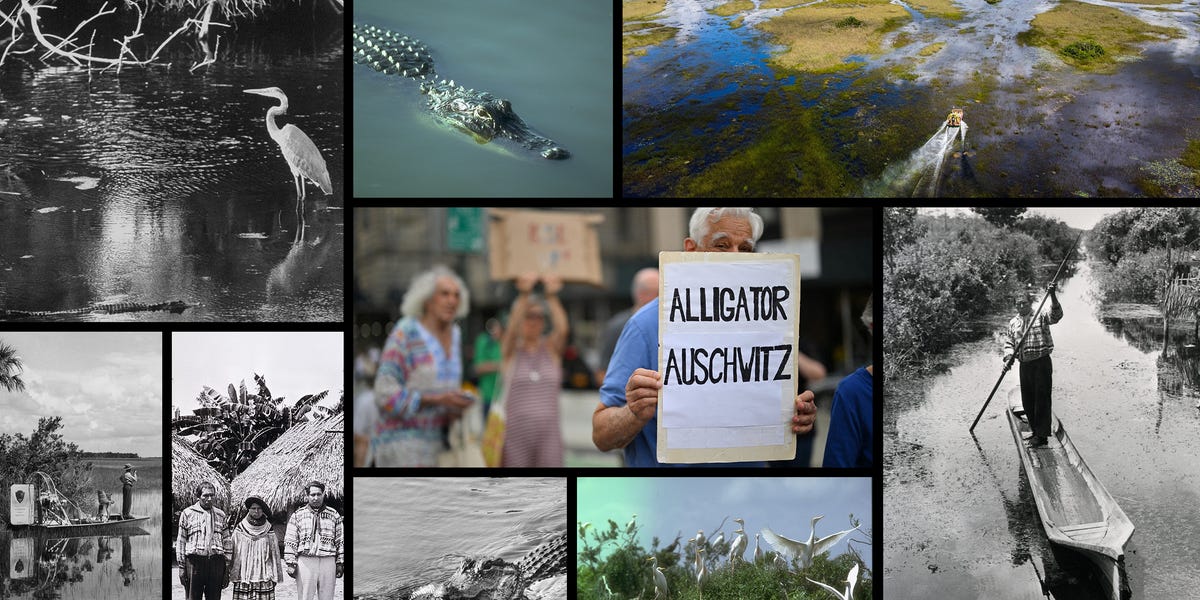
A new immigrant detention facility, to be named Alligator Alcatraz, would be built on a 10,500-foot-long old airport strip inside the Big Cypress National Preserve in the Florida Everglades.

“How is this happening right now?” she thought.

Home of the indigenous Miccosukee and Seminole people, the Everglades are the largest wetland ecosystem in the United States and the land where Osceola’s family grew up. This territory is considered a sacred place to tribe members and a national wildlife treasure to Floridians. But in less than 10 days, a portion of the Everglades was seized by the state and paved over to make room for a new prison built to hold up to 3,000 immigrants, a move supported by the Trump administration as a means to detain undocumented people.

On June 28, in the scorching heat, Osceola decided to go voice her opposition to this detention camp. Grassroots organizations such as Friends of the Everglades and Unidos Immokalee voiced environmental and human-rights concerns. Alongside independent activists, artists from the South Florida community joined with their protest art and signs to defend the home that has inspired them and that they love.

Outside the gates of the detention facility, and in the center of the Everglades, hundreds of Floridians gathered, chanting and holding up signs. Miccosukee tribal elder and environmental activist Betty Osceola, with Love the Everglades Movement, used her megaphone to address the crowd and keep people safe. Demonstrators lined up on the narrow road, north of the Tamiami Trail, as dozens of trucks with machinery entered the old Dade-Collier Airport, where the facility was being built. In the weeks since, different organizations have continued to arrange protests and gatherings weekly in front of these gates. There have been peaceful prayer vigils with no signs allowed, a protest asking to shut down the Everglades concentration camp, and family members of detainees gathered along with grassroots human-rights organizations, and a Catholic archbishop is waiting to see if he can hold a mass at the gates.

Outside the gates of the detention facility, and in the center of the Everglades, hundreds of Floridians gathered, chanting and holding up signs. Miccosukee tribal elder and environmental activist Betty Osceola, with Love the Everglades Movement, used her megaphone to address the crowd and keep people safe. Demonstrators lined up on the narrow road, north of the Tamiami Trail, as dozens of trucks with machinery entered the old Dade-Collier Airport, where the facility was being built. In the weeks since, different organizations have continued to arrange protests and gatherings weekly in front of these gates. There have been peaceful prayer vigils with no signs allowed, a protest asking to shut down the Everglades concentration camp, and family members of detainees gathered along with grassroots human-rights organizations, and a Catholic archbishop is waiting to see if he can hold a mass at the gates.

A member of the Seminole tribe, Osceola was aware of how hard the tribes fought in the 1970s to stop the construction of the old airport due to the environmental damage it would cause to the fragile ecosystem of the Glades. That battle was won when the construction came to a halt due to growing opposition from environmentalist groups. But now, into that abandoned air strip, the construction trucks started coming in, creating more and more traffic inside the Big Cypress National Preserve. Then, a sign with the words “Alligator Alcatraz” went up overnight, sparking sinister national jokes, memes, and merch about the alligators eating anyone who tries to escape this jail.

Protesters had different reasons to voice their opposition to the detention center: It would harm a fragile ecosystem and is not environmentally sound; it is an inappropriate use of FEMA funds; conditions there are inhumane. When Florida lawmakers visited the facility on a limited tour, they described 32 people per cage in the sweltering heat, exposed to bug infestations and fed meager meals, with prisoners crying for help and even one person pleading, “I’m a U.S. citizen!”

An important point ignored in national coverage is that the construction involves a seizure by the state of Miami-Dade-owned land under the guise of an emergency. The Miccosukee tribe joined other environmental groups, such as Love the Everglades, in suing federal and state agencies for failing to conduct an environmental review, as required by federal law, before initiating the project. Meanwhile, the ACLU is suing the Trump administration because of a lack of access to counsel at the detention center.

“I see my relatives, my family, in those cages. They came here undocumented, overstayed their visas, and eventually became citizens,” says Aubrey Brown, a Florida-based storyteller and artist who contributed to the protest sign art. Brown, who shares stories about Florida’s history with her 40,000 followers on social media, couldn’t stay silent and decided to speak up against the detention center, risking backlash. “I’ve always tried to stress that history and politics are inextricably intertwined,” she adds. Challenging the false narrative used by the president to make others believe there is nothing but fierce alligators and swamps in the Everglades, Brown argues, “People must understand that the Everglades is not a wasteland; this is people’s home. The Glades are wild, sacred, and free. It’s where the Seminoles went to hide from being captured, and it is where I go when I want to get away from everything.”

Acting as if no people exist in the Everglades, the federal government decided to seize land belonging to Miami-Dade County, completely ignoring the sovereignty of tribal nations at Big Cypress and that both their ceremonial and ancestral burial grounds stand near the facility.

“When it comes to my Seminole and Miccosukee friends, people treat them like they are not here anymore and are a relic of history,” Brown adds.

Once considered a swing state, Florida is now ground zero for the MAGA base supporting cruel anti-immigration policies. Built undercover, this facility was estimated to cost taxpayers $450 million a year. However, according to a review of purchases, the state has already spent $250 million on it in less than one month.

President Trump said that the facility would cage “some of the most vicious people on the planet” to be deported. Yet, a report released by the Miami Herald debunked this narrative, showing that hundreds of the detainees have no criminal charges.

Kidnapped without a warrant, stripped of their civil rights, and placed into a black hole where attorneys cannot reach their clients, only a third of detainees have a criminal conviction. But the public cannot see the nature of the sentence they received. ICE has so far offered the press only top-level statistics, which do not show whether a sentence is for a traffic violation or a murder attempt. Not only do the reports withhold details about the alleged offenses of each detainee, but ICE has not made public the records specifying how it targets the people it takes to detention centers, especially those without criminal charges. In response, The Guardian has decided to sue the Trump administration for withholding public documents from the press, which are a matter of clear public interest right now.

Maria Theresa Barbist, a Miami-based artist and psychologist who explores trauma, memory, and collective healing in her works, attended and made signs for the protest. “I am from Austria, and we have a dark history there. We have done this before. We have put people in concentration camps, and we know how this story ends. It’s our responsibility as descendants of Nazis never to let that happen again,” she says.

“The Nazis did not start with Auschwitz; they started with driving people out of their homes and putting them into camps. It was not just Jewish people, it was immigrants too,” she adds.

“This is not the first concentration camp being placed; they are just getting warmed up. Project 2025 is going to extend for at least the next four years,” says Eddie Aroyo, an artist who explores themes of power structures and attended the protest. “This is about absolute conquest,” he adds, referring to a conservative white nationalist agenda that opposes abortion and reproductive rights, LGBTQ rights, immigrants’ rights, and racial equity.

Democratic Florida representative Maxwell Frost visited the detention center on July 13 and shared on social media, “I didn’t see any Europeans who overstayed their visa. I saw nothing but Latino men and Haitian men. They are targeting specific types of people. And it’s the type of people that look like me.”

A few miles away from the detention camp, artist and native Floridian Sterling Rook, who attended the protest, is currently completing an artist residency in the Everglades National Park. Hosted by AIRIE (Artists in Residence in Everglades), this program allows artists to explore work related to the environment. The first day he entered the residency was also the day the first buses carrying migrants arrived in the Everglades. “It’s beautiful out here, but now I think about this every day, how 30 miles away from here there are people in tents in a terrible situation,” he says. “I’m not necessarily a political artist, but you become political just by the nature of your situation,” he adds. Rook used his residency time to work on a Glades skiff boat, which is known for navigating the marshy waters of the Everglades.

“As a performance, I would love to ride it out into ‘Alligator Alcatraz,’ maybe leave it there as a symbol of rescue and escape. But I also struggle with self-censorship,” he says.

This self-censorship comes from a place of very real fear about political persecution of artists who speak up. “There are genuine and considerable threats when speaking out against any of these violent governmental policies, especially in Florida,” says Johann C. Muñoz-Tapasco, an artist and organizer affiliated with the local collective Artists for Artists Miami (A4A: MIA). “Numerous artists have chosen to disengage from sought-after exhibition platforms and institutions altogether. Others have lost their jobs and clients. Many more have self-censored as a form of self-preservation.”

Federal and state funding cuts to the arts, combined with the elimination of National Endowment for the Arts grants and Florida’s political climate, have led many artists, organizations, and institutions that depend on this funding to limit freedom of expression, fearing retaliation or even more economic cuts. AIRIE did not respond to my request for a statement on its stance on this issue. The majority of Florida’s art institutions and organizations have remained silent.

A4A: MIA is currently discussing collaborative projects and planning actions against this detention facility, but it recognizes that American artists have been woefully unprepared to respond to the rise of fascism. “Since the postwar era, the ways artists validate their work and fund their practices have been tied to the tastes and whims of those in power,” misael soto, a Miami-based artist, educator, and organizer affiliated with this organization, stated. “Now those at the top whom we’ve been dependent on, on whichever side of the political spectrum, are mostly kneeling to fascism. Artists have to come to terms with how they sustain their practices and how this is intrinsically tied to their art.”

Mae’anna Osceola-Hart, a photographer and member of the Panther Clan and the Seminole tribe, participated in organizing the protest and lives within walking distance of the detention camp. Her grandfather was one of the tribe members who fought the development of the Dade-Collier Airport. These days, the traffic on the Big Cypress reserve is becoming increasingly dangerous, and she describes seeing the wildlife already being displaced. “The deer and bears now walk on the side of the road,” she says.

“My heart sinks, seeing how this concentration camp is affecting the land that protected us indigenous people since time immemorial, the environmental impacts it’s already causing, along with how it’s already harming human beings and their rights. Just yesterday, I saw three cars coming in with people wanting to take a photo in front of the [Alligator Alcatraz] sign, treating it like a roadside attraction,” she says.

“It feels like a fever dream.”
https://www.harpersbazaar.com/culture/features/a65488687/artists-fight-alligator-alcatraz

Alternet: Trump DOJ sitting on ‘more than 100,000 pages’ of unreleased Epstein materials: NY Times

A new report is shedding light on the truly massive trove of evidence the Department of Justice (DOJ) has amassed on Jeffrey Epstein — most of which has yet to see the light of day.

The New York Times reported Thursday on what went on behind the scenes during an extensive review of the Epstein files that the DOJ conducted for several months earlier this year. According to the Times, DOJ staff combed through “more than 100,000 pages of documents” pertaining to the 2019 federal investigation into the convicted pedophile.

DOJ attorneys reviewed the trove of evidence four times between February and April, and Deputy Attorney General Todd Blanche instructed staff to flag any mention of President Donald Trump, along with any other prominent public figures, “including former President Bill Clinton and Prince Andrew.” Then in May, Attorney General Pam Bondi confirmed to Trump that his name was in the Epstein documents, as the Wall Street Journal reported this week.

The Times reported that senior Trump administration officials like Blanche, Bondi, FBI Director Kash Patel and Deputy Director Dan Bongino have maintained there is no evidence implicating anyone outside of Epstein in the evidence. However, Trump’s MAGA base has continued to harp on the issue, believing that a full release of the evidence may reveal the names of previously unknown co-conspirators and associates of Epstein.

ABC News reported earlier this month on the FBI’s indexing of the Epstein evidence, and what has yet to be made public. This reportedly includes “40 computers and electronic devices, 26 storage drives, more than 70 CDs and six recording devices,” which “hold more than 300 gigabytes of data.”

“The evidence also includes approximately 60 pieces of physical evidence, including photographs, travel logs, employee lists, more than $17,000 in cash, five massage tables, blueprints of Epstein’s island and Manhattan home, four busts of female body parts, a pair of women’s cowboy boots and one stuffed dog,” the ABC report continued.

The network further reported that the FBI is sitting on logbooks of visitors to Epstein’s “Little Saint James” island — which housed his private compound — along with a log of boat trips to and from the island. The famed “client list” may also be among those items, as ABC reported that the FBI had a “document with names” among its Epstein-related evidence.

https://www.alternet.org/trump-doj-epstein-materials

The Nation: Punished for Playing by the Rules: the Deliberate Cruelty of Trump’s Deportation Regime

Joselyn Chipantiza-Sisalema, 20, dressed in a red shirt and blue jeans on a Tuesday morning in June and took the subway from Bushwick to Lower Manhattan. She walked into the Jacob Javits Federal building at 26 Federal Plaza, a few blocks north of City Hall, took her keys and phone out of her pockets to pass through security, and got in an elevator up to the 12th-floor courtroom of Judge Donald Thompson. Like the vast majority of people appearing in immigration court, she had no lawyer with her. Chipantiza-Sisalema’s parents and younger brother had made the brutal journey from Ecuador to the United States in 2022, part of an increasing number of Ecuadorans propelled north as their country destabilized. They settled in New York—where a large Ecuadoran population has been part of the city since the 1970s—and filed a claim for asylum. Chipantiza-Sisalema joined her parents last year, crossing into the US at El Paso in May 2024. In the volatile political climate in Ecuador, she had faced threats and stalking, her father later told reporters. Immigration officials in El Paso determined Chipantiza-Sisalema was not a flight risk or a danger to the community, so she was permitted to go on to New York to her family and told to appear in court more than a year later. She followed the rules.

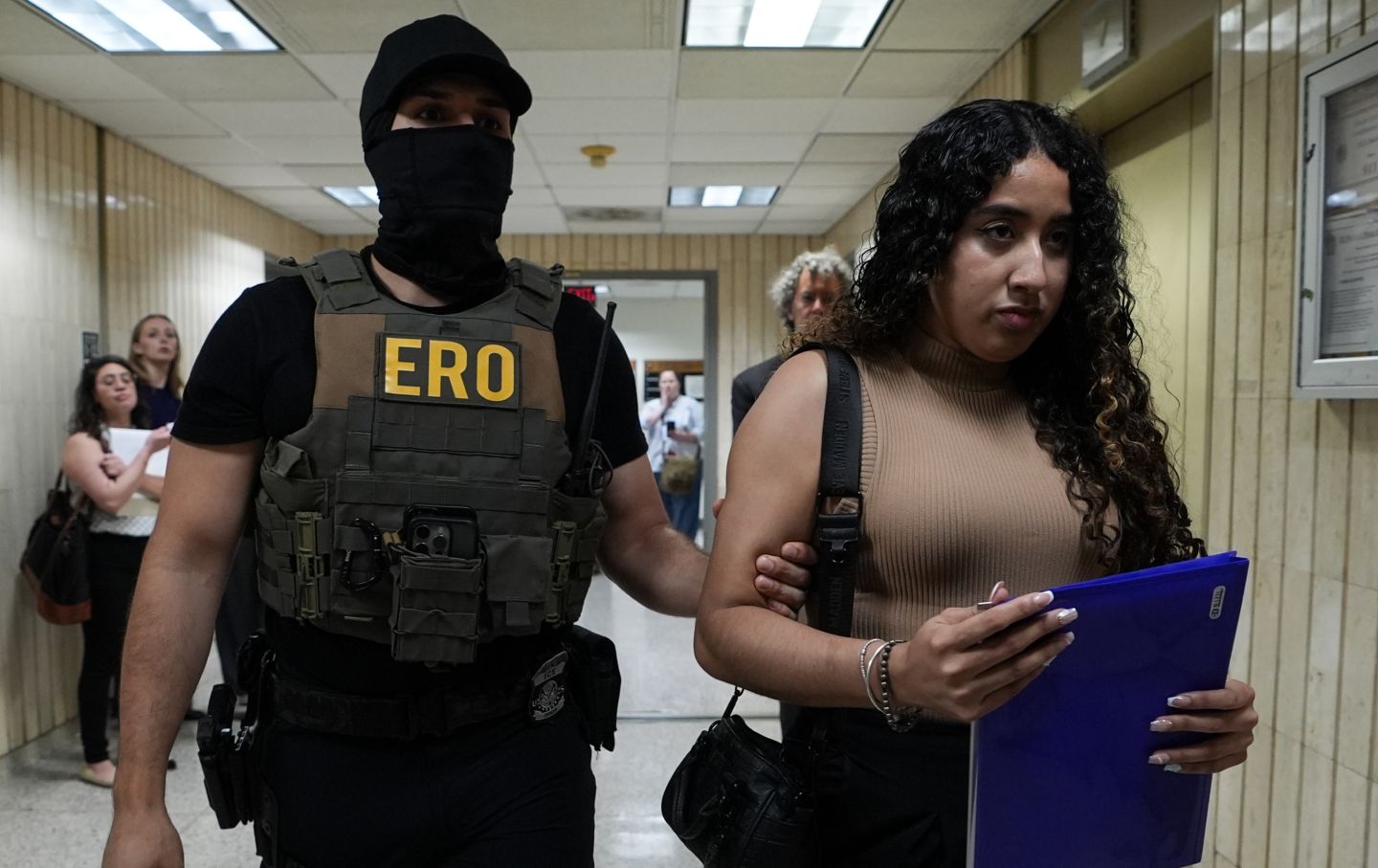
The June 24 hearing at 26 Federal Plaza was her first immigration hearing. It was brief. Judge Thompson scheduled her next date for March 2026. But when Chipantiza-Sisalema stepped out of the courtroom to return home, masked men grabbed her. She was hustled down to the 10th floor of the courthouse. She would remain there for nine days—without being charged or ever given the opportunity to contest her detention, without access to an attorney, sleeping on the floor, with minimal food and nowhere to bathe. In hasty one-minute phone calls, Chipantiza-Sisalema told her parents there were at least 70 other people there. The small number of holding cells in the federal building are meant to be used just for a few hours before someone is transferred to a different facility, attorneys familiar with the building explained. There is no provision for meals and no beds. When she was put on a plane and transferred to the for-profit Richwood Detention facility in Louisiana on the Fourth of July—before a New York judge had a chance to review the habeas corpus petition an attorney filed the day before—she was still wearing that same red shirt and blue jeans.

The overwhelming majority of immigrants whose cases are winding through the immigration court system show up for their hearings, believing that by adhering to the system’s labyrinthine requirements they’ll be rewarded with clearance to stay in the country. Or at least the chance to fight another day. But under President Donald Trump’s aggressive deportation regime, abiding by the immigration system’s rules has become increasingly dangerous. Those who show up in court now routinely face arrest. But failure to appear for a hearing generally triggers a deportation order, attorneys explained. Immigrants, advocates, and elected officials at all levels are scrambling to confront what they say is lawlessness inside the courthouse and throughout the ICE detention system. “ICE is just detaining everyone and giving only some a right to a hearing, and it’s only the possibility of having a lawyer who will shout and scream for you that your case is heard,” said Melissa Chua, an attorney at the pro bono New York Legal Assistance Group, who is representing several people who, despite following US immigration procedure, are now in detention.

Chipantiza-Sisalema is just one of hundreds of people taken in the past month by masked ICE agents at Manhattan’s immigration courts, Harold Solis, co–legal director for the Brooklyn-based immigrant rights group Make the Road New York, told The Nation. “The truth is, I don’t think anyone has a full scope of how many people have been held there.” Make the Road is now representing Chipantiza-Sisalema. Similar scenes have played out in courthouses across the country, with immigrants often shuttled between several facilities before their family or attorney can locate them. Beginning in April, it appeared to court observers in Manhattan that ICE was lying in wait for people whose cases were dismissed or who were ordered to be deported. Veteran attorneys say courthouse arrests had previously been extremely unusual. “In all my years of practice, it has never been a fact of life that going to immigration court leads to you being detained,” Solis said. By late June, ICE was routinely taking people even when, like Chipantiza-Sisalema, US immigration judges had ordered them to reappear several months in the future.

“People are being disappeared into this hole of 26 Federal Plaza for a prolonged period of time and in deplorable conditions,” said Kendal Nystedt, an attorney at the rights group Unlocal whose client was held there for six days. The New York Immigration Coalition is representing someone held for three weeks, executive director Murad Awawdeh said. The vast majority, maybe as many as 99 percent, according to a close court watcher who asked not to be identified because of the nature of her work, do not have an attorney.

“If you’re someone without a family member or no one has alerted us to you, there is no way for us to know what has happened,” said Chua. “They are really creating this shadow place that can deny people protections they are afforded by our Constitution.”

In the chaotic seconds as immigrants exit courtrooms, volunteer observers hastily attempt to catch people’s names, alien registration numbers, and contacts for family members before ICE strongarms them into elevators and out of sight. The hope is that by collecting people’s names, their families will be able to find out where they are sent. A diffuse mutual aid network raises commissary funds, tries to connect people to counsel, and offers support to families left behind—often without a breadwinner. Ordinarily when someone is detained, they show up in the ICE detainee locator in a mattered of hours, attorneys said. But those held at 26 Federal Plaza and in irregular detention in courthouses elsewhere are listed only as “in transit” for the days-long duration of their stay. In this limbo state, their lawyers and families can’t reach them.

Chua and other attorneys emphasized that the spectacle of ICE sweeping people up in courthouses was a dramatic departure from norms—even in an immigration system hardly characterized by transparency or compassion. Several members of New York’s congressional delegation, including Representatives Adriano Espaillat, Daniel Goldman, Jerrold Nadler, and Nydia Velasquez, have tried to find out how many people are held at 26 Federal Plaza—and to assess conditions. They’ve all been rebuffed.

In a surreal, Kakfaesque incident, Bill Joyce, deputy director of the New York ICE field office, told Representatives Goldman and Nadler in June that the 10th floor of 26 Federal Plaza—where a shifting number of immigrants are held against their will for days on end—is not a detention facility. Rather, it is a place ICE is “housing [immigrants] until they can be detained.” Members of Congress have a right to inspect places where people are detained, but not, Joyce argued, a place they are merely “held.” On July 14, Espaillat and Velasquez were again prevented from inspecting the facility. The lawmakers are considering legal action against the Department of Homeland Security for preventing them from exercising their oversight rights, Espaillat said.

That people are held within a courthouse in a sanctuary city that considers itself the capital of immigrant America is an affront that has New York lawmakers searching for solutions. “We’re fighting this from the legal front and the budgeting front and the legislative front. And we’re fighting this in public opinion,” Espaillat said. Likewise, New York City Public Advocate Jumaane Williams said his office is seeking litigation in support and praised the efforts of court observers. A coalition of immigrants rights groups in Washington, DC, filed a class action suit in federal district court in DC on July 17, alleging that the courthouse arrests are a violation of due process. New York groups could soon follow.

While ICE is barred by state law from entering New York criminal and civil courts, 26 Federal Plaza is under federal jurisdiction. But standing beside Chipantiza-Sisalema’s bereft and terrified parents at a July 3 press conference, several elected officials called on New York Governor Kathy Hochul to find a way to intervene. Assemblywoman Emily Gallagher, who represents parts of Brooklyn, thinks lawmakers, whose session ended mid-June, should return to Albany. “I also call on my governor, Kathy Hochul, to pass New York for All and to call us to a special session and get ICE out of our courts,” she said, referring to a bill that would extend some sanctuary protections to immigrants across New York State. Espaillat introduced HR 4176—The No Secret Police Act—in June. In the unlikely event it passes the Republican-controlled Congress, it would bar federal law enforcement officers from wearing masks or hiding their badges except in specific undercover instances. Last week, New York Attorney General Leticia James and a coalition of 20 attorneys general urged Congress to pass the bill and a bundle of similar legislation.

Closer to home, the New York City budget adopted at the end of June increased city funding for pro bono immigration lawyers by $76 million to $120 million in total, and the city’s law department filed amicus briefs in support of two detained New Yorkers this spring. But the New York Immigration Coalition wants to see a full right to counsel extended to immigration court. The rollout of city-funded right-to-counsel in housing court several years ago was not without complications, but it dramatically rebalanced the scale between tenants and landlords and has been copied elsewhere. New York wouldn’t be the first place to guarantee a right to an immigration lawyer. Oregon adopted universal access to representation in most immigration matters in 2022, said Isa Peña, director of strategy for Innovation Law Lab, based in Portland.

As courthouse arrests pile up, lawyers who are able to identify people being held are filing habeas corpus petitions in federal district courts, in hopes of keeping their clients from being transferred to distant detention facilities or deported—but also simply to compel the government to reveal where they are, dispelling the twilight status of being in perpetual “transit.” These petitions have the advantage of being heard by judges who are part of the federal judiciary—and perhaps more attuned to the rule of law than immigration court judges, who serve at the pleasure of the Department of Homeland Security.

In Buffalo, in a case since joined by the New York Civil Liberties Union, the Prisoners Legal Service is arguing that ICE’s aggressive presence in the halls of federal courthouses constitutes not just an escalation of Trump’s war on immigrants but a systematic attempt to deprive people of their due-process rights. “It’s a huge deviation in ICE tactics and unlawful in various ways,” said NYCLU attorney Amy Louise Belscher, who is representing Oliver Mata Velasquez in a habeas case. Mata Velasquez, 19, came to the United States from Venezuela in September 2024, using the CBPOne app the Biden administration required of asylum seekers.As with Chipantiza-Sisalema, immigration officials at the border determined Mata Velasquez was not a flight risk or a danger and permitted him to enter the country. He obtained work authorization and showed up May 21 for his first immigration hearing, as instructed. A judge told him to return in February 2026, but before he could leave the courthouse, ICE arrested him. Last week a judge ordered Mata Velasquez immediately released and forbade ICE from detaining him again without permission from the judge.

“Federal judges are finding these courthouse arrests unlawful,” Belscher said. “They are detaining people not because they are at risk of flight or a danger to the community, but because they are easy to find.” The NYCLU’s arguments for Mata Velasquez cite a bundle of cases successfully argued in Oregon, by the Innovation Law Lab. Those cases, named for ICE Seattle field office director Drew Bostock, argue that the courthouse arrests violate the immigrant’s right to due process. That such a violation is occurring precisely in the place one goes to seek justice has scandalized attorneys. “When we saw that people were targeted at the courthouse—where your fundamental freedoms are supposed to be upheld, we moved quickly to intervene,” Innovation Law Lab’s Peña said.

Some of the habeas petitions filed in New York last month resulted in judges’ issuing emergency orders to keep the person nearby, preventing ICE from venue shopping by sending the person to Texas or Louisiana.

People aren’t only being taken at court. Milton Maisel Perez y Perez, a teacher who fled his native Guatemala because of threats from gangs, has been in immigration proceedings for six years. Like hundreds of thousands of immigrants across the country, he gained the right to work legally and was required to check in periodically under the Department of Homeland Security’s Intensive Supervision Appearance Program (ISAP). Last month, he went to the ISAP facility in Jamaica, Queens. It was perhaps the 50th time he’d done so, his attorney S. Michael Musa-Obregon said. This time, Perez y Perez was arrested. He was transferred to the 10th floor of 26 Federal Plaza and held for three days. After Musa-Obregon filed a habeas petition with the Southern District of New York, but before it could be heard by a judge, ICE prepared to move Perez y Perez to detention—clear across the country in Seattle. A judge’s order at the last minute had him removed from the plane and transferred to detention in Goshen, New York.

The courthouse arrests are a cynical campaign, Musa-Obregon said. “They are detaining people with the idea that it is much easier to get people to give up their rights when they are incarcerated,” he said. On the Fourth of July, Trump signed into law his massive spending bill, which included $170 billion for immigration enforcement and border security. It makes ICE the largest law enforcement entity in the country and promises to vastly expand the for-profit immigrant detention system. The masked men in the halls of justice are just the beginning. But the ancient writ of habeas corpus appears to be working.

District Judge Analisa Torres ruled on Chipantiza-Sisalema’s habeas petition on July 13, ordering her immediate release. The manner of her arrest, the judge wrote, “offends the ordered system of liberty that is the pillar of the Fifth Amendment.” She was back in her parents’ arms on July 16. Snatched by masked men and held for three weeks, she’s one of the lucky ones.

https://www.thenation.com/article/society/ice-trump-detention-regime-cruelty

Also here:

https://www.msn.com/en-us/news/us/punished-for-playing-by-the-rules-the-deliberate-cruelty-of-trump-s-deportation-regime/ar-AA1JcQGd

Reuters: US sues New York City to block laws it says impede immigration enforcement

The U.S. government on Thursday sued New York City, seeking to block enforcement of several local laws its says are designed to impede its ability to enforce federal immigration laws.

In a complaint filed in Brooklyn federal court, the U.S. government said New York City’s “sanctuary provisions” are unconstitutional, and preempted by laws giving it authority to regulate immigration.

According to the Tenth Amendment, the federal government can’t force states to do the fed’s “regulating”. The states are not required to help you.

https://www.reuters.com/legal/government/trump-administration-sues-new-york-city-block-immigration-sanctuary-laws-2025-07-24

LA Times: ‘Hell on earth.’ A Venezuelan deportee describes abuse in El Salvador prison

  • Jerce Reyes Barrios, 36, was one of more than 250 Venezuelans sent to El Salvador from the United States in March and incarcerated in the country’s infamous prison.
  • “There was blood, vomit and people passed out on the floor, he said.
  • A one-time professional soccer player, Reyes Barrios left Venezuela last year amid political unrest and attempted to apply for asylum at the Otay Mesa border crossing in California.

When Jerce Reyes Barrios and other Venezuelan deportees entered a maximum security prison in El Salvador this spring, he said guards greeted them with taunts.

“Welcome to El Salvador, you sons of bitches,” Reyes Barrios said the guards told them. “You’ve arrived at the Terrorist Confinement Center. Hell on earth.”

What followed, Reyes Barrios said, were the darkest months of his life. Reyes Barrios said he was regularly beaten on his neck, ribs and head. He and other prisoners were given little food and forced to drink contaminated water. They slept on metal beds with no mattresses in overcrowded cells, listening to the screams of other inmates.

“There was blood, vomit and people passed out on the floor, he said.

Reyes Barrios, 36, was one of more than 250 Venezuelans sent to El Salvador from the United States in March after President Trump invoked the 1798 Alien Enemies Act to deport alleged members of the Tren de Aragua gang without normal immigration procedures. Many of the men, including Reyes Barrios, insist that they have no ties to the gang and were denied due process.

After enduring months in detention in El Salvador, they were sent home last week as part of a prisoner exchange deal that included Venezuela’s release of several detained Americans.

Venezuela’s attorney general said interviews with the men revealed “systemic torture” inside the Salvadoran prison, including daily beatings, rancid food and sexual abuse.

One of the former detainees, Neiyerver Adrián León Rengel, filed a claim Thursday with the Homeland Security Department, accusing the U.S. of removing him without due process and asking for $1.3 million in damages.

Reyes Barrios spoke to The Times over video Thursday after returning to his hometown of Machiques, a city of 140,000 not far from the Colombian border. He was overjoyed to be reunited with his mother, his wife and his children. But he said he was haunted by his experience in prison.

A onetime professional soccer player, Reyes Barrios left Venezuela last year amid political unrest and in search of economic opportunity. He entered the U.S. on Sept. 1 at the Otay Mesa border crossing in California under the asylum program known as CBP One. He was immediately detained, accused of being a gangster and placed in custody of Immigration and Customs Enforcement.

A court statement earlier this year from his attorney, Linette Tobin, said authorities tied Reyes Barrios to Tren de Aragua based solely on an arm tattoo and a social media post in which he made a hand gesture that U.S. authorities interpreted as a gang sign.

The tattoo — a crown sitting atop a soccer ball, with a rosary and the word “Díos” or “God” — is actually an homage to his favorite team, Real Madrid, Tobin wrote. She said the hand gesture is sign language for “I Love You.”

While in custody in California, Reyes Barrios applied for political asylum and other relief. A hearing had been set for April 17, but on March 15, he was deported to El Salvador “with no notice to counsel or family,” Tobin wrote. Reyes Barrios “has never been arrested or charged with a crime,” Tobin added. “He has a steady employment record as a soccer player as well as a soccer coach for children and youth.”

The surprise deportation of Reyes Barrios and other Venezuelans to El Salvador drew outcry from human rights advocates and spurred a legal battle with the Trump administration.

Reyes Barrios was not aware of the controversy over deportations as he was ushered in handcuffs from the airport in San Salvador to the country’s infamous Terrorism Confinement Center, also known as CECOT.

There, Reyes Barrios said he and other inmates were forced to walk on their knees as their heads were shaved and they were repeatedly beaten. He said he was put in a cell with 21 other men — all Venezuelans. Guards meted out measly portions of beans and tortillas and told the inmates they “would never eat chicken or meat again.”

El Salvador’s president, Nayib Bukele, has detained tens of thousands of his compatriots in CECOT and other prisons in recent years, part of a gang crackdown that human rights advocates say has ensnared thousands of innocent people.

Bukele garnered worldwide attention and praise from U.S. Republicans after he published dramatic photos and videos showing hundreds of prisoners crammed together in humiliating positions, wearing nothing but underwear and shackles. During a meeting with Bukele at the Oval Office this year, Trump said he was interested in sending “homegrowns” — i.e. American prisoners — to El Salvador’s jails.

A spokeswoman for Bukele did not respond to requests for comment Thursday.

Reyes Barrios said guards told him and the other detained Venezuelans that they would spend the rest of their lives in the prison.

Reyes Barrios said he started praying at night: “God, protect my mother and my children. I entrust my soul to you because I think I’m going to die.”

Then, several days ago, he and the other prisoners were awakened by yelling in the early morning hours. Guards told them they had 20 minutes to take showers and prepare to leave.

“At that moment, we all shouted with joy,” Reyes Barrios said. “I think that was my only happy day at CECOT.”

After arriving in Venezuela, Reyes Barrios and the other returnees spent days in government custody, undergoing medical checks and interviews with officials.

Venezuelan President Nicolás Maduro has seized on the treatment of prisoners, airing videos on state television in which some deportees describe suffering abuses including rape, beatings and being shot at with pellet guns. Venezuelan authorities say they are investigating Bukele over the alleged abuse.

Maduro, a leftist authoritarian who has ruled Venezuela since 2013, has maintained his grip on power by jailing — and sometimes torturing — opponents. Many of the 7.7 million Venezuelans who have fled the country in recent years have cited political repression as one reason for leaving.

In Tobin’s court statement, she said Reyes Barrios participated in two demonstrations against Maduro in early 2024. After the second, Reyes Barrios was detained by authorities along with other protesters and tortured, she wrote.

Reyes Barrios said he did not wish to discuss Venezuelan politics. He said he was just grateful to be back with his family.

“My mother is very happy, ” he said.

He was greeted in his hometown by some of the young soccer players he once coached. They wore their uniforms and held balloons. Reyes Barrios juggled a ball a bit, gave the kids hugs and high fives, and smiled.

https://www.latimes.com/world-nation/story/2025-07-24/i-think-im-going-to-die-a-venezuelan-deportee-recounts-abuse-in-el-salvador-prison