Associated Press: What to know about a large-scale immigration raid at a Georgia manufacturing plant

Hundreds of federal agents descended on a sprawling site where Hyundai manufactures electric vehicles in Georgia and detained 475 people, most of them South Korean nationals.

This is the latest in a long line of workplace raids conducted as part of the Trump administration’s mass deportation agenda. But the one on Thursday is especially distinct because of its large size and the fact that it targeted a manufacturing site state officials have long called Georgia’s largest economic development project.

The detainment of South Korean nationals also sets it apart, as they are rarely caught up in immigration enforcement compared to other nationalities.

Video released by U.S. Immigration and Customs Enforcement on Saturday showed a caravan of vehicles driving up to the site and then federal agents directing workers to line up outside. Some detainees were ordered to put their hands up against a bus as they were frisked and then shackled around their hands, ankles and waist. Others had plastic ties around their wrists as they boarded a Georgia inmate-transfer bus.

Here are some things to know about the raid and the people impacted:

The workers detained

South Korea’s Foreign Minister Cho Hyun said Saturday that more than 300 South Koreans were among the 475 people detained.

Some of them worked for the battery plant operated by HL-GA Battery Co., a joint venture by Hyundai and LG Energy Solution that is slated to open next year, while others were employed by contractors and subcontractors at the construction site, according to Steven Schrank, the lead Georgia agent of Homeland Security Investigations.

He said that some of the detained workers had illegally crossed the U.S. border, while others had entered the country legally but had expired visas or had entered on a visa waiver that prohibited them from working.

But an immigration attorney representing two of the detained workers said his clients arrived from South Korea under a visa waiver program that enables them to travel for tourism or business for stays of 90 days or less without obtaining a visa.

Attorney Charles Kuck said one of his clients has been in the U.S. for a couple of weeks, while the other has been in the country for about 45 days, adding that they had been planning to return home soon.

The detainees also included a lawful permanent resident who was kept in custody for having a prior record involving firearm and drug offenses, since committing a crime of “moral turpitude” can put their status in jeopardy, Lindsay Williams, a public affairs officer for U.S. Immigration and Customs Enforcement, said Saturday.

Williams denied reports that U.S. citizens had been detained at the site since “once citizens have identified themselves, we have no authority.”

Hyundai Motor Company said in a statement Friday that none of its employees had been detained as far as it knew and that it is reviewing its practices to make sure suppliers and subcontractors follow U.S. employment laws. LG told The Associated Press that it couldn’t immediately confirm how many of its employees or Hyundai workers had been detained.

The South Korean government expressed “concern and regret” over the operation targeting its citizens and is sending diplomats to the site.

“The business activities of our investors and the rights of our nationals must not be unjustly infringed in the process of U.S. law enforcement,” South Korean Foreign Ministry spokesperson Lee Jaewoong said in a televised statement from Seoul.

Most of the people detained have been taken to an immigration detention center in Folkston, Georgia, near the Florida state line. None of them have been charged with any crimes yet, Schrank said, but the investigation is ongoing.

Family members and friends of the detainees were having a hard time locating them or figuring out how to get in touch with them, James Woo, communications director for the advocacy group Asian Americans Advancing Justice-Atlanta, said Saturday in an email.

Woo added that many of the families were in South Korea because many of the detainees were in the United States only for business purposes.

Raid is the result of a monthslong investigation

The raid was the result of a monthslong investigation into allegations of illegal hiring at the site, Schrank said.

In a search warrant and related affidavits, agents sought everything from employment records for current and former workers and timecards to video and photos of workers.

Court records filed this week indicated that prosecutors do not know who hired what it called “hundreds of illegal aliens.” The identity of the “actual company or contractor hiring the illegal aliens is currently unknown,” the U.S. Attorney’s Office wrote in a Thursday court filing.

The sprawling manufacturing site

The raid targeted a manufacturing site widely considered one of Georgia’s largest and most high profile.

Hyundai Motor Group started manufacturing EVs at the $7.6 billion plant a year ago. Today, the site employs about 1,200 people in a largely rural area about 25 miles (40 kilometers) west of Savannah.

Agents specifically honed in on an adjacent plant that is still under construction at which Hyundai has partnered with LG Energy Solution to produce batteries that power EVs.

The Hyundai site is in Bryan County, which saw its population increase by more than a quarter in the early 2020s and stood at almost 47,000 residents in 2023, the most recent year data is available. The county’s Asian population went from 1.5% in 2018 to 2.2% in 2023, and the growth was primarily among people of Indian descent, according to Census Bureau figures.

Raid was the ‘largest single site enforcement operation’

From farms and construction sites to restaurants and auto repair shops, there have been a wide array of workplace raids undertaken in this administration. But most have been smaller, including a raid the same day as the Georgia one in which federal officers took away dozens of workers from a snack-bar manufacturer in Cato, New York.

Other recent high-profile raids have included one in July targeting a legal marijuana farm northwest of Los Angeles. More than 360 people were arrested in one of the largest raids since Trump took office in January. Another one took place at an Omaha. Nebraska, meat production plant and involved dozens of workers being taken away.

Schrank described the one in Georgia as the “largest single site enforcement operation” in the agency’s two-decade history.

The majority of the people detained are Koreans. During the 12-month period that ended Sept. 30, 2024, only 46 Koreans were deported during out of more than 270,000 removals for all nationalities, according to Immigration and Customs Enforcement.

Community members and advocates have mixed reactions

Kemp and other Georgia Republican officials, who had courted Hyundai and celebrated the EV plant’s opening, issued statements Friday saying all employers in the state were expected to follow the law.

The nonprofit legal advocacy organization Asian Americans Advancing Justice-Atlanta described the raid in a joint statement as “unacceptable.”

“Our communities know the workers targeted at Hyundai are everyday people who are trying to feed their families, build stronger communities, and work toward a better future,” the statement said.

Sammie Rentz opened the Viet Huong Supermarket less than 3 miles (4.8 kilometers) from the Hyundai site six months ago and said he worries business may not bounce back after falling off sharply since the raid.

“I’m concerned. Koreans are very proud people, and I bet they’re not appreciating what just happened. I’m worried about them cutting and running, or starting an exit strategy,” he said.

Ellabell resident Tanya Cox, who lives less than a mile from the Hyundai site, said she had no ill feelings toward Korean nationals or other immigrant workers at the site. But few neighbors were employed there, and she felt like more construction jobs at the battery plant should have gone to local residents.

“I don’t see how it’s brought a lot of jobs to our community or nearby communities,” Cox said.

Something’s fishy here — many had 90-day visa waivers but had been for a much shorter time.

This looks like part of a desperate attempt to meet the ghoulish Stephen Miller’s goal of 3000 deportations monthly.

https://apnews.com/article/immigration-raid-hyundai-plant-4dd1a6b2ad66d27567b2463c5f3c97bb

Daily Beast: ‘Homie’: DHS Ridicules Dad They Plan to Deport to Tiny African Nation

Kilmar Abrego Garcia has received a letter about where the DHS plans to send him next.

Maryland dad Kilmar Abrego Garcia has learned where the Department of Homeland Security has decided to deport him next.

In an email obtained by Fox News, lawyers for the DHS and Immigration and Customs Enforcement informed Abrego Garcia’s legal team on Friday that his new intended destination is the tiny African nation of Eswatini, formerly known as Swaziland.

Ridiculing Abrego Garcia’s legal claim of fear of persecution or torture—a core asylum principle—in many of the nations the government has considered deporting him to, the DHS wrote on social media that “Homie is afraid of the entire western hemisphere”.

The derisory use of the term “homie” sparked outrage on social media.

Abrego Garcia, who is currently in ICE custody in Virginia, became the face of the Trump administration’s immigration crackdown in March after he was mistakenly deported to El Salvador.

The government admitted to an “administrative error” following his return from the Central American nation, but is still intent on removing him from the U.S. over charges of human smuggling.

His lawyers claim such charges are a “preposterous and vindictive” punishment for challenging ICE policy.

Eswatini is the fourth potential destination for Abrego Garcia, who was taken into ICE custody for a second time on Aug. 25, and prepared for processing to Uganda.

A federal judge blocked the plan, accepting his lawyers’ concerns over fear of persecution or torture, ruling that it is “absolutely forbidden” to remove Abrego Garcia from the U.S. until further legal processing can be carried out. However, the DHS has stated it is not buying his legal defense.

“That claim of fear is hard to take seriously, especially given that you have claimed (through your attorneys) that you fear persecution or torture in at least 22 different countries,” the legal letter reads.

“Nonetheless, we hereby notify you that your new country of removal is Eswatini, Africa.”

The letter does not elaborate on how the DHS chose the country for Abrego Garcia’s intended removal.

The Daily Beast has contacted the DHS for comment.

DHS boss Kristi Noem has made it a personal mission to see Abrego Garcia deported. She has previously claimed her department is going after “the worst of the worst” and, in August, claimed the man is a “monster.”

“This illegal alien… is a MS-13 gang member, human trafficker, serial domestic abuser, and child predator,” Noem wrote on social media.

Abrego Garcia’s legal team has repeatedly denied all these allegations, including the often-trotted out line about his membership of the notorious MS-13 gang. Multiple judges have said there is no evidence to suggest he is gang-affiliated, while noting he has no prior criminal history.

In April, President Donald Trump insisted that Abrego Garcia had the gang name tattooed on his knuckles, challenging a reporter in an interview that an image of Abrego Garcia’s hand with “MS-13″ clearly superimposed over it was real.

At roughly 120 miles long and 80 miles wide, Eswatini is one of the smallest nations in Africa. It is the last absolute monarchy on the continent, and has a population of 1.2 million people. The country, which is bordered by South Africa and Mozambique, changed its name from Swaziland in 2018 to avoid confusion with Switzerland.

Abrego Garcia’s attorney, Simon Sandoval-Moshenberg, says the Trump administration is “weaponizing the immigration system in a manner that is completely unconstitutional.”

https://www.thedailybeast.com/dhs-ridicules-kilmar-abrego-garciawho-they-now-plan-to-deport-to-eswatini

Reuters: Trump administration drops defense of ban on employee ‘noncompete’ agreements

  • Rule barred agreements commonly signed by workers
  • Judicial rulings had blocked the Biden-era rule

 President Donald Trump‘s administration abandoned on Friday the U.S. government’s legal defense of a rule adopted under former President Joe Biden that had banned agreements commonly signed by workers not to join rivals of their employers or launch competing businesses.

The U.S. Justice Department filed motions in federal appeals courts in New Orleans and Atlanta to dismiss separate appeals of rulings by two judges that struck down the 2024 U.S. Federal Trade Commission rule concerning “noncompete” agreements. Republicans and business groups have criticized the rule.

The move was expected after FTC Chairman Andrew Ferguson, who was appointed to the post by Trump and had previously criticized the rule, said in February that the agency was reviewing it. The appeals involve legal challenges to the rule by a marketing firm and a real estate developer, as well as the U.S. Chamber of Commerce and other business groups.

Dropping the appeals means the courts will not have a chance to address the novel question of whether the commission, which enforces federal antitrust laws, can adopt sweeping regulations such as its nationwide ban on “noncompete” agreements.

More than 20% of U.S. workers have signed noncompete agreements, according to the FTC. The agency, in adopting the rule, had said the agreements limit worker mobility and suppress wages and competition for labor.

Ferguson and other Republicans on the commission have said the FTC has limited rulemaking powers and cannot adopt blanket bans on what it views as anticompetitive conduct.

During Trump’s first term as president, his administration had argued in court that while specific provisions of noncompetes can be unlawful, the agreements themselves were not.

The FTC on Thursday announced its first legal action of Trump’s second term related to noncompete agreements, a settlement barring the largest U.S. pet cremation business from enforcing these agreements with 1,800 workers.

The agency in that case, opens new tab said that the company’s broad agreements, signed even by low-level employees, unlawfully suppressed competitors’ entry into the pet cremation market.

Regressive! Non-compete agreements often unfairly make it all but impossible for many people to find jobs.

https://www.reuters.com/legal/litigation/trump-administration-drops-defense-ban-employee-noncompete-agreements-2025-09-06

L.A. Times: Postal traffic to U.S. down 80% after Trump ended exemption on low-value parcels

  • Postal traffic to the United States plunged 80% after the Trump administration eliminated tariff exemptions for imported goods valued under $800.
  • Eighty-eight postal operators worldwide suspended services because carriers cannot collect the newly required customs duties on low-value parcels.
  • The change ends a duty-free exemption that existed since 1938, with tariffs now ranging from 10% to 50% on previously exempt goods.

Postal traffic into the United States plunged by more than 80% after the Trump administration ended a tariff exemption for low-cost imports, the United Nations postal agency said Saturday.

The Universal Postal Union says it has started rolling out new measures that can help postal operators around the world calculate and collect duties, or taxes, after the U.S. eliminated the “de minimis” exemption for lower-value parcels.

Eighty-eight postal operators have told the UPU that they have suspended some or all postal services to the United States until a solution is implemented with regard to U.S.-bound parcels valued at $800 or less, which had been the cutoff for imported goods to escape customs charges.

“The global network saw postal traffic to the U.S. come to a near-halt after the implementation of the new rules on Aug. 29, 2025, which for the first time placed the burden of customs duty collection and remittance on transportation carriers or U.S. Customs and Border Protection agency-approved qualified parties,” the UPU said in a statement.

The UPU said information exchanged among postal operators through its electronic network showed traffic from its 192 member countries — nearly all the nations in the world — had fallen 81% on Aug. 29 compared with a week earlier.

The Bern, Switzerland-based agency said the “major operational disruptions” have occurred because airlines and other carriers indicated they weren’t willing or able to collect such duties, and foreign postal operators had not established a link to CBP-qualified companies.

Before the measure took effect, the postal union sent a letter to U.S. Secretary of State Marco Rubio to express concerns about its effect.

The de minimis exemption has existed in some form since 1938, and the administration says the exemption has become a loophole that foreign businesses exploit to evade tariffs and criminals use to get drugs into the United States.

Purchases that previously entered the U.S. without needing to clear customs now require vetting and are subject to their origin country’s applicable tariff rate, which can range from 10% to 50%.

While the change applies to the products of every country, U.S. residents will not have to pay duties on incoming gifts valued at up to $100, or up to $200 worth of personal souvenirs from trips abroad, according to the White House.

The UPU said its members had not been given enough time or guidance to comply with the procedures outlined in the executive order President Trump signed on July 30 to eliminate the duty-free eligibility of low-value goods.

https://www.latimes.com/world-nation/story/2025-09-06/postal-traffic-to-us-sank-80-after-trump-administration-ended-exemption-on-low-value-parcels

Raw Story: Stephen Miller boasts about ‘rich resources’ in nation targeted by Trump for regime change

White House Deputy Chief of Staff Stephen Miller couldn’t help but note Venezuela’s “rich resources and reserves” Saturday when speaking to a reporter in Washington, D.C., his comments made amid the Trump administration’s growing fixation on enacting regime change in the South American nation.

“It is a drug cartel that is running Venezuela; it is not a government, it is a drug cartel, a narco-trafficking organization that is running Venezuela,” Miller said, fielding questions from reporters. “The people of Venezuela have been suffering and struggling under the reality of a nation that is so rich in resources, so rich in reserves, that is run by (Venezuelan President Nicolas] Maduro, the head of the cartel.”

Tensions between the United States and Venezuela have risen in recent weeks, especially after the deadly U.S. precision strike this week on a supposed drug vessel heading toward American shores, an execution-style strike that has widely been condemned as amounting to murder.

President Donald Trump escalated tensions further when on Friday, he indicated that the United States would shoot down Venezuelan jets were they to fly over American naval ships, with at least eight warships and one submarine currently deployed off of Venezuela’s coast.

“Many Americans may not realize that the drugs killing their kids are coming from Maduro; also, the criminal aliens killing their kids are coming from Maduro,” Miller continued.

“So he’s sending his drugs, he is sending his killers, his assassins into our communities, and he’s working directly with other designated foreign terrorist organizations like the [Revolutionary Armed Forces of Colombia], and all the Mexican drug cartels, so it’s one continuous loop.”

Maduro was indicted by the Justice Department on narco-terrorism and drug trafficking charges in 2020, with the Trump administration issuing a $50 million bounty for his capture.

Given the Trump administration’s designation of drug cartels as terrorists, which permits the administration to carry out execution-style strikes on drug traffickers, a Trump official has admitted that Trump is keeping the idea of assassinating Maduro via strike “as an option.” Trump officials have also spoken favorably about the idea of enacting regime change in Venezuela.

“Maduro is an indicted drug trafficker, a fugitive from justice in America,” Miller said.

To watch the video, use this link.

https://www.rawstory.com/venezuela

Associated Press: South Sudan repatriates Mexican man deported from US in July

South Sudan said Saturday it repatriated to Mexico a man deported from the United States in July.

The man, a Mexican identified as Jesus Munoz-Gutierrez, was among a group of eight who have been in government custody in the east African country since their deportation from the U.S.

Another deportee, a South Sudanese national, has since been freed while six others remain in custody.

Munoz-Gutierrez’s repatriation to Mexico was carried out by South Sudan’s foreign ministry in concert with the Mexican Embassy in neighboring Ethiopia, the South Sudanese foreign ministry said in a statement.

The repatriation was carried out “in full accordance with relevant international law, bilateral agreements, and established diplomatic protocols,” it said.

In comments to journalists in Juba, the South Sudan capital, Munoz-Gutierrez said he “felt kidnapped” when the U.S. sent him to South Sudan.

“I was not planning to come to South Sudan, but while I was here they treated me well,” he said. “I finished my time in the United States, and they were supposed to return me to Mexico. Instead, they wrongfully sent me to South Sudan.”

The U.S. Department of Homeland Security has said that Munoz-Gutierrez had a conviction for second-degree murder and was sentenced to life in prison.

South Sudan is engaging other countries about repatriating the six deportees still in custody, said Apuk Ayuel Mayen, a spokeswoman for the foreign ministry.

It is not clear if the deportees have access to legal representation.

Rights groups have argued that the Trump administration’s increasing practice of deporting migrants to third countries violates international law and the basic rights of migrants.

The deportations have faced opposition by courts in the U.S., though the Supreme Court in June allowed the government to restart swift removals of migrants to countries other than their homelands.

Other African nations receiving deportees from the U.S. include Uganda, Eswatini and Rwanda. Eswatini, in southern Africa, received five men with criminal backgrounds in July. Rwanda announced the arrival of a group of seven deportees in mid-August.

https://apnews.com/article/south-sudan-us-mexico-deportations-924ebd609d65efc6681f4bb59b6cc94e

News Nation: Report: 14K federal workers, including USCIS, assisting ICE

The Cato Institute says over 14,500 federal law enforcement officers from other agencies are working with Immigration and Customs Enforcement agents to facilitate raids and make arrests nationwide, including new special agents from USCIS.

The Cato Institute this week reported that ICE’s Enforcement and Removal Operations (ERO) is receiving assistance from nearly 17,000 non-ERO agents, according to data given to the nonprofit organization.

That includes diverting U.S. Citizenship and Immigration Services employees to help with ICE raids.

The Department of Homeland Security this week announced a new class of USCIS employees had been “newly minted” as special agents to work with ICE.

USCIS personnel will have the authority “to investigate and enforce civil and criminal violations of the immigration laws within the jurisdiction of USCIS. These authorities include, but are not limited to, the issuance and execution of warrants, the arrest of individuals, and carrying of firearms,” according to a notice posted Friday in the Federal Register.

This includes ordering expedited removals. USCIS says it plans to recruit and train special agents for these roles.

“As (Homeland Security) Secretary Noem delegated lawful authorities to expand the agency’s law enforcement capabilities, this rule allows us to fulfill our critical mission. This historic moment will better address immigration crimes, hold those that perpetrate immigration fraud accountable, and act as a force multiplier for DHS and our federal law enforcement partners, including the Joint Terrorism Task Force,” USCIS Director Joseph Edlow said in a statement.

Edlow says this will allow his agency to handle investigations from start to finish, instead of referring some cases to Homeland Security Investigations (HSI) and ERO agents.

The Cato Institute reports that other federal employees diverted to ICE ERO include:

  • ICE HSI: 6,198
  • FBI: 2,840
  • Drug Enforcement Administration: 2,181
  • Alcohol, Firearms, Tobacco and Explosives: 1,778
  • U.S. Marshals Service: 650
  • Border Patrol: 335
  • Customs and Border Protection Office of Field Operations: 288
  • Department of State – Diplomatic Security: 93
  • CBP Air and Marine Operations: 68
  • Department of Defense: 35
  • IRS: 20
  • Bureau of Prisons: 11
  • U.S. Secret Service: 1

In addition, state and local law enforcement agencies have teamed up with ICE part of the 287(g) program. Cato reports that over 8,500 officers are contributing to ICE operations.

The American Immigration Lawyers Association (AILA) is opposed to arming USCIS personnel to become an arresting arm.

“The Trump Administration has transformed USCIS into an enforcement agency, weaponizing the immigration system against American families, asylum seekers, and businesses. What’s worse, this rule states they now plan to arm potentially hundreds of agents at USCIS,” AILA President Jeff Joseph said.

“Congress established USCIS after 9/11 to process legal immigration applications. Enforcement actions were left to other agencies to ensure that immigrants felt safe submitting their personal information and appearing for interviews. The administration’s continued attacks on those who are following the rules and going through legal channels will only serve to push people further into the shadows. Their aim of driving people out of the country shows a shocking disregard for the value and contributions that immigrants make to America,” Johnson said.

https://www.newsnationnow.com/us-news/immigration/report-14k-federal-workers-including-uscis-assisting-ice

Associated Press: Legal aid group sues to preemptively block U.S. from deporting a dozen Honduran children

A legal aid group has sued to preemptively block any efforts by the U.S. government to deport a dozen Honduran children, saying it had “credible” information that such plans were quietly in the works.

The Arizona-based Florence Immigrant & Refugee Rights Project (FIRRP) on Friday added Honduran children to a lawsuit filed last weekend that resulted in a judge temporarily blocking the deportation of dozens of migrant children to their native Guatemala.

In a statement, the organization said it had received reports that the U.S. government will “imminently move forward with a plan to illegally remove Honduran children in government custody as soon as this weekend, in direct violation of their right to seek protection in the United States and despite ongoing litigation that blocked similar attempted extra-legal removals for children from Guatemala.”

FIRRP did not immediately provide The Associated Press with details about what information it had received about the possible deportation of Honduran children. The amendment to the organization’s lawsuit is sealed in federal court. The Homeland Security Department did not immediately respond to email requests for comment on Friday and Saturday.

The Justice Department on Saturday provided what is perhaps its most detailed account of a chaotic Labor Day weekend involving the attempted deportation of 76 Guatemalan children. Its timeline was part of a request to lift a temporary hold on their removal.

Over Labor Day weekend, the Trump administration attempted to remove Guatemalan children who had come to the U.S. alone and were living in shelters or with foster care families in the U.S.

Advocates who represent migrant children in court filed lawsuits across the country seeking to stop the government from removing the children, and on Sunday a federal judge stepped in to order that the kids stay in the U.S. for at least two weeks.

The government initially identified 457 Guatemalan children for possible deportation, according to Saturday’s filing. None could have a pending asylum screening or claim, resulting in the removal of 91. They had to have parents or legal guardians in Guatemala and be at least 10 years old.

In the end, 327 children were found eligible for deportation, including 76 who boarded planes early Sunday in what the government described as a first phase, according to a statement by Angie Salazar, acting director of the U.S. Health and Human Services Department’s Office of Refugee Resettlement. All 76 were at least 14 years old and “self-reported” that they had a parent or legal guardian in Guatemala but none in the United States.

The Justice Department said no planes took off, despite a comment by one of its attorneys in court Sunday that one may have but returned.

Children who cross the border alone are generally transferred to the Office of Refugee Resettlement, which falls under the Health and Human Services Department. The children usually live in a network of shelters across the country that are overseen by the resettlement office until they are eventually released to a sponsor — usually a relative

Children began crossing the border alone in large numbers in 2014, peaking at 152,060 in the 2022 fiscal year. July’s arrest tally translates to an annual clip of 5,712 arrests, reflecting how illegal crossings have dropped to their lowest levels in six decades.

Guatemalans accounted for 32% of residents at government-run holding facilities last year, followed by Hondurans, Mexicans and El Salvadorans. A 2008 law requires children to appear before an immigration judge with an opportunity to pursue asylum, unless they are from Canada and Mexico. The vast majority are released from shelters to parents, legal guardians or immediate family while their cases wind through court.

Justice Department lawyers said federal law allows the Department of Health and Human Services to “repatriate” or “reunite” children by taking them out of the U.S., as long as the child hasn’t been a victim of “severe” human trafficking, is not at risk for becoming so if he or she is returned to their native country and does not face a “a credible fear” of persecution there. The child also cannot be “repatriated” if he or she has a pending asylum claim.

The FIRRP lawsuit was amended to include 12 children from Honduras who have expressed to the Florence Project that they do not want to return to Honduras, as well as four additional children from Guatemala who have come into government custody in Arizona since the suit was initially filed last week.

Some children have parents who are already in the United States.

The lawsuit demands that the government allow the children their legal right to present their cases to an immigration judge, to have access to legal counsel and to be placed in the least restrictive setting that is in the best interest of the child.

https://apnews.com/article/immigration-children-trump-deportations-guatemala-honduras-70c0912b3ee8c1038e793974b7141d67

CNN: Immigration raid at New York business left workers terrified and slowed production, co-owner says

When Lenny Schmidt arrived at his family-run nutrition bar manufacturing business in upstate New York Thursday morning, federal immigration agents were already there.

“The agents were swarming the plant,” he said. “There were probably over 100 of these agents, on four-wheelers, on foot, they had dogs.”

“They had surrounded the facility and forced their way through into the plant … using, I think, crowbars,” Schmidt, the company’s co-owner and vice president, told CNN’s Laura Coates on Friday.

By the end of the hourslong raid at Nutrition Bar Confectioners in Cato, a rural community about 30 miles northwest of Syracuse, dozens of employees had been detained.

The raid in Cato coincided with a similar operation in Ellabell, Georgia, where federal agents detained 475 workers, mostly Korean nationals suspected of living or working in the US illegally. It marked the largest sweep yet in the Trump administration’s immigration crackdown at worksites, which has increasingly targeted industries like manufacturing and agriculture that often depend on immigrant labor.

At the New York facility, agents sealed the exits, halting production and corralling workers for questioning.

“They cornered all of our workers, seemingly targeting just the Hispanic employees, separated everybody … later on, they ended up escorting them into vans,” Schmidt said.

Schmidt said his company, which has been operating since 1978, complies with all federal labor laws.

“We vet each person as best as we can in accordance with those laws and get the correct documentation to support this,” he said, adding that all his employees possessed the necessary documentation to legally work in the US.

ICE told CNN affiliate WSTM the raid was a “court-authorized enforcement operation,” but did not provide further details. Employees told WSTM that around 60 workers were detained. CNN has reached out to the agency for details.

New York Gov. Kathy Hochul sharply condemned the raid, calling it a cruel disruption to immigrant families.

“What they did was shatter hard-working families who are simply trying to build a life here, just like millions of immigrants before them,” the governor said.

‘Everyone got scared’

The operation began around 9 a.m., according to a Guatemalan worker who has been working on the production line for two years. Speaking on condition of anonymity, the worker described the mounting panic as agents surrounded the building and gathered up to 70 workers – many from Guatemala and Nicaragua – into the lunchroom, where the entire workforce was questioned.

“They surrounded the building. Everyone got scared.”

The worker, a legal US resident, said ICE agents neither showed warrants nor explained the reason for the raid.

“They went straight to the workers,” the employee said. “They asked what country we were from, if we had permission to be in the US. They demanded papers.”

After showing his identification card, the worker was released within half an hour, but others, including coworkers with valid work permits, were taken into custody, he said.

CNN contacted the Department of Homeland Security and Immigration and Customs Enforcement to find out if the detainees had valid work permits and awaits a response.

Some employees who were released from detention returned to the plant almost immediately, Schmidt said.

“It’s heartbreaking … some of them came back to work. I remember seeing somebody punching the clock and I walked up to him and I couldn’t believe my eyes. So I shook his hand and gave him a hug,” he said.

Production at the plant came to a standstill during the raid, but Schmidt said operations have resumed – though at reduced capacity.

“It’s going to slow us down probably half speed or just less until we get hopefully some of these workers back,” Schmidt said, adding they will also start the hiring process for new workers this weekend.

“What makes us successful is having these wonderful workers,” he said. “We hope and pray for our workers to be safe and to return home to their families and, hopefully, back to work.”

https://www.cnn.com/2025/09/06/us/cato-new-york-immigration-raid-business-owner-hnk

CNN: Florida’s new immigrant detention site dubbed ‘Deportation Depot’ is now taking detainees, officials say

Florida has opened its second immigration detention site, dubbed “Deportation Depot,” amid an ongoing legal battle over its controversial “Alligator Alcatraz” facility.

The facility is at a temporarily closed state prison, the Baker Correctional Institution, which is housing 117 detainees with the capacity to hold 1,500 people, according to the office of Gov. Ron DeSantis. It is about 45 miles west of Jacksonville near the Osceola National Forest.

“Deportation Depot” opened a day after a federal appeals court temporarily blocked a judge’s order requiring the state and federal government to shut down “Alligator Alcatraz,” located deep in the marshy wetlands of the Everglades.

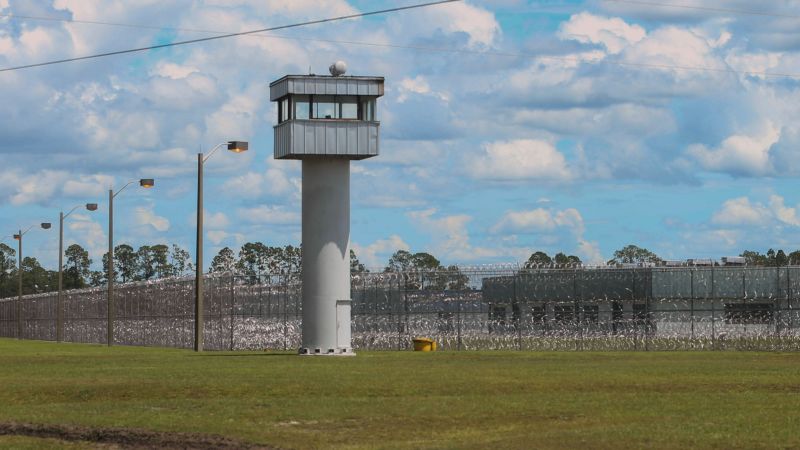
The facility, wrapped in tall, wire fencing, is made up of a number of a squat, single-story buildings. Guard towers are positioned strategically around the campus and, out front, a Humvee is parked next to a white pop-up tent.

Other states have announced similar sites to supplement what the Trump administration has described as limited capacity in immigration detention centers nationwide. “Deportation Depot” is part of that equation and just one part of the Florida governor’s push for an expansion of the state’s detention centers to hold immigrants.

DeSantis is doubling down on his plans to build a third detention site in Florida’s panhandle, which he has called “Panhandle Pokey,” along with another facility at a Florida National Guard training center known as Camp Blanding, roughly 30 miles southwest of Jacksonville.

Other proposed immigration facilities include Indiana’s “Speedway Slammer” and Louisiana’s “Camp 57,” located at the country’s largest maximum-security prison. The Louisiana State Penitentiary, commonly known as Angola, is an 18,000-acre facility situated an hour north of Baton Rouge.

The new detention facilities are emerging as the White House continues to push authorities to make at least 3,000 immigration-related arrests per day as part of the administration’s mass deportation efforts.

Many detainees have so far been sent to Guantanamo Bay or deported to El Salvador’s CECOT mega prison.

Back in Florida, “Deportation Depot” was announced in August just before a federal judge placed a preliminary injunction on “Alligator Alcatraz” that would have effectively shut that site down.

Since a federal appeals court stayed the lower court’s order to force the closure of “Alligator Alcatraz,” the state has said it will continue transporting detainees out of there.

The ruling was a major blow to environmental groups, who filed a federal lawsuit asking a judge to block operations and construction at the site until environmental laws are followed.

The Everglades site had been the subject of intense criticism for its treatment of migrants who had been confined there amid sweltering heat, bug infestations and meager meals, prompting members of Congress and state representatives that witnessed the conditions to demand its immediate closure.

https://www.cnn.com/2025/09/05/us/deportation-depot-florida-open