U.S. Immigration and Customs Enforcement (ICE) began Operation Midway Blitz in Chicago this week, arresting multiple criminal illegal immigrants as Fox News joined agents for an exclusive ride-along.
On Tuesday, ICE agents arrested a Mexican national on a federal criminal arrest warrant for multiple felony reentries into the United States. Fox News learned that the individual had been deported twice to Mexico and returned a third time to the U.S. He is also facing charges for assault in a previous case.
Fox News cameras followed agents as they approached the Mexican national outside his home. The individual tried to enter his car to avoid arrest, forcing ICE agents to break its window and extract him from the vehicle. He then appears to continue resisting arrest.
The Mexican national will face federal criminal prosecution before he is deported, potentially spending time in jail, Fox News learned.
Tag Archives: Chicago
Fox News: DHS launches major operation in Illinois targeting illegal immigrants with criminal records
Problem is, not withstanding DHS’s endless lies to contrary, most of the people rounded up in these sweeps are NOT criminals.
Washington Post: Senators ramp up pressure on Trump to abandon threats to send troops into U.S. cities
A group of Democratic senators is filing a friend of the court brief Tuesday in California Gov. Gavin Newsom’s lawsuit against President Donald Trump, stepping up pressure to keep Trump from overriding Democratic leaders and sending National Guard troops into Democrat-led cities like Chicago.
The 19 senators are asking the U.S. Court of Appeals for the 9th Circuit to overturn a temporary order issued by a three-judge panel in June that found that Trump had the authority to send National Guard troops into Los Angeles this summer over Newsom’s objections. The Democratic senators argue that the issue has gained greater salience since then, as Trump began threatening to go into other states and cities against the wishes of their governors and mayors.
The senators are amplifying Newsom’s argument that the president’s use of the federal troops — at a moment when local law enforcement officials said they did not need federal support — violated the separation of powers doctrine by usurping Congress.
A federal district court judge initially sided with Newsom on June 12. Then, on June 19, the three-judge panel issued their temporary ruling siding with Trump. California is waiting on a final ruling from the appeals court.
Led by California Democratic Sens. Adam Schiff and Alex Padilla, the group includes senators who represent Baltimore, Boston, Chicago, and Portland — all cities that Trump has threatened to send in National Guard troops to “straighten it out” as he ramps up enforcement on crime and immigration. Schiff said in a statement that he hoped the Newsom case would become “the line drawn in the sand to prevent further misuse of our service members on the streets of American cities.”
The senators argue in their brief that by federalizing 4,000 California National Guard troops for domestic law enforcement over Newsom’s objections “without showing a genuine inability to enforce federal laws with the regular forces,” Trump violated the Tenth Amendment’s anti-commandeering mandate and contravened the provisions of the Constitution assigning power over militias to Congress.
“Our concern that President Trump will continue to act in bad faith and abuse his power is borne out by his recent deployment of state militias to Washington, D.C. and his stated intent to deploy state militias elsewhere (like Chicago and Baltimore),” the senators wrote in the brief obtained by The Washington Post that will be filed in court Tuesday. They warned that courts are the last resort to “prevent the President from exceeding his constitutional powers” and that failing to do so could “usher in an era of unprecedented, dangerous executive power.”
In court filings this summer, the administration argued that Trump was compelled to send the National Guard to protect federal personnel and property because numerous “incidents of violence and disorder” posed unacceptable safety risks to personnel who were “supporting the faithful execution of federal immigration laws.” Department of Justice lawyers argued that Trump was within his rights to mobilize the National Guard and Marines “to protect federal agents and property from violent mobs that state and local authorities cannot or choose not to control.”
Before Trump sent National Guard troops into Los Angeles this summer in the midst of protests against his administration’s immigration raids, prior presidents had deployed Guard troops on American soil primarily to assist after natural disasters or to quell unrest.
The senators write that the last instance in which a president federalized the National Guard without consent from the state’s governor is when Alabama Gov. George Wallace (D) ordered the Alabama Highway Patrol to prevent the Rev. Martin Luther King, Rep. John Lewis and others from marching from Selma to Montgomery. President Lyndon B. Johnson intervened to protect the marchers.
Our arguments to the court make clear that Trump’s unprecedented militarization of Los Angeles should not be used as a playbook for terrorizing other cities across America,” Padilla said in a statement.
Last month, the president deployed National Guard troops and federal agents to D.C., arguing that they needed to tackle a “crime emergency” that local officials say does not exist. D.C. Attorney General Brian Schwalb, a Democrat, last week sued the Trump administration, seeking to force it to withdraw troops from the city.
In recent days, Trump has escalated his warnings to intervene in Chicago, posting on his social media site that the city is “about to find out why it’s called the Department of WAR,” a reference to the Defense Department.
Illinois Gov. JB Pritzker (D) said on social media Monday that Trump’s threats were not “about fighting crime,” which would require “support and coordination” from the administration that he had not yet seen.
The Department of Homeland Security announced Monday that it had launched an operation to target immigrants in Chicago as the president vowed a broader crackdown on violent crime. A spokesperson for Pritzker said Monday that the governor’s office has not received any formal communication from the Trump administration or information about its plans.
Reuters: Trump administration says it launched ‘Operation Midway Blitz’ in Chicago
- DHS says operation targets ‘criminal illegal aliens’ in Chicago
- Illinois governor say no advance notice or coordination provided
- Critics decry ‘Operation Midway Blitz’ as political theater
- Local officials say ICE sweep terrorizes Latino communities
After weeks of vowing to deploy National Guard troops to fight crime in Chicago, the Trump administration said on Monday it had launched a deportation crackdown in Illinois targeting hardened criminals among immigrants in the U.S. without legal status.
The U.S. Department of Homeland Security said in an online statement that “Operation Midway Blitz” was being conducted by the Immigration and Customs Enforcement agency, but details about its scope and nature were not immediately made clear.
It remained to be seen whether President Donald Trump would send National Guard soldiers into Chicago to accompany ICE and other federal law enforcement officers, as he has in and around Los Angeles and the District of Columbia.
Illinois Governor JB Pritzker and Chicago Mayor Brandon Johnson, both Democrats, each said their offices had received no official notice from federal authorities about the operation, which they decried as a political stunt designed to intimidate.
Trump has been ramping up his rhetoric about expanding federal law enforcement and National Guard presence in Democratic-led cities and states, casting the use of presidential power as an urgent effort to confront crime even as local officials cite declines in homicides and other violent offenses.
DHS said its latest ICE operation was necessary because of city and state “sanctuary” laws that limit cooperation with federal immigration authorities.
Assistant DHS Secretary Tricia McLaughlin said the crackdown was aimed at convicted gang members, rapists, kidnappers and drug traffickers who she called “the worst of the worst criminal illegal aliens in Chicago.”
The press release cited 11 cases of immigrants in the U.S. illegally, most from Mexico and Venezuela, who DHS said had records of arrest or convictions for serious crimes and were released from local jails rather than turned over to federal immigration officials.
City Alderwoman Jeylu Gutierrez, who represents the predominantly Hispanic 14th Ward on Chicago’s southwest side, said at least five members of her community had been detained in what she called a “federal assault.”
Among those arrested, Gutierrez said, was a flower vendor taken into custody on the job, while others were detained as they waited for a bus or walked on the sidewalk.
‘THIS ISN’T ABOUT FIGHTING CRIME’
“This was never about arresting the worst of the worst, this is about terrorizing our communities,” Gutierrez, a Mexican immigrant, told a press conference.
Pritzker, widely seen as a potential 2028 candidate for the White House, also disputed the crime-fighting rationale that Trump voiced last Tuesday when he said he would send National Guard troops to Chicago, the nation’s third most populous city and a Democratic stronghold.
“This isn’t about fighting crime,” Pritzker said on social media platform X on Monday. “That requires support and coordination — yet we’ve experienced nothing like that over the past several weeks.”
Pritzker has suggested Trump’s National Guard deployments might be a dress rehearsal for using the military to manipulate the 2026 midterm congressional elections.
Johnson said he was concerned about “potential militarized immigration enforcement without due process,” citing “ICE’s track record of detaining and deporting American citizens and violating the human rights of hundreds of detainees.”
In a post on Truth Social on Monday, Trump cited recent murders and shootings in Chicago and blamed Pritzker for making no requests for assistance from the Trump administration.
“I want to help the people of Chicago, not hurt them,” Trump wrote. “Only the Criminals will be hurt! We can move fast and stop this madness.”
In a separate post on Saturday, Trump posted a meme based on the 1979 Vietnam War movie “Apocalypse Now” that showed an image of the Chicago skyline with flames and helicopters, reminiscent of the deadly helicopter attack on a Vietnamese village in the film.
The Trump administration launched a parallel immigration enforcement operation in Boston in recent days, an ICE official confirmed on Monday.
ICE also said on Monday that its Houston-based agents had arrested 822 “criminal aliens, transnational gang members, child predators, foreign fugitives and other egregious offenders” during a week-long operation last month in southeastern Texas.
Previously, DHS said ICE had arrested nearly 1,500 immigration offenders during a month-long enforcement surge in Massachusetts in May and early June.
The latest ICE operation in Chicago was announced the same day that the U.S. Supreme Court issued a 6-3 decision allowing federal agents in Southern California to proceed with immigration raids that detain people on the basis of their race, ethnicity, language or accent, even without “reasonable suspicion” that they are in the country illegally.

NBC News: New tariff rules bring ‘maximum chaos’ as surprise charges hit consumers
The bills are sudden and jarring: $1,400 for a computer part from Germany, $620 for an aluminum case from Sweden and $1,041 for handbags from Spain.
Some U.S. shoppers say they are being hit with surprise charges from international shipping carriers as the exemption on import duties for items under $800 expires as a part of President Donald Trump’s tariff push.
That’s leading to some frustration and confusion as shoppers and shippers both try to navigate a new reality for anybody ordering goods from abroad.
“It’s maximum chaos,” said Nick Baker, co-lead of the trade and customs practice at Kroll, a firm that advises freight carriers.
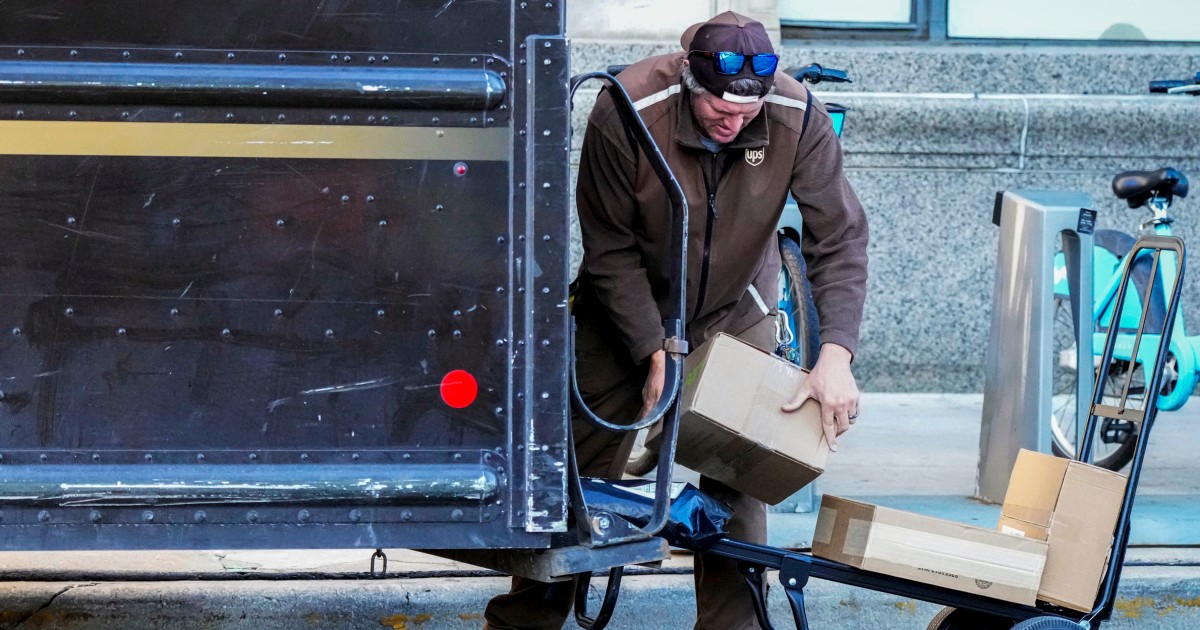
Thomas Andrews, who runs a business in upstate New York restoring vintage computers from the 1980s and 1990s, said he was shocked to receive a tariff bill from UPS for approximately $1,400 on a part worth $750. He said he assumed there must have been a mistake.
“That’s extortion,” Andrews said.
Late Friday, a representative for UPS told Andrews that the initial charge was indeed incorrect: The tariff bill should have only been for about $110. But it was too late: Andrews had already refused shipment to avoid paying the charge. Soon after learning about the corrected charge, he realized UPS had already begun sending the item back to Germany.
The final annoyance, Andrews said: He’s being charged for the return shipping — about $50.
In a statement, UPS said it has solutions available to merchants designed to navigate the new environment. It did not address the customer-billing situation.
On Aug. 29, for the first time in nearly a century, small-dollar items coming into the U.S. — also called de minimis goods — began facing import duties. That means even small, personal orders now face the sizable tariffs placed on U.S. trading partners. While a recent ruling by the U.S. Court of Appeals for the Federal Circuit found many of Trump’s duties unconstitutional, they remain in effect while Trump appeals the case to the Supreme Court.
To comply with the new de minimis rules, a wave of countries have halted shipments to the U.S. That’s caused postal traffic into the U.S. to decline by some 80%, according to a United Nations agency.
But many orders are still flowing. And since the new de minimis rule began taking effect, social media platforms have been filled with accounts of U.S. customers receiving shock bills from major shippers like DHL, FedEx and UPS, having received no notice about the charges from the foreign merchant they’d ordered from.
The shippers, in turn, are being inundated with messages from customers disputing the charges, along with return-to-sender requests as the customers refuse shipments to avoid having to pay the bills.
A representative for DHL said the firm “is committed to supporting customers through the recent tariff changes and ensuring their shipments are managed efficiently.”
“We encourage customers to take note of the shipping policies of the brands they shop with and to also remember that tariffs are payable to the U.S. government,” it said.
The Trump administration has heralded the billions in revenues the tariffs are bringing in — and in the case of the new de minimis rule, argued the change is essential to halting the flow of small-sized illicit drug packages and drug ingredients. In a statement posted the day the new de minimis rules took effect, U.S. Customs and Border Protection said the logistics industry “has already adapted to the changes with minimal interruption.”
“This change has been months in the making, and we are fully prepared to implement it,” said Susan S. Thomas, acting executive assistant commissioner for CBP’s Office of Trade. “Foreign carriers and postal operators were given clear timelines, detailed guidance, and multiple options to comply. The only thing ending on August 29 is the pathway that has been used by criminals to exploit America’s borders.”
Baker said foreign merchants are obligated to provide information to the shipper about the classification of the item, which is key to the tariff calculation — but from a regulatory perspective, the customer, as the importer of record, is ultimately responsible for the accuracy of that information.
But many people are still getting caught off guard.
After receiving a tariff bill for $620 on a $300 aluminum computer case from Sweden, Robert Wang decided to turn the shipment away.
A software engineer in the San Francisco Bay Area, Wang said he placed his order Aug. 22 with Louqe, a high-end Swedish merchant. More than a week later, he received notice from UPS about the bill.
“Confusion transitioned into a late-night panic,” Wang said, as he frantically researched the situation. Eventually UPS confirmed he’d been charged the 200% tariff Trump has slapped on certain aluminum goods.
Wang said he tried to reach out to Louqe about the charge, but did not hear back. The company did not respond to a request for comment from NBC News.
Baker said many foreign businesses that rely on U.S. customers now face the dilemma of eating the tariff cost — assuming they are properly accounting for it in the first place — or passing it on to their customers, which could scare off business. Many merchants abroad have posted to social media to alert U.S. customers that they are suspending shipments there.
Some U.S. small businesses are also paying a price. A day after receiving a shipment from Spain for handbags he said were worth about $600, Herm Narciso said he and his wife, who run a brick-and-mortar shop in Dunedin, Florida, that resells goods from Europe, got a tariff invoice for $1,041.44 from DHL.
“We can’t understand how it’s possible to assess us with that level of tariffs,” Narciso said.
They said that they plan to file a dispute, but that the response could take two to four weeks. Narciso is worried their shop won’t survive the recent changes if they start getting similar bills going forward.
“This last quarter is probably going to tank us,” Narciso said. “The margins on this type of business are slim to begin with.”
He added: “It just doesn’t feel like the American way to me.”

https://www.nbcnews.com/business/consumer/surprise-tariff-bills-de-minimis-rcna229375
Washington Post: Military-related work absences at a 19-year high amid deployments
The number of Americans missing work for National Guard deployments or other military or civic duty is at a 19-year high, adding disruption to a labor market that’s already under strain.
Between January and August, workers reported 90,000 instances of people missing at least a week of work because of military deployments, jury duty or other civil service, according to data from the Bureau of Labor Statistics. That is more than double the number of similar absences in the same eight-month period last year, and the highest level since 2006, when President George W. Bush deployed the National Guard to Iraq, Afghanistan and the Southwest U.S. border in large numbers.
The absences are due at least in part to a growing military presence in American cities. Since taking office in January, President Donald Trump has sent thousands of National Guard service members — civilians, many with full-time jobs — to Los Angeles and Washington, D.C. He has suggested expansions of those efforts to at least seven more cities, including Chicago, New York, Baltimore and New Orleans, and called for the creation of a new military unit that can quickly mobilize anywhere in the country.
The ramp-up is happening at a vulnerable time for the labor market. Job openings have dropped in recent months, layoffs are picking up and businesses are slow to hire. Companies added just 22,000 new jobs in August, well below economists’ expectations, while the unemployment rate edged up to 4.3 percent.
Military-related absences so far make up just a sliver of overall workplace disruptions. In August, for example, more than twice as many people reported missing work because of labor disputes, and seven times as many said they were out because of bad weather. Economists also caution that the data are calculated using a small subset of responses, which can distort the numbers. Even so, with the president considering expanding National Guard presence to other parts of the country, they warn the burden on workers and employers could deepen.
“Uncertainty over whether you or your employees might be called to National Guard duty and how long that deployment might last is just adding to the chaos” for families and businesses, said Michael Makowsky, an economist at Clemson University whose work focuses on law enforcement. “Anything that makes it harder to make a plan is generally bad for the economy.”
The White House says its efforts are improving the U.S. economy by combating crime and unrest in major cities.
The “President has rightfully deployed the National Guard to cities like Los Angeles, which was ravaged by violent riots … and Washington, DC, while strengthening small businesses and revitalizing our economy,” spokeswoman Anna Kelly said in a statement. “These deployments saved small businesses from further destruction and preserved great American jobs.”
Although military-related work absences tend to fluctuate throughout the year, spiking during hurricane season, for example, they have been consistently higher than in 2024 almost every month this year.
“You can see an elevation in the data, that’s for darn sure,” said William Beach, who headed the BLS during Trump’s first term and is now a senior fellow at the Economic Policy Innovation Center. “It’s more than likely because of a military influence — an increase in reserve duty or an increase in military service.”
The data come from the Current Population Survey, a monthly federal survey that asks Americans whether they missed work in a given week each month, and why. Civil or military duty-related absences include jury duty, Armed Forces reserve duty, National Guard duty or “a similar obligation,” according to the BLS.
National Guard recruitment has recently picked up after years of decline. In an executive order last month, Trump called for the creation of an online job portal to encourage more people to apply to join federal law enforcement efforts, saying they are needed in “cities where public safety and order has been lost.”
Deployment orders are expected to accelerate as the president leans on the National Guard to crack down on what he calls rampant crime in U.S. cities. Although a federal judge last week ruled that the Trump administration’s use of troops to carry out domestic law enforcement in Los Angeles was illegal, he did not require that the administration withdraw the 300 service members who are still in the city.
The Trump administration has appealed that ruling and suggested that it will not hamper plans to send troops to other cities. The White House is also expected to extend the National Guard’s deployment in D.C. — where it has faced criticism for relying on troops for landscaping and trash removal — from mid-September to Dec. 31.
For those who are being deployed, assignments require stepping away from duties at their day jobs. Despite federal protections, some National Guard members say they have trouble finding or keeping work, especially in a labor market weighed down by uncertainty.
“Companies say they’re veteran-friendly until it’s time for you to deploy or there’s a natural disaster, and they realize your time out of the office is going to cost them productivity or they’re going to have to hire someone to cover for you,” said Charlie Elison, a noncommissioned officer in the Army National Guard who also works a day job as an executive director for the city of Philadelphia.
Elison, who until earlier this year worked for U.S. Citizenship and Immigration Services, said his career options have been “very limited” because of growing military responsibilities. He spends about 90 days a year out of the office in uniform, and he usually does a year-long deployment overseas every four years. Adding crime-related domestic duties to that list, he said, could add new challenges for troops and employers.
“There’s this unfunded mandate across our country, where Guard and reserve members are asked to do more and more every year,” he said. “And there’s this unfunded requirement for our civilian employers to shoulder that burden.”
Slingshot News: ‘You Don’t Know This’: Trump Makes Freudian Slip, Infers His GOP Underlings Are Dumb During White House Dinner Event
For once, Trump was right!
Washington Post: ICE begins immigration crackdown in Massachusetts, DHS says
The Trump administration has launched an Immigration and Customs Enforcement operation in Massachusetts, saying it would target what it called “the worst of the worst criminal illegal aliens” in the state.
The Department of Homeland Security provided few details on the scale of the latest operation, called Patriot 2.0. But in a statement Saturday, the department said that it followed “the success of Operation Patriot in May.” The earlier ICE raids resulted in nearly 1,500 arrests across Massachusetts, including dozens of migrant workers on Martha’s Vineyard.
“If you come to our country illegally and break our laws, we will hunt you down, arrest you, deport you, and you will never return,” the statement said.
The Massachusetts operation comes as the Trump administration has signaled it is preparing to deploy National Guard troops to Chicago — a move that local leaders have strongly opposed.
On Thursday, the administration sued Boston and its leaders for allegedly refusing to cooperate with immigration authorities, adding to a string of similar lawsuits against so-called “sanctuary cities.”
Boston Mayor Michelle Wu has defended the city’s laws, describing the lawsuit Thursday as an “unconstitutional attack on our city.” The mayor’s office did not immediately respond to a request for comment on the ICE operation Saturday.
In its statement Saturday, DHS said “sanctuary policies like those pushed by Mayor Wu not only attract and harbor criminals but also place these public safety threats above the interests of law-abiding American citizens.”
Trump’s border czar Tom Homan vowed last week to increase immigration enforcement across sanctuary cities, saying the administration was planning to “flood the zone” with thousands of agents.
Department of Homeland Security Secretary Kristi L. Noem has repeatedly said that immigration officers are arresting the “worst of the worst.” But a Washington Post analysis of ICE data from June found the administration is increasingly targeting unauthorized immigrants with no criminal record as it ramps up arrests.
Federal authorities said the Massachusetts arrests in May included an alleged MS-13 gang member and someone described as a “child sex offender.” But according to community members, most of the migrants had no criminal record and were stopped on their way to work.
Sipa USA: Thousands in downtown Chicago to oppose President Trumps threat to deploy troops
POLITICO: Duckworth says DHS ‘fled the base’ during visit by Democrats
Sen. Tammy Duckworth said Homeland Security officials “locked the doors” of the Great Lakes Naval Base.
Sen. Tammy Duckworth (D-Ill.) said federal officials disappeared from a Navy base near Chicago on Friday after Democrats announced they would tour the facility ahead of the arrival of immigration officers.
In an interview with host Margaret Brennan on CBS’ “Face the Nation,” Duckworth said when she joined fellow Illinois Democrats Sen. Dick Durbin and Rep. Brad Schneider for a tour of the Naval Station Great Lakes, Department of Homeland Security officials had given staff the day off, “locked the doors and left the base.”
“Basically, they fled the base,” Duckworth said. Naval Station Great Lakes, which opened in 1911, is the site for boot camp for Naval trainees.
Officials last week said that up to 300 ICE agents would be operating out of the Great Lakes Naval Base as President Donald Trump ramps up his efforts against Democratic-controlled sanctuary cities. Trump also said the administration will deploy the National Guard to the city, drawing outrage from Democrats including Illinois Gov. JB Pritzker and Chicago Mayor Brandon Johnson.
Ahead of the lawmakers’ trip to the base, Duckworth said, she and her colleagues asked DHS if they could come tour the facility to have a “better understanding of what your operations are.”
DHS officials, she said, replied no.
“This is not the action of someone that’s doing something legal or that they’re- that they’re proud of,” said Duckworth.
“We certainly have sent the administration multiple inquiries about what they are planning on doing. Who are they bringing into Chicago? Are they planning to bring the National Guard in? They’ve none of that. They’ve not even reached out to local law enforcement to try to coordinate,” she added. “And we’ve not gotten any communications or feedback from the administration, whatsoever.”
Navy officials that were on the base during the Democrats’ tour told them that the assistance they’ve been requested to provide so far is only office space for ICE, Duckworth added.
While it is unclear when ICE officials or the National Guard will be sent to Chicago, Trump on Saturday said his administration will go to “WAR” with the city of Chicago.
“Chicago [is] about to find out why it’s called the Department of WAR,” Trump said in a post on Truth Social, referring to the Department of Defense’s planned name change.
Illinois officials quickly responded to the post, calling the president a “tyrant” and a “declaration of war.”
“I take what the President of the United States says very seriously, because that is the respect you have to give to the office,” Duckworth said on Sunday. “And if that’s what he’s declaring, then let me make it clear, it would be an illegal order to declare war on a major city, any city within the United States, by the President of the United States.
https://www.politico.com/news/2025/09/07/duckworth-dhs-fled-naval-base-visit-00549536