‘Watch Him With The Hands’: Trump Tests The Limits Of His Hypocrisy, Takes Jab At Gavin Newsom’s Body Language In Tone-Deaf Rant
Reply
A federal judge who ruled last week that the Trump administration broke federal law by sending National Guard troops to the Los Angeles area said Tuesday he will not immediately consider a request to bar the ongoing use of 300 Guard troops.
In a court order, Senior District Judge Charles Breyer in San Francisco said he was not sure he had the authority to consider California’s motion for a preliminary injunction blocking the administration’s further deployment of state National Guard troops. That’s because the case is on appeal before the 9th U.S. Circuit Court of Appeals, the judge said.
Breyer indefinitely paused all proceedings related to the state’s motion, though he suggested California officials could file the request with the 9th Circuit.
An email to the California attorney general’s office late Tuesday was not immediately returned.
Breyer’s Sept. 2 ruling took on heightened importance amid President Donald Trump’s talk of National Guard deployments to other Democratic-led cities like Chicago, Baltimore and New York. Trump has already deployed the Guard as part of his unprecedented law enforcement takeover targeting crime, immigration and homelessness in Washington, where he has direct legal control over the District of Columbia National Guard.
The Trump administration sent troops to the Los Angeles area in early June after days of protests over immigration raids.
Breyer ruled the administration “willfully” broke federal law, saying the government knew “they were ordering troops to execute domestic law beyond their usual authority” while using “armed soldiers ( whose identity was often obscured by protective armor) and military vehicles to set up protective perimeters and traffic blockades, engage in crowd control, and otherwise demonstrate a military presence in and around Los Angeles.”
He did not require the 300 remaining soldiers to leave but pointed out that they received improper training and ordered the administration to stop using them “to execute the laws.” The order that applies only to California was supposed to take effect Sept. 12, but the 9th Circuit has put it on hold for now.
California later sought a preliminary injunction blocking an Aug. 5 order from the administration extending the deployment of the 300 troops for another 90 days.
The further deployment “would ensure that California’s residents will remain under a form of military occupation until early November,” including while voting on Nov. 4 on whether to adopt new congressional maps — “an election with national attention and significance,” state officials said in a court filing.
https://apnews.com/article/trump-california-national-guard-troops-08f8a71ca5834b8f32ce4c3ee944abca
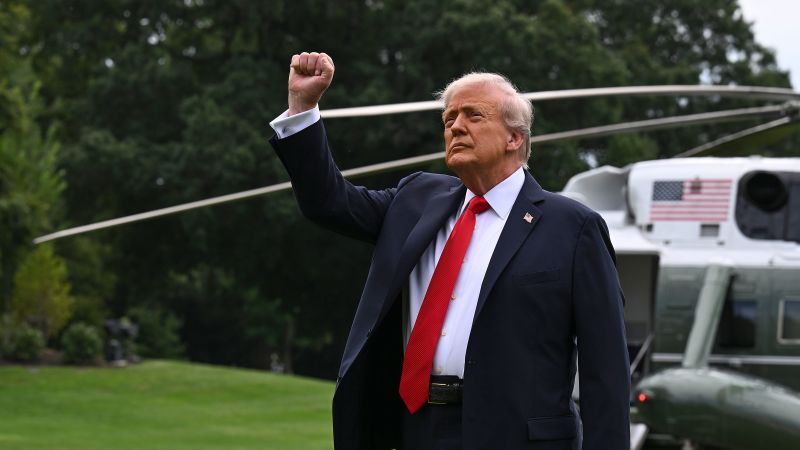
Having rebranded the Department of Defense as the Department of War, the president is going on offense with the US military.
Donald Trump has foisted National Guard troops on Washington, DC, and Los Angeles. Other cities are on edge, particularly after he posted an apparently artificially generated image of himself dressed up like Robert Duvall’s surfing cavalry commander in “Apocalypse Now,” a meme that seemed to suggest he was threatening war on the city of Chicago.
Trump later clarified that the US would not go to war on Chicago, but he’s clearly comfortable joking about it. And he’s of the opinion his authority over the military is absolute.
“Not that I don’t have the right to do anything I want to do. I’m the president of the United States,” he said at a Cabinet meeting in August, when he was asked about the prospect of Chicagoans engaging in nonviolent resistance against the US military.
He’s reorienting the US military to focus on drug traffickers as terrorists and told Congress to expect more military strikes after the US destroyed a boat in the Caribbean last week.
All of this projects the kind of strongman decisiveness Trump admires.
A lot of it might also be illegal.
A ‘violation of the Posse Comitatus Act’
US District Judge Charles Breyer ruled this month that Trump and Defense Secretary Pete Hegseth committed a “a serious violation of the Posse Comitatus Act” when they deployed federalized troops to Los Angeles over the objections of the state’s governor and mayor.
The Posse Comitatus Act was passed by Congress in 1878 as Southern states worked to oust federal troops and end Reconstruction. Questions over how and whether troops can be used to enforce laws goes back to the pre-Civil War period, when federal marshals sought help from citizens and militiamen in recovering fugitive slaves and putting down the protests of abolitionists, according to the Congressional Research Service.
It is not clear why Trump has not yet, as he has promised, called up the National Guard to patrol in Chicago, but he may be waiting for the Supreme Court, which has been extremely deferential to his claims of authority, to weigh in on a preliminary basis.
Trump has more authority to deploy the military inside Washington, DC, which the Constitution says Congress controls. But Congress has ceded some authority to locally elected officials in recent decades. DC’s Attorney General Brian Schwalb has sued the Trump administration over the deployment.
Testing the War Powers Act
Trump’s strike on a boat in the Caribbean is also on murky legal ground.
After Vietnam, Congress overrode Richard Nixon’s veto to pass another law, the War Powers Act of 1973, which requires presidents to notify Congress within 48 hours of a military strike. And Trump did do that, at least his third such notification since taking office in January. Trump also sent notifications to Congress about his strike against an Iranian nuclear facility and Houthi rebels who were attacking shipping routes.
The Reiss Center at New York University maintains a database of War Powers Act notifications going back to the 1970s.
Cartels as terrorist organizations
In the notification about the Caribbean strike, Trump’s administration argued that it has declared drug cartels are terrorist organizations and that he operated within his constitutional authority to protect the country when he ordered the strike.
Strikes against terrorists have been authorized under the catchall vote that authorized the use of military force against Islamic terrorists after the 9/11 terror attacks.
But Congress, which the Constitution puts in charge of declaring war, has not authorized the use of military force against Venezuelan drug cartels.
Lack of explanation from the White House
Over the weekend, CNN’s Katie Bo Lillis, Natasha Bertrand and Zachary Cohen reported that the Pentagon abruptly canceled classified briefings to key House and Senate committees with oversight of the military, which means lawmaker have been unable to get the legal justification for the strike.
Many Americans might celebrate the idea of a military strike to take out drug dealers, and the administration is clearly primed to lean on the idea that the cartels are terrorists.
Here’s a key quote from CNN’s report:
“The strike was the obvious result of designating them a terrorist organization,” said one person familiar with the Pentagon’s thinking. “If there was a boat full of al Qaeda fighters smuggling explosives towards the US, would anyone even ask this question?”
Few details
It’s not yet clear which military unit was responsible for the strike, what intelligence suggested there were drugs onboard, who was on the boat or what the boat was carrying.
“The attack on the smuggling vessel in the Caribbean was so extraordinary because there was no reported attempt to stop the boat or detain its crew,” wrote Brian Finucane, a former State Department legal advisor now at International Crisis Group for the website Just Security. “Instead, the use of lethal force was used in the first resort.”
Secretary of State Marco Rubio said the US could have interdicted the boat and made a legal case against those onboard, but it decided instead to blow up the boat. The notice to Congress makes clear the administration will continue with other strikes.
War crime? Vance doesn’t ‘give a sh*t’
“The decision to blow up the boat and kill everyone onboard when interdiction and detention was a clearly available option is manifestly illegal and immoral,” Oona Hathaway, a law professor and director of the Center for Global Legal Challenges at Yale Law School, told me in an email.
The view of the administration could be best summarized by Vice President JD Vance stating that using the military to go after cartels is “the highest and best use of our military.”
When a user on X replied that the extrajudicial killing of civilians without presenting evidence is, by definition, a war crime, Vance, himself a Yale-educated lawyer, said this:
“I don’t give a sh*t what you call it.”
That’s not an acceptable response even for some Republicans.
“Did he ever read To Kill a Mockingbird?” wrote Sen. Rand Paul of Kentucky in his own post on X. “Did he ever wonder what might happen if the accused were immediately executed without trial or representation?? What a despicable and thoughtless sentiment it is to glorify killing someone without a trial.”
Congress has power it likely won’t use
Congress has the power to stop Trump’s campaign against boats in the Caribbean. The War Powers Act allows lawmakers in the House and Senate to demand the president seek approval before continuing a campaign longer than 60 days. But that seems unlikely to occur at the moment.
After the strike against Iran earlier this year, Paul was the only Republican senator to side with Democrats and demand Trump seek approval for any future Iran strikes.
During his first term, seven Republicans voted with Senate Democrats to hem in Trump’s ability to strike against Iran after he ordered the killing of Iranian commander Qasem Soleimani. But there were not enough votes to overcome Trump’s veto that year.
Trump’s authority to use military force without congressional approval of the Caribbean operation technically expires after 60 days after he reports on the use of force, although he can extend it by an additional 30 days, although he could also declare a new operation is underway.
The use of these kinds of tactics has likely been in the works for some time.
In February, Trump designated drug cartels, including Venezuela’s Tren de Aragua, as foreign terror organizations. In April, CNN reported the CIA was reviewing whether it had authority to use lethal force against drug cartels.
But the military strike against the alleged cartel boat happened as part of a broader campaign against Venezuela, including positioning US ships, aircraft and a submarine in the Caribbean, according to a CNN report.
Trump may have campaigned as a president who would end wars, but he’s governing like a president who is very comfortable using his military.
https://www.cnn.com/2025/09/10/politics/venezuela-trump-military-strike-war-powers-explainer
A group of Democratic senators is filing a friend of the court brief Tuesday in California Gov. Gavin Newsom’s lawsuit against President Donald Trump, stepping up pressure to keep Trump from overriding Democratic leaders and sending National Guard troops into Democrat-led cities like Chicago.
The 19 senators are asking the U.S. Court of Appeals for the 9th Circuit to overturn a temporary order issued by a three-judge panel in June that found that Trump had the authority to send National Guard troops into Los Angeles this summer over Newsom’s objections. The Democratic senators argue that the issue has gained greater salience since then, as Trump began threatening to go into other states and cities against the wishes of their governors and mayors.
The senators are amplifying Newsom’s argument that the president’s use of the federal troops — at a moment when local law enforcement officials said they did not need federal support — violated the separation of powers doctrine by usurping Congress.
A federal district court judge initially sided with Newsom on June 12. Then, on June 19, the three-judge panel issued their temporary ruling siding with Trump. California is waiting on a final ruling from the appeals court.
Led by California Democratic Sens. Adam Schiff and Alex Padilla, the group includes senators who represent Baltimore, Boston, Chicago, and Portland — all cities that Trump has threatened to send in National Guard troops to “straighten it out” as he ramps up enforcement on crime and immigration. Schiff said in a statement that he hoped the Newsom case would become “the line drawn in the sand to prevent further misuse of our service members on the streets of American cities.”
The senators argue in their brief that by federalizing 4,000 California National Guard troops for domestic law enforcement over Newsom’s objections “without showing a genuine inability to enforce federal laws with the regular forces,” Trump violated the Tenth Amendment’s anti-commandeering mandate and contravened the provisions of the Constitution assigning power over militias to Congress.
“Our concern that President Trump will continue to act in bad faith and abuse his power is borne out by his recent deployment of state militias to Washington, D.C. and his stated intent to deploy state militias elsewhere (like Chicago and Baltimore),” the senators wrote in the brief obtained by The Washington Post that will be filed in court Tuesday. They warned that courts are the last resort to “prevent the President from exceeding his constitutional powers” and that failing to do so could “usher in an era of unprecedented, dangerous executive power.”
In court filings this summer, the administration argued that Trump was compelled to send the National Guard to protect federal personnel and property because numerous “incidents of violence and disorder” posed unacceptable safety risks to personnel who were “supporting the faithful execution of federal immigration laws.” Department of Justice lawyers argued that Trump was within his rights to mobilize the National Guard and Marines “to protect federal agents and property from violent mobs that state and local authorities cannot or choose not to control.”
Before Trump sent National Guard troops into Los Angeles this summer in the midst of protests against his administration’s immigration raids, prior presidents had deployed Guard troops on American soil primarily to assist after natural disasters or to quell unrest.
The senators write that the last instance in which a president federalized the National Guard without consent from the state’s governor is when Alabama Gov. George Wallace (D) ordered the Alabama Highway Patrol to prevent the Rev. Martin Luther King, Rep. John Lewis and others from marching from Selma to Montgomery. President Lyndon B. Johnson intervened to protect the marchers.
Our arguments to the court make clear that Trump’s unprecedented militarization of Los Angeles should not be used as a playbook for terrorizing other cities across America,” Padilla said in a statement.
Last month, the president deployed National Guard troops and federal agents to D.C., arguing that they needed to tackle a “crime emergency” that local officials say does not exist. D.C. Attorney General Brian Schwalb, a Democrat, last week sued the Trump administration, seeking to force it to withdraw troops from the city.
In recent days, Trump has escalated his warnings to intervene in Chicago, posting on his social media site that the city is “about to find out why it’s called the Department of WAR,” a reference to the Defense Department.
Illinois Gov. JB Pritzker (D) said on social media Monday that Trump’s threats were not “about fighting crime,” which would require “support and coordination” from the administration that he had not yet seen.
The Department of Homeland Security announced Monday that it had launched an operation to target immigrants in Chicago as the president vowed a broader crackdown on violent crime. A spokesperson for Pritzker said Monday that the governor’s office has not received any formal communication from the Trump administration or information about its plans.
Supreme Court Justice Sonia Sotomayor blasted the Trump administration’s operation of the Los Angeles immigration raids, vowing not to stand idly by while the United States’ “constitutional freedoms are lost.”
On Sept. 8, the Supreme Court lifted a restraining order from a federal judge in LA who had restricted Immigration and Customs Enforcement (ICE) agents from conducting stops without reasonable suspicion.
In July, US District Judge Maame Frimpong of the Central District of California said the government can’t rely solely on the person’s race, the language they speak, the work they perform, and whether they’re at a particular location, such as a pickup site for day laborers.
However, the Sept. 8 reversal by the Supreme Court’s mostly conservative majority gave the Trump administration another victory, as Sotomayor condemned the vote.
“That decision is yet another grave misuse of our emergency docket,” Sotomayor wrote in a blistering, 21-page dissent on Sept. 8. “We should not have to live in a country where the Government can seize anyone who looks Latino, speaks Spanish, and appears to work a low-wage job.”
Sotomayor called the order “unconscionably irreconcilable with our nation’s constitutional guarantees.”
The justice, an Obama appointee, ripped her high court conservative colleagues and the government over the ruling. Sotomayor declared that all Latinos, whether they are U.S. citizens or not, “who work low-wage jobs are fair game to be seized at any time, taken away from work, and held until they provide proof of their legal status to the agents’ satisfaction.”oss California by broadening its scope from those only with criminal records to anyone in the United States without proper authorization. The crackdown ignited protests, prompting Trump to call in the National Guard and eventually the Marines to diffuse the outrage.
In June, the Trump administration ramped up immigration raids across California by broadening its scope from those only with criminal records to anyone in the United States without proper authorization. The crackdown ignited protests, prompting Trump to call in the National Guard and eventually the Marines to diffuse the outrage.
Sotomayor takes exception to Kavanaugh’s explanation
Justice Brett Kavanaugh, who agreed with the Trump administration, said in his concurrence on Sept. 8 that the District Court overreached in limiting ICE’s authority to briefly stop people and ask them about their immigration status.
“To be clear, apparent ethnicity alone cannot furnish reasonable suspicion; under this Court’s case law regarding immigration stops, however, it can be a ‘relevant factor’ when considered along with other salient factors,” Kavanaugh said.
He added, “Immigration stops based on reasonable suspicion of illegal presence have been an important component of US immigration enforcement for decades, across several presidential administrations.”Despite fears, still looking for work:
Sotomayor took exception to Kavanaugh’s comments. She said ICE agents are not simply just questioning people, they are seizing people by using firearms and physical violence.
Sotomayor added that the Fourth Amendment, which is meant to protect “every individual’s constitutional right,” from search and seizure, might be in jeopardy.
“The Fourth Amendment protects every individual’s constitutional right to be ‘free from arbitrary interference by law officers,'” Sotomayor said. “After today, that may no longer be true for those who happen to look a certain way, speak a certain way, and appear to work a certain type of legitimate job that pays very little.”
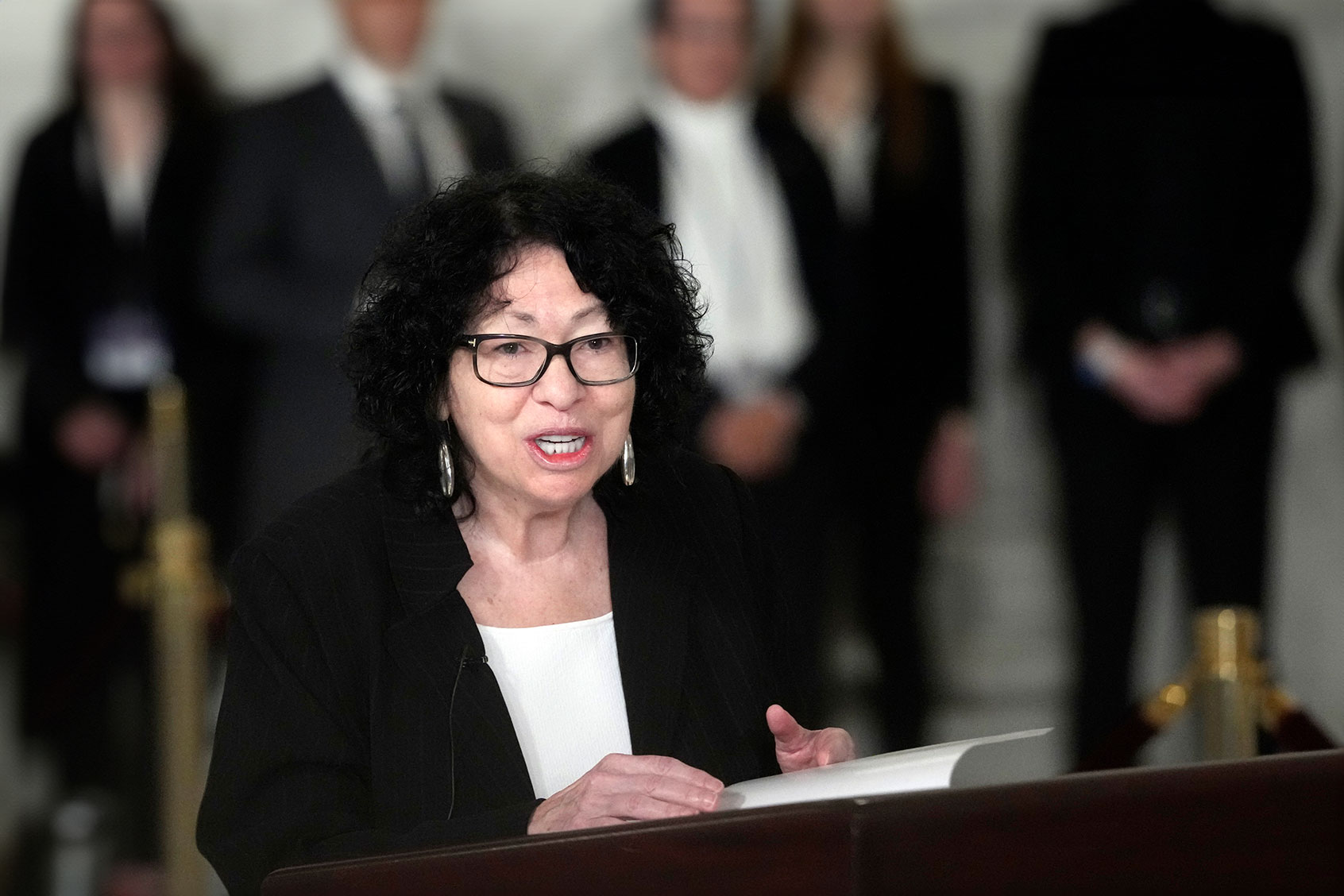
Supreme Court Justice Sonia Sotomayor blasted the Supreme Court’s decision to allow wide-scale ICE raids and immigration stops in Los Angeles to continue on Monday. In a scathing dissent, she said the court was giving the Department of Homeland Security a green light to “seize anyone who looks Latino.”
The Monday ruling lifted an injunction on “roving” ICE actions in Southern California. That order from a lower court judge barred agents from carrying out detentions based on ethnicity, languages being spoken, employment or location.
While the Supreme Court’s ruling was unsigned, it appeared to be supported along partisan lines as all three liberals dissented. Writing for the liberal justices, Sotomayor called the order “unconscionable” and said it made Latinos throughout the region “fair game.”
“We should not have to live in a country where the Government can seize anyone who looks Latino, speaks Spanish, and appears to work a low-wage job,” Sotomayor wrote.
Justice Brett Kavanaugh, concurring with the unnamed majority, said ethnicity was a “a ‘relevant factor’” for ICE agents to consider. He added that “many” undocumented immigrants in the Los Angeles area “do not speak much English,” and work low-wage, manual labor jobs.
“Under this Court’s precedents, not mention common sense, those circumstances taken together can constitute at least reasonable suspicion of illegal presence in the United States,” Kavanaugh wrote.
In her dissent, Sotomayor raised concerns about how the ruling could impact constitutional protections against unreasonable search and seizure.
“The Fourth Amendment protects every individual’s constitutional right to be free from arbitrary interference by law officers,” she wrote. “After today, that may no longer be true for those who happen to look a certain way, speak a certain way, and appear to work a certain type of legitimate job that pays very little.”
https://www.salon.com/2025/09/08/sotomayor-says-scotus-ruling-lets-ice-seize-anyone-who-looks-latino
The Trump administration is vowing to “FLOOD THE ZONE” after the Supreme Court opened the door for federal law enforcement officers to roam the streets of Los Angeles to make immigration arrests based on racially profiling suspects.
A 6-3 decision from the nation’s high court Monday overturned an injunction that blocked federal agents from carrying out sweeps in southern California after a judge determined they were indiscriminately targeting people based on race and whether they spoke Spanish, among other factors.
The court’s conservative majority did not provide a reason for the decision, which is typical for opinions on the court’s emergency docket.
In a concurring opinion, Trump-appointed Justice Brett Kavanaugh said that “apparent ethnicity alone cannot furnish reasonable suspicion” but it can be a “relevant factor” for immigration enforcement.
Attorney General Pam Bondi called the ruling a “massive victory” that allows Immigration and Customs Enforcement agents to “continue carrying out roving patrols in California without judicial micromanagement.”
The Department of Homeland Security said its officers “will continue to FLOOD THE ZONE in Los Angeles” following the court’s order.
“This decision is a victory for the safety of Americans in California and for the rule of law,” the agency said in a statement accusing Democrat Mayor Karen Bass of “protecting” immigrants who have committed crimes.
Federal law enforcement “will not be slowed down and will continue to arrest and remove the murderers, rapists, gang members and other criminal illegal aliens that Karen Bass continues to give safe harbor,” according to Homeland Security assistant secretary Tricia McLaughlin.
The court’s opinion drew a forceful rebuke from liberal Justice Sonia Sotomayor, the first Hispanic justice on the bench, who accused the conservative justices of ignoring the Fourth Amendment, which protects against unlawful protects against unlawful searches and seizures
“We should not have to live in a country where the Government can seize anyone who looks Latino, speaks Spanish, and appears to work a low wage job,” she wrote in a dissenting opinion.
“The Fourth Amendment protects every individual’s constitutional right to be “free from arbitrary interference by law officers,’” she added. “After today, that may no longer be true for those who happen to look a certain way, speak a certain way, and appear to work a certain type of legitimate job that pays very little.”
Immigration raids throughout the Los Angeles area in June sparked massive protests demanding the Trump administration withdraw ICE and federal agents from patrolling immigrant communities.
In response, Trump federalized National Guard troops and sent in hundreds of Marines despite objections from Democratic city and state officials. The administration deployed roughly 5,000 National Guard soldiers and Marines to the Los Angeles area, assisting with more than 170 law enforcement operations carried out by federal agencies, according to the Department of Defense.
The Pentagon has ended most of those operations, but hundreds of National Guard members remain active in southern California.
California Governor Gavin Newsom sued the administration, alleging the president illegally deployed the troops in violation of a 140-year-old law that prohibits the military from performing domestic law enforcement operations.
ACLU legal director Cecillia Wang, representing groups who sued to block indiscriminate raids in Los Angeles, said the Supreme Court order “puts people at grave risk.”
The order allows federal agents “to target individuals because of their race, how they speak, the jobs they work, or just being at a bus stop or the car wash when ICE agents decide to raid a place,” she said.
“For anyone perceived as Latino by an ICE agent, this means living in a fearful ‘papers please’ regime, with risks of violent ICE arrests and detention,” Wang added.
In his lengthy concurring opinion, Kavanaugh suggested that the demographics of southern California and the estimated 2 million people without legal permission living in the state support ICE’s sweeping operations.
He also argued that because Latino immigrants without legal status “tend to gather in certain locations to seek daily work,” work in construction, and may not speak English, officers have a “reasonable suspicion” to believe they are violating immigration law.
Sotomayor criticized Kavanaugh’s assessment that ICE was merely performing “brief stops for questioning.”
“Countless people in the Los Angeles area have been grabbed, thrown to the ground and handcuffed simply because of their looks, their accents and the fact they make a living by doing manual labor,” she wrote. “Today, the court needlessly subjects countless more to these exact same indignities.”
Because the court did not provide a reasoning behind the ruling, it is difficult to discern whether the justices intend for the order to have wider effect, giving Donald Trump a powerful tool to execute his commands for millions of arrests for his mass deportation agenda.
Bass warned that the ruling could have sweeping consequences.
“I want the entire nation to hear me when I say this isn’t just an attack on the people of Los Angeles, this is an attack on every person in every city in this country,” she said in a statement.

After weeks of vowing to deploy National Guard troops to fight crime in Chicago, the Trump administration said on Monday it had launched a deportation crackdown in Illinois targeting hardened criminals among immigrants in the U.S. without legal status.
The U.S. Department of Homeland Security said in an online statement that “Operation Midway Blitz” was being conducted by the Immigration and Customs Enforcement agency, but details about its scope and nature were not immediately made clear.
It remained to be seen whether President Donald Trump would send National Guard soldiers into Chicago to accompany ICE and other federal law enforcement officers, as he has in and around Los Angeles and the District of Columbia.
Illinois Governor JB Pritzker and Chicago Mayor Brandon Johnson, both Democrats, each said their offices had received no official notice from federal authorities about the operation, which they decried as a political stunt designed to intimidate.
Trump has been ramping up his rhetoric about expanding federal law enforcement and National Guard presence in Democratic-led cities and states, casting the use of presidential power as an urgent effort to confront crime even as local officials cite declines in homicides and other violent offenses.
DHS said its latest ICE operation was necessary because of city and state “sanctuary” laws that limit cooperation with federal immigration authorities.
Assistant DHS Secretary Tricia McLaughlin said the crackdown was aimed at convicted gang members, rapists, kidnappers and drug traffickers who she called “the worst of the worst criminal illegal aliens in Chicago.”
The press release cited 11 cases of immigrants in the U.S. illegally, most from Mexico and Venezuela, who DHS said had records of arrest or convictions for serious crimes and were released from local jails rather than turned over to federal immigration officials.
City Alderwoman Jeylu Gutierrez, who represents the predominantly Hispanic 14th Ward on Chicago’s southwest side, said at least five members of her community had been detained in what she called a “federal assault.”
Among those arrested, Gutierrez said, was a flower vendor taken into custody on the job, while others were detained as they waited for a bus or walked on the sidewalk.
‘THIS ISN’T ABOUT FIGHTING CRIME’
“This was never about arresting the worst of the worst, this is about terrorizing our communities,” Gutierrez, a Mexican immigrant, told a press conference.
Pritzker, widely seen as a potential 2028 candidate for the White House, also disputed the crime-fighting rationale that Trump voiced last Tuesday when he said he would send National Guard troops to Chicago, the nation’s third most populous city and a Democratic stronghold.
“This isn’t about fighting crime,” Pritzker said on social media platform X on Monday. “That requires support and coordination — yet we’ve experienced nothing like that over the past several weeks.”
Pritzker has suggested Trump’s National Guard deployments might be a dress rehearsal for using the military to manipulate the 2026 midterm congressional elections.
Johnson said he was concerned about “potential militarized immigration enforcement without due process,” citing “ICE’s track record of detaining and deporting American citizens and violating the human rights of hundreds of detainees.”
In a post on Truth Social on Monday, Trump cited recent murders and shootings in Chicago and blamed Pritzker for making no requests for assistance from the Trump administration.
“I want to help the people of Chicago, not hurt them,” Trump wrote. “Only the Criminals will be hurt! We can move fast and stop this madness.”
In a separate post on Saturday, Trump posted a meme based on the 1979 Vietnam War movie “Apocalypse Now” that showed an image of the Chicago skyline with flames and helicopters, reminiscent of the deadly helicopter attack on a Vietnamese village in the film.
The Trump administration launched a parallel immigration enforcement operation in Boston in recent days, an ICE official confirmed on Monday.
ICE also said on Monday that its Houston-based agents had arrested 822 “criminal aliens, transnational gang members, child predators, foreign fugitives and other egregious offenders” during a week-long operation last month in southeastern Texas.
Previously, DHS said ICE had arrested nearly 1,500 immigration offenders during a month-long enforcement surge in Massachusetts in May and early June.
The latest ICE operation in Chicago was announced the same day that the U.S. Supreme Court issued a 6-3 decision allowing federal agents in Southern California to proceed with immigration raids that detain people on the basis of their race, ethnicity, language or accent, even without “reasonable suspicion” that they are in the country illegally.

The number of Americans missing work for National Guard deployments or other military or civic duty is at a 19-year high, adding disruption to a labor market that’s already under strain.
Between January and August, workers reported 90,000 instances of people missing at least a week of work because of military deployments, jury duty or other civil service, according to data from the Bureau of Labor Statistics. That is more than double the number of similar absences in the same eight-month period last year, and the highest level since 2006, when President George W. Bush deployed the National Guard to Iraq, Afghanistan and the Southwest U.S. border in large numbers.
The absences are due at least in part to a growing military presence in American cities. Since taking office in January, President Donald Trump has sent thousands of National Guard service members — civilians, many with full-time jobs — to Los Angeles and Washington, D.C. He has suggested expansions of those efforts to at least seven more cities, including Chicago, New York, Baltimore and New Orleans, and called for the creation of a new military unit that can quickly mobilize anywhere in the country.
The ramp-up is happening at a vulnerable time for the labor market. Job openings have dropped in recent months, layoffs are picking up and businesses are slow to hire. Companies added just 22,000 new jobs in August, well below economists’ expectations, while the unemployment rate edged up to 4.3 percent.
Military-related absences so far make up just a sliver of overall workplace disruptions. In August, for example, more than twice as many people reported missing work because of labor disputes, and seven times as many said they were out because of bad weather. Economists also caution that the data are calculated using a small subset of responses, which can distort the numbers. Even so, with the president considering expanding National Guard presence to other parts of the country, they warn the burden on workers and employers could deepen.
“Uncertainty over whether you or your employees might be called to National Guard duty and how long that deployment might last is just adding to the chaos” for families and businesses, said Michael Makowsky, an economist at Clemson University whose work focuses on law enforcement. “Anything that makes it harder to make a plan is generally bad for the economy.”
The White House says its efforts are improving the U.S. economy by combating crime and unrest in major cities.
The “President has rightfully deployed the National Guard to cities like Los Angeles, which was ravaged by violent riots … and Washington, DC, while strengthening small businesses and revitalizing our economy,” spokeswoman Anna Kelly said in a statement. “These deployments saved small businesses from further destruction and preserved great American jobs.”
Although military-related work absences tend to fluctuate throughout the year, spiking during hurricane season, for example, they have been consistently higher than in 2024 almost every month this year.
“You can see an elevation in the data, that’s for darn sure,” said William Beach, who headed the BLS during Trump’s first term and is now a senior fellow at the Economic Policy Innovation Center. “It’s more than likely because of a military influence — an increase in reserve duty or an increase in military service.”
The data come from the Current Population Survey, a monthly federal survey that asks Americans whether they missed work in a given week each month, and why. Civil or military duty-related absences include jury duty, Armed Forces reserve duty, National Guard duty or “a similar obligation,” according to the BLS.
National Guard recruitment has recently picked up after years of decline. In an executive order last month, Trump called for the creation of an online job portal to encourage more people to apply to join federal law enforcement efforts, saying they are needed in “cities where public safety and order has been lost.”
Deployment orders are expected to accelerate as the president leans on the National Guard to crack down on what he calls rampant crime in U.S. cities. Although a federal judge last week ruled that the Trump administration’s use of troops to carry out domestic law enforcement in Los Angeles was illegal, he did not require that the administration withdraw the 300 service members who are still in the city.
The Trump administration has appealed that ruling and suggested that it will not hamper plans to send troops to other cities. The White House is also expected to extend the National Guard’s deployment in D.C. — where it has faced criticism for relying on troops for landscaping and trash removal — from mid-September to Dec. 31.
For those who are being deployed, assignments require stepping away from duties at their day jobs. Despite federal protections, some National Guard members say they have trouble finding or keeping work, especially in a labor market weighed down by uncertainty.
“Companies say they’re veteran-friendly until it’s time for you to deploy or there’s a natural disaster, and they realize your time out of the office is going to cost them productivity or they’re going to have to hire someone to cover for you,” said Charlie Elison, a noncommissioned officer in the Army National Guard who also works a day job as an executive director for the city of Philadelphia.
Elison, who until earlier this year worked for U.S. Citizenship and Immigration Services, said his career options have been “very limited” because of growing military responsibilities. He spends about 90 days a year out of the office in uniform, and he usually does a year-long deployment overseas every four years. Adding crime-related domestic duties to that list, he said, could add new challenges for troops and employers.
“There’s this unfunded mandate across our country, where Guard and reserve members are asked to do more and more every year,” he said. “And there’s this unfunded requirement for our civilian employers to shoulder that burden.”