MiBolsillo Colombia: 800,000 Jobs Lost in the U.S.: Are Trump’s Tariffs to Blame?

800,000 Jobs Lost in the U.S.: Are Trump’s Tariffs to Blame?

The U.S. labor market is experiencing a turbulent phase in 2025, with job losses reaching alarming levels. Reports indicate that over 800,000 jobs have been cut in the first seven months of the year, marking a 75% increase compared to the same period in 2024. This surge in job cuts is the highest since the COVID-19 pandemic in 2020, which saw over 1.8 million layoffs. 

A report by Challenger, Gray & Christmas highlights three primary causes for these job cuts. Among them, the economic conditions and uncertainty stemming from the tariffs imposed during Trump’s administration are significant contributors. These tariffs have increased the cost of essential inputs for many U.S. businesses, squeezing profit margins.

Andrew Challenger, a labor expert, noted that tariff-related concerns have directly impacted nearly 6,000 jobs this year. The lack of clarity on whether tariffs will remain, increase, or decrease adds to the economic uncertainty, making it challenging for businesses to strategize effectively. However, tariffs are not the sole factor in the current employment crisis.

The report also points to the controversial federal budget cuts enacted by the Trump administration, which have resulted in the loss of 289,679 jobs. These cuts have affected the federal workforce and its contractors, impacting non-profit organizations, the healthcare sector, and government operations. Agencies like the IRS are now struggling to fill critical gaps left by these reductions.

Technological advancements, particularly in Artificial Intelligence (AI), have emerged as another significant factor. The report indicates that automation and AI-related technological updates have led to the loss of 20,219 jobs, with an additional 10,375 cuts directly attributed to these advancements. This trend highlights a rapid shift in the labor market driven by the adoption of new technologies.

While Trump’s tariffs have undeniably contributed to economic uncertainty and job losses, the current wave of layoffs in the U.S. is the result of a confluence of factors. These include federal budget cuts and the rise of AI, which are reshaping the labor landscape. The interplay of these elements underscores the complexity of the employment challenges facing the nation.

https://www.mibolsillo.co/news/800000-Jobs-Lost-in-the-U.S.-Are-Trumps-Tariffs-to-Blame-20250908-0019.html

USA Today: ‘Unconscionably irreconcilable’. Sotomayor rips Supreme Court’s pro-Trump ICE ruling

The liberal justice called the order “unconscionably irreconcilable with our nation’s constitutional guarantees.”

  • Justice Sonia Sotomayor wrote a dissenting opinion criticizing the majority’s decision and the Trump administration’s actions.
  • Sotomayor argued the ruling allows the government to seize people based on their appearance, language, and type of work.
  • The Supreme Court overturned a lower court’s order that had restricted ICE agents’ tactics in Los Angeles.

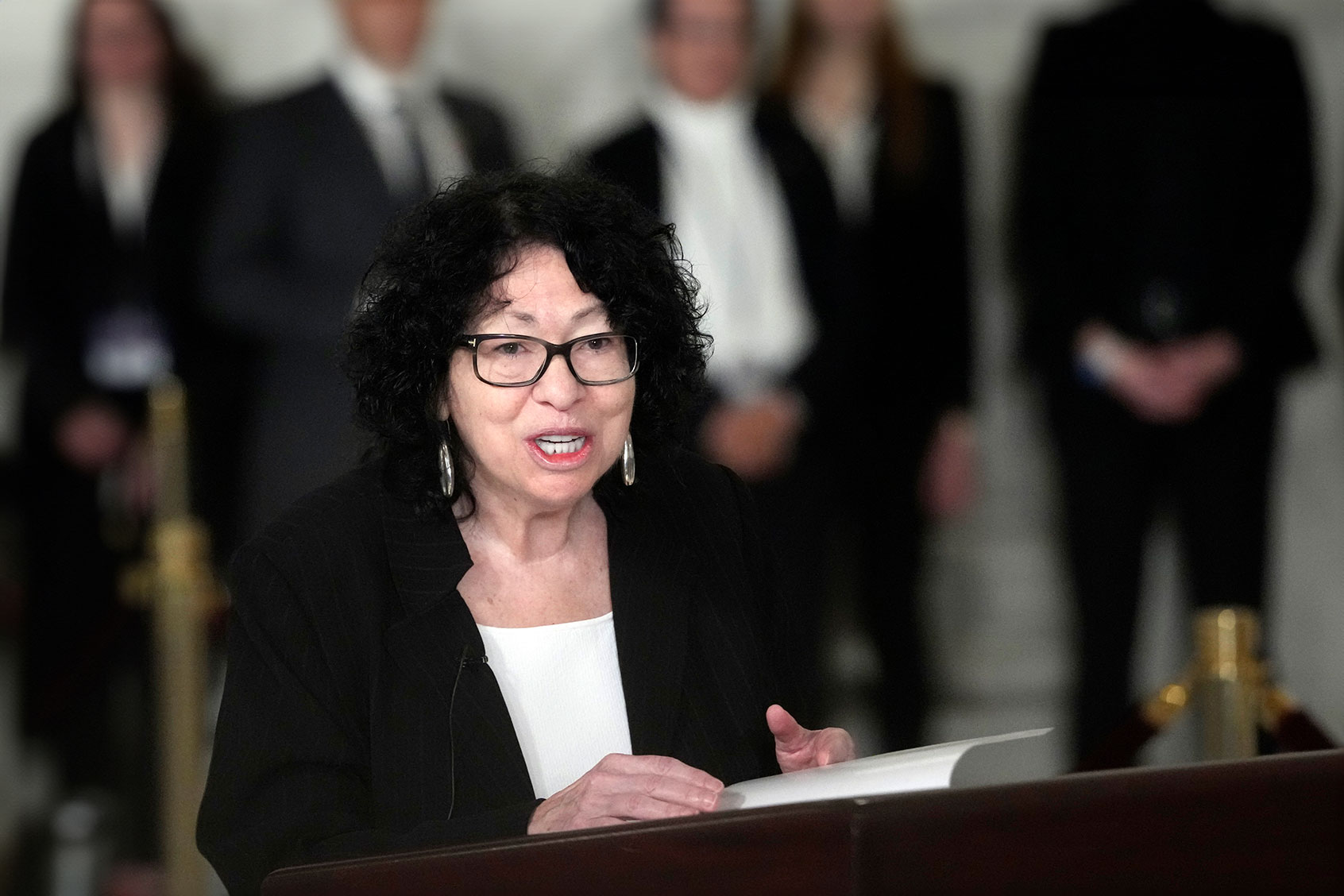
Supreme Court Justice Sonia Sotomayor blasted the Trump administration’s operation of the Los Angeles immigration raids, vowing not to stand idly by while the United States’ “constitutional freedoms are lost.”

On Sept. 8, the Supreme Court lifted a restraining order from a federal judge in LA who had restricted Immigration and Customs Enforcement (ICE) agents from conducting stops without reasonable suspicion.

In July, US District Judge Maame Frimpong of the Central District of California said the government can’t rely solely on the person’s race, the language they speak, the work they perform, and whether they’re at a particular location, such as a pickup site for day laborers.

However, the Sept. 8 reversal by the Supreme Court’s mostly conservative majority gave the Trump administration another victory, as Sotomayor condemned the vote.

“That decision is yet another grave misuse of our emergency docket,” Sotomayor wrote in a blistering, 21-page dissent on Sept. 8. “We should not have to live in a country where the Government can seize anyone who looks Latino, speaks Spanish, and appears to work a low-wage job.”

Sotomayor called the order “unconscionably irreconcilable with our nation’s constitutional guarantees.”

The justice, an Obama appointee, ripped her high court conservative colleagues and the government over the ruling. Sotomayor declared that all Latinos, whether they are U.S. citizens or not, “who work low-wage jobs are fair game to be seized at any time, taken away from work, and held until they provide proof of their legal status to the agents’ satisfaction.”oss California by broadening its scope from those only with criminal records to anyone in the United States without proper authorization. The crackdown ignited protests, prompting Trump to call in the National Guard and eventually the Marines to diffuse the outrage.

In June, the Trump administration ramped up immigration raids across California by broadening its scope from those only with criminal records to anyone in the United States without proper authorization. The crackdown ignited protests, prompting Trump to call in the National Guard and eventually the Marines to diffuse the outrage.

Sotomayor takes exception to Kavanaugh’s explanation

Justice Brett Kavanaugh, who agreed with the Trump administration, said in his concurrence on Sept. 8 that the District Court overreached in limiting ICE’s authority to briefly stop people and ask them about their immigration status.

“To be clear, apparent ethnicity alone cannot furnish reasonable suspicion; under this Court’s case law regarding immigration stops, however, it can be a ‘relevant factor’ when considered along with other salient factors,” Kavanaugh said.

He added, “Immigration stops based on reasonable suspicion of illegal presence have been an important component of US immigration enforcement for decades, across several presidential administrations.”Despite fears, still looking for work: 

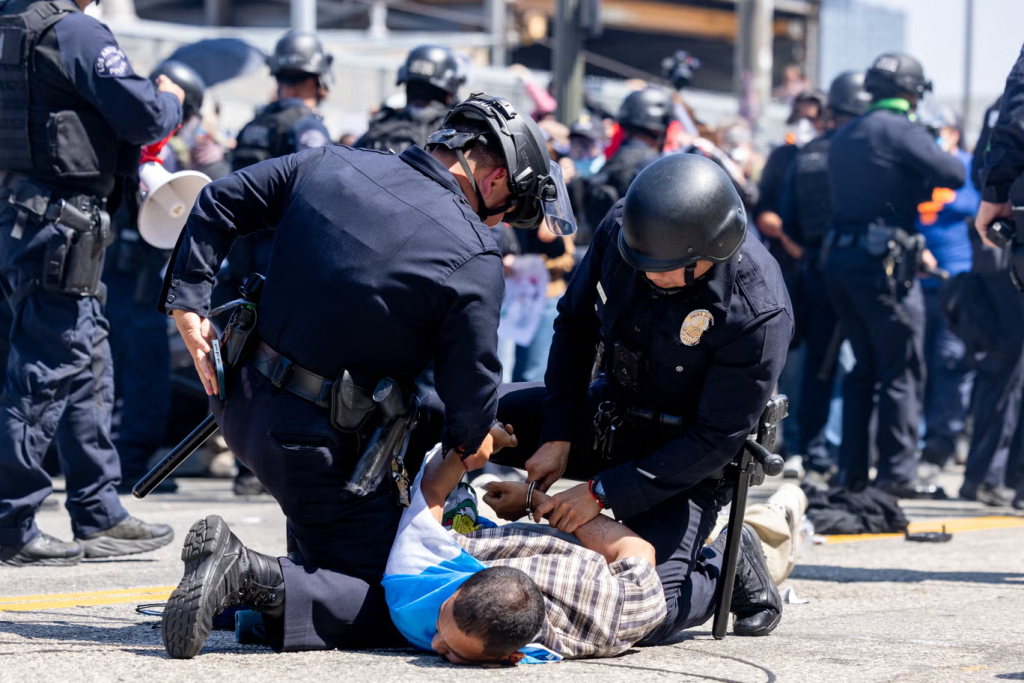
Sotomayor took exception to Kavanaugh’s comments. She said ICE agents are not simply just questioning people, they are seizing people by using firearms and physical violence.

Sotomayor added that the Fourth Amendment, which is meant to protect “every individual’s constitutional right,” from search and seizure, might be in jeopardy.

“The Fourth Amendment protects every individual’s constitutional right to be ‘free from arbitrary interference by law officers,'” Sotomayor said. “After today, that may no longer be true for those who happen to look a certain way, speak a certain way, and appear to work a certain type of legitimate job that pays very little.” 

https://www.usatoday.com/story/news/politics/2025/09/08/sotomayor-supreme-court-ruling-unconscionably-irreconcilable/86048909007

Salon: Sotomayor says SCOTUS ruling lets ICE “seize anyone who looks Latino”

Sotomayor worried that the ruling made Latinos living in Los Angeles “fair game” for ICE harassment

Supreme Court Justice Sonia Sotomayor blasted the Supreme Court’s decision to allow wide-scale ICE raids and immigration stops in Los Angeles to continue on Monday. In a scathing dissent, she said the court was giving the Department of Homeland Security a green light to “seize anyone who looks Latino.”

The Monday ruling lifted an injunction on “roving” ICE actions in Southern California. That order from a lower court judge barred agents from carrying out detentions based on ethnicity, languages being spoken, employment or location.

While the Supreme Court’s ruling was unsigned, it appeared to be supported along partisan lines as all three liberals dissented. Writing for the liberal justices, Sotomayor called the order “unconscionable” and said it made Latinos throughout the region “fair game.”

“We should not have to live in a country where the Government can seize anyone who looks Latino, speaks Spanish, and appears to work a low-wage job,” Sotomayor wrote.

Justice Brett Kavanaugh, concurring with the unnamed majority, said ethnicity was a  “a ‘relevant factor’” for ICE agents to consider. He added that  “many” undocumented immigrants in the Los Angeles area “do not speak much English,” and work low-wage, manual labor jobs.

“Under this Court’s precedents, not mention common sense, those circumstances taken together can constitute at least reasonable suspicion of illegal presence in the United States,” Kavanaugh wrote.

In her dissent, Sotomayor raised concerns about how the ruling could impact constitutional protections against unreasonable search and seizure.

“The Fourth Amendment protects every individual’s constitutional right to be free from arbitrary interference by law officers,” she wrote. “After today, that may no longer be true for those who happen to look a certain way, speak a certain way, and appear to work a certain type of legitimate job that pays very little.”

https://www.salon.com/2025/09/08/sotomayor-says-scotus-ruling-lets-ice-seize-anyone-who-looks-latino

Forbes: New $250 Visa Integrity Fee Will Cost US $11 Billion, Say Tourism Officials

U.S. tourism officials say Congress’s controversial $250 visa integrity fee will deter international visitors and cost the country nearly $11 billion in lost visitor spending and tax revenue over the next three years.

  • The Congressional Budget Office (CBO) estimated that the new $250 visa integrity fee will bring in around $27 billion over a decade—or $2.7 billion per year—to U.S. government coffers and reduce the national debt.
  • But a U.S. tourism official told Forbes the fee will instead cost the U.S. economy $11 billion over three years, including $9.4 billion in lost visitor spending and $1.3 billion in lost tax revenue—or about $3.6 billion per year, according to an analysis by Tourism Economics.
  • In addition, the lost revenue will lead to losing 15,000 U.S. travel jobs, according to U.S. tourism industry estimates.

How Will The $250 Fee Impact Tourism To The U.s.?

The CBO based its estimate solely on the potential revenue generated by the fee itself, while the U.S. tourism industry looked at the macroeconomic impact of implementing the fee, hence the wildly different estimates. The CBO estimated that charging roughly 11 million annual visa applicants $250 apiece would rake in roughly $2.7 billion per year for the State Department. Tourism officials say Congress wrongly assumed the pricey fee would have little impact on the volume of visitation. Tourism Economics, a division of Oxford Economics, estimated that the $250-per-person fee is onerous enough to deter 5.4% of international visitors from coming to the U.S., which would translate to a drop of nearly 1 million fewer visits annually. Fewer visitors translate to less visitor spending, and in turn to lower tax revenue and job losses in the tourism industry, sending a negative ripple effect throughout the national economy. “By longstanding tradition, the Congressional Budget Office does not incorporate macroeconomic feedback effects into its traditional cost estimates,” a CBO spokesperson told Forbes. “We didn’t specifically do a dynamic analysis of this provision.” In other words, the CBO did not factor in the potential negative economic impact from lower visitor spending, tax revenue and subsequent job cuts—key metrics used by the U.S. tourism industry and the U.S. Commerce Department to evaluate the overall value of tourism to the U.S. economy. “I think in the minds of congressional leaders, foreign visitors don’t vote, so making them pay more to help fund the [Big Beautiful] Bill wouldn’t come at any political cost,” Erik Hansen, senior vice president of government relations at the U.S. Travel Association, told Forbes. “But the problem is it comes at a huge economic cost to American businesses.”

What Else Do U.s. Tourism Experts Say Congress Got Wrong?

“Congress made the mistake of assuming that this worldwide visa integrity fee would not have a big impact on visitors from countries like India or Brazil,” Hansen told Forbes. “This is the exact type of armchair public policymaking that is going to get us into a big mess.” India, in particular, is a “bright spot” for inbound international travel because visitation numbers have surpassed where they were in 2019, he said, while most other countries are lagging behind their pre-pandemic volume. In 2024, Indian tourists spent roughly $13.3 billion in the U.S., according to the National Travel and Tourism Office, part of the U.S. Commerce Department. “Applying a $250 fee to a country where travel is growing is mindboggling. It will absolutely deter travel—that’s what our research has found,” Hansen said.

What Do International Visitors Need To Know About The Visa Integrity Fee?

The fee is not actually as “refundable” as Congress has billed it to be. As written, the Big Beautiful Bill says the State Department “may reimburse” the fee after the visitor’s visa expires, provided that the visa holder has complied with all conditions of the visa. But most visitor visas are valid for 10 years, Hansen pointed out. “The idea that you’re going to give the government money and then wait around 10 years and remember to ask for it back, even if you followed the rules, is just absolutely crazy,” he said. Indeed, to arrive at its projection, the CBO reasoned in its estimate that “a large number of nonimmigrants would not be eligible to seek reimbursement until several years after paying the fee” so consequently only “a small number of people would seek reimbursement.” In other words, said Hansen, “there’s a very good understanding that the refund process itself is not going to be easy, and even if it is easy, that a lot of people aren’t going to seek that refund after a decade.” Another red flag: The $250 fee was inserted into the Big Beautiful Bill without a plan for processing refunds. In its analysis, the CBO wrote that “the Department of State would need several years to implement a process for providing reimbursements.”

Why Are So Many International Travelers Avoiding The U.s. This Year?

In June, a World Travel & Tourism Council (WTTC) analysis of the economic impact of tourism in 184 countries revealed the U.S. was the only country forecast to see international visitor spending decline in 2025, which by some estimates is as much as $29 billion. The root causes of this decline, multiple studies have found, are a combination of President Trump’s tariffs, travel bans, inflammatory rhetoric and harsher immigration policies, all which have created a chilling effect on visitors. “While other nations are rolling out the welcome mat, the U.S. government is putting up the ‘closed’ sign,” Julia Simpson, president and CEO of WTTC, said in a statement. “Given we’re halfway through the year and we’ve seen these impacts, we don’t know when the stiffest headwind is, but I think it does stay sustained,” Aran Ryan, director of industry studies at Tourism Economics, told Forbes last month. “We’re generally assuming that this persists for a while and that some of it is going to persist throughout the end of the administration.” Simpson characterized the WTTC study as a “wake-up call for the U.S. government,” adding that “without urgent action to restore international traveler confidence, it could take several years for the U.S. just to return to pre-pandemic levels of international visitor spend.”

Tangent

Trump’s signature spending bill contains another blow to U.S. tourism. A Senate committee led by Senator Ted Cruz (R-Tex.) slashed the budget of Brand USA, the country’s public-private destination marketing organization, from $100 million to $20 million. “This is another error that Congress has made,” Hansen said, noting that the Trump administration recommended full funding for the organization in its fiscal year 2026 budget. “We have a big misperception problem among international visitors right now, but Congress cut funding for the one organization that’s in charge of setting perceptions and sending a welcoming message about travel to the United States.”

https://www.forbes.com/sites/suzannerowankelleher/2025/08/15/visa-integrity-fee-cost-us-11-billion

Forbes: Struggling U.S. Tourism Takes Another Hit: New Visa Requirement For Foreign Visitors

The U.S. State Department announced a brand new hurdle for international travelers seeking tourist visas—which will make already-long visa wait times even longer.

  • “Effective immediately,” the State Department announced Saturday that nonimmigrant visa applicants should schedule an interview at their local U.S. embassy, adding “applicants must be able to demonstrate residence in the country where they are applying.”
  • The announcement warned applicants who schedule interviews at a U.S. embassy or consulate outside of their country of nationality or residence they “might find that it will be more difficult to qualify for the visa,” noting that fees “will not be refunded and cannot be transferred.”
  • The new rule applies to short-term visas for tourists as well as business travelers, students and temporary workers.
  • Forbes has reached out to the U.S. Travel Association for comment.

How Do Long Visa Wait Times Hurt U.s. Tourism?

The U.S. tourism industry has carped about the State Department’s long visa wait times for years. Geoff Freeman, CEO of the U.S. Travel Association, explained to Forbes in 2023 that long visa wait times create an unnecessary friction that makes the country less competitive as a destination. “We need to look at travel as a path of least resistance. That’s what travelers tend to follow: Who makes it easy? Who makes it comfortable?” Freeman said at the time. Depending on a would-be tourist’s nationality, the wait time for a visa interview at a U.S. consulate or embassy abroad can be more than a year.

Why Are International Tourists Essential To The Us Economy?

International tourists spent $181 billion in the U.S. in 2024, according to travel association data. While domestic tourism represents a five-times-bigger slice of the country’s overall tourism pie, foreign travelers stay longer than Americans traveling within the U.S., and spend, on average, $4,000 per trip—eight times more than domestic travelers.

Key Background

U.S. tourism officials were initially expecting to see a 9% increase in overall international arrivals to the U.S. in 2025. Instead, the U.S. is the only country that will see international visitor spending decline in 2025, according to a study from the World Travel & Tourism Council (WTTC) that analyzed the economic impact of tourism in 184 countries. The U.S. is facing an 8.2% decline in foreign tourists this year, according to Tourism Economics, the travel-focused division of Oxford Economics. “Geopolitical and policy-related concerns … paired with harsh rhetoric” have contributed to “unpredictability and negative global travel sentiment toward the US,” Tourism Economics wrote in its August update, noting “the sentiment drag has proven to be severe.” The organization noted international inbound air bookings for August through October are pacing 10% to 14% below last year, and air bookings from Canada—which accounts for nearly one quarter of all inbound tourism—have fallen by up to 43% compared to this time last year. All told, the U.S. went from an anticipated $16.3 billion increase in international tourism revenue to a loss of between $8.3 billion (Tourism Economics estimate) and $12.5 billion (WTTC estimate), meaning the U.S. is facing a shortfall of as much as $29 billion this year.

How Else Has The U.s. Made It Harder For International Visitors?

The passage of the “Big Beautiful Bill,” which President Donald Trump signed into law in July, introduced a new $250 “visa integrity fee” for most non-immigrant U.S. visas, including tourist, student and work visas, beginning in 2026. The Congressional Budget Office (CBO) estimated that the new fee will bring in around $27 billion over a decade—or $2.7 billion per year—to U.S. government coffers. But a U.S. Travel Association official disputed how Congress calculated its estimate, telling Forbes its economic impact study found the fee will instead cost the U.S. economy $3.6 billion per year, including more than $3 billion in lost visitor spending and more than $450 million in lost tax revenue. In addition, the lost revenue will lead to 15,000 U.S. fewer travel jobs, according to U.S. tourism industry estimates.

Tangent

Brand USA, the country’s public-private destination marketing organization, has laid off 15% of its staff, the travel industry news outlet Skift reported Saturday. The cuts come after the Big Beautiful Bill slashed the organization’s budget from $100 million to $20 million. USTA said it is “deeply concerned” by the cuts, noting in a statement that “for every $1 spent on marketing, Brand USA adds $25 to the U.S. economy.”

https://www.forbes.com/sites/suzannerowankelleher/2025/09/08/struggling-us-tourism-takes-another-hit-new-visa-requirement-for-foreign-visitors

MSNBC: House Oversight Committee member shares expectations for Epstein estate docs

https://www.msn.com/en-us/news/politics/house-oversight-committee-member-shares-expectations-for-epstein-estate-docs/vi-AA1M7TP2

Wall Street Journal: Did a Boat Strike in Caribbean Exceed Trump’s Authority to Use Military Force?

President Trump was operating within his constitutional powers as commander in chief when he ordered the U.S. military to destroy a vessel in the Caribbean, administration officials said, describing the drugs it was allegedly smuggling as an imminent national security threat.

But that claim was sharply disputed by legal experts and some lawmakers, who said that Trump exceeded his legal authority by using lethal military force against a target that posed no direct danger to the U.S. and doing so without congressional authorization.

The disagreement since Trump announced the deadly attack Tuesday underscored how much of a departure it represents from decades of U.S. counternarcotics operations—and raised questions about whether drug smugglers can be treated as legitimate military targets.

“Every boatload of any form of drug that poisons the American people is an imminent threat. And at the DOD, our job is to defeat imminent threats,” Defense Secretary Pete Hegseth told reporters Thursday during a visit to an Army base in Georgia. “A drug cartel is no different than al Qaeda, and they will be treated as such.”

Trump administration officials said Tuesday’s strike, which killed 11 people on the boat, was just the opening salvo in an expanded campaign to dismantle the drug cartels they say pose a major threat to Americans.

But in importing tactics from the post-9/11 war against terrorist groups to use against drug cartels, some former officials said, Trump is trampling on longstanding limits on presidential use of force and asserting legal authorities that don’t exist.

The casualties “weren’t engaged in anything like a direct attack on the United States” and weren’t afforded a trial to determine their guilt, said Frank Kendall, who served as the secretary of the Air Force during the Biden administration and holds a law degree. “Frankly, I can’t see how this can be considered anything other than a nonjudicial killing outside the boundaries of domestic and international law.”

Unlike the interdictions which are usually conducted by the U.S. Coast Guard, the strike was carried out without warning shots, and no effort was made to detain the ship, apprehend its crew, or confirm the drugs on board. “Instead of interdicting it, on the president’s orders they blew it up,” Secretary of State Marco Rubio said in Mexico City on Wednesday.

Trump said U.S. forces “positively identified” the crew before the attack as members of Venezuelan crime syndicate Tren de Aragua, calling them “narcoterrorists.” Tren de Aragua is among the Latin American cartels and gangs that Trump has designated as foreign terrorist organizations since February.

The White House has provided no further information on the operation against the boat or detailed the legal arguments that it claims support it. Nor have officials disclosed where the strike took place, the identities of the casualties or the weapons used.

Some Trump administration officials suggest that by designating the drug cartels as foreign terrorist organizations, the Pentagon has the leeway to treat the groups as it would foreign terrorists. As commander in chief, Trump has the power to order military action against imminent threats without congressional authorization, they said.

The strike “was taken in defense of vital U.S. national interests and in the collective self-defense of other nations,” White House spokeswoman Anna Kelly said, adding that the strike occurred in international waters and “was fully consistent with the law of armed conflict.”

But Geoffrey Corn, a retired lieutenant colonel who was the Army’s senior adviser on the law of war, said: “I don’t think there is any way to legitimately characterize a drug ship heading from Venezuela, arguably to Trinidad, as an actual or imminent armed attack against the United States, justifying this military response.”

Corn, a law professor at Texas Tech University, noted that critics have condemned U.S. drone strikes since 2001 against militants in Afghanistan, Iraq and other countries as extrajudicial killings, but those strikes were legitimate, he said, because the U.S. was engaged in an armed conflict under the laws of war against al Qaeda and other terrorist groups.

Brian Finucane, a former State Department lawyer who is now at the International Crisis Group, said that designation of drug cartels as terrorist groups doesn’t authorize the use of military force against them. Rather it enables the U.S. to levy sanctions and pursue criminal prosecutions against individuals who support the groups.

Nor can military action be justified under the law Congress passed authorizing the use of force against al Qaeda and related terrorist groups following the Sept. 11, 2001, terrorist attacks, experts said.

For the military to use force, “there needs to be a legitimate claim of self-defense in international waters, an action that is necessary and proportional in response to an armed attack or imminent armed attack,” said Juan Gonzalez, who served as the National Security Council’s senior director for Western Hemisphere affairs during the Biden administration. “That clearly didn’t happen.”

The attack was the U.S. military’s first publicly acknowledged airstrike in Central or South America since the U.S. invasion of Panama in 1989. The White House released a grainy black-and-white video that showed the destruction of a small boat, which it celebrated as a blunt warning for drug traffickers throughout the region.

Trump administration officials have offered conflicting accounts of the episode. On Tuesday, Rubio said the drugs the vessel was carrying “were probably headed to Trinidad or some other country in the Caribbean” and could “contribute to the instability these countries are facing,” differing from Trump’s statement that the vessel was “heading to the United States.” On Wednesday, Rubio suggested that the shipment was “eventually” headed to the U.S.

No state in the region has publicly appealed for the U.S. to take military action against the cartels as an act of collective self-defense, Corn said.

On Thursday, two Venezuelan F-16 jet fighters flew near one of the U.S. Navy warships that have been positioned near the county. The Pentagon criticized the apparent show of force as a “highly provocative move” and warned Venezuela not to interfere with its “counter narco-terror operations.”

In the past, some U.S. counternarcotics strikes have ended in tragedy. In 2001, Peruvian and U.S. counterdrug agents mistook a small plane carrying American missionaries over the Peruvian Amazon as belonging to drug traffickers. The Peruvian Air Force shot down the plane, killing a 35-year-old woman and her infant daughter.

The U.S. has limited intelligence on small drug boats leaving Venezuela, from which the Drug Enforcement Administration was expelled in 2005 under then-President Hugo Chávez, said Mike Vigil, a former DEA director of international operations.

“The United States doesn’t really have the capability to develop good intelligence about these embarkations,” he said. “You don’t just send a missile and destroy a boat. It is the equivalent of a police officer walking up to a drug trafficker on the street and shooting him.”

In Quito, Ecuador, on Thursday, Rubio announced the designation of two more criminal groups—the Ecuadorean Los Choneros and Los Lobos—as foreign terrorist organizations. He said U.S. partners in the region would participate in operations to use lethal force against drug cartels.

A senior Mexican naval officer with decades of service and experience boarding drug vessels said actions like the one taken Tuesday by the U.S. would never be allowed by its Mexican counterpart, which has been trained in interdiction procedures by the U.S. Coast Guard.

“There is never a direct attack unless you are attacked,” he said. “As commander of the ship, I would get into serious trouble. I could be accused of murder.”
https://www.msn.com/en-us/news/world/did-a-boat-strike-in-caribbean-exceed-trump-s-authority-to-use-military-force/ar-AA1LU02a

Knewz: Trump appointee deals legal blow to the president

https://www.msn.com/en-us/video/news/trump-appointee-deals-legal-blow-to-the-president/vi-AA1LYtO7

Showbizz Daily: ICE ‘Superman’ Dean Cain injured: Gavin Newsom jokes about it

Dean Cain, known for his role as Superman in the series ‘Lois and Clark,’ has sparked controversy by joining U.S. Immigration and Customs Enforcement (ICE), sparking criticism on several social media platforms.

So much so that when the actor shared on X that he had been injured, jokes about it quickly flooded the comments section.

However, no one expected the most viral of all to come from the extremely active Press Office of California Governor Gavin Newsom.

“Turns out arresting innocent Latino kids and farm workers is harder than playing Superman…” commented Gavin Newsom in response to Dean Cain.

How did Dean Cain react to this response? Badly. He did not hesitate to respond. “Hysterical gaslighting from these idiots. Injury had nothing to do with ICE duties, just a simple home mishap…,” said the actor.

Meanwhile, dozens of users suggested that he put ‘ice’ on the injury.

Unfortunately for Dean Cain, John Oliver also joined in the mockery and did not hesitate to attack him on his programme ‘Last Week Tonight’ on HBO.

However, he did not need to resort to the injury, as it was enough for him to criticise ICE and address the serious recruitment problem: “If all you can get is Dean Cain, you are f***d’’.

https://www.msn.com/en-us/tv/news/ice-superman-dean-cain-injured-gavin-newsom-jokes-about-it/ss-AA1LOt3E